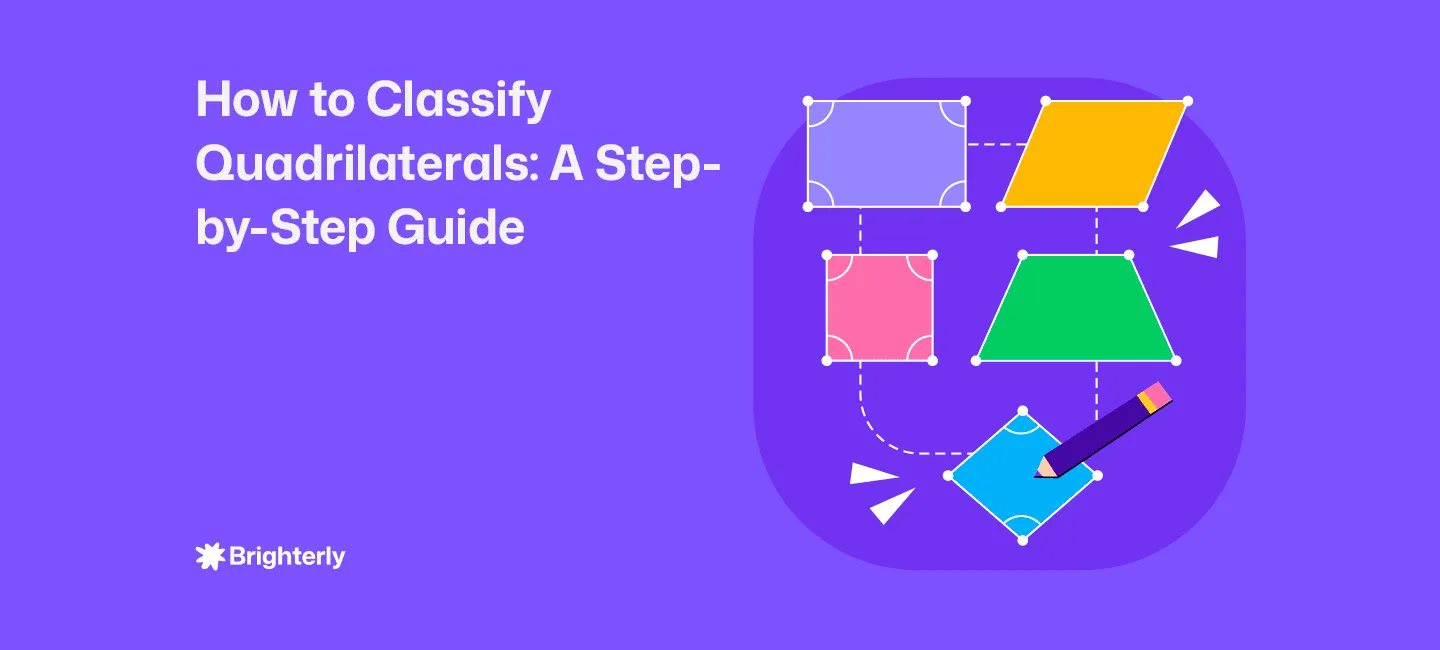
6 Types of Quadrilaterals Explained
Geometry sorts quadrilaterals into six standard/main types, which include parallelogram, rectangle, square, rhombus, trapezoid, and kite. While squares, rectangles, and rhombuses are basically just different versions of a parallelogram, trapezoids and kites stand apart. Knowing how exactly different quadrilaterals vary from each other helps classify them correctly.
Parallelogram
A parallelogram is a quadrilateral with two congruent pairs of sides and angles — each pair of its opposite sides is of equal length, while the matching angles also match in degrees. Neighboring angles of a parallelogram add up to 180°, so a parallelogram that isn't a rectangle will have two wider angles and two narrower ones. The diagonals of a parallelogram cut each other in half, but differ in length.
Rectangle
A rectangle is a parallelogram with four right angles, equal-length opposite sides, and equal-length diagonals. So, while every rectangle is a parallelogram, only parallelograms with 4 square corners are rectangles.
Square
A square is a unique type of parallelogram with 4 equal sides and 4 same-size right angles (90° each). The diagonals of a square are the same length and cross at right angles. Because a square has two pairs of parallel sides and four equal sides, it also qualifies as a rectangle and a rhombus, apart from being a parallelogram.
Rhombus
A rhombus is a parallelogram with 4 equal sides, with both pairs of sides parallel to each other. Rhombus angles’ measures may differ and be either 90° each or different, but opposite angles are equal. So, while a square is always a rhombus, a rhombus is a square only when its angles are all right. Rhombus diagonals cross at right angles, splitting the shape into 4 matching right triangles. The diagonals are equal when a rhombus is a square and differ in length if it’s not.
Trapezoid
A trapezoid has one pair of parallel sides, called the bases. The other two sides, called legs, aren't parallel, so the shape resembles a triangle without the tip. Side lengths and angle measures can vary. The diagonals of a trapezoid are equal only when its non-parallel legs are the same length.
Kite
Among the shapes that are quadrilaterals, a kite has two pairs of adjacent sides that are equal in length. The shape of a kite resembles a rhombus, but unlike a rhombus, a kite has no parallel sides. Kite’s diagonals cross at right angles, and one diagonal cuts the other in half.