How to Help Kids with Homework: 10 Proven Strategies for Parents (2026)
reviewed by Laila A. Lico
Updated on September 4, 2026
Key points:
Helping kids with homework means providing them the freedom to think and find solutions independently, and to guide only when they move in the wrong direction. This also means you should guarantee them a good working environment and emotional support.
How to Help Your Child with Homework: 10 Strategies That Work
The best way to help your child with homework is to act as a supporter rather than an intruder. This means establishing a structure in their routines, creating a comfy environment, and asking kids to work independently.
Build a Consistent Homework Routine
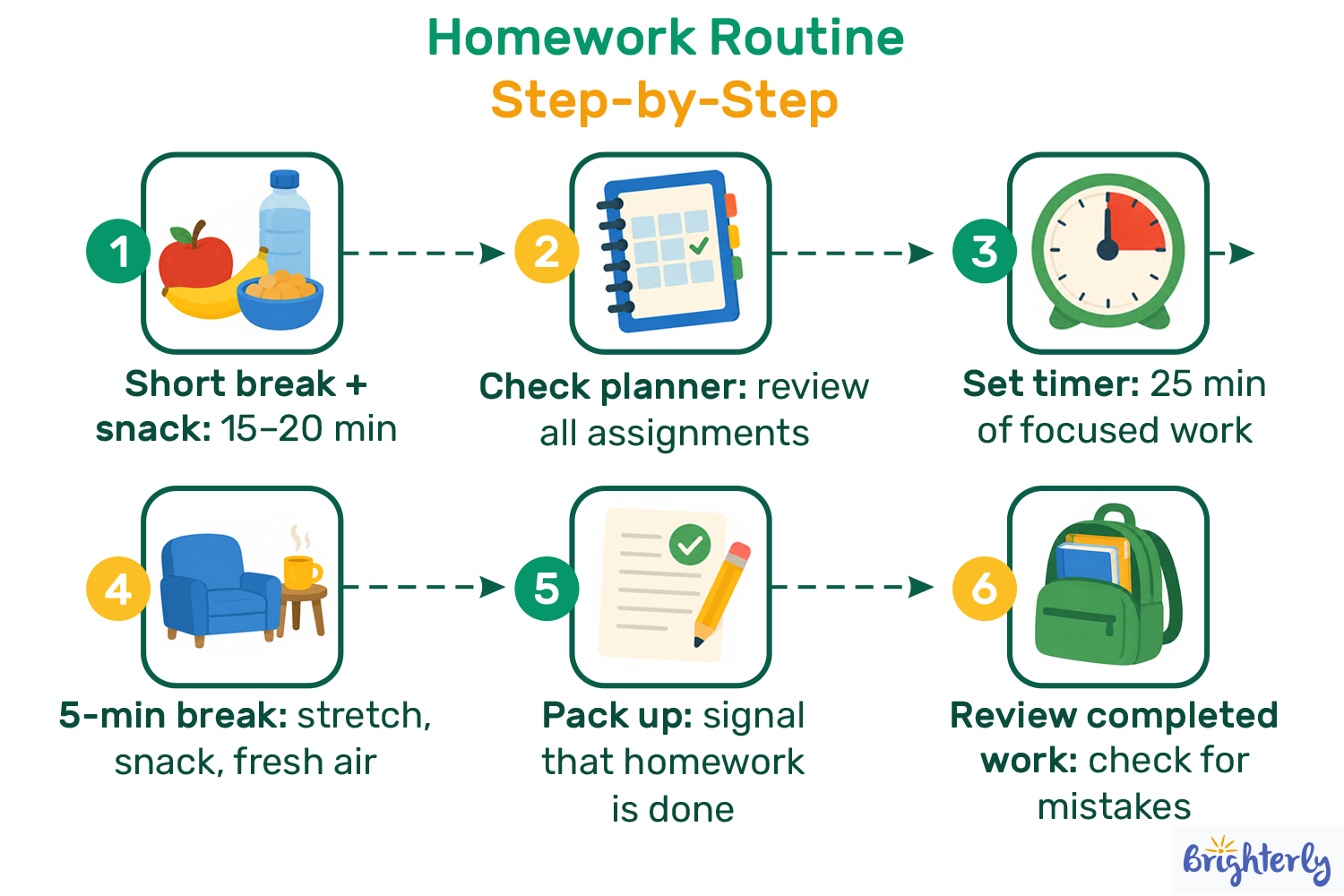
Homework routine for kids builds discipline. A consistent habit of starting homework at a set time and place will reduce stress for everyone. To do that, first, set a fixed time for homework. Normally, the appropriate time should be between late afternoon and early evening hours, say around 4 to 5 PM, so that your child can have lunch and a short time after school.
Second, make sure to remove any distractions such as phones, toys, and popping-up notifications. If your child struggles to focus, try the Pomodoro technique. The method is simple yet effective: 25 minutes of focused work, then a 5-minute break. For that, you can find special timers online that come with break bells and background focus music, both popular focus techniques for kids.
The International Journal of Environmental Research and Public Health (2022) confirmed that regular short breaks during studying sharpen children’s focus and boost academic results.
Last but not least, create a dedicated study space where your kid can focus. It doesn’t have to be anything fancy. A quiet corner with good lighting and all the supplies and materials will be a perfect place.
Note: If you’re wondering how to make a homeschool schedule, this article can be a strong tool to set up your routine.
Online reading programs and math programs like Brighterly can also significantly help build consistent study habits for kids through regular 1:1 sessions with tutors. Our tutors provide a detailed analysis of the child’s needs and capabilities, then develop a suitable schedule. Lessons are conducted on a regular basis (from 1 to 4 times a week) to ensure maximum progress in your case.


Is Your Child Falling Behind in School?
Our tutors follow US education standards and build habits that last.
Make Sure Your Child Understands the Assignment
Most homework battles happen because kids don’t understand their initial task: they don’t know where to start, are confused about tasks, or lack confidence in their ability to solve it.
What parents often overlook is checking comprehension first, as it might be the reason a child is unable to answer independently. For that, ask them to explain the task in their own words. If they are wrong or hesitate, you may need to provide an explanation. Then, ask the kid to explain the task in their own words. That small shift of the initiative keeps kids involved.
Note: But what if your kid understands the task but doesn’t want to tackle it? That’s called procrastination. This article shares proven methods on how to stop procrastinating on homework.
Plan and Prioritize the Work
Homework will feel much less stressful when your child knows exactly where to start. Always begin with the easiest or most familiar task. It works like a warm-up: your child builds confidence and momentum before tackling the harder stuff. Finishing something quickly also gives them a motivational boost to keep going.
For bigger projects, show them how to break the work into smaller steps – outline the paper before writing each section, for example. If there are multiple subjects in one day, estimate how long each task will take together and set a realistic goal. That habit alone teaches time management skills that go way beyond homework.
Use Timers for Focus and Breaks
Another solution for how to motivate a child to do homework is to use timers. The Pomodoro technique for kids uses 25 minutes of work and 5 minutes of rest. Younger kids do better with shorter intervals – adjust the timer based on their age and the task.
You should also account for the task’s difficulty, but be sure to incorporate breaks in between. In such a way, you will be able to keep your child’s mind fresh. During breaks, you can provide your kid with brain-boosting snacks, encourage light exercise, or go for a short walk. These short breaks will help your kid stay focused without losing homework motivation.
Explain Why Homework Matters
Try to show your child that homework is useful and often interesting, not just created to keep them busy. For example, connect tasks to real moments from life. Maybe there were moments when your kid struggled with a math problem in class, but understood it much better after reading and math practice at home. Remind them that there is nothing complicated in fact.
Good homework tips for parents and kids always highlight that both parties should understand that homework is created for a reason. It ensures that kids do not lag behind and are able to review everything that they have been taught.
Note: Looking for extra help? These 12 best homework help websites can come in handy.
Help Your Child Develop a Growth Mindset
In simple terms, a growth mindset for children means your kid should be confident and know that he or she will improve through continuous effort. As a parent, your role is huge in developing confidence in young, emotional kids.
Pay attention to what you say in moments when the child struggles, because it matters more than you think. Excess pressure or criticism can make your child fragile and unconfident, while excess praise or just telling answers won’t nurture the necessary confidence in your kid.
Instead, when your child gets stuck on an assignment, remind them that this exact moment is where growth happens. Try saying something like:
- “I can see how hard you’re thinking about this – that alone matters a lot.”
- “You don’t give up, and that’s what matters. You’ll crack this.”
- “You weren’t able to do this a month ago. Look at you now.”
Note: Share stories from your own school years, too – moments when something felt impossible but clicked with practice. Kids need to hear that struggling is normal, not a sign they’re failing.
Help With Homework – But Don’t Do It for Them
Should parents help with homework? Sure, but it is important to differentiate between assisting and simply solving tasks for them. When you’re both exhausted, it will be hard to resist just giving your kid the answers. But this approach deprives them of the confidence and pleasure of finding the answer independently.
Your role should be more of a mentor, asking questions like: “Do you think you should begin with this?” and “Does it seem familiar to you?” Moreover, you shouldn’t always be present when your children are working on their tasks. Different children have different needs, and some might need more privacy. You might discuss it beforehand and come up with a certain plan; for example, sit in the same room and do your stuff with occasional checks every 20 minutes.
Use Technology Strategically
Today’s technology is really exciting, and once your child becomes absorbed by games or videos, you will find it very hard to turn their attention back to homework. Still, technology, when used wisely by parents, can actually make homework help for kids much more effective.
For instance, you can try online videos, interactive tests, and free practice materials as additional resources for learning at home.
The key is balance. Don’t let your child spend too much time online, and make sure what they are looking for is genuinely educational, not just entertainment.
Note: Elementary kids benefit most from gamified learning. If that’s the case with your child, our elementary math tutors and reading comprehension programs for any grade are a worthy place to try.
Create a Positive Homework Environment
The environment is just as important as the task itself. A child struggling with homework often needs a calm, comfortable space before anything else. Here are a few things that make a real difference:
- Find a good place for them to study․ Create a space‚ a place that says “this is where we learn” in their mind․ But make sure they don’t choose their sofa or don’t lie in bed․ That distinction between the place to study and to rest is the basis for the brain’s ability to switch focus․
- Lighting is important‚ and natural daylight is preferred․ If that’s not possible‚ use a lamp with a neutral white light as the light source‚ so it doesn’t cast a shadow․
- Keep a tidy, clean desk․ Only keep out what they need for their work․ Put everything else away․ A tidy space is a focused space․
- Air quality is important․ The ideal temperature for studying in a room is between 19 and 22 degrees Celsius․ Open a window before beginning the session․
And beyond the physical space, the emotional atmosphere matters just as much. Notice your child’s effort, celebrate small wins, and stay patient in the hard moments. That kind of warmth makes homework easier.
Get Homework Help from a Qualified Tutor
Note: For supplementary assistance, check out this list of homework help apps.
When the other nine strategies aren’t enough, a qualified tutor fills the gap. When a kid is struggling with homework, they often don’t know where to start. A qualified tutor gives your child the individual attention they don’t always get in a busy classroom. They explain confusing topics, work through problems step by step, and build confidence that makes future assignments easier.
That’s exactly what we do at Brighterly. Our tutors work with kids from elementary through high school on math and reading, and every child gets a personalized program based on how they actually learn. We also build a homework schedule that fits your family’s routine, and give individual study tips in math and reading.
To get started, explore our free math worksheets, reading tests, and math homework help resources. They’re a great way to see where your child stands and what kind of support would help most.
Does Your Child Struggle with Math or Reading?
Brighterly tutors make learning click – one lesson at a time
Explore Brighterly Learning Experience
Learn exactly how Brighterly helps students thrive through expert sessions, online tools, and proven feedback from thousands of satisfied parents
How to Adjust Your Support Based on Your Child’s Age
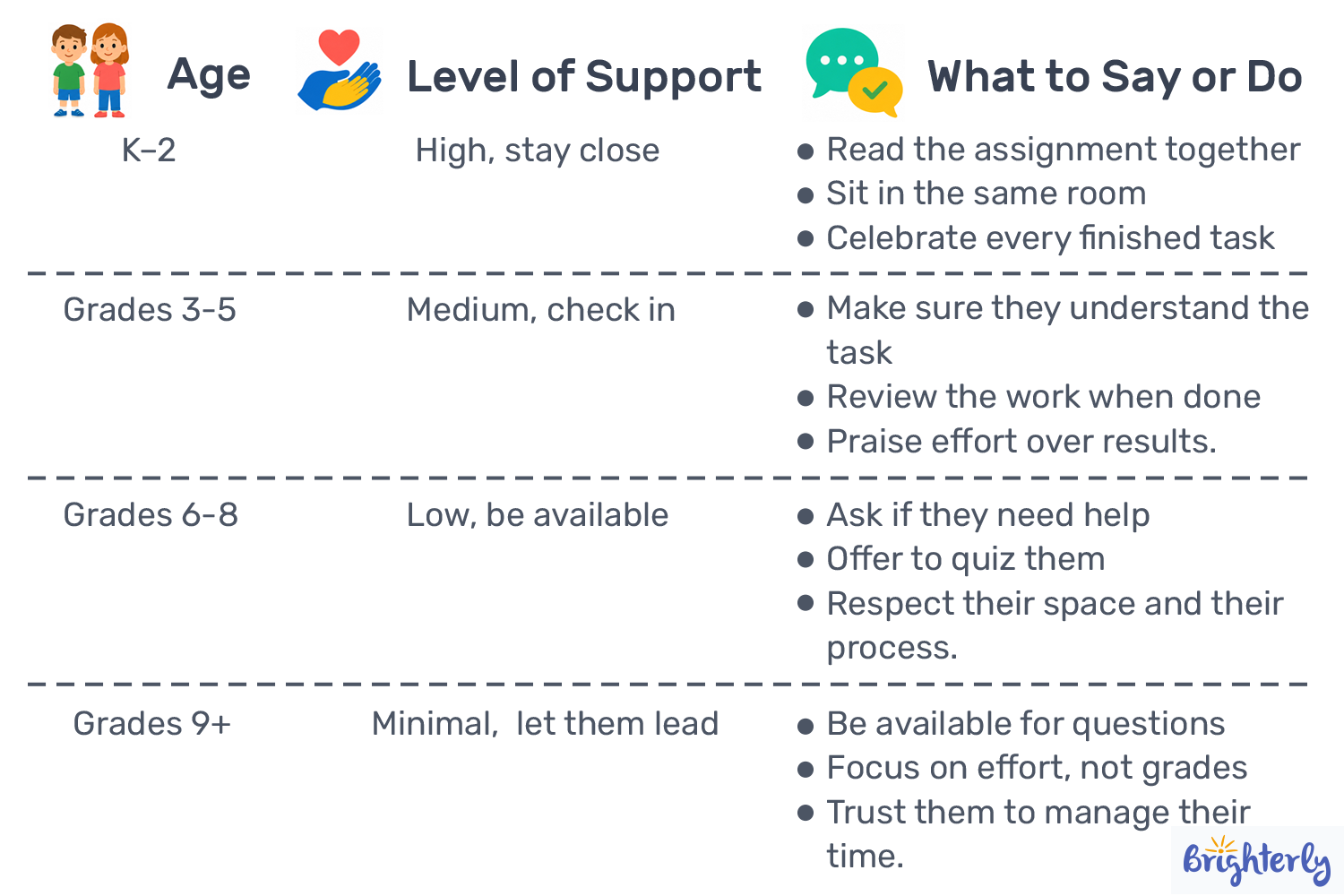
To adjust your support based on your child’s age, keep in mind age-specific learning styles and requirements. Younger kids need presence more than anything else. As your child gets older, your job gradually shifts from guide to backup available when needed, but not hovering. This peaks in high school, when parents become more of observers and moderators than helpers.
Note that middle school is often the trickiest transition, as it bridges the gap between the basics covered in elementary grades and the advanced concepts and exam preparation of high school. That’s why the need for an individual tutor peaks at this time. If that’s the case, a Brighterly middle school math tutor can help bridge that gap between close parental involvement in education and full independence.
What to Do When Your Child Refuses to Do Homework
To eliminate homework avoidance, take a step back and try to figure out what’s really going on. Are they exhausted, confused, or just feeling overwhelmed by the workload? Once you get to the bottom of it, you can start to fix the issue.
Try suggesting a short break, then review the assignment together. Keep in mind that kids often get stuck on getting started, not the actual homework. Help them get through the first few small tasks, and they’ll usually get into a groove.
If your child is constantly refusing to do homework, it’s time to dig a bit deeper. Every child learns differently – finding the right homework strategies for kids makes all the difference. A good tutor can help with that – you can check out our math homework help to see how we approach it.
Frequently Asked Questions
What Is the Best Time for Kids to Do Homework?
In most cases, it is recommended that you do your homework from 3 to 6 pm because the children will be fresh enough to get something out of the work and have some energy to put into it. Do not forget that there should be a thirty to sixty-minute after-school routine for lunch and mild rest.
Why Should Parents Help Their Child with Homework?
First of all, kids can do their homework alone from the start of school. However, homework can become a huge challenge for a child without any support, which will lead to anxiety and uncertainty. That’s the reason why parent roles are important: you, as a mentor, give knowledge on how to deal with tasks, which strategy to use in various options, and how to keep track of time.
How Much Time Should a Child Spend on Homework Each Day?
According to the “10-minute rule,” children should spend about 10 minutes on homework for each grade level. For example, a 3rd grader would do around 30 minutes, while a 6th grader – about 60 minutes.
The approach was developed during 1987-2003 by Harris Cooper and described in the Duke Today 2007 review. The research remains relevant today because it addresses ongoing concerns about balancing academic achievement, student well-being, and homework-related stress in modern education systems.
How Do I Help My Child with Homework Without Doing It for Them?
Never ever do the homework for kids. The golden rule: stay involved, but stay back. Read the instructions together, make sure they understand what’s expected, and check the answers when they’re done. Besides, make sure your child knows that you’re nearby and ready to help anytime, but that learning is their responsibility.
What Should I Do If My Child Has Homework Anxiety?
First, find out what’s behind it – is it because your child didn’t keep up with the material, or maybe the atmosphere at home feels tense? Just remember that the chance of reducing anxiety is much higher when parents keep things calm at home. Organize the proper table and lighting for studying, and help break complex tasks into smaller steps and explain material your child doesn’t understand.
At What Age Should Kids Do Homework Independently?
It’s very individualistic, but in middle school, your child should be independent enough. Here’s a rough guide:
- Ages 5-7: These kids benefit from having a parent close by.
- Ages 8-10: They can start working alone, but it’s good to check in regularly.
- Ages 11-13: Most kids can manage their homework independently, while you stay available for support.
- Ages 14+: At this stage, they should be fully independent, but you can always help with questions.



⭐️Overall rating: 5.5/10. The guide analyzes Adventure Academy reviews in 2025-2026 to determine whether it is effective, user-friendly, supportive, and worth its cost. The ratings reveal whether Adventure Academy is good for your kid, or whether it’s worth considering alternative methods like hiring an online math tutor for your learning needs. Rating Methodology The Adventure […]

Dec 05, 2025

To find the best homeschool writing curriculum for your child, take into account their grade level, learning needs, current gaps, and future aspirations. This guide compares the features, pricing, and pros and cons of 10 popular options to help you decide on the right pick. Paid Best Writing Homeschool Curriculum: Comparison *Pricing info verified as […]

Dec 08, 2025
Math & reading from 1st to 12th grade
Looking for homework support for your child?

Choose kid's grade

Math & Reading for Grades 1–12
Build real confidence for your child with a Brighterly math or reading tutor.