How to Improve Handwriting for Kids: A Step-by-Step Guide for Parents
reviewed by Laila A. Lico
Updated on November 13, 2026
Key Points:
- The steps below show how to improve kids’ handwriting by checking the 4 Ps that occupational therapists teach: posture, pencil grasp, paper position, and pressure.
- Practice stays manageable when sessions are short, positive, and built around real writing, such as grocery lists and birthday cards.
- Messy handwriting often comes from weak fine motor skills, rushing, or limited instruction, and online writing classes can add one-on-one structure when home practice stalls.
- Hand cramps, writing avoidance, or trouble with other fine motor tasks signal that a teacher or specialist should check for dysgraphia.
Handwriting combines fine motor control, letter formation, size, and spacing, so messy writing is common while kids are still learning. Parents can improve handwriting for kids with a better writing setup, a short daily routine, and a fix matched to the exact problem. This guide covers each step, age expectations, and signs that a child needs extra help.
How Do You Improve Handwriting in Kids?
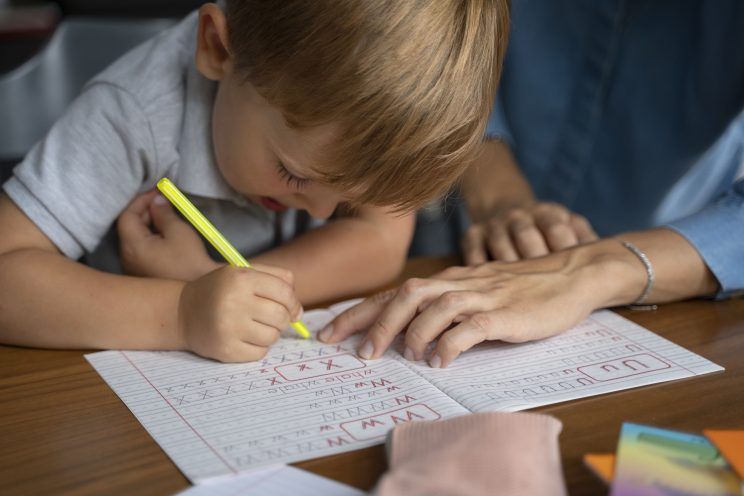
To improve handwriting, kids need short, regular practice that targets one skill at a time. Parents can fix posture, grasp, and paper position first, then add tracing, copying, and real writing. Brief, positive sessions build control without frustration, and a small daily routine builds the habit.
Try this daily routine:
- Warm up the hands. Rub them together, shake them out, or squeeze play dough for a minute.
- Check the 4 Ps. Feet flat, back straight, elbows bent in an L shape, and paper turned slightly toward the writing arm.
- Trace three letters. Choose letters with similar strokes, such as l, t, and i, and trace them on wide-ruled paper.
- Copy one word. Pick a familiar word, such as the child’s name, and copy it from a model.
- Write one real line. A grocery item or a card message works. Then circle the best letter and praise it.
St. Jude Children’s Research Hospital’s occupational therapy guidance (reviewed May 2026) advises starting with short practice times and increasing them slowly. Printable handwriting practice worksheets give ready-made tracing lines for steps three and four.
Brighterly, a school-supplemental K-12 learning platform, offers personalized 1:1 teaching aligned with US state standards. Our ELA tutors can build writing skills when home practice needs more guidance.


See where your child’s writing stands
Answer a few quick questions and get personalized next steps for your child.
Explore Brighterly Learning Experience
Learn exactly how Brighterly helps students thrive through expert sessions, online tools, and proven feedback from thousands of satisfied parents
Why Is My Child’s Handwriting So Messy?
Messy handwriting in kids usually traces back to one or more skill gaps: weak fine motor control, uneven letter size or spacing, rushing, or too little instruction. According to Understood, a nonprofit focused on learning differences, messy writing is often tied to motor skills, and it doesn’t mean a child is lazy or careless.
|
Sign you see |
Likely cause |
First fix |
|---|---|---|
|
Letters float above or below the line |
Trouble judging where letters sit on the page |
Wide-ruled paper with highlighted or raised lines |
|
Capital and lowercase sizes mix inside words |
Weak letter-size awareness |
Play “Sky, Grass, Dirt” (see the tools below) |
|
Words run into each other |
Missing space between words |
Use a craft-stick spacer |
|
Dark and light strokes, torn paper |
Uneven pencil pressure |
Recheck the 4 Ps and practice light strokes |
|
Rushed, sloppy work |
Impulsivity or speed over accuracy |
Set a one-slow-line rule before each task |
Which Tools and Setup Changes Help Most?
The most helpful setup changes are a desk that fits the child, a relaxed pencil grasp, a slightly turned page, and paper with clear guidelines. Each tool solves a specific mistake, so match the fix to the problem instead of buying everything at once.
- Hunching over the page: Use a slant board. Understood explains that a three-inch three-ring binder turned sideways makes a low-cost version with clips to hold the paper.
- Drifting off the line: Trace the lines with glue or puffy paint. After it dries, the child feels the pencil bump the raised line.
- Words crowding together: Lay a craft stick after each word and start the next word on its other side.
- Mixed letter sizes: Play “Sky, Grass, Dirt.” Tall letters like h reach the sky, short letters like o and s stay on the grass, and letters like p drop into the dirt.
What Activities Build Fine Motor Skills and Letter Formation?
Activities that build finger strength and hand control prepare kids for neat letters. Good options include tracing in sand, picking up small objects with tweezers, squeezing play dough, and writing real messages. Short, playful sessions keep this practice from feeling like homework.
- Trace letters with a finger in sand, rice, or shaving cream.
- Draw letters in the air with a finger or a favorite toy before writing them.
- Pick up beads or small toys with tweezers or tongs, and squeeze play dough.
- Write real messages, such as grocery lists, birthday cards, and labels for drawings.
These ideas draw on St. Jude’s occupational therapy guidance and on Expressable’s occupational therapists, who recommend everyday writing tasks as practice. Printable sight words tracing worksheets add structure once letters feel comfortable.
Kids who still mix up letters may need more letter recognition practice before neat writing makes sense.
Book a free 1:1 writing lesson today
A Brighterly tutor reviews your child’s writing habits and builds a personalized plan.
What Should Handwriting Look Like at Each Age?
Handwriting for kids develops in stages: pre-writing shapes first, then letters and numbers, then words, sentences, and legibility. Kids reach each stage at different speeds, and Understood notes that children who are young for their grade can take longer to build these skills.
|
Stage |
What to expect |
Focus now |
|---|---|---|
|
Preschool to kindergarten |
Shapes, lines, and tracing. Common Core standard L.K.1.a asks kindergartners to print many uppercase and lowercase letters. |
Fine motor play and a comfortable grasp. See the kindergarten readiness skills checklist. |
|
1st grade |
Standard L.1.1.a asks first graders to print all uppercase and lowercase letters. |
Letter formation, size, and spacing. See the first grade readiness skills checklist. |
|
2nd grade and up |
Words and sentences. Legibility and stamina grow with practice. |
Speed, consistency, and short timed writing blocks. |
Teachers often see steady gains when practice stays regular, even if letters aren’t perfect. St. Jude’s guidance notes that imperfect letters are normal at first.
When Is Messy Handwriting Dysgraphia or ADHD?
Messy handwriting points toward dysgraphia when it stays hard despite regular practice. An International Dyslexia Association fact sheet describes dysgraphia as a learning disability that can affect handwriting, spelling, or both, and it may occur alone or with dyslexia. Only a qualified professional can diagnose dysgraphia.
Parents who notice dysgraphia handwriting signs, such as those below, should ask a teacher, pediatrician, or occupational therapist for an evaluation:
- Handwriting that doesn’t improve with regular practice
- Hand pain or cramping while writing
- Trouble with other fine motor tasks, such as tying shoes or using scissors
- Avoiding writing or getting upset about it
- Clear ideas spoken aloud, but trouble putting them on paper
Because dysgraphia can affect spelling, a spelling tutor can support the words behind the writing, and a reading tutor for dyslexia helps when reading difficulties appear alongside it.
ADHD can add rushing and trouble staying with writing tasks, and Understood notes that impulsive kids may speed through work and make sloppy mistakes. Breaking writing into small steps, as St. Jude recommends, and using raised-line paper keep sessions manageable.
After a diagnosis, both IEPs and 504 plans can include accommodations and assistive technology, and St. Jude lists extra time and note-taking help as common examples.
Conclusion
Knowing how to improve handwriting starts with a steady routine, a setup that fits the child, and fixes matched to the exact mistake. Start with the 4 Ps this week and add one short practice block each day. When progress stalls, book free class with a Brighterly tutor for personalized 1:1 support.
Frequently Asked Questions
How Long Should a Child Practice Handwriting Each Day?
Start with short sessions and lengthen them slowly. St. Jude Children’s Research Hospital’s occupational therapy guidance suggests a short timer matched to the child’s age and attention span, then more time as comfort grows. Ending on a success often makes the next session easier to start.
Does Messy Handwriting Mean a Child Isn’t Smart?
No. Understood explains that handwriting trouble doesn’t mean a child is lazy or careless, and kids may try as hard as they can and still need support. Messy writing often reflects motor skills rather than effort. A child can have strong ideas and still struggle to write them down.
Can Typing Replace Handwriting Practice?
Typing and speech-to-text can ease long assignments, and Understood lists typing as one school support for kids with handwriting trouble. Handwriting practice still builds letter formation and fine motor control, so parents often keep short sessions alongside typing. Writing apps for kids can add variety.
Which Pencil Grip Is Normal for Kids?
Most children use a dynamic tripod grasp, holding the pencil between the thumb and index finger. Expressable’s occupational therapists note that a quadrupod grasp, which uses four fingers, can also work when the child keeps good control and the hand doesn’t tire quickly. Comfort and control matter most.
What Should Parents Do If a Child Refuses to Write?
Shrink the task and change the format. Try tracing in sand, drawing, or writing one line on a card, and keep practice short and positive, as Expressable’s occupational therapists advise. If avoidance continues, talk to the child’s teacher or pediatrician, as Understood suggests.


ABCmouse vs Kiddopia vs Brighterly each take a different approach to children’s learning. Brighterly stands out by offering live, one-on-one online tutoring in math and reading. ABCmouse offers a wide-ranging, structured digital curriculum designed for early learners between ages 2 and 8. Kiddopia leans more heavily into game-based interaction, targeting preschool and kindergarten-aged kids. Kiddopia […]

Nov 25, 2025

If you have doubts regarding active or interactive learning effectiveness, you’re in the right place. In this overview, you’ll find all the relevant interactive learning statistics, with key numbers and trends. Key stats Based on the introductory infographic, traditional lecturing failure rates are 55% higher compared to their active learner peers. 60% of kids perform […]

Nov 29, 2025
Math & reading from 1st to 12th grade
Looking for homework support for your child?

Choose kid's grade

Math & Reading for Grades 1–12
Build real confidence for your child with a Brighterly math or reading tutor.