How to Write an Introduction Paragraph: Steps, Parts, and Examples
reviewed by Laila A. Lico
Updated on July 21, 2026
Key points:
- When writing an introductory paragraph, focus on engaging the reader, presenting the topic, and setting out the main goal of the piece.
- Intro paragraphs consist of five main parts: the hook, the context and significance, the thesis, and additional structure.
- An argumentative introduction strives to persuade the reader. Narrative introductions focus on emotional engagement, and academic introductions tell the reader what was studied and why it matters.
- The most common introductory paragraph errors are making it too long, too broad, or too vague.
- Aim for roughly 5-10% of the total paper length. This usually works out as one full paragraph for the standard essay.
An introductory paragraph tells your reader what to expect from your paper. It provides the context the reader needs to understand what follows and explains why they should continue reading.
When learning how to write an introduction paragraph, students first need to understand its purpose and what it includes. Following a step-by-step guide can make the process easier, especially if you’re new to essay writing.
What Is an Introduction Paragraph?
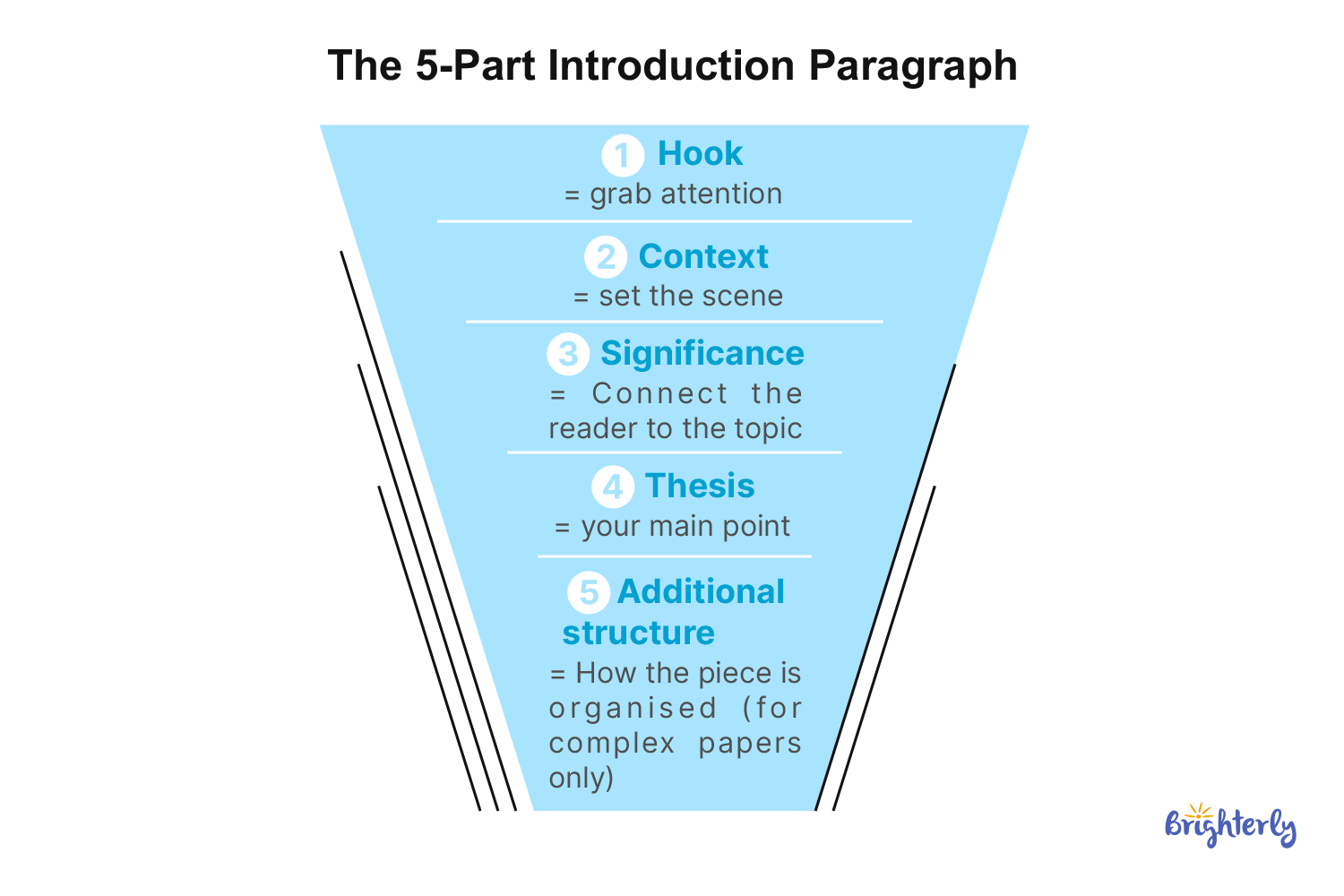
An introduction paragraph is the opening of almost any written work; its aim is to engage the reader and present the topic. It must also provide the main objective of the text. As a rule, there are five main parts to an intro paragraph: the hook, context, significance, thesis statement and additional structure.
Why Is an Introductory Paragraph Important?
Introductory paragraphs matter because they:
- Set the context of the essay
- Capture the reader’s attention
- State the thesis or main objective
- Establish the tone and structure of the narrative.


Does Your Kid Need Essay Writing Help?
Book a 1-to-1 essay writing tutor to help your kid master writing.
Explore Brighterly Learning Experience
Learn exactly how Brighterly helps students thrive through expert sessions, online tools, and proven feedback from thousands of satisfied parents
The 5 Parts of an Introduction Paragraph
|
Examples |
Tip |
|
|
Hook |
|
Keep it brief. |
|
Context |
|
Provide only the important background. |
|
Significance |
|
Connect the topic to the reader (their interests, impact, etc.). |
|
Thesis statement |
|
Ensure it’s arguable. |
|
Further structure |
|
Use transition words. |
Hook (Attention Grabber)
A hook grabs the reader’s attention and makes them want to keep going. Think of it like a teaser trailer for a movie, it should make your audience sit up and pay attention. A weak hook can leave your reader feeling apathetic or disconnected from your writing, or even stop reading it altogether.
Context
This is where you provide whatever background information is needed so your reader can understand what you’re writing about and why it matters. Keep it brief, no more than a sentence or two, and make sure it’s clear and concise. It’s ok to revise the context as you move through the rest of the essay, and the purpose becomes clearer.
Significance
Placed near the context, this short part explains why your topic is important. Writing an essay on climate change and natural disasters? Tell the reader what could happen in the future. Making the reader care about your writing will ensure they finish the piece, even if they don’t agree.
Thesis Statement
The thesis statement is a one-sentence summary that states the main claim or purpose of your writing. According to Purdue University, the narrower the thesis, the more effective it becomes. It is usually placed near the end of the introduction paragraph and lets your reader know what exactly you’re going to argue, explain, or review.
Further Structure
Sometimes an introductory paragraph needs a concluding sentence that explains how the essay will be organized and what main points will be covered. Additional structure is more commonly included if you’re writing research essays that cover several topics.
How to Write an Introduction Paragraph (Step by Step)
If you’re unsure of how to write an introduction, then breaking the process into small steps makes it easier to remember to include all the key information.
Note: Following a consistent structure is a great way to improve your writing.
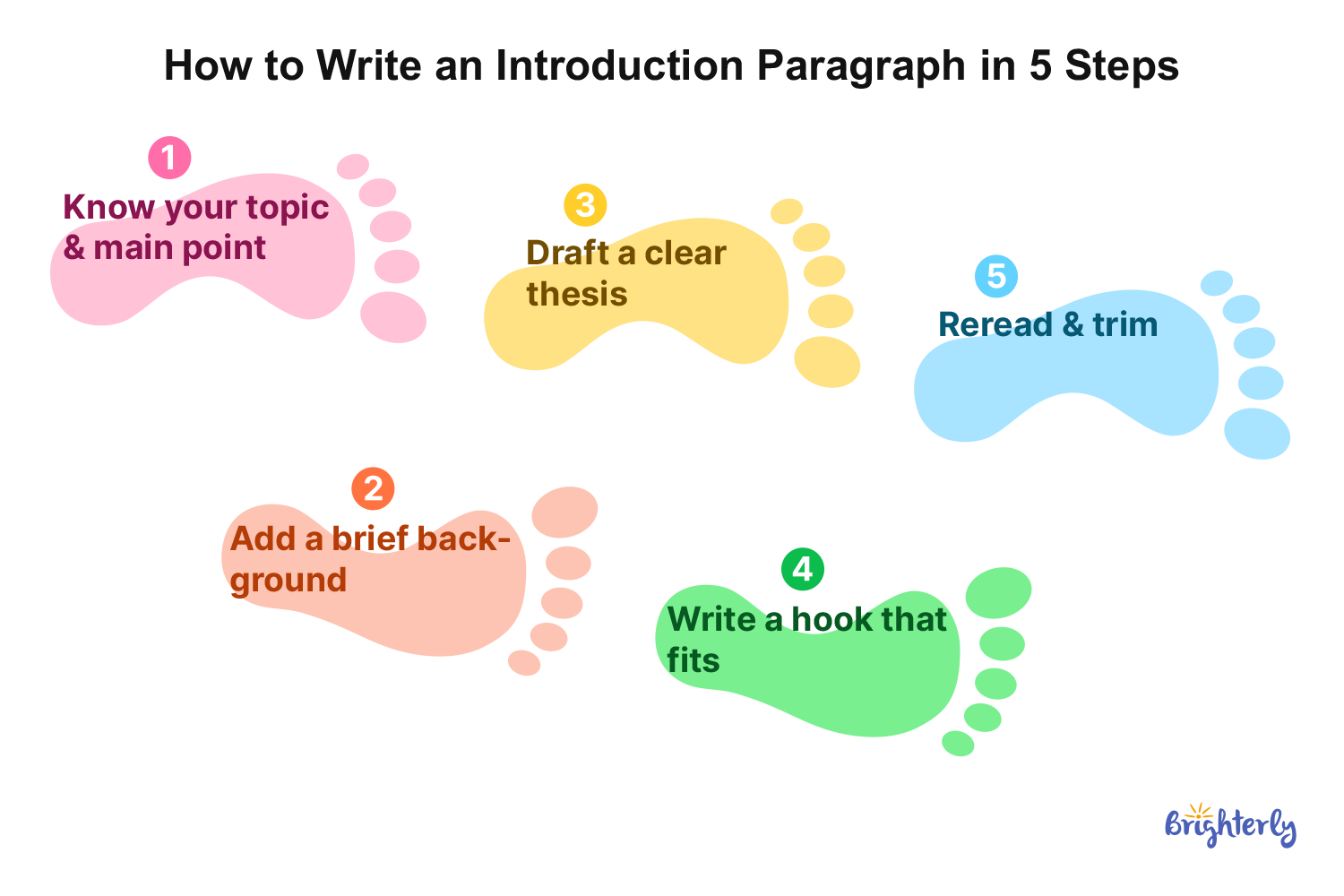
Writing an introduction paragraph outline using the following 5-step guide can help you formulate exactly what you want to say while keeping it clear, engaging, and interesting for your reader.
- Step 1: Know your topic and main point. Make sure you’re crystal clear on what you’re writing about, the argument you want to make, and what you want the reader to learn. If you don’t fully understand what you want to write about, then the reader won’t either.
- Step 2: Add a brief background. Provide any information or background (the context) your reader needs to understand what they’re about to read or why it matters (the significance).
- Step 3: Draft a clear thesis. A strong, one-sentence summary of your essay’s main idea tells the reader what to expect and sets the tone for the rest of the paper.
- Step 4: Write a hook that fits. The opening sentence should reel a reader in, engage them in what you’re about to say, and make them want to keep reading.
- Step 5: Reread and trim. Opening paragraphs often evolve as you progress through the paper. It’s fine to go back and change the introduction words to fit your essay and the story you’re trying to tell.
How Brighterly Helps Kids Master Writing Structure
Brighterly is an online platform that offers one-on-one lessons for K-12 students. Our writing tutors teach kids how to write introduction paragraphs alongside other key essay-writing skills. Take a look at our reviews to see what parents value about Brighterly.
To fit different educational needs, we offer various one-on-one lesson pricing plans. In addition to the lessons, you can download free & printable reading worksheets or sign up for the all-in-one reading program to help your kid’s progress.
How to Start an Introduction Paragraph: 6 Hook Types
Start With a Question
A great way to hook a reader is by starting with a question. Ask something that makes the reader pause and think. Your question should spark curiosity and make people want to find the answer in your text.
Example: “Did you know that the average teenager spends roughly 4.8 hours a day on social media?”
Use an Interesting Statistic or Fact
Numbers and facts add credibility and grab attention. You can shock your reader with an interesting statistic and strengthen your argument at the same time.
Example: “Studies have found that delaying school start times can improve students’ sleep, concentration, and academic performance”
Share a Short Story or Example
People love stories, and even a small one can help your reader to feel invested in your writing.
Example: “I never expected that a simple conversation with a stranger would change the way I feel about technology.”
Start With a Quote
A famous quote can be a great way to hook your reader, just make sure it’s relevant to your essay topic.
Example: “As Zig Ziglar once said, you don’t have to be great to start, but you have to start to be great.”
Present a Problem or a Painful Truth
These types of hooks work well as they hit an emotion.
Example: “Climate change is no longer a problem for future generations, its effects are already being felt by billions around the world.”
Use Contrast
Introductions with contrasting ideas can create instant interest.
Example: “Students have instant access to more information than ever before, but many can’t tell the difference between what’s fact and what’s fiction.”
What To Include in an Introduction Paragraph?
Introduction paragraph formats can vary by assignment, but all of them usually include:
- An opening topic sentence (to grab the reader’s attention)
- A transition leading to the broader topic
- A statement explaining why the topic is important
- A clear and concise definitive sentence (identifying what will be proven or discussed)
- A brief preview of the key sub-topics for longer or more complex papers.
“Students usually ramble or forget their main point in the first paragraph.”


Check Your Kids Reading Level
Take our free diagnostic test to see how your child is reading
How to Write an Introduction Paragraph for Different Essay Types
Argumentative Essay Introduction
Begin with a particular problem, a surprising statistic, or maybe even a widespread misconception. Then, provide an overview of the current discourse and acknowledge diverse perspectives on the issue. Finish with a precise thesis statement and a brief preview of what evidence you’re presenting to support your claim.
Narrative Essay Introduction
These focus more on emotional engagement. They often start with a vivid sensory description to establish the atmosphere of the story. In the background section, introduce key characters and particular details – to orient the reader. And conclude your narrative introduction with a thematic thesis hinting at the essays importance.
Research Paper Introduction
Consider starting with a definition of a real-world problem. Afterward, summarize relevant previous research and determine key technical terms. Finish with your formal thesis (or research hypothesis) and mention the particular methodology used to address the research question.
|
Primary goal |
Core thesis function |
|
|
Argumentative |
Persuade the reader |
Declares a specific and arguable stance on a debate. |
|
Narrative |
Immerse the reader |
Establishes the central theme or lesson of a story. |
|
Research |
Inform the reader |
Presents a formal hypothesis or research objective. |
Good Introduction Paragraph Examples for Students
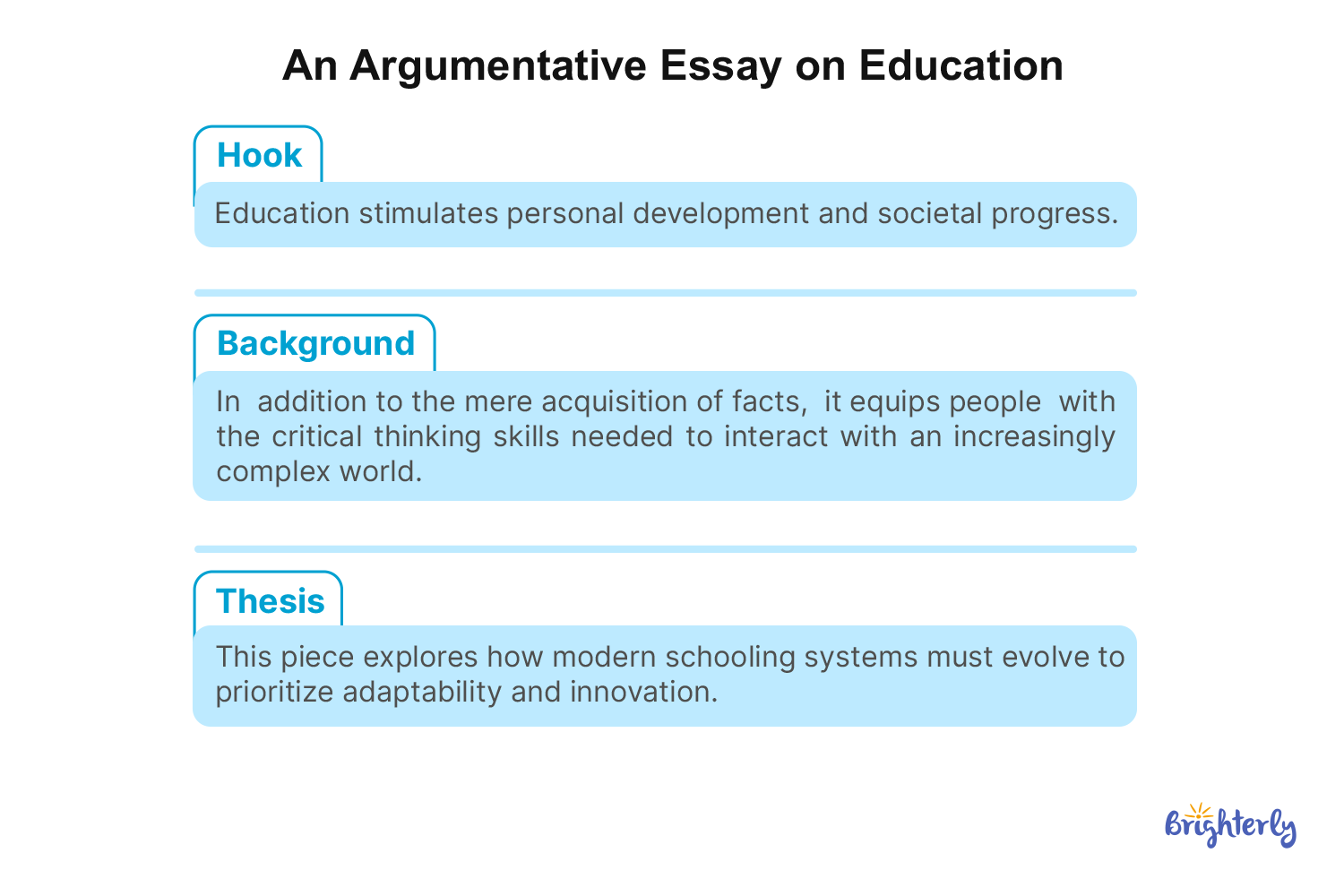
Let’s take a look at some good introduction examples so you can see how to write an introduction paragraph for an essay. An easy way to remember how to write an intro is by following the ‘ABC’ method: Attention getter (hook), Background information (context and significance), and Claim (thesis). More complex papers might require a sentence at the end describing how the paper will be structured. If you’re still struggling to write an opening paragraph, an ELA tutor can help guide you.
An Essay for Computer Science Class
[Hook] Imagine that your phone knows what you need before you need it. While that may sound crazy now, technology isn’t that far away. [Background] In recent years, technology has improved so quickly that AI is now part of everyday life. [Thesis] This essay examines how AI is changing the way we work, find information, and make decisions.
A Personal Essay
[Hook] Stepping off the plane into a completely foreign environment, I was immediately surrounded by unfamiliar smells and sights. [Background] What I thought would be a simple vacation quickly became something far more meaningful. [Thesis] The experience taught me lasting lessons about resilience and gratitude that I still carry with me today.
A Literary Essay
[Hook] Love has the power to unite people, or it can drive them towards tragedy when shaped by conflict and fate. [Background] In Romeo and Juliet, two young lovers are caught between their love for each other and the long-standing feud between their families. [Thesis] This essay discusses how Shakespeare presents love, family, and conflict, and why there was never any other ending for the star-crossed lovers.
How Long Should an Introduction Paragraph Be?
An essay introduction should typically take about 5-10% of the total length. For a standard academic essay (5-7 pages), a single paragraph is usually sufficient. In longer research papers or complex reports, it may span 2-3 paragraphs. When writing an introductory paragraph, remember: It should be long enough to establish the purpose and context, but concise enough to transition quickly into the body of the piece.
Common Mistakes When Writing Introduction Paragraphs
- Starting with tired phrases, a weak or cliched hook.
- Providing excessive background information.
- Failing to present a clear thesis.
- Introducing topics or anecdotes that don’t directly support the thesis.
- Making the introduction too long or spanning multiple paragraphs.
- If the introduction promises a particular scope or argument that the rest of the text fails to deliver, the paper loses credibility.
- Using a vague or overly broad thesis.
“The most common intro mistake is starting too broad.”

Conclusion
Writing an introductory paragraph isn’t always easy, but following a step-by-step approach can make it much simpler. By crafting an engaging hook, providing an appropriate background, and writing a clear one-sentence thesis, you’ll capture your readers attention and start your paper on the right foot.
If your kid has been feeling stuck when it comes to essay writing, then try an online essay writing tutor who can help them structure creative or academic essay writing.
Frequently Asked Questions
Should You Write the Introduction Paragraph First or Last?
Typically, most people find it easier to write the intro first and then go back to review and tweak it after they have written the body of the paper. But you should do what feels right for you. Create a rough guide first to keep your essay on track.
What Is the Difference Between a Hook and a Thesis Statement?
A hook draws the reader in: stating an interesting fact or quote, displaying a unique angle, or inciting emotion in the reader. A thesis is a one-sentence summary of your main idea and prepares your reader for what’s to come.
What Is a Good Opening Sentence for an Introduction Paragraph?
Your opening sentence should grab your readers attention and make them want to read on. Examples include using a dramatic quote from the book you’re reviewing, starting with a shocking statistic on the topic you’re covering, or sharing a short emotional story.
Do All Introduction Paragraphs Need a Thesis Statement?
Including a thesis statement is like giving your reader a headline. It lets them know what the purpose of your paper is. It can also help you to stay on track when writing the body of your paper because you’ve clearly identified the main claim.
How Is an Introduction Paragraph Different From a Conclusion?
An introductory paragraph sets the stage for what’s to come, orients your reader, and excites their attention. A conclusion wraps up what you’ve said by summarizing the main points and tying them all together. They serve different purposes, but are both equally important.
At What Grade Do Students Start Writing Introduction Paragraphs?
Students typically start learning to write essays around grades 3-5. At this point, they will begin to practice how to structure a simple essay, which will likely include a basic introductory paragraph. By high school, students will be able to write more complex papers and introductory paragraphs. If your kids need extra support or you’re not sure what level they’re currently at, try a reading test to see where they stand.


How to get better at writing comes down to three core habits: reading regularly, practicing daily, and actively seeking feedback. These habits build vocabulary, sharpen grammar, and develop a natural writing voice for students and adults alike. The 18 tips below cover each of these areas with specific, actionable steps you can start today. Key […]

Nov 18, 2025

Trying to choose between Leapfrog Academy vs ABC mouse for helping your kid build foundational skills in core subjects? This comparison breaks down the key features of the two platforms to help you select the right one for your child. Meanwhile, it’s worth noting that learning apps can deliver significantly better results when combined with […]

Nov 21, 2025
Math & reading from 1st to 12th grade
Looking for homework support for your child?

Choose kid's grade

Math & Reading for Grades 1–12
Build real confidence for your child with a Brighterly math or reading tutor.