70+ Idioms for Kids – Easy Explanations and Funny Examples
reviewed by Marvi M. Andres
Updated on June 1, 2026
Key Points:
- Idioms for kids are phrases with a hidden figurative meaning, totally different from what the literal words mean.
- The convenient division of idioms to have your child get familiarized with includes everyday use, animal and food themes, body parts, nature and weather, funny idioms, and those used at school.
- Teach your kid one idiom a day, introducing picture storybooks, acting out both literal and figurative meanings, and using DIY card games, quizzes, and free printable worksheets.
‘Zip your lips!’ You tell your kid before a game of hide-and-seek. For a second, they might hesitate, wondering how a jacket zipper could possibly belong on their face. Because kids have to learn that ‘zipping your lips’ means promising to keep a secret, here’s a ready-to-use list of common idioms for kids (with meanings and examples) along with practical tips on how to teach them.
What Is an Idiom for Kids?
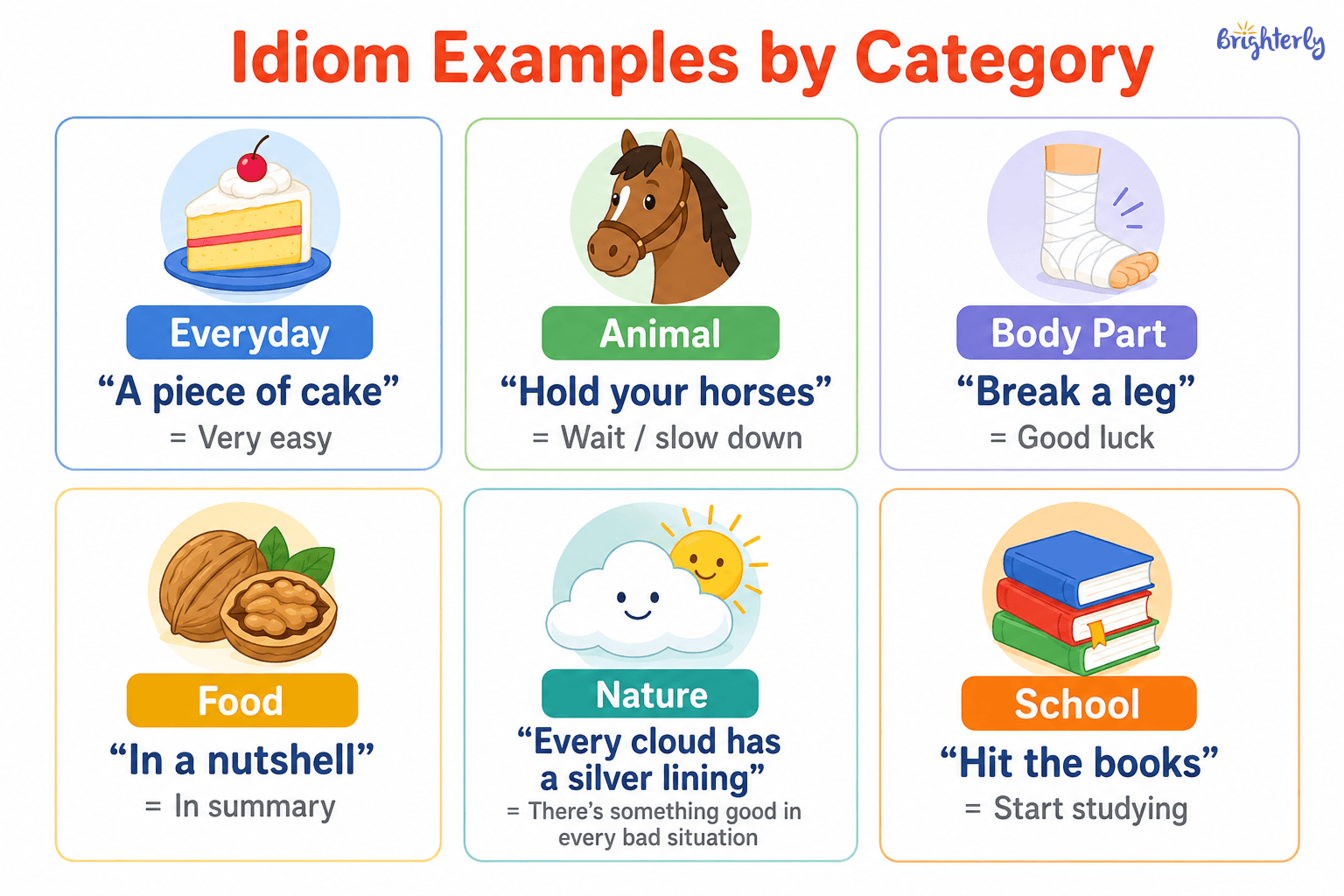
An idiom is a phrase in figurative language. Words in different idiomatic expressions have an established hidden meaning, totally different from what those words actually say. Take an idiom ‘break a leg’: It doesn’t mean causing a physical injury – it’s used to wish someone ‘good luck’ (like before a big test).
How Idioms Differ from Literal Phrases
| Easy Idioms for Kids |
Literal vs Figurative Meaning |
|
| Bite the bullet | Physically clamp your teeth on a piece of ammunition. | Face a difficult situation with courage and get through it. |
| Under the weather | Stand directly beneath rain or clouds. | Feel slightly sick or tired. |
| Spill the beans | Knock on a container of beans so they scatter on the floor. | Reveal a secret. |
Why Kids Struggle with Idioms (and Why That’s Normal)
Kids struggle with the idiomatic everyday expressions because, from 3 to 6 years old, their brain processes words literally, as stated by scientists from Language Development Research (2025). If a child hears ‘it’s raining cats and dogs,’ their mind tries to visualize actual animals falling from the sky. At ages 7-9, though, children’s brains can already understand abstract concepts and recognize context hinting at secondary meanings.
Make figurative language less confusing
Brighterly helps kids practice understanding hidden meanings and common English idioms.


Explore Brighterly Learning Experience
Learn exactly how Brighterly helps students thrive through expert sessions, online tools, and proven feedback from thousands of satisfied parents
Everyday Idiom Examples for Kids
- Cost an arm and a leg – something costs a lot of money.
E.g.: The new video game console costs an arm and a leg, so I’m saving up my allowance to buy it.
- It’s a piece of cake – a task is very easy to do.
E.g.: I studied hard for my spelling test, so completing it was a piece of cake.
- Break the ice – do something to help people feel more comfortable when they first meet.
E.g.: The teacher played a fun game on the first day of school to help the new students break the ice.
- Hit the nail on the head – say something exactly right.
E.g.: You hit the nail on the head when you said that the final answer to the math problem was twenty-four.
- Let the cat out of the bag – accidentally reveal a secret.
E.g.: Sarah let the cat out of the bag about the surprise party when she accidentally texted the invitation to the birthday boy.
- Once in a blue moon – something that happens very rarely or almost never.
E.g.: My family goes to the amusement park once in a blue moon because it’s located far away from our house.
- Barking up the wrong tree – looking for solutions in the wrong place, or accusing the wrong person.
E.g.: If you think I took your missing shoe, you’re barking up the wrong tree because I’ve been at soccer practice all afternoon.
- Burn bridges – destroy a relationship so that you can’t go back again.
E.g.: When you leave a sports team, it’s important to thank your coach so you don’t burn bridges if you want to play next year.
- Beat around the bush – avoiding the main topic or not speaking directly about a problem.
E.g.: Stop beating around the bush and just tell me if you broke the toy or not.
- The ball is in your court – it’s your turn to make the next move.
E.g.: I offered to trade you my soccer card for your basketball card, so now the ball’s in your court.
- A penny for your thoughts – asking someone what they’re thinking about when they’re very quiet.
E.g.: You’ve been staring out the window for ten minutes, so a penny for your thoughts.
- Kill two birds with one stone – achieve two different goals with just one action.
E.g.: By riding my bike to the library, I can return my books and get my daily exercise, killing two birds with one stone.
- Cry over spilled milk – get upset or complain about a past mistake that can’t be fixed.
E.g.: You dropped your ice cream cone on the ground, but there’s no use crying over spilled milk, so let’s just go get a fresh one.
- Miss the boat – miss out on a good opportunity to do something because you acted too slowly.
E.g.: The sign-ups for the art field trip ended yesterday, so I completely missed the boat.
- Pull someone’s leg – tease someone.
E.g.: Don’t worry, I’m just pulling your leg when I say we’re having broccoli for dessert.
- Zip your lips – promise to keep a secret safe.
E.g.: I know exactly where the hidden treasure is, but I’ll zip my lips so the other team doesn’t find out.
Animal Idioms for Kids
- A bull in a china shop – someone very clumsy in a situation where they need to be careful and gentle.
E.g.: When my brother tried to walk through the crowded gift shop with his giant backpack on, he was like a bull in a china shop.
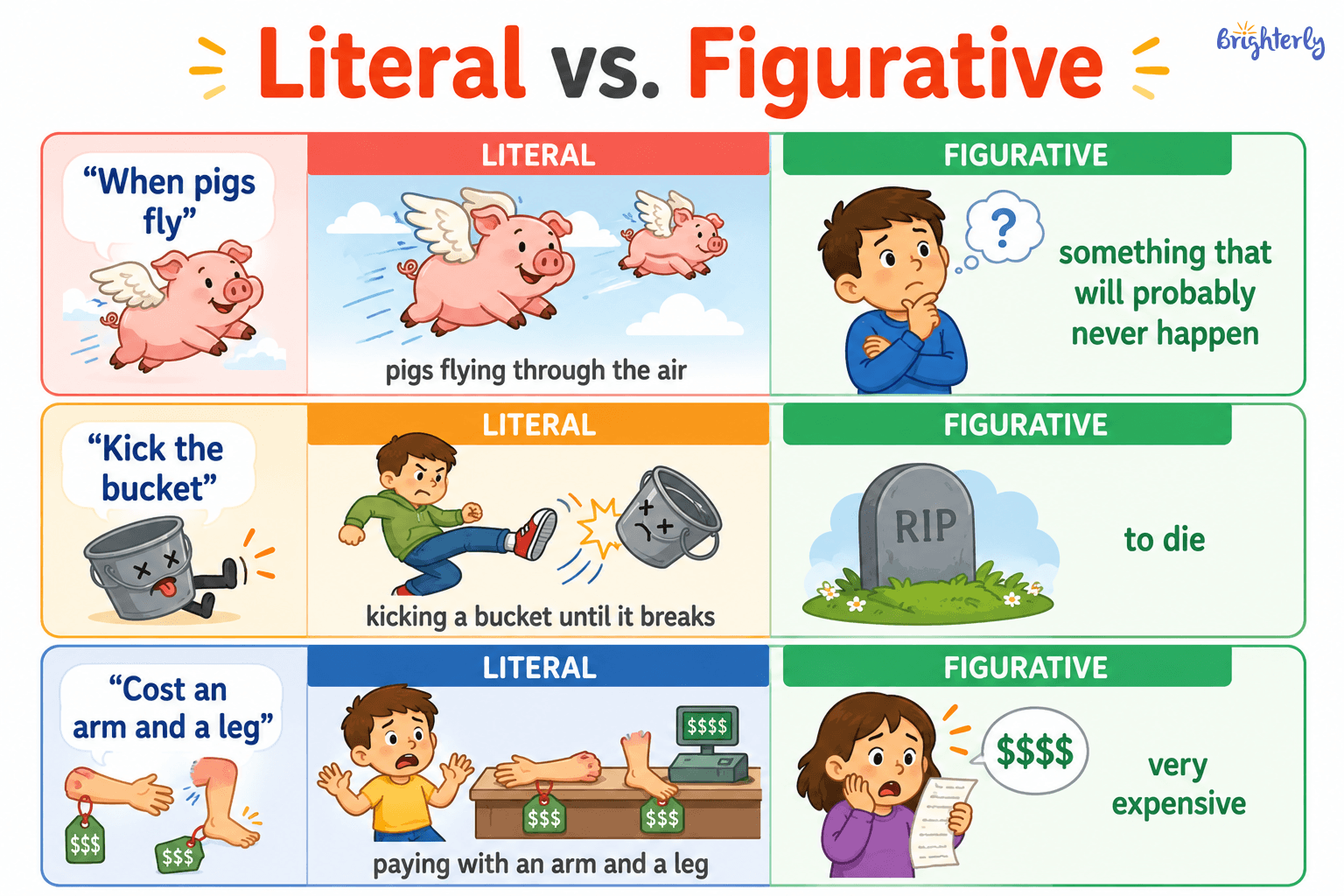
- Hold your horses – slow down before rushing into action.
E.g.: Hold your horses until everyone receives a slice of cake before you start eating yours.
- The elephant in the room – a great problem everyone knows about, but no one wants to talk about.
E.g.: The messy pile of unfolded laundry on the couch was the elephant in the room that everyone ignored during dinner.
- A wolf in sheep’s clothing – someone who appears to be friendly on the outside, but is actually dangerous on the inside.
E.g.: The character in the story seemed nice at first, but he turned out to be a wolf in sheep’s clothing when he stole the main character’s map.
- Busy as a bee – work hard and move constantly from one task to another.
E.g.: My mom was busy as a bee all morning setting up decorations and cleaning the house for the party.
- The lion’s share – the largest part of something.
E.g.: My older brother ate the lion’s share of the pizza, leaving only two small slices for my sister and me.
- Straight from the horse’s mouth – getting information straight from the original person who knows the exact facts.
E.g.: We’re having a pop quiz today – I heard it straight from the horse’s mouth when the teacher told the principal.
- Curiosity killed the cat – a warning that trying to find out too much about something that doesn’t concern you can lead to trouble.
E.g.: I’d like to open that wrapped box, but curiosity killed the cat, so I’ll wait until my parents come home.
- Like a fish out of water – feel very awkward or out of place (in an unfamiliar situation).
E.g.: On my first day at the new school, I felt like a fish out of water until a classmate invited me to join their lunch table.
- Let sleeping dogs lie – leave a situation alone to prevent causing new trouble.
E.g.: My friend forgot that I lost his pencil last week, so I decided to let sleeping dogs lie and not mention it again.
Body Part Idioms for Children
- Keep an eye on – watch someone to ensure they’re okay.
E.g.: Please keep an eye on your little sister at the playground while I go pack up our picnic blanket.
- Turn a blind eye – ignore something wrong instead of correcting it.
E.g.: The camp counselor turned a blind eye when the kids stayed up five minutes past bedtime to finish their board game.
- Put your foot in your mouth – accidentally say something embarrassing or hurtful.
E.g.: I really put my foot in my mouth when I asked my friend if he liked his birthday present, forgetting that I hadn’t given it to him yet.
- Heart of gold – be super kind and caring to people.
E.g.: Our school bus driver has a heart of gold because she always hands out bookmarks on holidays.
- All ears – listen very carefully.
E.g.: Tell me all about your weekend trip to the zoo – I am all ears!
- Bite your tongue – force yourself to avoid saying something rude.
E.g.: I had to bite my tongue when my teammate made a mistake, as we’re all just learning how to play.
- Shoulder to cry on – a supportive person always ready to comfort when you’re sad.
E.g.: When my pet turtle ran away, my best friend was a shoulder to cry on and sat with me until I felt better.
- Face the music – accept the negative consequences of a mistake you made.
E.g.: After accidentally breaking the kitchen window with a baseball, it was time to face the music with my parents.
Food Idioms for Kids Examples
- In a nutshell – using only a few words to explain something quickly.
E.g.: To put our whole science project in a nutshell, plants need sunlight and water to grow.
- The apple of my eye – someone incredibly special to you.
E.g.: My grandma always hugs me tightly and tells me that I’m the apple of her eye.
- Butter someone up – being super nice to someone because you want a favor from them.
E.g.: I tried to butter my dad up by cleaning the living room before asking him if we could get pizza for dinner.
- Bring home the bacon – earn money so that you can buy things you need.
E.g.: My parents both work hard every day to bring home the bacon and provide for our family.
- A tough cookie – someone very brave who doesn’t give up when things get difficult.
E.g.: Although Emily scraped her knee when she fell off her scooter, she didn’t cry because she’s a tough cookie.
- Easy as pie – something super effortless to complete.
E.g.: Once I practiced the steps a couple of times, riding my bike without training wheels was easy as pie.
- Not my cup of tea – something you don’t find interesting.
E.g.: I tried out for the drama club, but acting on stage is just not my cup of tea.
- Hot potato – a problem that people find uncomfortable to deal with and want to pass on to someone.
E.g.: Nobody wanted to take responsibility for losing the playground ball, so the issue became a hot potato.
Nature and Weather Idioms for Kids
- Every cloud has a silver lining – there’s always something good to find, even in a bad situation.
E.g.: Our soccer game was canceled because of the heavy rain, but the silver lining was that we got to stay inside and watch a movie together.
- Weather the storm – stay strong during difficult times until things get better.
E.g.: Moving to a new city was really hard at first, but our family managed to weather the storm, and now we love our new neighborhood.
- Under the sun – absolutely anywhere or anything.
E.g.: The enormous toy store downtown seems to have every single board game under the sun.
- A breath of fresh air – a refreshing change that makes a situation feel much better.
E.g.: Having a cheerful new student join our classroom was a breath of fresh air for everyone.
- Steal someone’s thunder – take attention away from someone’s achievement, by saying something big at the same time.
E.g.: I was about to show everyone my perfect score on the art project, but my brother stole my thunder by announcing he won the school spelling bee.
- On thin ice – misbehave, resulting in a risky situation.
E.g.: After forgetting to do my chores three days in a row, I knew I was on thin ice with my parents.
- The calm before the storm – a peaceful period right before trouble begins.
E.g.: The quiet classroom before the dismissal bell rang felt like the calm before the storm.
- Can’t see the forest for the trees – focusing on tiny details so much that you fail to understand the main point.
E.g.: I spent so much time worrying about the exact shade of green for one leaf that I couldn’t see the forest for the trees on my entire science poster.
School and Learning Idioms for Kids
- Hit the books – begin studying hard for school assignments.
E.g.: I need to hit the books tonight because we have a big history quiz tomorrow morning.
- Learn the ropes – figure out the basic rules or steps for doing something new.
E.g.: It took me a few days to learn the ropes of using the new school library computer system.
- Pass with flying colors – complete a test with a very high score.
E.g.: Maria studied her vocabulary words every day and passed the final exam with flying colors.
- Put your thinking cap on – think deeply and creatively to solve a problem.
E.g.: The science riddle is quite tricky, so let’s put our thinking caps on and figure out the answer together.
- Burning the midnight oil – staying up very late studying.
E.g.: My older brother was burning the midnight oil to finish his high school science fair project before the morning deadline.
- Draw a blank – know something but forget when asked.
E.g.: I knew the name of the capital city yesterday, but when the teacher called on me, I completely drew a blank.
- Ace it – earn an excellent grade on a test.
E.g.: You practiced your piano piece so many times that I know you’re going to ace it at the recital.
- Raise the bar – increase standards, making a task more challenging.
E.g.: The art teacher raised the bar this semester by asking us to create three-dimensional models instead of standard drawings.
Note: Online vocabulary lessons at Brighterly can help your kid with teaching idioms and ultimate vocabulary building. Our live 1:1 interactive lessons extremely strive to improve grammar and enhance reading comprehension for your kid to better decode figurative language. Plus, with our experienced middle school reading tutors, children master language arts according to the US state standards altogether.
Funny Idioms for Kids
- Barking mad – acting crazy and wild.
E.g.: The puppy went barking mad and ran in fast circles around the living room when he saw his new chew toy.
- Fly off the handle – become very angry over something small.
E.g.: My brother flew off the handle when I accidentally knocked over his tower of building blocks.
- Lose your marbles – act foolishly.
E.g.: When my dad started dancing in the grocery store, I asked him if he’d completely lost his marbles.
- Bite the hand that feeds you – treat badly someone who’s helping you.
E.g.: Complaining about the dinner your parents cooked for you is like biting the hand that feeds you.
- Cat got your tongue? – asked when someone’s unusually quiet.
E.g.: You’re usually so loud, but right now you’re totally silent – cat got your tongue?
- Jump the shark – when something popular drops in quality because it’s trying too hard to stay exciting.
E.g.: That cartoon series really jumped the shark when the main characters traveled to outer space for no reason.
- Add fuel to the fire – say or do something that makes an already bad situation even worse.
E.g.: My sister was already upset about losing her favorite marker, and teasing her about it just added fuel to the fire.
- Head in the clouds – being completely distracted or daydreaming.
E.g.: Billy had his head in the clouds during the soccer game and didn’t notice the ball rolling right past his feet.
Make the idiom easier for kids
Interactive lessons help children decode idioms and improve reading comprehension skills.
How to Teach Idioms to Kids
- Start with one idiom a day. In the morning, introduce one idiom – say a phrase, clarify its meaning, suggest real-life examples. Before bedtime, ask them to remember examples of idioms for kids used throughout the day.
- Use picture books and stories.
- Amelia Bedelia Series by Peggy Parish
- In a Pickle and Other Funny Idioms by Marvin Terban
- Parts and More Parts by Tedd Arnold
- Act it out. To better grasp the contrast between the two meanings, show your kid the exact literal meaning of an idiom (like, pretend to physically pull someone’s leg) and the figurative one – tease someone with a joke.
- Play matching games.
- DIY card games: Write the idiom on one index card and its definition on the other, further turning and intermixing multiple cards to find the matching pairs.
- Quizzes: Say an idiom and give three funny choices for the kid to choose from for what it might mean.
- Worksheets: Print and practice with our free worksheets with common idioms for kids and free worksheets for context clues.
Frequently Asked Questions
At What Age Can Kids Start Learning Idioms?
Children can begin learning idioms when they are 7-9 years old. Before this age, according to Language Development Research (2025), their brain processes language precisely as it’s spoken. By 2nd or 3rd grade, a child’s cognitive development shifts, and they become capable of thinking beyond the literal definitions of words.
How Is an Idiom Different from a Saying or Proverb?
In an idiom, the literal meaning of the words makes no sense in the context (e.g., ‘under the weather’).
A saying or a proverb is traditional advice or a well-known truth. The individual words in them make literal sense on their own, and the phrase is meant to teach a lesson (e.g., ‘practice makes perfect’).
Why Do Kids Often Take Idioms Literally?
According to researchers from the University of Rennes, young children take idioms literally because of their concrete stage of brain development. When they’re 3-6 years old, a child’s mind treats language like a direct mirror of reality. Therefore, introduce them to the list of idioms for kids when their brains are ready for abstract concepts (around 7-9).
Can Kids Learn Idioms Through Books and Movies?
Yes, children can learn idioms from books and movies due to the contextual and visual clues. When kids see a character fly off the handle in a cartoon or read about Amelia Bedelia’s literal mistakes in a storybook, they can look at the surrounding action to figure out the hidden meaning of the common English phrases.
How Many Idioms Should a Child Know by 5th Grade?
There’s no official US educational standard specifying an exact required number of idioms a child must know by 5th grade. However, official English Language Arts standards define the expected skill level: By 5th grade, children should be able to precisely define figurative meanings of English idioms and proverbs from context and apply them correctly in everyday life and classroom instruction.
What Are Some Fun Ways to Practice Kid Friendly Idioms at Home?
- Play DIY card games. Write idioms and definitions on different index cards and mix them up for the kid to find matching pairs.
- Host quizzes. For one idiom, suggest to your child three funny definition choices to pick from.
- Act it out. Show the kid the physical contrast between the literal and figurative meanings of phrases.


Real user reviews on independent feedback platforms most often cover Revolution Prep’s full-time faculty model and integrated cognitive science methods. Families also discuss the learning approach and its effectiveness for AP, IB, SAT, and ACT preps. Let’s find out how it all correlates with the official pricing plans and whether or not it’s worth it. […]

Jun 01, 2026

⭐ Overall rating: 7.3/10. You’ll find out what real users on Reddit and TrustPilot think about the school’s learning approach, the overall experience, customer support, and pricing plans. Publicly shared comments will also reveal the most frequently reported benefits and complaints, and how families evaluate the academic and emotional effectiveness. Rating Methodology For an unbiased […]

Jun 02, 2026
Math & reading from 1st to 12th grade
Looking for homework support for your child?

Choose kid's grade

Math & Reading for Grades 1–12
Build real confidence for your child with a Brighterly math or reading tutor.