Statistics on How Students Learn Best in 2026
reviewed by Laila A. Lico
Updated on January 23, 2026
As a teacher, I closely follow learning trends to better understand what my students really need. This year, education looks very different from just a few years ago. What actually works today, online platforms, personalized learning, blended formats, or something else? Instead of relying on assumptions, this article looks at statistics on how students learn best, highlighting the most effective learning approaches in 2026.
Key points
- How do most students learn best? Statistics show that online learning is the future. Today, almost half of students worldwide have taken at least one online training course, and around 70% of them say online education is effective.
- Offline learning is still the most popular option. Despite the growth of digital education, about 75% of students still prefer studying in physical classrooms.
- Blended studying stands out as the most effective format. More than 73% of teachers believe that combining online and in-person learning delivers the best results.
- If you are looking for effective online learning that combines modern trends with personalized, interactive lessons, take a look at the Brighterly platform.
Online learning vs in person learning: Which method works better?
Personally, I don’t have a clear answer to how do students learn best – online or offline. Each has its own strengths and limitations. However, the numbers tell an interesting story.
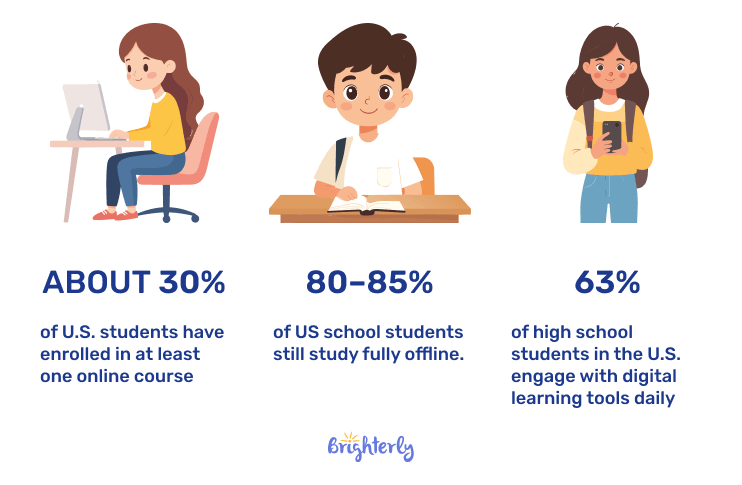
At least 49% of students worldwide have taken at least one online course, and around 70% of them say that online learning is equal to or even better than traditional classroom education.
At the same time, offline learning still dominates in the US. According to EdChoice, traditional in-person education remains the primary format for school students, with around 80–85% relying exclusively on offline classes.
Online learning statistics
The 2026 data shows that online learning is no longer a niche alternative. Now, it has turned into a full-fledged educational pathway with a promising future. Let’s explore the numbers to back it up.
Just imagine: the online learning market has been growing since 2000, expanding by 900%. Analysts predict that by 2026, its total revenue will reach $400 billion. In terms of users, more than 87.6 million people are expected to be enrolled on online platforms in the US alone by 2029.
Looking at today, 60+% of universities around the globe now offer some form of online program. That’s for a good reason – more than 49% of students globally have taken at least one online course. These student learning statistics show that digital formats are indispensable in modern education. In the United States, online programs are also expanding rapidly. Thus, over half of institutions report that online enrollments are growing faster than on-campus enrollments.
You can see this trend in the table below. Enrollment has grown from almost 4.9 million in 2022 to over 5 million in 2024, and this increase happened without a major disruption like a pandemic. Check out this hands-on online learning statistics:
Year |
2022 |
2023 |
2024-2026 |
| Number of students studying fully online in the US |
≈ 4,918,059 students (enrolled only in online college programs in the US) |
≈ 4,982,428 students (fully online, ~1.3% increase from 2022) |
≈ 4,9–5 mln students (trend shows steady growth; however, exact numbers are not publicly confirmed) |
Why do students choose online learning?
Flexibility is one of the main reasons to why students choose online learning. Students like learning at their own pace, and they can balance studies with work, family responsibilities, or health needs. So, when do students learn best? Basically, when it’s convenient and comfortable for them!
Here’s a quick look at what students think about online learning:
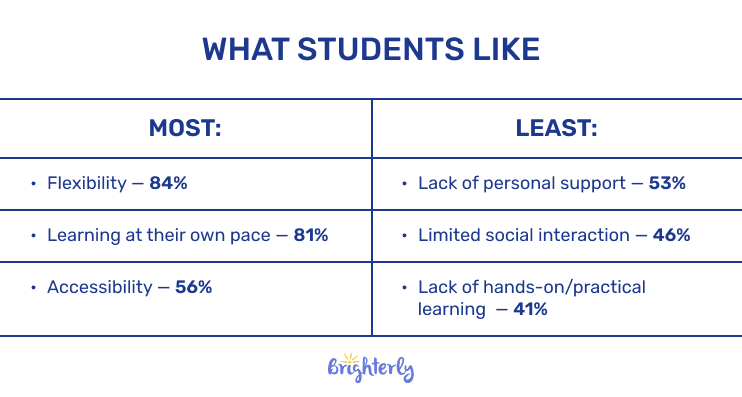
Of course, most of these data are from college and university students, but they reflect broader trends in education and give a good idea of what to expect in schools or future learning environment.
Note: If you’re curious about different platforms, you can check out the article: 15 e-learning websites.
When can online platforms like Brighterly work best for your child?
If your child’s offline school isn’t providing the learning results you’d like, it might be time to consider additional online learning. Statistics show that online learning can be very effective.
From my experience, some of the best options on the US market are the Brighterly math and reading platform and its Brighterly tutors.
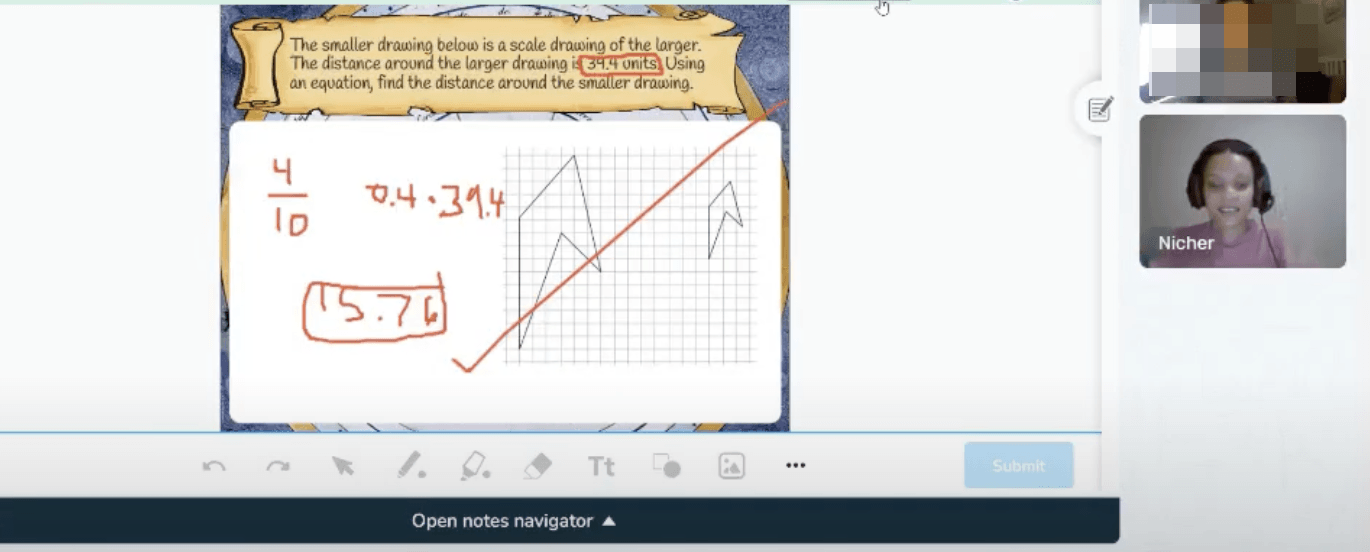
So, when could Brighterly be the perfect fit for your child?
- If you’re looking for professional tutors in math or reading
- If you want personalized learning with a structured lesson plan
- If you prefer one-on-one lessons between the teacher and your child
- If you want lessons to be fun, modern, and animated
If you’re not ready to commit to a full learning plan, you can first start with practical tasks available at Brighterly. These include:
- Free math worksheets and reading worksheets for working together with your child.
- Math tests and reading tests to check your child’s strengths and weaknesses before starting formal lessons. This helps you identify which topics need extra attention – and it’s all free!
Check the basics behind this term
Take our quick quiz to discover the perfect learning solution based on your child’s needs.
In person learning statistics
Despite the growth of online education, in-person learning remains the main format, especially in American schools. Attendance rates for grades K-12 have stabilized in recent years since the pandemic.
According to NCES, in 2023, the average daily attendance in US K–12 schools was around 90%. In the 2024-25 school year, it rose to ≈93.45%, almost reaching pre-pandemic levels, when the average daily attendance was about 94%
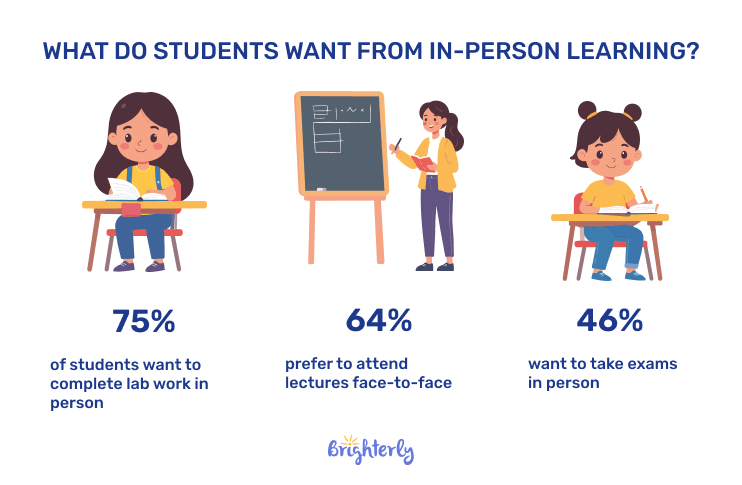
These statistics from Educause provide insight into how students learn best in the classroom. For example:
- 75% of students want to attend laboratory sessions in person
- 64% prefer attending lectures face-to-face, compared to only 30% who favor online formats
When it comes to exams and research assignments, students still lean toward online formats:
- 46% prefer taking exams in person (up 6 points from 2023)
- 48% prefer taking exams online (down 5 points from 2023)
This data highlights that in-person education still remains vital for many aspects of student engagement.
Blended learning statistics
In my view, blended learning solves a key problem in education. This format keeps flexibility while maintaining real connections with teachers and classmates. These statistics give a picture of how students learn through blended learning
Here’s what the numbers say:
- As of 2026, around 60% of students prefer a blended learning format.
- Over 80% of educational institutions worldwide offer blended courses.
- Both teachers and students believe blended learning boosts engagement and motivation – 73% of teachers and 59% of students agree. Plus, 60% of educators are convinced that blended learning improves overall student performance.
Learning styles statistics in 2026
The idea of learning styles has been popular with teachers and students for years. Back in 2019, over 80% of Americans believed in this theory. But by 2026, reliable statistics on learning styles no longer exist. They no longer have strong support in science, and most academic communities don’t see them as valid anymore.
A University of Michigan review even calls learning styles a myth, since studies haven’t shown real benefits from teaching this way. This view also appears in many professional education publications in 2026.
Despite the critical thinking of scientists, I still believe this concept makes sense, and from experience, it can help parents and teachers understand how do students learn best – visually, aurally, or kinesthetically. So, I’ll share a few more numbers on this topic.
Visual learning statistics
Visual learners find it easier to understand material through videos and pictures. According to visual learning statistics 2026 and this survey, a whopping 48% of students identify as visual learners.
For visual learners, studying through clear visual materials works best. An ideal learning format for them is math worksheets and reading worksheets. These are bright, well-designed sheets where all texts and math problems are visualized with no distractions.
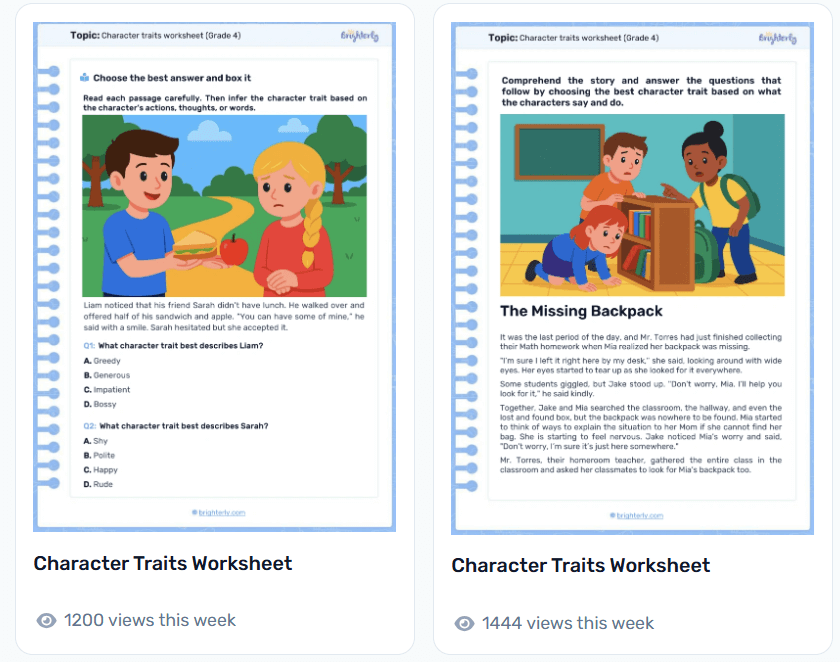
Here’s what Brighterly worksheets look like. There are different sheets designed for students from grades 1 to 9.
Auditory learning statistics
Auditory learners absorb information better through listening. Lectures, podcasts, and clear verbal explanations work especially well for them. While there are no official auditory learning statistics 2026, one small study of 38 students found that about 42% showed an auditory learning preference. Another study among medical students reported that 54% preferred auditory input.
Kinesthetic learning statistics
In the kinesthetic style, students often say, “I learn best when I can actually do something”. This type of learning happens through practical activities such as experiments and simulations. Studies show this type of learning preference occurs in 15.8% to 36.8% of students.
Active learning vs passive learning statistics in 2026
Active learning is one of the strongest trends in modern education, and by 2026, there’s enough research to assess its effectiveness. Simply put, active learning involves students discussing topics, asking and answering questions, and engaging with the material, rather than just sitting quietly and memorizing.
Analysis by Engageli (2024) shows a huge difference between active learning vs passive learning:
- Engagement: Students in active learning statistics show ≈62.7% engagement, while those in passive (traditional lecture) formats show only ≈5%. This demonstrates a much higher involvement in the learning process.
- Grades: About 54% of active learners achieve higher grades than in passive formats.
- Memory: Students in active groups demonstrate up to 55% better material retention than in traditional lectures.
- Outcomes: Students learning through active methods are 1.5 times less likely to fail a course compared to those in traditional lectures.
Note: Check the article Interactive learning statistics for even further insights into the topic.
Learning trends 2026: Experiential and personal learning
In 2026, education continues to evolve: students and teachers are increasingly using experiential and personalized learning. These trends are gaining popularity and showing results.
Experiential learning statistics
A survey of Generation Z graduates found that over 80% of students experienced experiential learning in college. In 2026, this approach was widely used in both high school and college education. One of the biggest benefits of hands on learning is that students can apply what they learn to real-life situations.
Why is hands on learning important? This approach improves professional skills immediately and gives students a better chance at employment right after graduation. This trend is a valuable asset for young professionals, and it may even be adopted in schools in the future.
Personalized learning statistics
Personalized learning is an approach that adapts teaching to each student’s needs, pace, strengths, and interests. By 2026, personalization will have become much more accessible thanks to AI-powered technologies. According to Engageli, over 86 % of educational institutions used AI tools this year to automate content and tailor it to different learners. This means personalized learning will continue to grow and thrive in the coming years.
Check the basics behind this term
Take our quick quiz to discover the perfect learning solution based on your child’s needs.
Conclusion: What is the best learning method for students?
In 2026, statistics show that there’s room in the education market for in-person, online, and blended learning, as all of these formats are valuable to students. However, the future clearly leans toward technological progress. Online resources and tools, including artificial intelligence, will continue to grow, paving the way for personalized learning to flourish.
By the way, today’s modern trends and techniques are both being used by one of the best platforms in my opinion – Brighterly. If you’re looking for an online reading and math program, I highly recommend them. They offer:
- Personalized learning programs
- Interactive, animated lessons
- Mentorship from professional tutors
If you’re unsure whether it’s right for your child, you can book free lesson and see for yourself.


If you are not sure whether to subscribe to DreamBox or not, and how much does DreamBox math cost, I’m here to help. I’ve gathered all the information on pricing and plans in one article. I’ve also included real reviews from parents and kids for you to know exactly what to expect. Key points DreamBox […]

Jan 02, 2026

Brilliant.org cost isn’t obvious at first glance. You can taste interactive math through a free trial, but as you achieve some progress, you find yourself at the door with paid access. What’s hidden behind the Brilliant.org price? What’s included in the subscription, and how does the cost scale over time? I’ll answer these questions, and […]

Jan 04, 2026
Math & reading from 1st to 9th grade
Looking for homework support for your child?
Choose kid's grade

Math & Reading for Grades 1–9
Build real confidence for your child with a Brighterly math or reading tutor.