Area of a Square – Definition, Formula, Examples
Updated on July 31, 2026
The area of a square is the amount of space inside it, and it equals the side length multiplied by itself: Area = side × side, or side². Area is always measured in square units, such as square centimeters (cm²) or square inches (in²). For a square with sides of 5 cm, the area is 5 × 5 = 25 cm².
Area is a cornerstone of elementary geometry. If your child wants extra practice connecting side length, perimeter, and area, a Brighterly geometry tutor can guide them.
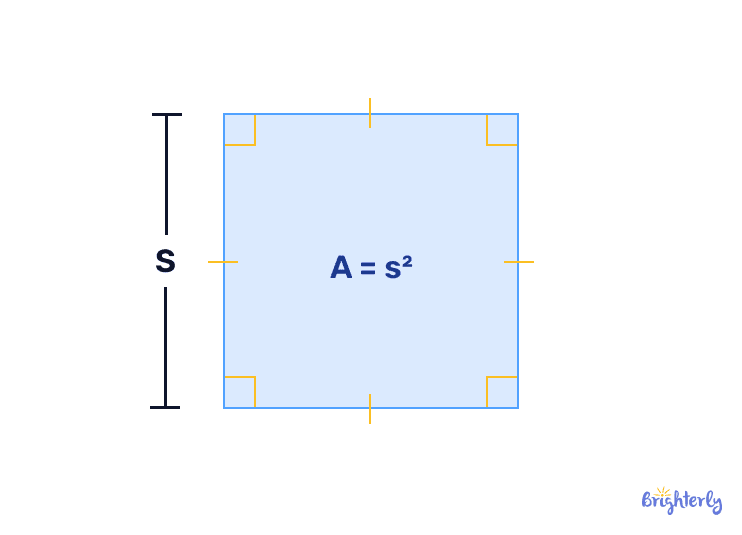
What Is the Area of a Square?
The area of a square is the space enclosed by its four equal sides, measured in square units. Because all sides of a square are equal, knowing just one side is enough to find the area. If your measurements are in inches, the area is in square inches; if in centimeters, the area is in square centimeters.
Expert Math Tutors for Every Level
Connect with professional and certified educators who provide specialized support for every grade level, from elementary school basics to advanced algebra
What Is the Area of a Square Formula?
The formula for the area of a square is Area = side × side, which is written as side². Since every side of a square is equal, multiplying one side by itself gives the total space inside. For example, a square with a side of 6 m has an area of 6² = 36 m².
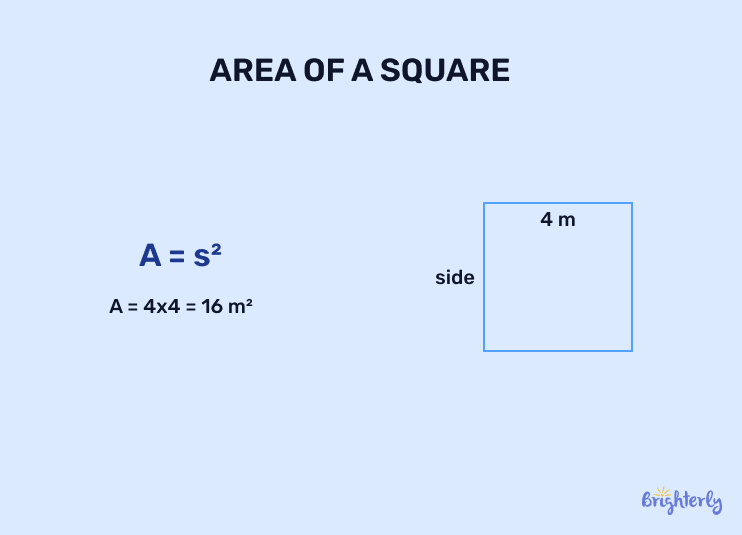
How to Find the Area of a Square
You can find the area of a square from its side length, its perimeter, or its diagonal. The table below shows the formula for each case, so you can use whichever measurement you already have.
| If you know the… | Area formula |
| Side length (s) | A = s² |
| Perimeter (P) | A = (P ÷ 4)² |
| Diagonal (d) | A = d² ÷ 2 |
Area of a Square When the Side Is Given
When you know the side length, square it. For a square with a side of 5 cm, the area is 5 × 5 = 25 cm². This is the most direct way to find the area, and the one students use most often.
Area of a Square When the Perimeter Is Given
The perimeter of a square is the sum of its four equal sides, so dividing the perimeter by 4 gives one side. Then square that side. For a perimeter of 20 cm: 20 ÷ 4 = 5 cm, and 5 × 5 = 25 cm².
Area of a Square When the Diagonal Is Given
If you know the diagonal, use A = d² ÷ 2. For a diagonal of 6 cm, the area is 6² ÷ 2 = 36 ÷ 2 = 18 cm². This formula comes from the Pythagorean theorem, which relates a square’s side to its diagonal.
How to Calculate the Area of a Square (Step by Step)
- Identify what you know: the side, the perimeter, or the diagonal.
- If you have the perimeter or diagonal, first find the side length.
- Multiply the side by itself (or apply the matching formula).
- Write the answer in square units, such as cm² or in².
Solved Examples on the Area of a Square
Example 1: A square has a side of 9 in. Its area is 9 × 9 = 81 in².
Example 2: A square has a perimeter of 32 cm. One side is 32 ÷ 4 = 8 cm, so the area is 8 × 8 = 64 cm².
Example 3: A square has a diagonal of 10 cm. Its area is 10² ÷ 2 = 100 ÷ 2 = 50 cm².
Area and Square Worksheets
Put this into practice with related Brighterly worksheets:
Frequently Asked Questions About the Area of a Square
What Is the Formula for the Area of a Square?
The formula for the area of a square is Area = side × side, written as side². Because all four sides of a square are equal, you only need one side length to find the area. For example, a square with a side of 7 cm has an area of 7² = 49 cm². Area is always given in square units.
How Do You Find the Area of a Square From the Perimeter?
First, divide the perimeter by 4 to find one side, since a square has four equal sides. Then square that side length. For example, if the perimeter is 24 cm, one side is 24 ÷ 4 = 6 cm, and the area is 6 × 6 = 36 cm². This two-step method works for any square.
Why Is Area Measured in Square Units?
Area is measured in square units because it counts how many unit squares fit inside a shape. When you multiply a length by a length, the units multiply too — centimeters × centimeters become square centimeters (cm²). Square units show that area describes a two-dimensional space rather than a single distance.
What Is the Difference Between Area and Perimeter of a Square?
Area measures the space inside a square and uses square units, found with side². Perimeter measures the distance around the outside and uses regular length units, found by multiplying the side length by 4. For a square with a 5 cm side, the area is 25 cm², and the perimeter is 20 cm — different measurements of the same shape.
How Do You Find the Area of a Square With the Diagonal?
Use the formula A = d² ÷ 2, where d is the diagonal. For example, a square with an 8 cm diagonal has an area of 8² ÷ 2 = 64 ÷ 2 = 32 cm². This formula works because the diagonal splits the square into two right triangles, linking the diagonal to the side through the Pythagorean theorem.


Need help with Geometry?

- Does your child need extra support with mastering geometry lessons?
- Start lessons with an online tutor.
Choose kid's grade

Is your child finding it hard to understand the fundamentals of geometry? An online tutor could be of help.
Book FREE lesson