Benchmark Numbers – Definition with Examples
Updated on February 11, 2026
The benchmark is a standard or reference point from which other things can be measured, assessed, or compared. How does a math benchmark work? What is the meaning of benchmark in math?
What is a benchmark in math?
A benchmark number is a number that can be used to estimate and compare other numbers or quantities. Benchmark numbers are often multiples of 10, 100, or other convenient values (such as 25), depending on context. The operations like addition, subtraction, and so on are simplified using them.
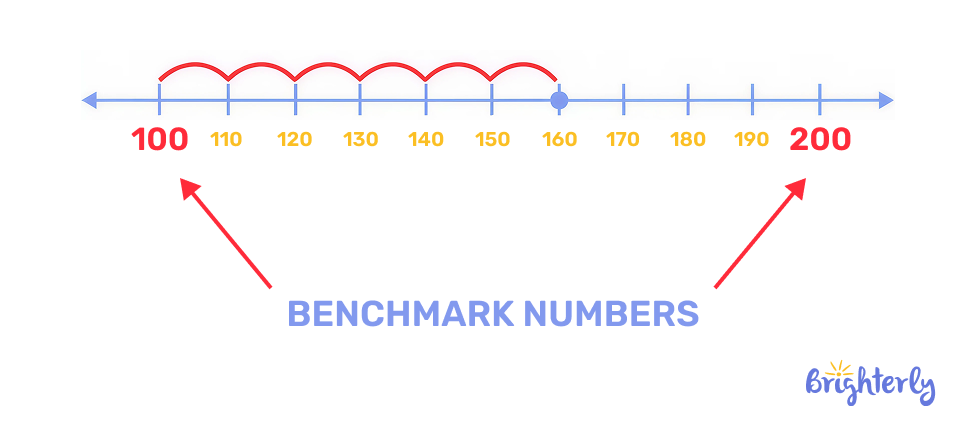
What are benchmark numbers?
Benchmark numbers are specific, “friendly” values like 10, 50, or 100 that are easy to remember and use mentally. It’s also important to know what is a benchmark fraction? There are three common fraction benchmarks: 0, 1/2, and 1.
A quick estimate can be made with them, as well as determining whether an answer is reasonable.
Definition of benchmark numbers
Benchmark numbers are used to compare or evaluate other numbers or quantities. In most cases, the benchmark number is a multiple of 10, 100, or 1000, but it can also be a multiple of 25. The following are the main benchmark numbers:
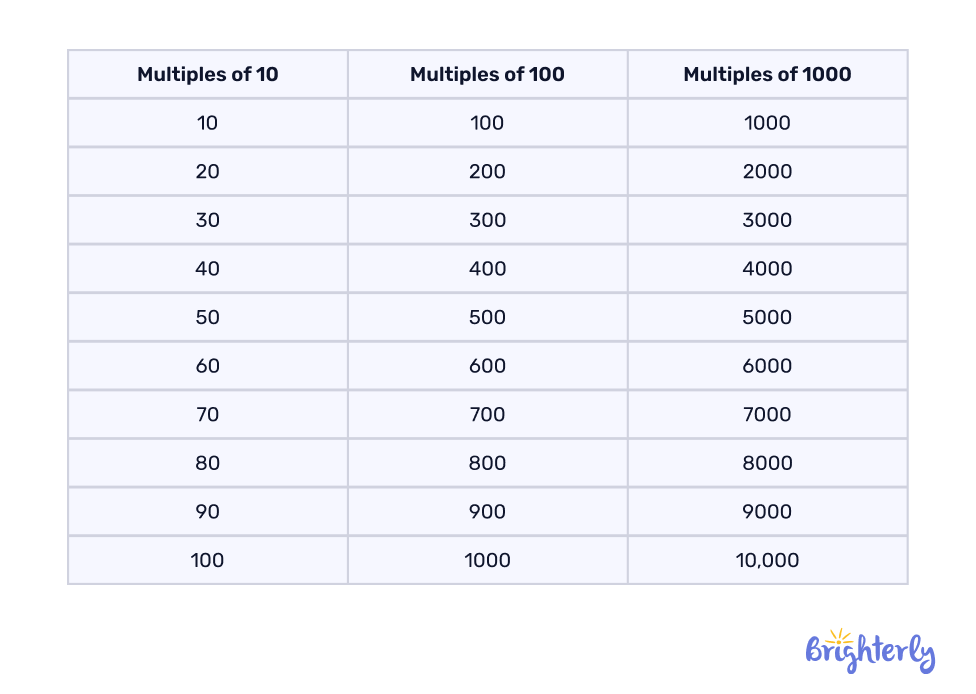
Importance of benchmark numbers
Benchmark numbers are essential for developing mathematical fluency. They serve three primary roles:
- Simplifying mental math: Benchmark numbers provide “friendly” targets like 10, 50, or 100. Solving complex problems becomes easier when you use these values. They are easier to add and subtract in your head.
- Developing number sense: Students learning benchmark numbers 2nd grade use them to understand how values relate to each other. The purpose of this is to build a foundation for comparing fractions, decimals, and percentages. It also provides an opportunity for students to identify mistakes in multi-step problems by identifying unreasonable answers.
Examples of benchmark numbers
- Whole Numbers: Standard benchmark numbers example include 10, 50, 100, and 1,000. They are called “friendly numbers” because of easy visualization. By using them, large arithmetic operations become faster.
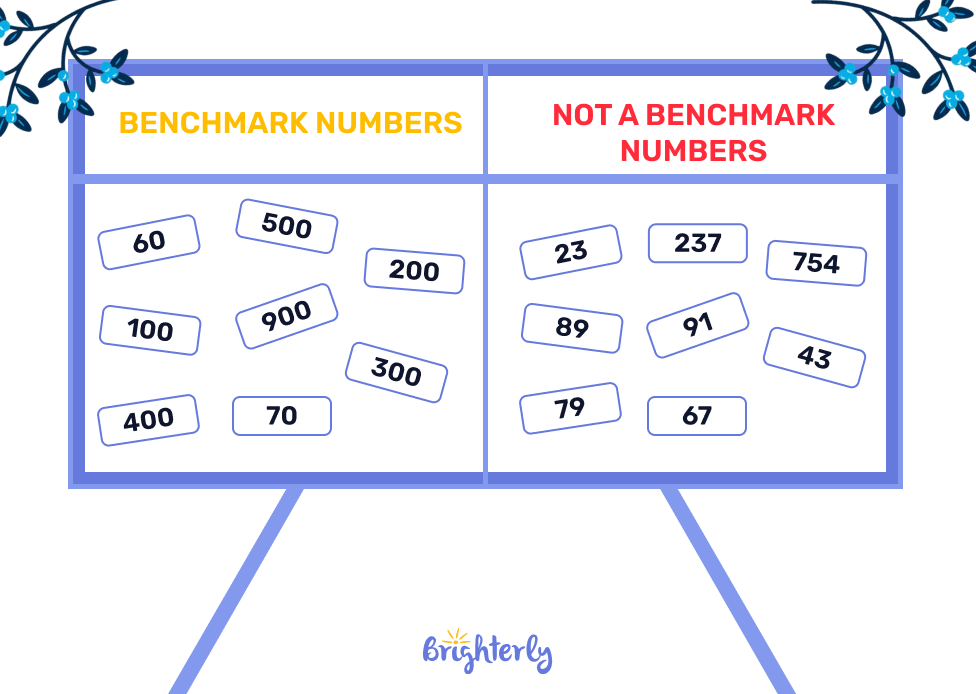
- Fractions: The most common fraction benchmarks are 0, 1/2, and 1. They provide a quick way to compare the size of different fractions. You can determine which fraction is larger without finding a common denominator.
- Decimals and percentages: Important decimal benchmarks are 0.25, 0.50, and 0.75 (used for money and percentage calculations). They represent 25%, 50%, and 75%.
Properties of benchmark numbers
The use of benchmark numbers is naturally intuitive and easy to remember when performing mental calculations. In most cases, they are multiples of 10, 100, or fractions such as 1/2 and 1/4. An anchor on a number line serves as a consistent reference point.
Using benchmark numbers for estimation
The process of estimation involves replacing precise, difficult numbers with their closest benchmark equivalents. It is possible to find an approximate sum or product using this technique without a calculator. Answers are only checked for reasonableness and logical soundness.
Using benchmark numbers for comparisons
A comparison is made by comparing two unknown values against the same math benchmark standard. When two fractions are compared to the same benchmark (such as 1/2), you can often determine which is larger without finding a common denominator. Every time you compare two things, you don’t have to find a common denominator.
The difference between benchmark numbers and other numerical concepts
Benchmark numbers differ from rounding and estimation in their purpose and flexibility.
- Benchmarking vs. rounding: The process of rounding follows strict mathematical rules in order to find the nearest ten or hundred. Benchmarking is a more flexible method. Depending on your task, you pick a benchmark numbers example like 25, 50, or 75. While rounding provides a specific number, benchmarking provides a comparative reference.
- Benchmarking vs. estimation: Estimation is the overall process of finding an approximate answer. Benchmark number is the specific tool used to make that estimate. When judging the size of a value, you use “friendly” landmarks like 0, 1/2, or 1. In this way, you can determine the scale of a number without having to divide or multiply it.
- Flexible reference points: There are fixed and rigid place values in standard numerical systems. A benchmark serves as a logical anchor. The fraction 5/11 is slightly larger than the benchmark 1/2. Numerical logic is the focus of this method rather than memorized calculation steps.


Check the basics behind this term
Take our quick quiz to discover the perfect learning solution based on your child’s needs.
Equations involving benchmark numbers
For checks of reasonableness, equations with benchmark numbers often replace complex values with simpler equivalents. If we use the benchmarks 1/2 and 1, we can estimate the result of 4/9 + 11/12. As a result, 1/2 plus 1 equals 1 1/2 when the benchmark equation is simplified.
Writing equations using benchmark numbers
In order to write these equations, identify the closest “friendly” number for each term. The benchmarks math statement can be simplified by replacing the original numbers with the benchmarks. Using this new equation, we can estimate sums or differences that are easy to calculate mentally.
Practice problems on benchmark numbers
- When looking at the tens place, the number 64 comes between which two benchmark numbers?
- 60 and 65
- 0 and 100
- 60 and 70
- 64 and 65
Answer:
| 60 and 70 |
- Which number comes between the benchmark numbers 120 and 130?
- 119
- 127
- 131
- 25
Answer:
| 127 |
- When looking at the hundreds place, the number 835 comes between which two benchmark numbers?
- 830 and 840
- 800 and 850
- 800 and 900
- 30 and 40
Answer:
| 800 and 900 |
- Which number pair adds up to make a benchmark number of 100?
- 40, 50
- 12, 98
- 75, 25
- 100, 10
Answer:
| 75, 25 |
Conclusion
In short, a benchmark number is a convenient reference value, often a multiple of 10, 100, 1000, or 25, that can be used to compare or assess other numbers or quantities. With the help of this article, we hope you now have a clear understanding of what is a benchmark in math. Using this information about the benchmark number meaning, you can easily answer questions about this topic in your class or examination.
Frequently asked questions on benchmark numbers
What is a benchmark number?
The benchmark number is a familiar reference point for comparing and evaluating other numbers. It’s easy to visualize and manipulate these “friendly” values. On a number line, they serve as landmarks to help you understand how big a number is in relation to others.
Why are benchmark numbers important in mathematics?
Knowing how to define benchmark numbers simplifies mental calculations by providing easy substitutes. By using them, students can develop a strong sense of number magnitude and logic. A math problem can also be quickly verified to determine if an answer is reasonable by using these landmarks.
Can you give me examples of benchmark numbers?
Examples of benchmark math numbers include 10, 25, 50, and 100.
How are benchmark numbers different from rounding or estimating?
Benchmark numbers are landmarks used to judge the size of other values. Rounding changes a number to the nearest ten or hundred based on its last digit. Estimation is the act of calculating an approximate answer using these simplified values.



Math & reading from 1st to 9th grade
Looking for homework support for your child?

Choose kid's grade

Math & Reading for Grades 1–9
Build real confidence for your child with a Brighterly math or reading tutor.