What Is a Constant? Definition, and Solved Examples
reviewed by Jo-ann Caballes
Updated on August 4, 2026
A constant in math is a fixed value that never changes — a number like 7, a fraction like ½, or a symbol with a set value, such as π (about 3.14159). In an algebraic expression, the constant is the term that stands on its own, without a variable attached to it. For example, in 12x + 14, the constant is 14, because that value stays the same no matter what x is.
Constants first appear in elementary arithmetic (every plain number is a constant) and become a named idea in middle-school algebra, around grade 6, when students start distinguishing constants, variables, and coefficients in expressions and equations. This guide defines constants, shows their types, and gives you solved and practice problems to check your understanding.
What Is a Constant in Math?
A constant is any quantity whose value is fixed and known. It can be written as a number (5, –12, 0.75), a fraction, or a symbol that always represents the same number (π or Euler’s number e). What makes a term a constant is simple: it never changes value within a given problem.
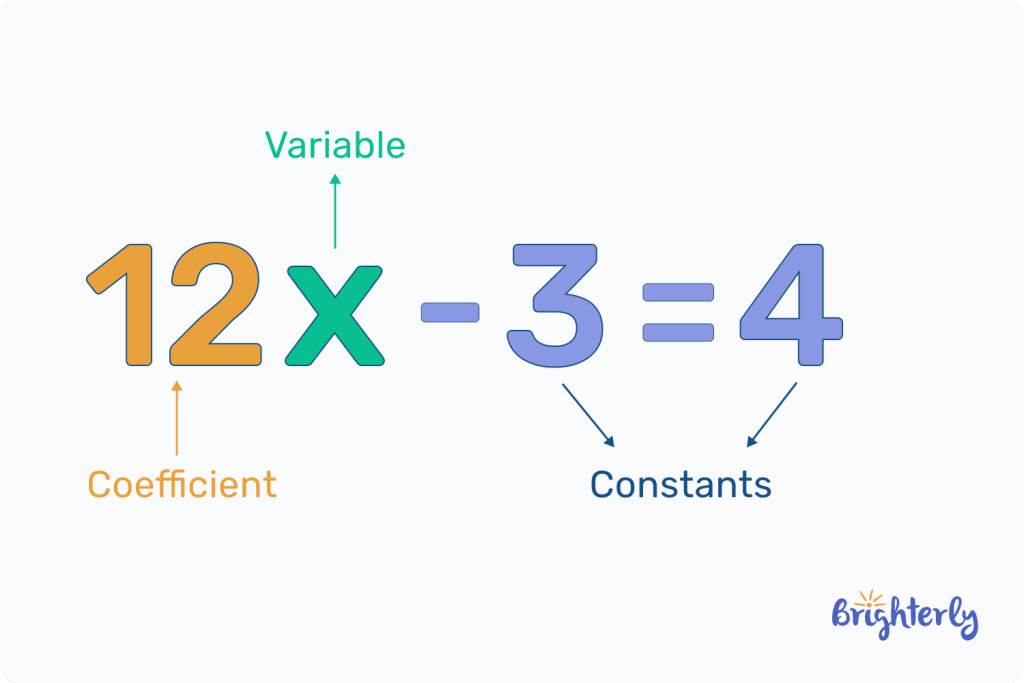
A constant is easiest to understand next to the two terms it is often confused with — the variable and the coefficient. The table below compares all three using the expression 12x + 14.
| Term | What it is | In 12x + 14 |
| Constant | A fixed value that never changes | 14 |
| Variable | A symbol standing for an unknown or changeable value | x |
| Coefficient | A number that multiplies a variable | 12 |
Expert Math Tutors for Every Level
Connect with professional and certified educators who provide specialized support for every grade level, from elementary school basics to advanced algebra
Types of Constants With Examples
Constants come in a few common forms: whole numbers, fractions and decimals, and named symbolic constants. Each behaves the same way — the value is locked — but they look different on the page.
- Numeric constants: standalone numbers such as 3, ‒11, or 100. In 5 + x, the 5 is a constant.
- Fractions and decimals: values like ½ or 0.25 are constants because they still name one fixed number.
- Symbolic constants: symbols with a permanent value, such as π ≈ 3.14159 or e ≈ 2.71828. In the equation 5 × π = 15.70796…, every term is a constant.
How to Identify a Constant in an Algebraic Expression
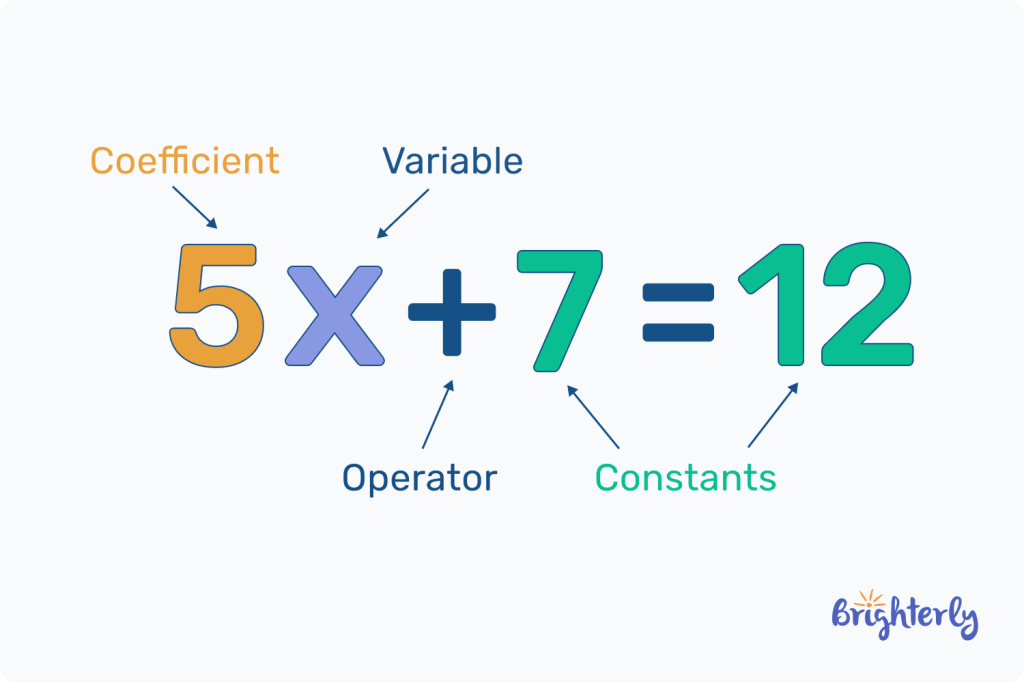
To find the constant in an algebraic expression, look for the term that has no variable attached to it. If a number stands alone — not multiplied by x, y, or any other letter — it is the constant. Follow these steps:
- Scan the expression for standalone numbers not tied to a variable (in 5y + x there is no constant; in 5 + x, the 5 is the constant).
- Include symbols that represent a fixed number, such as π.
- Count fractions and decimals as constants — they are still fixed values.
- Ignore any number directly multiplying a variable; that number is a coefficient, not a constant.
Practicing this with a tutor makes the distinction stick quickly. A Brighterly algebra tutor can walk your child through spotting constants, variables, and coefficients in real problems. You can book a free trial lesson to see how it works.
Constant vs. Variable: What’s the Difference?
A constant has a fixed, known value; a variable represents a value that can change. In an expression, the constant stays put while the variable is the letter whose value you may be solving for. For instance, in 3x + 7, the 7 is constant and x is the variable.
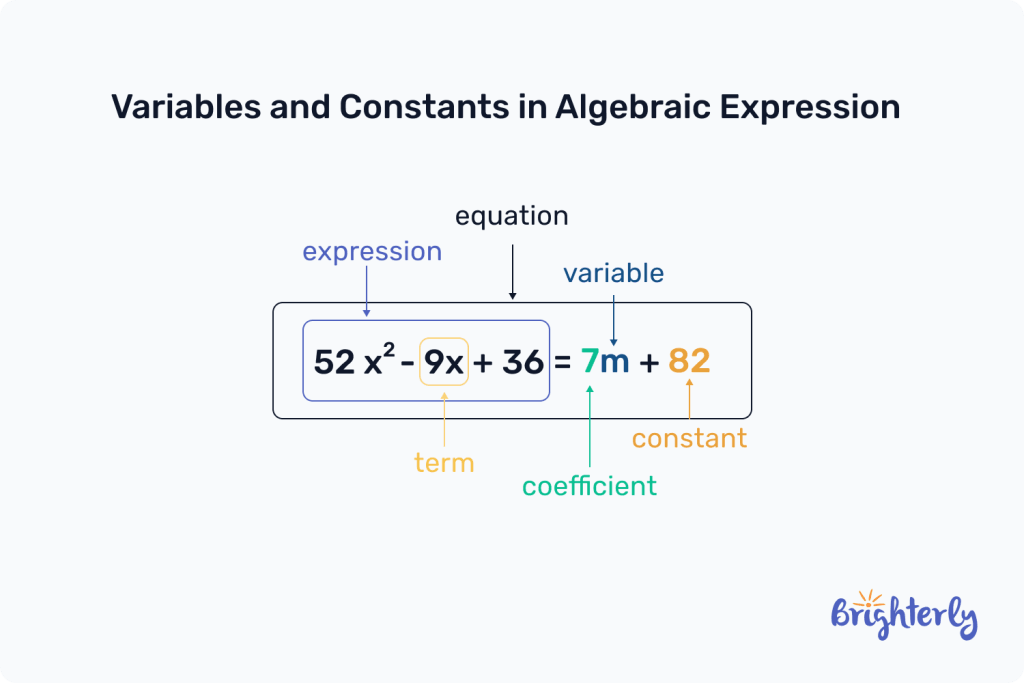
Constants and coefficients also differ: a coefficient is a number multiplying a variable (the 3 in 3x), while a constant sits alone. Every well-formed expression can be read as a mix of these parts, plus operators like +, −, ×, and ÷.
Solved Examples of Constants
Work through these examples, then check your answers below each one.
Example 1
In the equation 6x + (3y − 4) = 12, identify the constant terms.
Answer: 4 and 12. They are the only terms with no variable attached. Both 6x and 3y contain variables (a coefficient times a variable), so they are not constants.
Example 2
In the expression π + (x + 13) = 24, identify the constant terms.
Answer: π, 13, and 24. Pi always represents a fixed number, and 13 and 24 are fixed numbers too, so all three are constants. Only x can change.
Example 3
In the equation x + (y − a) = 14, identify the constant terms.
Answer: 14. Every other term (x, y, and a) is a variable, so 14 is the only constant.
Constant: Practice Math Problems
Constant Worksheets
Put this into practice with related Brighterly worksheets:
Frequently Asked Questions About Constants
What Is a Constant in Simple Words?
A constant is a number or symbol whose value never changes. Whether it appears in an equation, an expression, or a formula, a constant always stands for the same amount — like 8, ½, or π. It is the opposite of a variable, which can take on different values depending on the problem.
Is Pi (π) a Constant?
Yes. Pi is a constant because it always equals the same value, approximately 3.14159. It represents the ratio of a circle’s circumference to its diameter, and that ratio is the same for every circle. Because its value never changes, π behaves exactly like a fixed number in any equation.
What Is the Difference Between a Constant and a Variable?
A constant has a fixed value that does not change, while a variable stands for a value that can change. In 4x + 9, the 9 is a constant and x is a variable. You always know a constant’s value, but a variable’s value is unknown until you solve for it or are told what it is.
Is Zero a Constant?
Yes. Zero is a constant because it is a fixed number with an unchanging value. Like any other standalone number, if it appears as a term without a variable attached, it is a constant term — though a lone zero is often dropped from an expression because adding it changes nothing.
What Is a Constant Term in a Polynomial?
The constant term in a polynomial is the term with no variable — the number that stays the same regardless of the variable’s value. In x² + 4x + 6, the constant term is 6. It is the value the polynomial takes when the variable equals zero.
Can a Constant Be Negative?
Yes. A constant can be negative, positive, or zero — what matters is that its value is fixed. In the expression 2x − 5, the constant term is −5. Negative constants are common in equations and behave the same way as positive ones: their value simply never changes.


Math & reading from 1st to 12th grade
Looking for homework support for your child?

Choose kid's grade

Math & Reading for Grades 1–12
Build real confidence for your child with a Brighterly math or reading tutor.