Customary Units of Measurement – Definition with Examples
Updated on February 13, 2026
One way we use math is to measure things, such as length, weight, or the amount of space something takes up. Today, at Brighterly, we are learning about customary units of measure. They do exactly that — help us measure length, weight, volume, and area.
In the United States, we still use customary units for many everyday things, like measuring a room, buying milk, or weighing fruit. Let’s explore with Brighterly the US customary units of measurement and see how easy and useful they can be!
Customary units: Introduction
Customary units are used by the customary system of measurement (also called the US Customary System).
The US customary system originated from English units used in the British Empire before US independence. In 1826, the United Kingdom standardized its measurements on the imperial system, which differed slightly from the US customary system. Although many US units are essentially the same as their imperial counterparts, there are noticeable differences between them.
Maybe you’re wondering what countries use customary units of measurement? Unlike the metric system, which is widely used around the world, the customary system is unique to the United States.
In practice, most U.S. customary units were defined in terms of meters and kilograms with the Mendenhall Order of 1893. These definitions were refined by the International Yard and Pound Agreement of 1959.
With this historic background, now let’s move further to customary units definition.
Definition of customary units
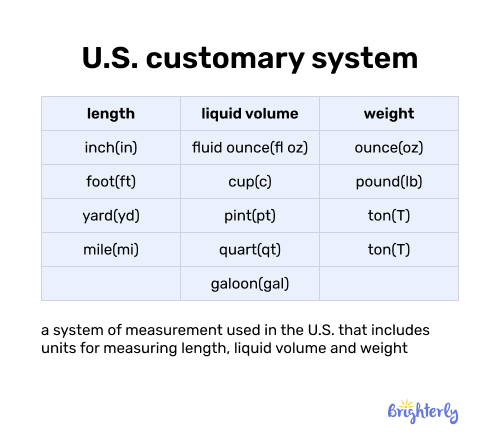
A customary unit is a unit used for measuring length, weight, volume, area, and temperature. They do not belong to the metric system. A customary unit does not follow tens like a metric unit. It is possible to measure length in inches, feet, yards, and miles. Pounds, ounces, and tons are examples of weight units.
These units are mostly used in the United States today.
US customary units
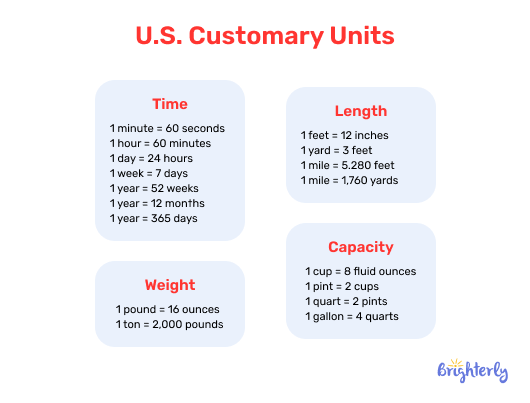
In the United States, we use specific measurements, hardly available anywhere else in the world. In the table below, you can check how they work and where they’re used through the customary units of measurement chart:
Customary system
The customary system is a complete system of measurement. It is mainly used in the United States. In most other countries, the metric system is used. It is common for dry and liquid measurements to have different names in the customary system. Dry volume is measured in pints and quarts, while liquid volume is measured in fluid ounces, cups, and gallons.
Note! The customary measurement system is older than the metric measurement system and was developed from traditional human measurements.
Customary units of length
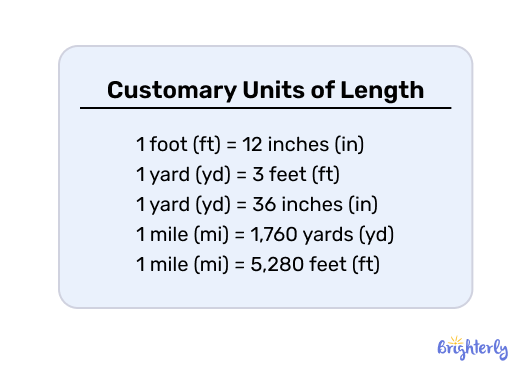
There are only four customary length measurements used in everyday life in the US customary system:
- inch,
- foot,
- yard,
- mile.
Until 1893, the foot was defined as 1200⁄3937 m, approximately 0.3048006 m. Starting on July 1, 1959, the units of length have been defined as 1 yd = 0.9144 m, making the foot exactly 0.3048 m long.
Сustomary units of weight
Customary units of weight are used to measure how heavy something is. They help us compare and weigh different objects. Common units include ounces, pounds, and tons.
For example, fruit is often weighed in pounds, and very heavy items like trucks are measured in tons.
The U.S customary units of weight are used today:
- 1 pound (lb.) = 16 ounces (oz.)
- 1 ton = 2000 lbs.
Сustomary units of capacity
Capacity customary units are used to measure how much something can hold. They are commonly used for liquids and containers. Gallons, quarts, and pints are the most common units used. Milk can be stored in a cup, and water or juice can be stored in a gallon.
- 1 cup = 8 fluid ounces
- 1 pint = 2 c
- 1 quart = 2 pt
- 1 gallon = 4 qt
Customary units of area
To measure how much space a surface occupies, we use the unit of area. Comparing flat sizes is made easier by them. 1 square foot = 144 square inches, and 1 square yard = 9 square feet. Often, the size of a room’s floor is measured in square feet.


Check the basics behind this term
Take our quick quiz to discover the perfect learning solution based on your child’s needs.
Customary units of volume
Cubic inches, cubic feet, and cubic yards are used to measure volume in the customary system of measurement. There is one group of units for measuring liquids. These units are based on the gallon and smaller units like fluid ounces. There is another group of units for measuring dry materials. These units have their own names and smaller units.
Dry volume
Dry volume is measured using a different system. Many of the unit names are the same. Small fruits and vegetables are often sold in dry pints and dry quarts.
Fluid volume
Fluid volume is used to measure liquids. It tells us how much liquid a container can hold. Common fluid volume units include fluid ounces, cups, pints, quarts, and gallons. These units are often used for water, milk, and juice.
Customary units of temperature
Temperature is usually indicated to tell how hot or cold something is. In the United States, we usually use the Fahrenheit (°F) system. Water freezes at 32°F and boils at 212°F. Fahrenheit is used to describe the weather, ovens, and many everyday temperatures. For instance, a warm summer day can be 85°F, and a cold winter morning could be 20°F. Even your refrigerator and oven use Fahrenheit to show the temperature.
Metric system vs customary system
Globally, two main systems of measurement are used: the metric system and customary measurement with the metric system prevailing in most countries. Due to its ten-based numbers, it is easy to use. It is also used in the United States to use the customary measurements system. The units of length, weight, volume, and temperature are referred to by their own names. Despite using different numbers and names, both systems measure the same thing. Here is a simple comparison:
| Measurement Type | Metric System | Customary System | Example |
| Length | meter (m) | inch, foot, yard, mile | A classroom: 5 m long ≈ 16 ft |
| Weight | kilogram (kg) | ounce, pound, ton | An apple: 0.2 kg ≈ 7 oz |
| Volume | liter (L) | cup, pint, quart, gallon | Milk: 1 L ≈ 1 qt |
| Temperature | Celsius (°C) | Fahrenheit (°F) | Water boils: 100°C ≈ 212°F |
Solved examples on customary units
1. How many gallons are in 16 quarts?
Solution: 1 gallon = 4 quarts
| 16 quarts = 16 ÷ 4 gallons = 4 gallons |
2. How many fluid ounces are in 3 quarts?
Solution: 1 quart = 2 pints
1 pint = 2 cups
1 cup = 8 fluid ounces
1 quart = 2 × 2 × 8 = 32 fluid ounces
| 3 quarts = 3 × 32 = 96 fluid ounces |
3. How many ounces are in 5 pounds?
Solution: 1 pound = 16 ounces
| 5 pounds = 5 × 16 ounces = 80 ounces |
4. How many feet are in 3 yards?
Solution: 1 yard = 3 feet
| 3 yards = 3 × 3 feet = 9 feet |
Practice problems on customary units
- A car weighs about 1 ton. How many ounces does it weigh?
- 32,000 oz
- 16,000 oz
- 18,000 oz
- 6,000 oz
- Which of the following is the correct unit to measure the radius of a coin?
- Ounces
- Inches
- Pounds
- Feet
- How many pints are equal to 1 gallon?
- 2 pints
- 8 pints
- 16 pints
- 10 pints
- 4 ounces = ____ pound
- 0.5
- 0.25
- 1
- 0.75
- 8 yards equals how many feet?
- 3 feet
- 11 feet
- 15 feet
- 24 feet
Conclusion
In this lesson, we learned how customary units of measure can be used to measure length, weight, volume, area, and temperature. We also explore customary units meaning and understand the difference between them and the metric system. They serve the same purpose – they describe the size, weight, and volume of objects. Cooking, measuring rooms, weighing fruit, checking liquids, and even reading the temperature are all done with them.
Frequently asked questions on customary units
What is customary system?
The customary system is the system of weights and measures used in the United States. This system has its own units for length, weight, volume, and temperature (inches, pounds, gallons, and degrees Fahrenheit). This is how a customary system definition sounds.
What are the customary units of length?
Customary units of length are inches, feet, yards, and miles. For example, a pencil can be 7 inches long, a door can be 7 feet tall, and a road trip may be 50 miles.
What is a customary unit of weight?
Customary units of weight are ounces, pounds, and tons. For example, an apple can weigh 7 ounces, a bag of flour 5 pounds, and a truck several tons.
Which countries use the customary system?
The United States mainly uses the customary system in daily life. Some other countries may use it for certain things, but most countries use the metric system. The US uses customary units for things like cooking, measuring rooms, buying milk, and describing the weather.
Is ounce metric or customary?
No, an ounce doesn’t belong in the metric system. An ounce is a customary unit of weight. For liquids, there is also a fluid ounce. Metric units, such as grams and liters, are used in most other countries. For example, a soda can be 12 fluid ounces.
Customary units of measurement worksheets
Explore our Brighterly worksheets to help students practice using customary units. Here you can find exercises for length, weight, volume, and temperature. Worksheets can also have conversion problems, such as converting feet to inches or quarts to cups. These activities make learning hands-on, simple, and fun.



Struggling with Measurement?
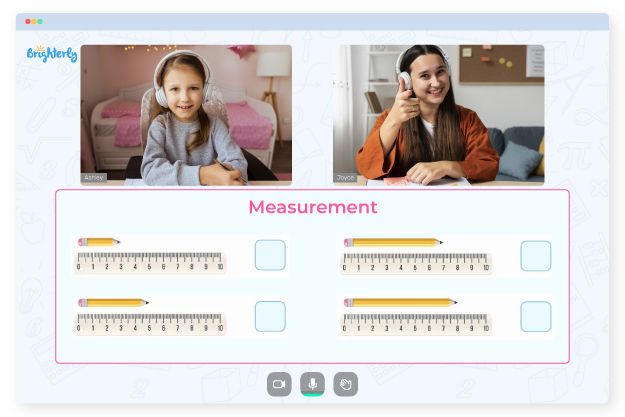
- Does your child need additional help with mastering the concept of measurement?
- Start studying with an online tutor.
Choose kid's grade

Is your child finding it challenging to understand measurement lessons? An online tutor could be the solution.
Book FREE lesson