Denominator – Definition, Examples, Facts, FAQs
reviewed by Jo-ann Caballes
Updated on August 4, 2026
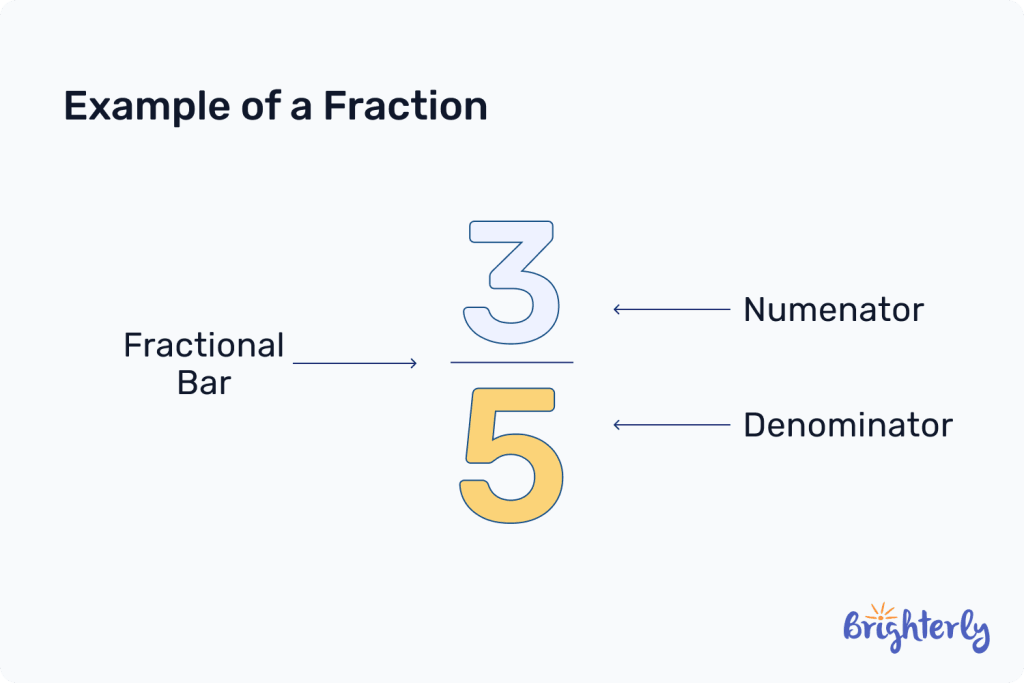
The denominator is the bottom number in a fraction. It tells you how many equal parts a whole has been divided into. In ⅗, the denominator is 5, meaning the whole is split into 5 equal parts, while the top number (the numerator) counts how many of those parts you have. Children meet denominators when fractions are introduced, at around grade 3.
What Is a Denominator?
A denominator is the number written below the line in a fraction. It shows the total number of equal parts the whole has been divided into. The denominator is central to working with basic fractions, rational numbers, ratios, and more, which is why it is such an important early idea.
Expert Math Tutors for Every Level
Connect with professional and certified educators who provide specialized support for every grade level, from elementary school basics to advanced algebra
Numerator vs. Denominator
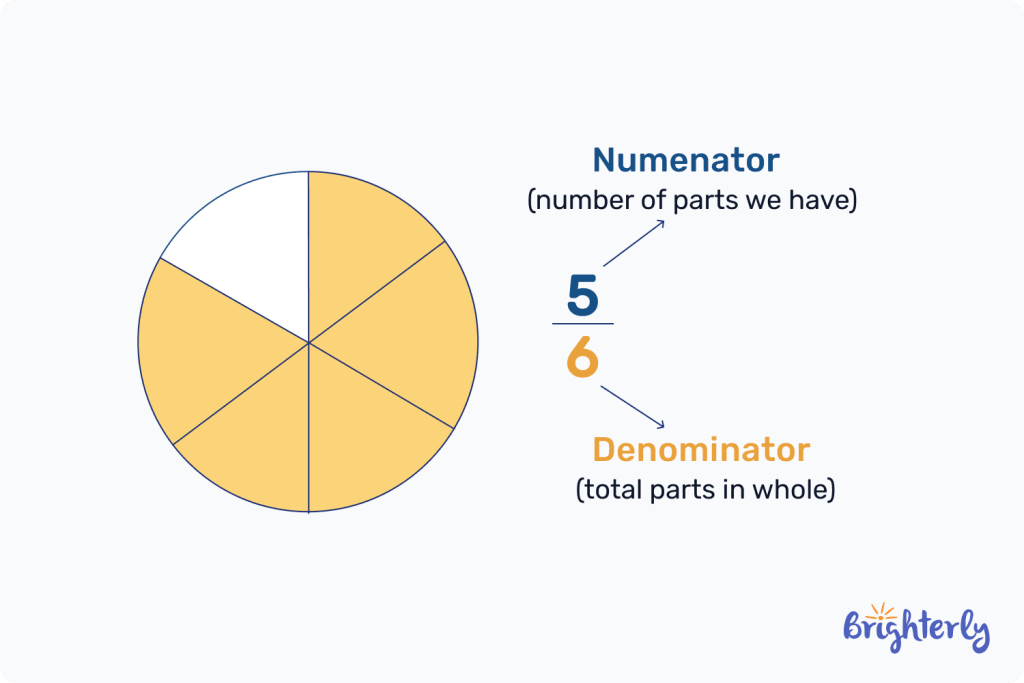
Every fraction has two parts. The numerator is the top number and counts how many parts you have, while the denominator is the bottom number and states how many equal parts make up the whole. In ⅗, the numerator 3 means you have 3 parts out of the 5 equal parts named by the denominator. Neither part can exist without the other.
How to Find the Denominator of a Fraction
To find the denominator, simply look at the bottom number of the fraction — the value written below the fraction line. That number is always the denominator, and it tells you how many equal pieces the whole has been divided into.
Extra help from an elementary math tutor can make these skills click for younger students.
Denominator Examples
Here are some fractions alongside their denominators:
| Fraction | Denominator |
| ½ | 2 |
| ¾ | 4 |
| ⅝ | 8 |
| 7/10 | 10 |
| 9/15 | 15 |
It also helps to see denominators in real-world situations:
| Scenario | Working out the denominator |
| Sharing a pizza | Cut a pizza into 8 slices and take 2, and you have taken 2/8. The denominator, 8, is the number of slices. |
| A book-reading challenge | Read 4 of the 10 books in a summer challenge and you have read 4/10. The denominator, 10, is your target number. |
| Saving money | Aim to save $100 and you already have $35, giving the fraction 35/100. The denominator, 100, is your total goal. |
Can a Denominator Be 0?
No, a denominator can never be 0. Division by zero is undefined in mathematics, so a fraction with a denominator of 0 has no meaning. If the denominator tells you how many equal parts a whole is split into, it makes no sense to split something into zero parts.
Types of Fractions Based on the Denominator
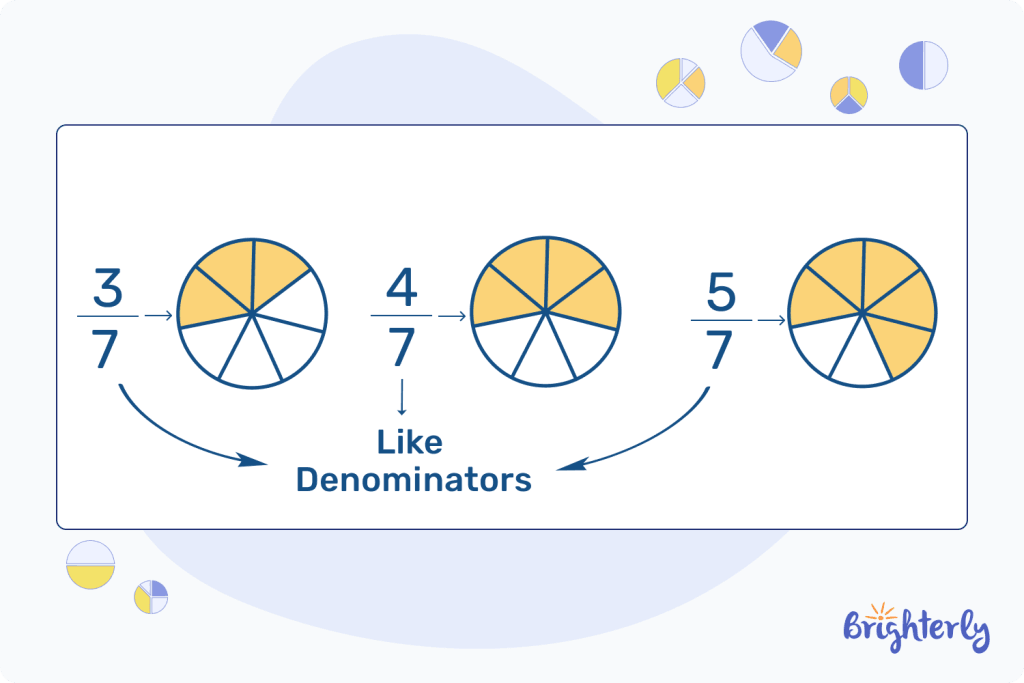
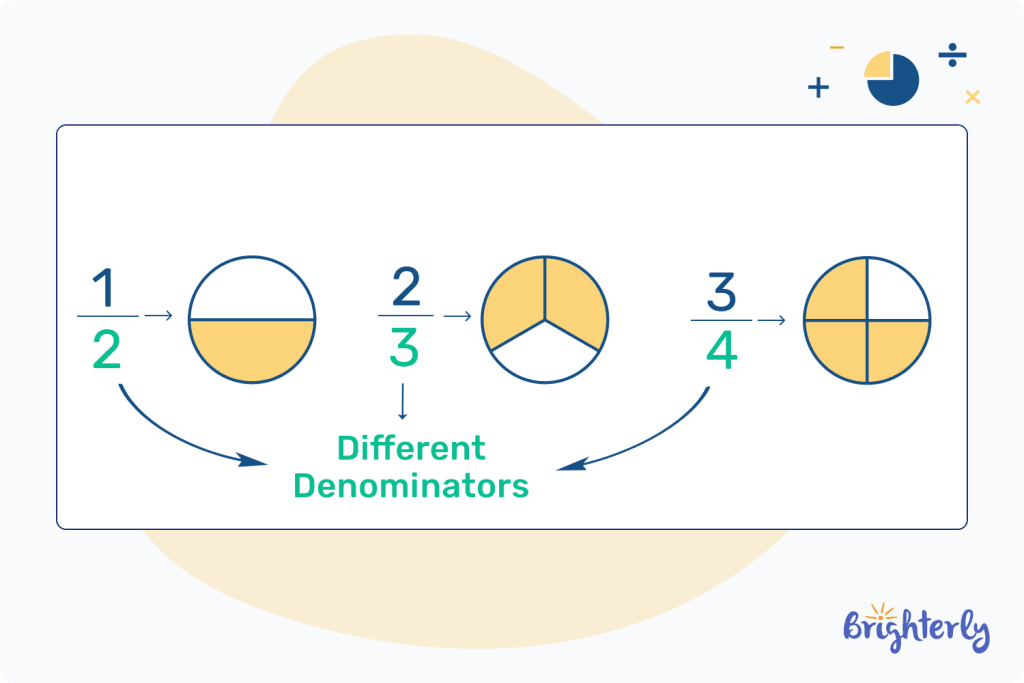
Denominators let you classify fractions. When two or more fractions share the same denominator, such as ⅕ and ⅖, they are called like fractions. When their denominators differ, such as ⅗ and ½, they are unlike fractions.
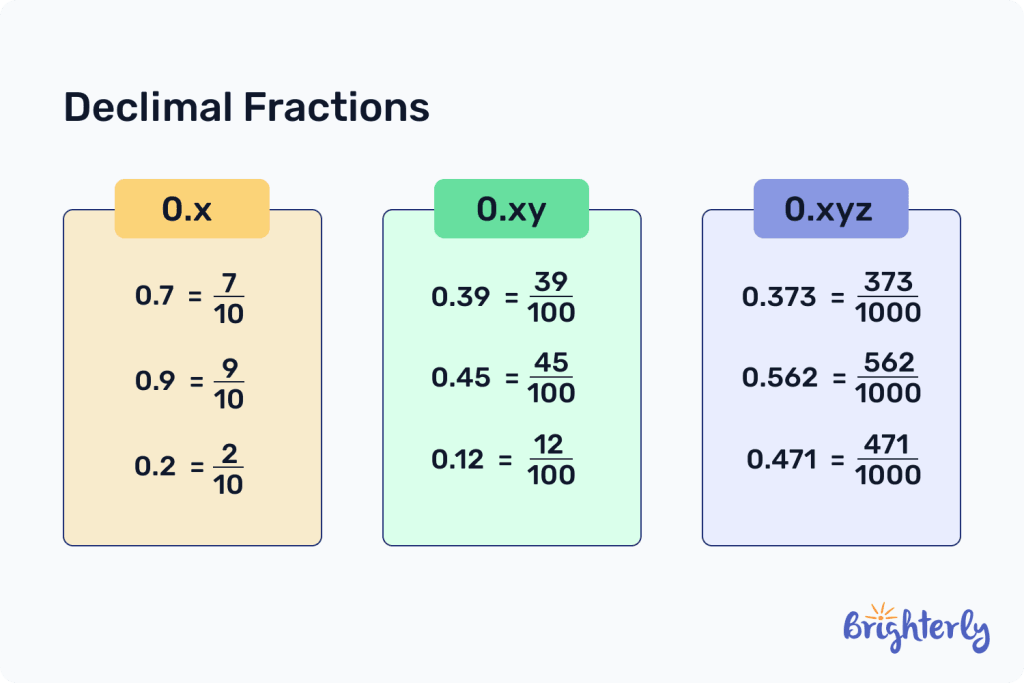
There are also decimal fractions, whose denominators are powers of 10 — such as 10, 100, or 1000 — and which convert easily into decimals. For example, 4/10 becomes 0.4.
Least Common Denominator
When you add or subtract fractions, they need a common denominator. The least common denominator (LCD) is the smallest number that every denominator divides into evenly — it is the least common multiple of the denominators. For ⅗ and ½, the LCD is 10, the smallest number both 5 and 2 divide into.
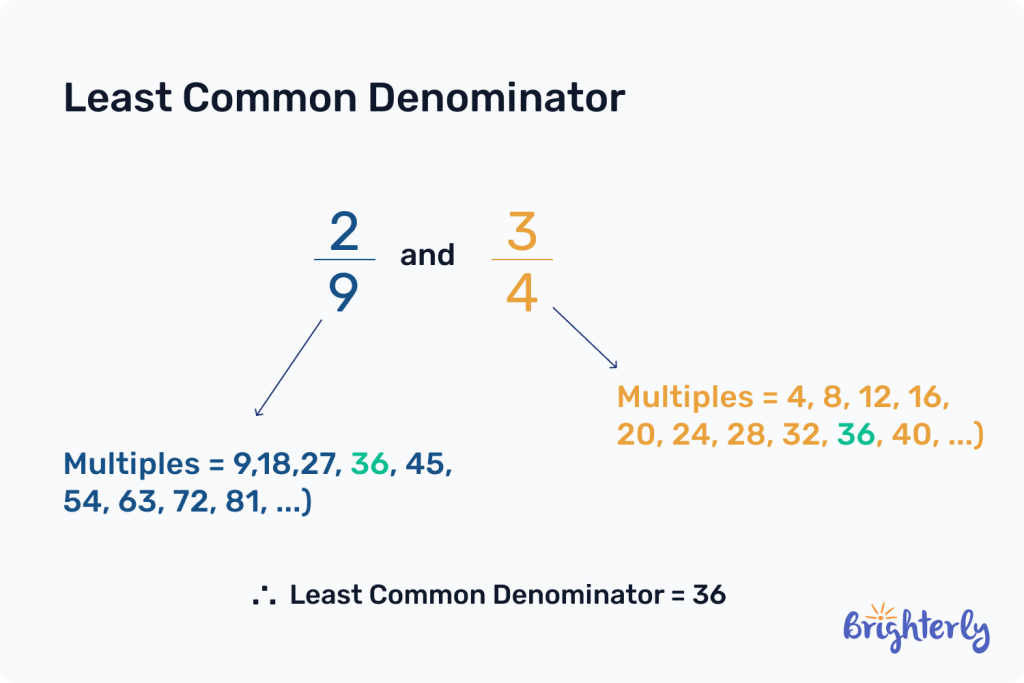
To find the least common denominator, list the multiples of each denominator and pick the smallest value they share. For ⅔ and ¾, the multiples of 3 are 3, 6, 9, 12… and of 4 are 4, 8, 12…, so the LCD is 12.
Denominator in Division
The denominator matters when you divide fractions. To divide by a fraction, multiply by its reciprocal — the fraction flipped so the denominator and numerator swap places. For example, ½ ÷ ⅔ = ½ × 3/2 = ¾, where 3/2 is the reciprocal of ⅔.
Denominator in a Ratio
In a ratio, the second term acts like a denominator when the ratio is written as a fraction. The ratio 3 : 4 can be written as ¾, so 4 plays the role of the denominator. This connection is why understanding denominators helps with proportions and rates.
Simplifying Fractions
To simplify a fraction, divide both the numerator and the denominator by their greatest common factor (GCF) — the largest number that divides evenly into both. Take 16/24: the numbers that divide 16 are 1, 2, 4, 8, and those that divide 24 are 1, 2, 3, 4, 6, 8, 12, so the GCF is 8. Dividing top and bottom by 8 gives ⅔. For more practice, see our guide on learning fractions.
Solved Examples
Example 1
A snack bowl has 15 snacks, and 5 of them are chocolate bars. Write the chocolate bars as a fraction.
Answer: 5/15 (which simplifies to ⅓). There are 5 chocolate bars out of 15 total snacks, so the denominator is 15.
Example 2
Find the lowest common denominator of ⅝ and 11/12.
Answer: 15/24 and 22/24. The least common multiple of 8 and 12 is 24. Rewriting each fraction with 24 as the denominator: 5/8 = 15/24 and 11/12 = 22/24.
Example 3
Rewrite ⅙ and 1/18 with 54 as the common denominator.
Answer: 9/54 and 3/54. Since 54 ÷ 6 = 9 and 54 ÷ 18 = 3, multiply each numerator accordingly: 1 × 9 = 9 and 1 × 3 = 3.
Denominator: Practice Math Problems
Denominator Worksheets
Put this into practice with related Brighterly worksheets:
- Subtracting fractions with unlike denominators worksheets
- Comparing fractions with unlike denominators worksheets
- Adding fractions with unlike denominators worksheets
- Equivalent fractions worksheets
Frequently Asked Questions About Denominators
What Is a Denominator in a Fraction?
A denominator is the bottom number in a fraction. It tells you how many equal parts a whole has been divided into. In ¾, the denominator is 4, meaning the whole is split into four equal parts. The denominator works together with the numerator, the top number, which counts how many of those parts are being described.
What’s the Difference Between a Numerator and a Denominator?
The numerator is the top number of a fraction and the denominator is the bottom number. The denominator states how many equal parts make up the whole, while the numerator counts how many of those parts you have. In ⅗, 5 is the denominator (five equal parts) and 3 is the numerator (three of them).
Can a Denominator Be Zero?
No. A denominator can never be zero, because dividing by zero is undefined in mathematics. A fraction represents a whole divided into equal parts, and it is impossible to split something into zero parts. For this reason, any fraction with a denominator of 0 has no meaning.
What Is the Least Common Denominator?
The least common denominator (LCD) is the smallest number that all the denominators in a set of fractions divide into evenly. It equals the least common multiple of those denominators. Finding the LCD lets you rewrite unlike fractions with a shared denominator, which is the key step before adding or subtracting them.
What Are Like and Unlike Denominators?
Like denominators are denominators that are the same, as in ⅕ and ⅖. Unlike denominators are different, as in ⅗ and ½. Fractions with like denominators can be added or subtracted directly, while fractions with unlike denominators must first be rewritten over a common denominator, usually the least common denominator.
How Do You Simplify a Fraction?
Divide the numerator and the denominator by their greatest common factor, the largest number that divides evenly into both. For 16/24, the greatest common factor is 8, so dividing top and bottom by 8 gives ⅔. Simplifying does not change the value of the fraction — it just writes it in its simplest form.


Math & reading from 1st to 12th grade
Looking for homework support for your child?

Choose kid's grade

Math & Reading for Grades 1–12
Build real confidence for your child with a Brighterly math or reading tutor.