Dozen – Definition, Unit, Examples
Updated on February 25, 2026
Welcome to Brighterly’s knowledge base series, where we tell you about the most exciting mathematical topics and help you understand them the easy way. Today, we will be looking into the measurement known as one dozen. You’ve probably heard this word, and you may even know that dozen represents the number twelve, but there is so much more to discover! From definitions and examples to the history and what comes in a dozen, in this article, we’ll deep dive into this fascinating measure. Ready? Let’s start.
What is a dozen?
So, in mathematics and in daily life, a dozen is a unit of measurement we use to quantify a group of objects.
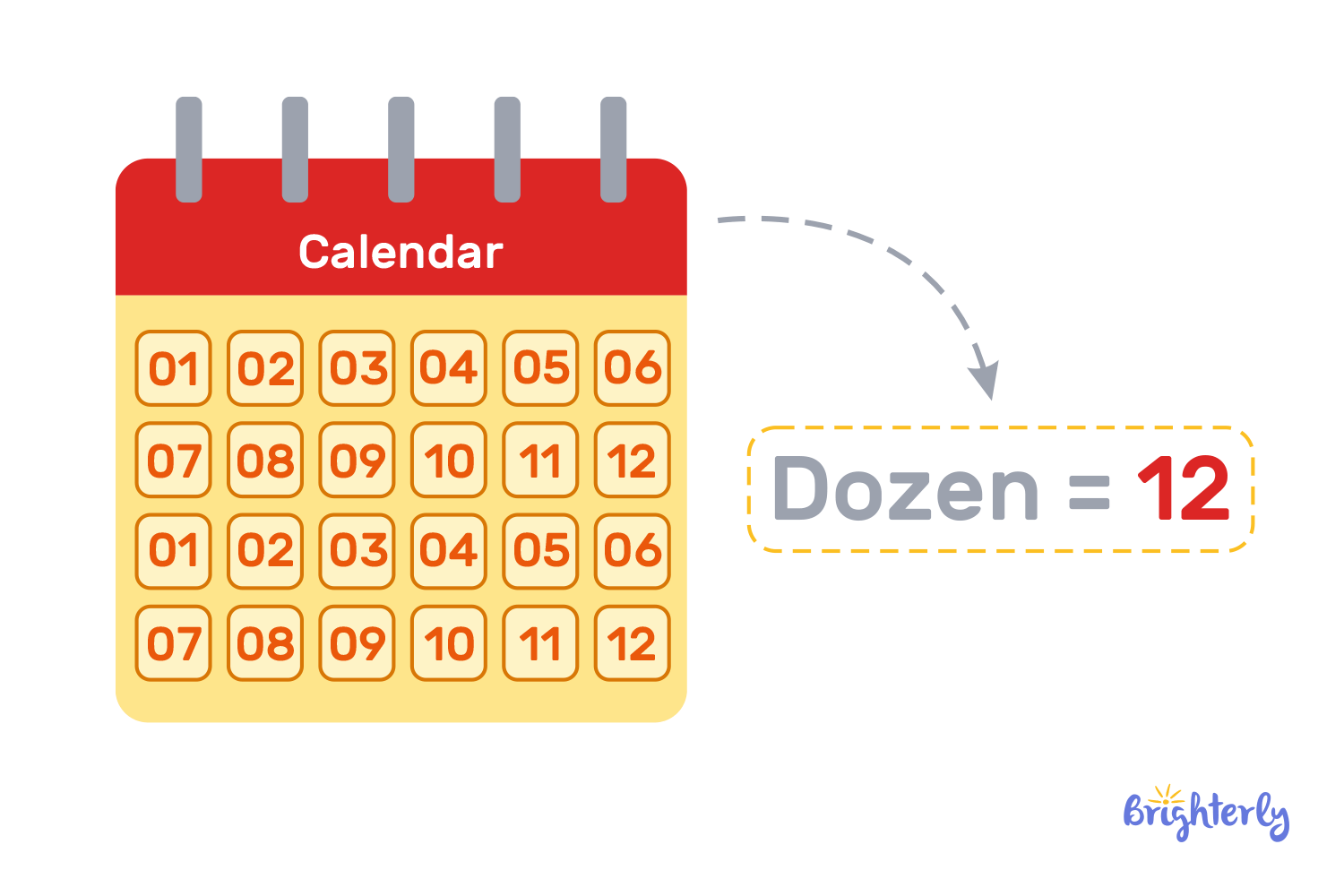
At its simplest, a dozen is a unit of measurement, a collective noun that we use to represent a group of 12 items. For a long time, it has been used in commerce, as it makes it easier to count, package, and trade goods in bulk. One reason for that is that 12 is a highly composite number, divisible by many numbers, which makes grouping into subgroups easier.
Dozen definition
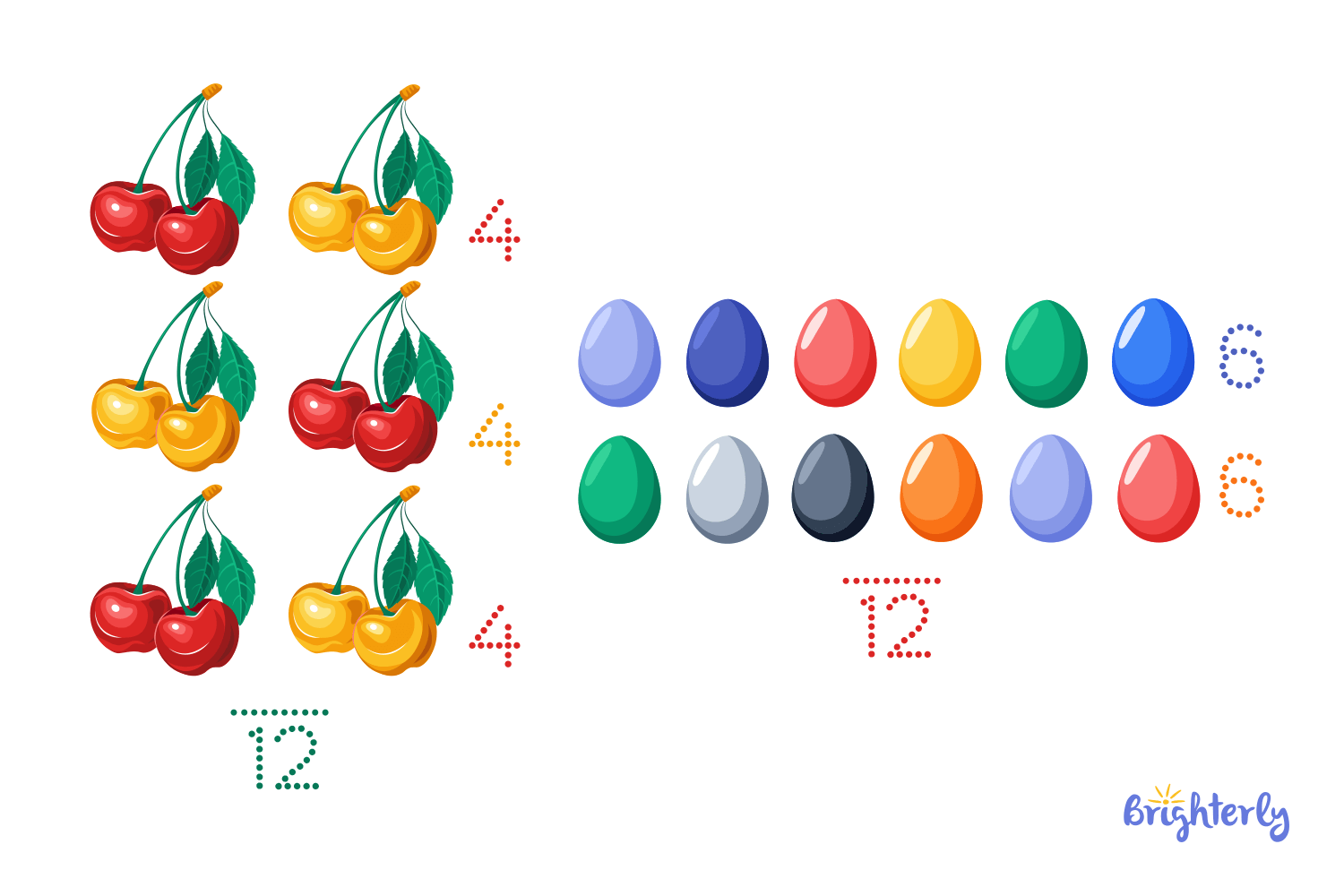
The definition of a dozen is quite simple: one dozen refers to exactly 12 items. Whether it’s 12 eggs in a box or 12 kids in a class, you can simply say there are a dozen of them. It’s simply a counting unit, similar to how pair means two.
As we mentioned above, number 12 is highly divisible, and it is what makes the term a dozen so enduring. Unlike the number 10, which you can only divide evenly by 2 and 5, the number 12 is a highly composite number. You can divide it into:
- Halves: 12/2=6
- Thirds: 12/3 = 4
- Quarters: 12/4 = 3
- Sixths: 12/6 = 2
Because you can split it into so many parts without ending up with fractions and remainders, it has become the gold standard for commerce throughout history. But we will look at the history of the dozen number in more detail in a bit.
Things that come in a dozen
Since 12 is such a flexible number, we use a dozen for many items. You’ve probably even come across some items that come in dozens yourselves. Let’s look at some of the things that come in dozens:
- Eggs are probably the most classic example, as almost all standard egg cartons contain 12 eggs
- Bakeries often sell their delicious cakes, donuts, and cookies in a dozen as well
- Pencils and pens are often also packaged in boxes of 12.
This is far from being an exhaustive list, as many more things you use in your life come in dozens. Next time you do groceries or get yourself some nice, colorful pencils, pay attention to how they are packaged. Chances are, they come in dozens!
Where did the term “dozen” come from?
Let’s now do a journey through time to see what does dozen mean and how it came to be at all.
The short version is, the English version, a dozen, came from the Old French word dozaine, which is a derivative of douze, which means 12.
However, the history goes even further back, and it gets quite interesting. If we trace the lineage of the word even further, we arrive at the Latin roots, the word deodecim. In Latin, duo means two, and decim (or decem) means ten (our number system is called a decimal system because of this).
So, even then, a dozen wasn’t perceived as a separate entity, but a sum of 2 and 10, an extension of the base-10 system we use today.
Due to its flexibility and the resulting utility, the dozen amount became popular across European marketplaces in the Middle Ages. The common merchants used it because it made the logistics of selling goods simpler. We still use it for things like a clock face due to the same reason, the high divisibility.
It’s worth mentioning that although we use a base-10 system in our daily lives (and probably think of it as the only correct one), there is also a duodecimal system (base-12 system), which uses 12 as its foundation. We look into this a bit later.
What is a dozen of dozens?
If you ever find yourself in a large warehouse or a large wholesale market, you might hear a different word, a Gross. In that context, gross won’t represent an attitude, but a measure defined as a dozen of dozens. Mathematically, it is 12 x 12 = 144.
Just as a dozen makes counting small items sold in multiples easier, a gross helps to count a large number of items. For example, if you were a manufacturer of pencils, selling them in dozens would still involve too much paperwork. Instead, you box them in a gross (144 pencils). If you multiply the gross by twelve once more, you’ll have Great Gross, at 1,728 units.
This dozen-based system today is still the standard language for global shipping and wholesale inventory management, as it lets to easily track and handle thousands of items with just a few measuring units.


Check the basics behind this term
Take our quick quiz to discover the perfect learning solution based on your child’s needs.
Decimal system versus dozen system
Today, our world almost exclusively uses the decimal system (base-10). We use it for counting, currency, scientific measurements, and everything else. So much so that many people don’t even know that another system exists. The decimal system seems natural to us; having 10 fingers also played a role, as it was easier to count objects on fingers and group them based on that.
However, there is also a dozen system (the duodecimal system we mentioned earlier), which is a base-12 system. Many mathematicians and “dozenalists” argue that the system based on the dozen is a better choice for day-to-day life, and their argument is mostly based on the divisibility of the number 12.
While the world is unlikely to switch to a dozen system anytime soon, it still survives in areas where the decimal system fails to be practiced. We still have 12 months in a year and 12 hours on a clock because dividing time into tenths would make scheduling much more complicated.
The sexagesimal system
At this last stage of learning about the origins of a dozen and why it is so significant, we need to look at its “big brother”, the sexagesimal system. This is the Base-60 system. This system goes back thousands of years, so it really is ancient history. You may ask what 12 and 60 have in common, and the answer is, as you could have guessed, their divisibility. More specifically, their shared divisors. Just as 12 is highly divisible, 60 is a “super-composite” number that can be divided by 2, 3, 4, 5, 6, 10, 12, 15, 20, and 30.
The one dozen is essentially the building block of the sexagesimal system, as 12 x 5 = 60. Sumerians and Babylonians, the ancient civilizations that developed the Base-60 system, used it for astronomy and geometry, because it made calculations involving circles and triangles much easier. Because a circle has 360 degrees (60 x 6), and an hour has 60 minutes, the dozen still remains a core unit that helps us break these large numbers down into manageable pieces.
Even today, every time you look at your watch, you are using the sexagesimal system, but its direct simplified version, which is based on the number 12. If you think about it, it’s a great testament to the dozen, as even after so many years, we haven’t found a better way to measure time.
Solved examples on dozen
Solved example 1
A warehouse receives a shipment of 1,200 branded pens. How many dozen pens are in this shipment?
Solution: First, pay attention to the total number of items. It’s 1200. Next, you need to divide the number to 12, as one dozen is twelve items. You get 1200 ÷ 12 = 100
| There are 100 dozen pens in the shipment. |
Solved example 2
If a dozen donuts cost $15, what is the price of a single donut?
Solution: Start by identifying the total cost ($15) and the total number (one dozen = 12 items). To get the per-item price, divide the total price by the item number, like so: 15 ÷ 12 = 1.25
| Each donut costs $1.25 |
Solved example 3
A hair salon orders 3 Gross of hair clips. How many total clips did they receive?
Solution: Remember the Gross. It was a short way of saying a dozen dozen. So, gross is a dozen of 12, and to find the total number of hair clips, all you need to do is 12 x 12 = 144.
| The hair salon ordered 144 hair clips. |
Practice problems on dozen
Math problem 1: Is 12 a dozen? If yes, how many dozens of apples would you have if you had 210 apples?
Math problem 2: The bakery near your house sold 15 dozen cupcakes every Saturday morning. How many individual cupcakes did they sell in total?
Math problem 3: If you have 156 eggs in a large box, how many dozen eggs do you have?
Math problem 4: A recipe for a large party requires 2.5 dozen eggs. If eggs are sold in cartons of 12, how many individual eggs do you need to take out of the fridge?
Conclusion
Whats a dozen is an incredibly fascinating topic in math. It’s a remarkable unit of measurement with an exciting backstory, which bridges the gap between ancient history and our modern daily life. Whether you are buying eggs at the grocery store, checking the time on a clock, or calculating bulk orders in a warehouse, the number 12 provides a level of flexibility that our standard decimal system cannot in many cases.
How many in a dozen is one of the most common questions students ask when learning about this unit of measurement. Understanding it and the reasons dozen came to be is not only useful in math classes, but in day-to-day life as well. As you’ve read this article, in addition to hopefully understanding a dozen is how many, you also learned about a measure that has kept our world organized for hundreds of years.
Frequently asked questions on dozen
How many is a dozen?
How many are in a dozen is a common question among children, andhe answer is, a dozen is exactly 12 items of anything, from bottles of water to dinner invitations. If you have 12 of something, you can say you have a dozen.
Where does the word dozen come from?
The word dozen comes from ‘duodecim’, which translates to two and ten. It traveled through Old French as dozaine before becoming the standard English term we use today, and has been used by merchants since the Middle Ages.
How many is 4 dozen?
To calculate 4 dozen, we simply need to multiply 12 (this is how many is dozen) by 4, like so: 12 x 4 = 48. So, if you have 4 dozen of something, you have exactly 48 items.


Troubles with Numbers?
- Does your child need extra support with mastering numbers lessons?
- Start lessons with an online tutor.
Choose kid's grade

Is your child having trouble grasping the basics of numbers? An online tutor could provide the necessary guidance.
Book FREE lesson