Equivalent Fractions – Definition with Examples
Updated on February 11, 2026
Taking a piece of cake, cutting it in half, and eating one of the halves is equivalent to eating half a cake. It is still half a cake if you cut it into eight equal pieces and eat four of them. So, we’ve just dealt with the example of equivalent fractions. In this Brighterly guide, you will learn:
- how to do equivalent fractions with ease
- some of real life examples of equivalent fractions.
In mathematics, equivalent fractions are those with the same value despite having different numerators and denominators. For example, 9/12 and 6/8 are equivalent fractions, since both simplify to 3/4. As shown in the example above, all equivalent fractions are reduced to the same fraction when reduced to their simplest form. To gain a better understanding of how equivalent fractions are found and how they can be checked, explore the given lesson.
What are equivalent fractions?
Equivalent fractions are the fractions that are equal in size, when simplified, even if they have different numbers. This is how the equivalent fractions definition sounds. As an example, 5/25, 6/30, and 4/20 can all be simplified to 1/5.
Equivalent fractions are fractions that have the same value regardless of their numerators and denominators. When simplified, 6/12 and 4/8 both equal 1/2, so they are equivalent.
Example: 1/4, 2/8, 3/12, and 4/16 are equivalent fractions. Let’s take a look at how their values are equal. For each of these fractions, we will draw a circle with shaded parts. A whole view of all the figures reveals that the shaded portions represent the same portion.
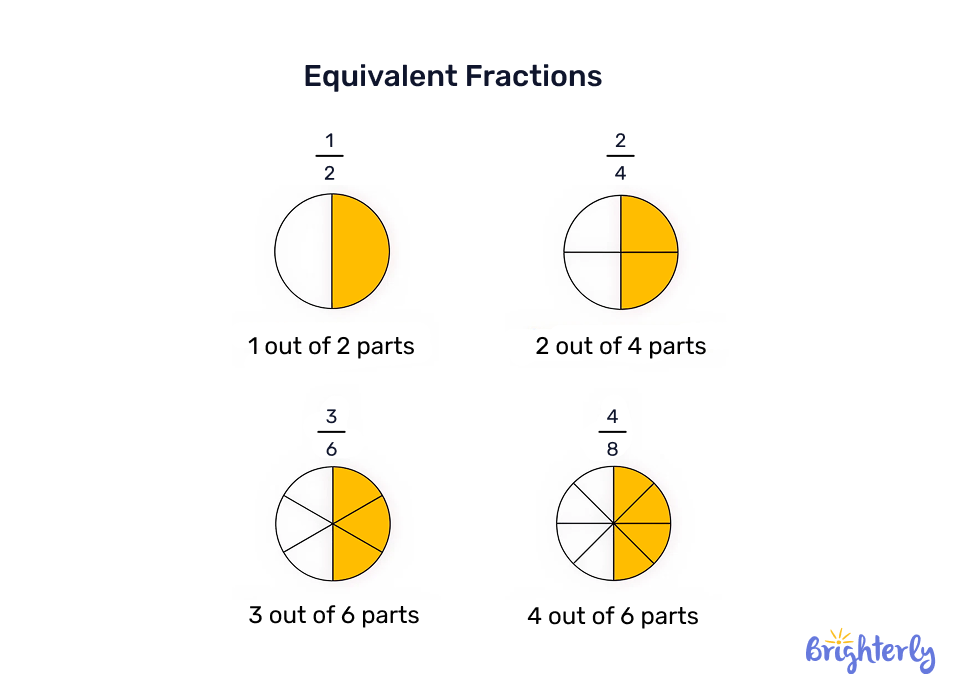
How to find equivalent fractions?
After exploring the equivalent fraction definition, let’s learn how to find them! Equivalent fractions can be created by multiplying or dividing both the numerator and denominator by the same non-zero number. The following methods can be used to make equivalent fractions:
- By multiplying the numerator and denominator by the same amount, the result will be the same.
- By dividing the numerator and the denominator by the same number.
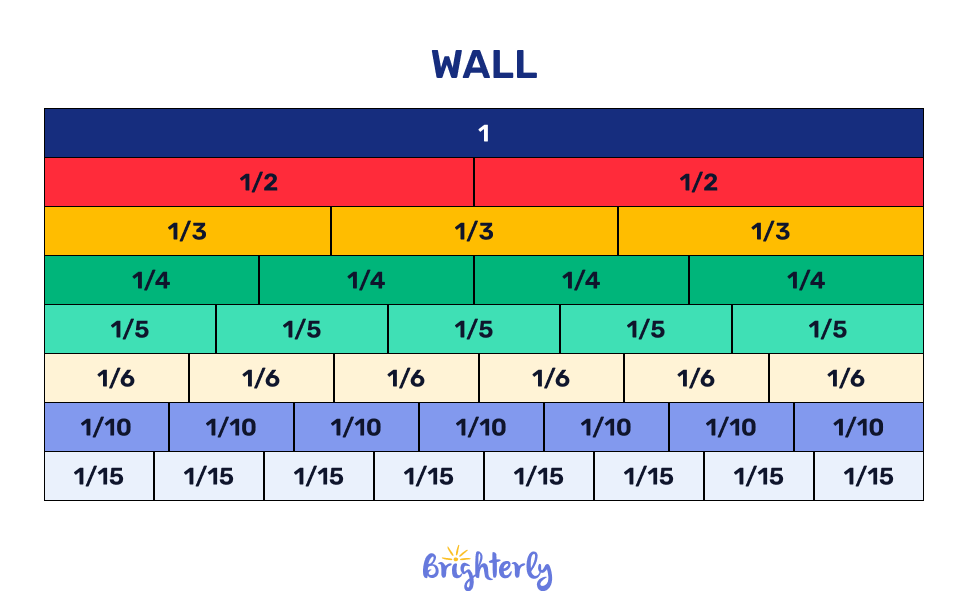
- By a fraction wall or a bar model
Let’s explore each of these methods using examples of equivalent fractions.
By multiplying
For any fraction, you can multiply the nume rator and denominator by the same number for finding equivalent fractions. A fraction of 2/5 is equivalent to 2/5 by multiplying the numerator 2 and denominator 5 by 2. As a result, 4/10 is equivalent to 2/5. A fraction’s numerator and denominator can be multiplied by any non-zero number to find other equivalent fractions.
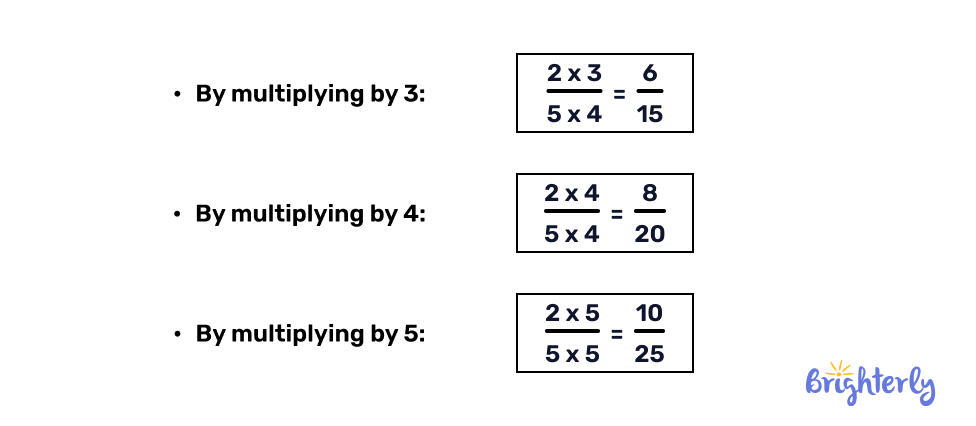
Thus, the equivalent fractions of 2/5 are 4/10, 6/15, 8/20, and 10/25.
By dividing
You can find equivalent fractions by dividing the numerator and denominator by the same number. For example, we must first find the common factors of 60/90 in order to find their equivalent fractions. As we know, 60 and 90 both have a common factor of 2. In this case, 60/90 would have an equivalent fraction if its numerator and denominator were divided by 2. In other words, 30/45 is the same as 60/90.
Here is a simplified fraction:
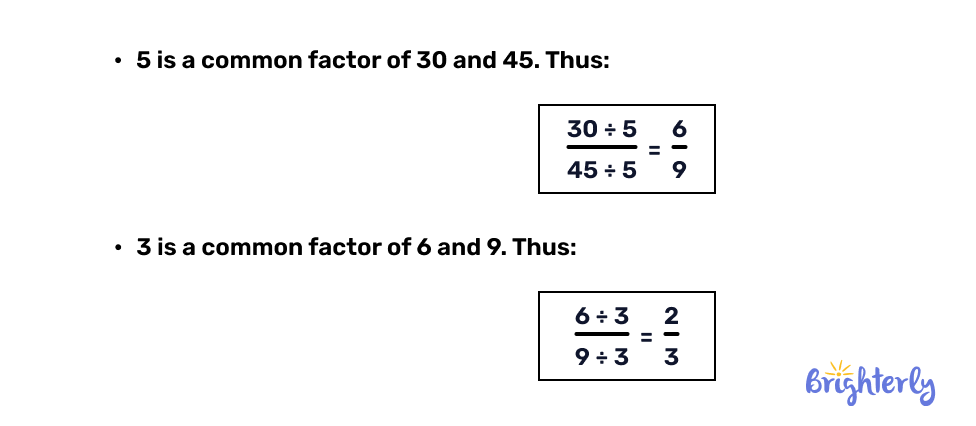
There are three equivalent fractions of 60/90: 30/45, 6/9, and 2/3. The simplified version (or simplest form) of 60/90 is 2/3 because 2 and 3 do not share a common factor (other than 1).
Fraction wall
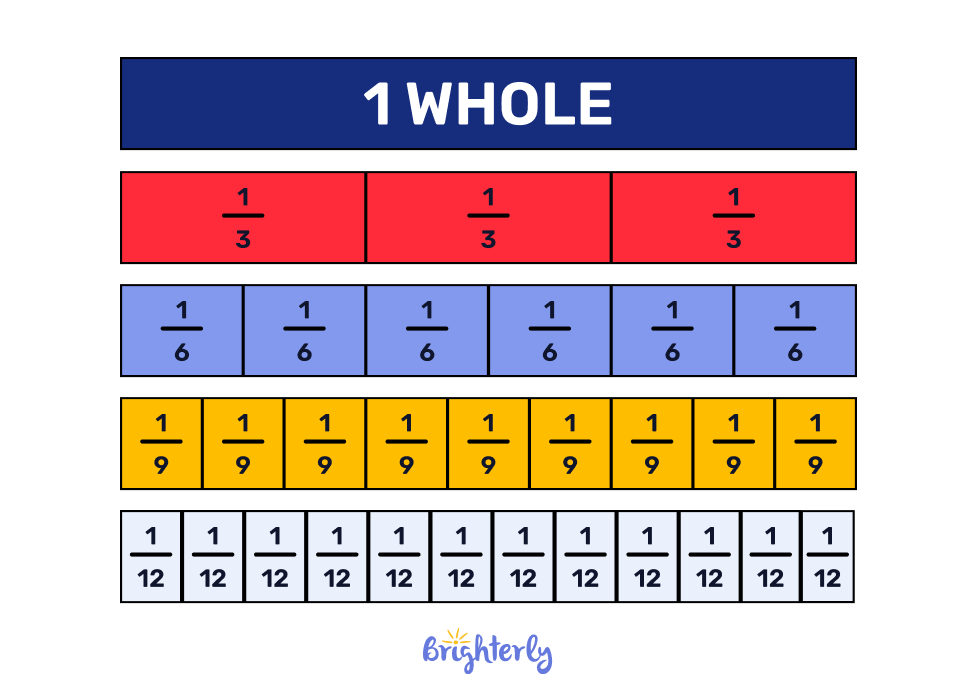
Children often have difficulty understanding fractions. Fraction walls can be helpful to children to write equivalent fractions, learning fractions with denominators up to 12. In addition, it can facilitate their understanding of fractions and division by allowing them to compare and order fractions.
In a fraction wall, equivalent fractions are visually displayed by aligning fractional parts (halves, thirds, quarters, etc.) in rows, where fractions arranged in the same row (or lining up perfectly with a vertical line) have the same value, such as 1/2, 2/4, 3/6, and 4/8 covering the same distance on the wall. It makes finding equivalent fractions easy. If your fraction (for instance, 1/3) covers the same amount of the whole as other fractions (such as 2/6, 3/9), you have found your equivalent.
How do you know if two fractions are equivalent?
To determine whether the given fractions are equivalent, we need to simplify them. It is possible to simplify numbers so that both the numerator and denominator are whole numbers. There are several methods for determining if fractions are equivalent. Here are a few examples:
- Using the same denominators.
- The decimal form of both fractions should be found.
- Multiplication by cross.
- The visual method.
Using each of these methods, let us determine whether 2/4 and 9/12 are equivalent fractions.
Same denominators
Fractions 3/4 and 9/12 have denominators 4 and 12. The least common multiple (LCM) of 4 and 12 is 12. To compare or check equivalence, multiply 3/4 by 3/3 to get 9/12. Since both fractions now have the same denominator and equal numerators, they are equivalent.
- 3/4=3×3/4×3= 9/12
- 9/12 — the denominator is already 12, so the fraction remains unchanged 9/12
There is no difference between the two fractions as they are equivalent to the same fraction 9/12. Therefore, the fractions given are equivalent.
Important! If the fractions are not equivalent, we can determine the greater or smaller fraction by examining the numerator of both fractions. As a result, this method can also be used to compare fractions.
Decimal form
To find out if the fractions 3/4 and 9/12 give the same value in decimal form, let us convert each fraction into decimal form.
- 3/4= 0.75
- 9/12= 0.75
Due to their decimal values being the same, both of the fraction equivalent.


Check the basics behind this term
Take our quick quiz to discover the perfect learning solution based on your child’s needs.
Cross multiplication method
To check whether 3/4 and 9/12 are equivalent, we perform cross-multiplication. If both products are equal, the fractions that are equivalent:
- Multiply the numerator of the first fraction by the denominator of the second: 3 \times 12 = 36
- Multiply the denominator of the first fraction by the numerator of the second: 4 \times 9 = 36
Since both results are 36, these fractions are officially considered equivalent.
Visual method
Let’s represent the fractions 3/4 and 9/12 graphically using two identical shapes to check if the shaded portions are equal.
- In the first circle, divided into 4 equal parts, we shade 3 parts.
- In the second circle of the same size, divided into 12 equal parts, we shade 9 parts.
We can observe that the shaded areas in both circles occupy the same amount of space, representing the same portion of the whole.
Equivalent fractions chart
The use of charts and tables is often an effective way to represent concepts because they make calculations easier and serve as a handy reference. Students can better understand equivalent fractions with anchor charts and tables like the one below. To find the equivalent fractions of 1/3, let’s use the following chart.
How to determine equivalent fractions
We describe them above. In order to find equivalent fractions, you multiply or divide both the numerator (top) and the denominator (bottom) by the same whole number.
Practice questions on equivalent fractions
- Find the value of x that makes the following fractions equivalent:
3/5 = x/20 - Reduce the fraction 18/24 to its simplest form. What is its most basic equivalent fraction?
- Determine 4/7 and 12/21 if the following pair of fractions is equivalent using the cross-multiplication method.
- Which of the following fractions is NOT equivalent to 2/3?
- 4/6
- 10/15
- 8/11
- 12/18
- A recipe calls for 3/4 of a cup of sugar. If you only have a measuring spoon that holds 1/8 of a cup, how many scoops do you need to equal the required amount?
Conclusion
We already learned what is equivalent fraction and explored equivalent fraction examples. Brighterly makes even the most complex topics seem easy, doesn’t it?
Fractions are a fundamental skill that simplifies everything from advanced algebra to everyday problem-solving. By using visual models and consistent practice, anyone can transform a confusing set of numbers into a clear, logical tool. No matter what you’re simplifying or comparing, equivalent fractions are the key to understanding the real value.
Frequently asked questions on equivalent fractions
What is an equivalent fraction?’
A fraction with the same value is called an equivalent fraction. As an example, 1/2, 5/10, 8/16, 10/20.
What are some real-life examples of equivalent fractions?
4 slices of an 8-slice pizza equals 1 side of a half-pizza. An 8-inch board is made up of two 4-inch boards placed end-to-end. Thirty minutes is the same as two intervals of fifteen minutes.
Why are equivalent fractions important?
They make math problems easier to solve and help you compare fractions. You need them to add and subtract fractions with different denominators. As well as simplifying large numbers, they also make them easier to read.
What are equivalent fractions examples?
Equivalent fractions examples are 1/3, 2/6, and 3/9. These are created by multiplying the top and bottom numbers of the original fraction by the same number.
How to teach equivalent fractions?
The better way to teach is by using simple worksheets and real-life examples. Brighterly offers useful worksheets for easy learning. Add practice each day and try to find real-life examples while learning.
Equivalent fractions worksheet practice
To master your knowledge, use Brighterly’s worksheets. They are especially designed for young students for easy learning and fun:
You can find more worksheets for 3rd grade on Brighterly’s worksheets page. Master your knowledge with ease!


Math & reading from 1st to 9th grade
Looking for homework support for your child?

Choose kid's grade

Math & Reading for Grades 1–9
Build real confidence for your child with a Brighterly math or reading tutor.