Expression in Math – Definition with Examples
reviewed by Jo-ann Caballes
Updated on August 4, 2026
An expression in math is a combination of numbers, variables, and operators (such as +, −, ×, and ÷) that represents a mathematical relationship — for example, 3x + 2. Unlike an equation, an expression has no equals sign, so it states a value or relationship rather than something to be solved for a single answer.
Expressions are the building blocks of algebra. Once your child is comfortable writing and simplifying them, the step up to equations and functions becomes far smoother. If that jump feels steep, a Brighterly algebra tutor can work through it with them at their own pace.
What Is an Expression in Math?
An expression is a phrase that pairs numbers and/or variables using mathematical operators to show how quantities relate. It represents a value but is never set equal to anything. For example, 5 + 2 and 4a − 7 are both expressions because they describe a quantity without asserting that it equals a specific result.
Expert Math Tutors for Every Level
Connect with professional and certified educators who provide specialized support for every grade level, from elementary school basics to advanced algebra
What Are the Parts of an Expression?
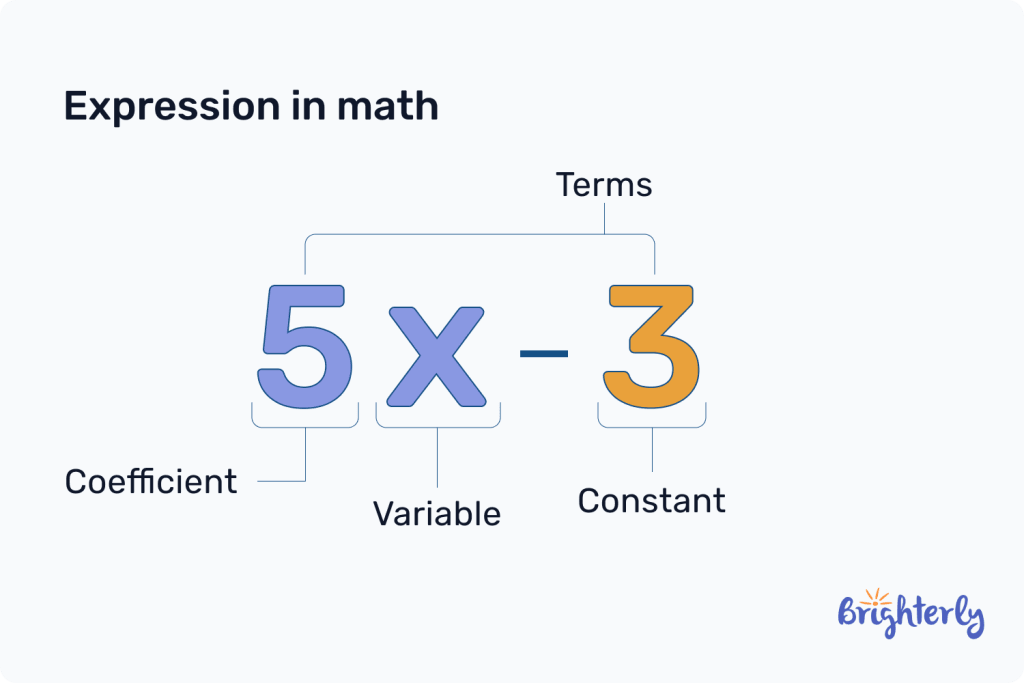
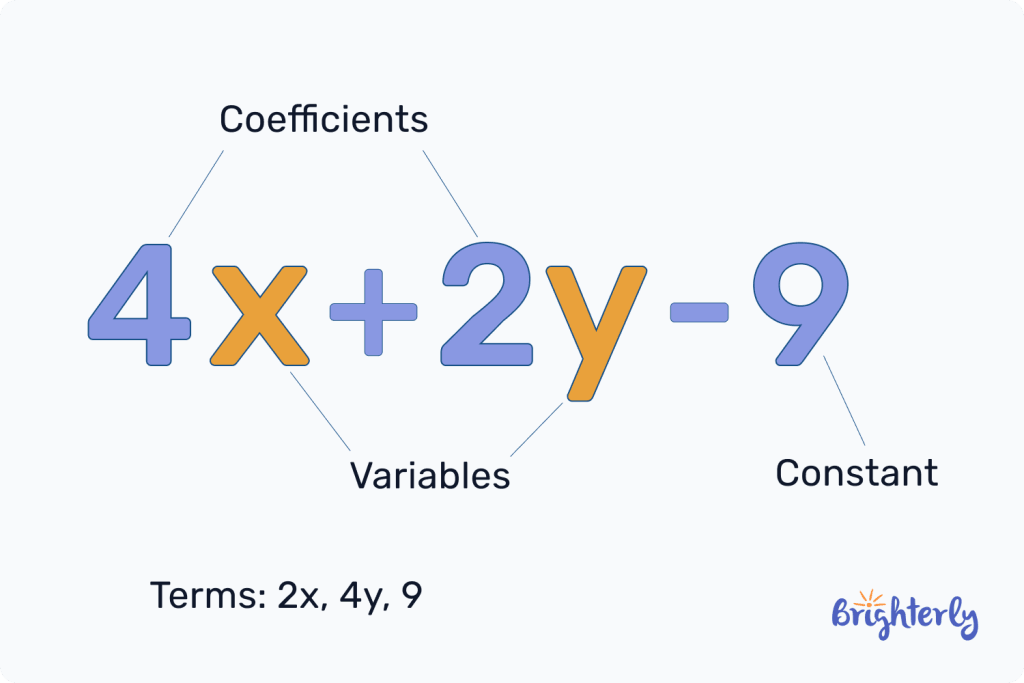
Every math expression is built from up to four parts: constants, variables, terms, and operators. Recognizing each part helps students read an expression correctly and decide what they can combine or simplify. In the expression 3x + 2, for instance, all four ideas appear together.
- Constants — fixed numbers whose value never changes, such as the 2 in 3x + 2.
- Variables — letters that stand for an unknown or changing value, such as the x in 3x + 2.
- Terms — the individual pieces separated by + or −; here, 3x and 2 are the two terms.
- Operators — the symbols +, −, ×, and ÷ that tell you what to do with the terms.
What Are the Types of Expressions?
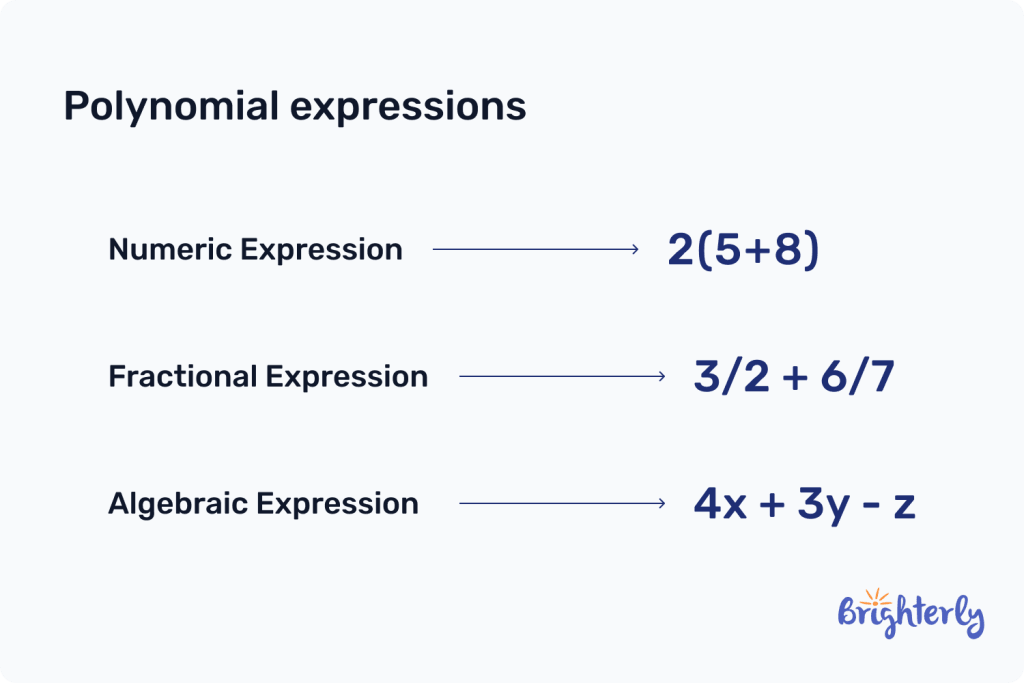
There are three common types of expressions, and they build on one another: numerical, algebraic, and polynomial. The difference comes down to whether variables appear and how those variables are used. The table below compares all three at a glance.
| Type | What it contains | Example |
| Numerical expression | Only numbers and operators | 4 + 7 or 3 × (5 − 2) |
| Algebraic expression | Numbers, variables, and operators | 3x + 2 |
| Polynomial expression | Variables with whole-number exponents | 4x² − 3x + 1 |
A polynomial is a specific kind of algebraic expression in which every variable is raised to a whole-number power and the terms are joined by addition or subtraction.
What Is the Distributive Property?
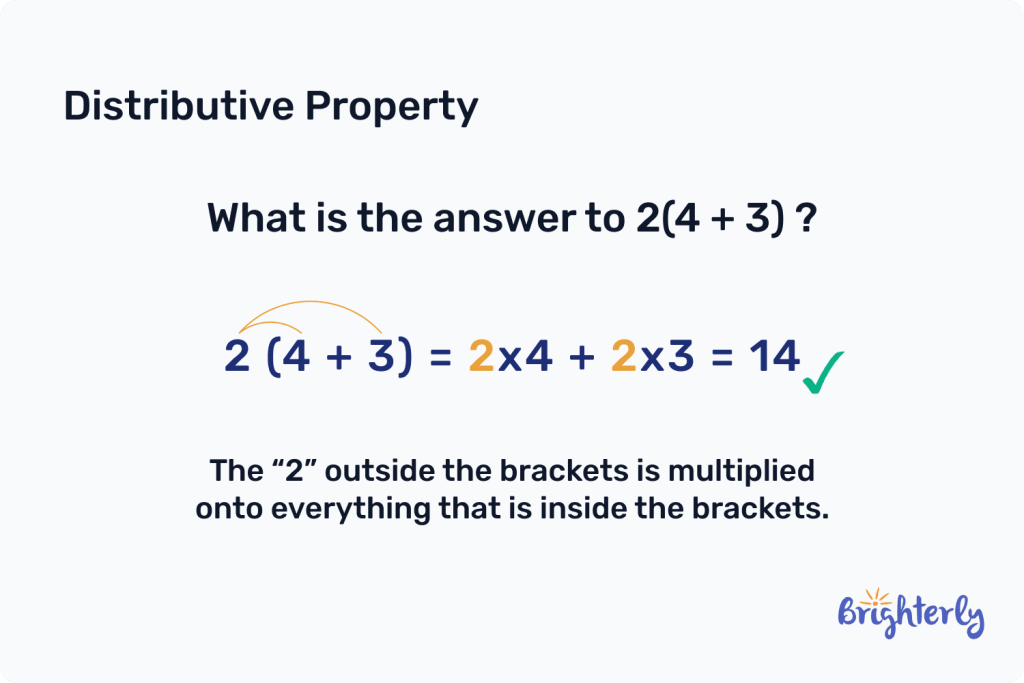
The distributive property lets you multiply a single term by each term inside a set of parentheses. It follows the rule a(b + c) = ab + ac. This property is one of the main tools for expanding and simplifying expressions, so students meet it early and use it constantly in algebra.
How to Simplify an Expression
To simplify an expression, you rewrite it in its shortest equivalent form by combining like terms and applying the properties of operations. Follow these steps:
- Apply the distributive property to remove any parentheses.
- Identify like terms — terms with the same variable raised to the same power.
- Combine like terms by adding or subtracting their coefficients.
- Write the result with terms in a tidy order, for example, 6x − 2y.
Example: 4x + 2x − 3y + y becomes 6x − 2y, because 4x + 2x = 6x and −3y + y = −2y.
What’s the Difference Between an Expression and an Equation?
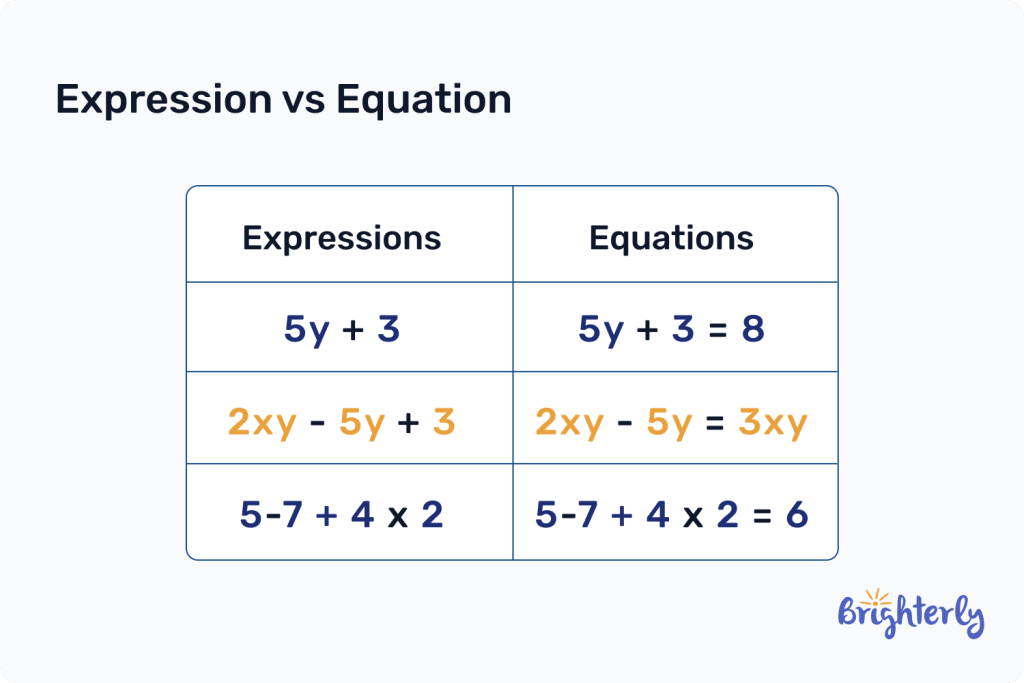
The key difference is the equals sign. An expression (like 3x + 2) shows a relationship but has no equals sign, while an equation (like 3x + 2 = 8) sets two expressions equal so you can solve for the variable. Put simply, you simplify an expression but you solve an equation.
Solved Examples of Expressions
Example 1: Simplify (3x − 7) + 2(5x + 4). Distribute the 2 to get (3x − 7) + (10x + 8), then combine like terms: 3x + 10x = 13x and −7 + 8 = 1. The simplified expression is 13x + 1.
Example 2: Simplify 4(2x − 3) − (x + 5). Distribute to get 8x − 12 − x − 5, then combine like terms: 8x − x = 7x and −12 − 5 = −17. The simplified expression is 7x − 17.
For a related skill, review the order of operations, which tells you the sequence to follow when an expression mixes several operations.
Expression Practice Math Problems
Expression Worksheets
Put this into practice with related Brighterly worksheets:
- Evaluating expressions worksheets
- Algebraic expressions worksheets
- Order of operations worksheets
- Equations and inequalities worksheets
Frequently Asked Questions About Expressions
What Is an Expression in Math in Simple Terms?
An expression is a math phrase that combines numbers, variables, and operators to represent a value, such as 3x + 2 or 5 + 7. It has no equals sign, so it is not something you solve for one answer — instead, you can evaluate it once you know the value of any variables, or simplify it into a shorter equivalent form.
What Is the Difference Between an Expression and an Equation?
An expression has no equals sign and shows a relationship, like 4x − 1. An equation contains an equals sign and states that two expressions are equal, like 4x − 1 = 7. You simplify or evaluate an expression, but you solve an equation to find the value of its variable. Every equation is built from two expressions.
What Are Like Terms in an Expression?
Like terms are terms that share the same variable raised to the same power, such as 3x and 5x, or 2y² and −7y². Only like terms can be combined by adding or subtracting their coefficients. For example, 3x + 5x = 8x, but 3x + 5y cannot be combined because the variables are different.
What Is a Coefficient in an Expression?
A coefficient is the number multiplied by a variable in a term. In the term 3x, the coefficient is 3, and in −7y, the coefficient is −7. If a variable appears alone, like x, its coefficient is understood to be 1. Coefficients tell you how many of each variable a term contains.
Can an Expression Have No Variables?
Yes. An expression made only of numbers and operators, such as 4 + 7 or 3 × (5 − 2), is called a numerical expression. It still counts as an expression because it combines values with operators to represent a quantity. Adding one or more variables turns it into an algebraic expression.


Need help with Equations?
- Is your child finding it challenging to master equations concepts?
- An online tutor could be the solution.
Choose kid's grade

Does your child struggle to understand equations basics? Try studying with an online tutor.
Book FREE lesson