Factors of 18 – Definition With Examples
Updated on February 25, 2026
Welcome to Brighterly, where one of the things we love most is making math concepts simple and fun for young learners!
In this article, we will delve into the world of factors, focusing on the factors of 18. You’ll learn how to find the prime factors of 18, understand the prime factorization, and see how factors work in pairs.
What are factors?
Let’s start with understanding what factors are and why they are important to know. The simplest way to describe factors is as numbers that you can multiply together to get another number. For example, if you multiply 2 and 3 together, you’ll get 6. Therefore, 2 and 3 are factors of 6.
If you think about division now, it’s a useful direction to go in. You can also think of factors as numbers that divide into other numbers exactly, without leaving remainders.
When we look at the factors of a specific number, we are essentially looking at the building blocks of that number. Understanding them is important because they help to explain how numbers relate to each other. Children will use them when they learn to simplify fractions, find common denominators, and solve division problems.


Help your child reach their full potential!
Answer a few quick questions about your child’s learning, and we’ll recommend next steps.
Expert Math Tutors for Every Level
Connect with professional and certified educators who provide specialized support for every grade level, from elementary school basics to advanced algebra
Definition of the factors of 18
Let’s now look at what are factors of 18. Based on our definition of factors earlier in the article, the factors of 18 are all the whole numbers that can divide 18 evenly, without leaving a remainder. In other words, if we divide 18 by a number and the result is a whole number, then that number is a factor of 18.
How many factors does 18 have?
The number 18 has six factors in total. This also includes 1 and 18, as counting factors correctly means making sure you include 1 and the number itself, as one and the number itself are always factors of any whole number.
What are all the factors of 18?
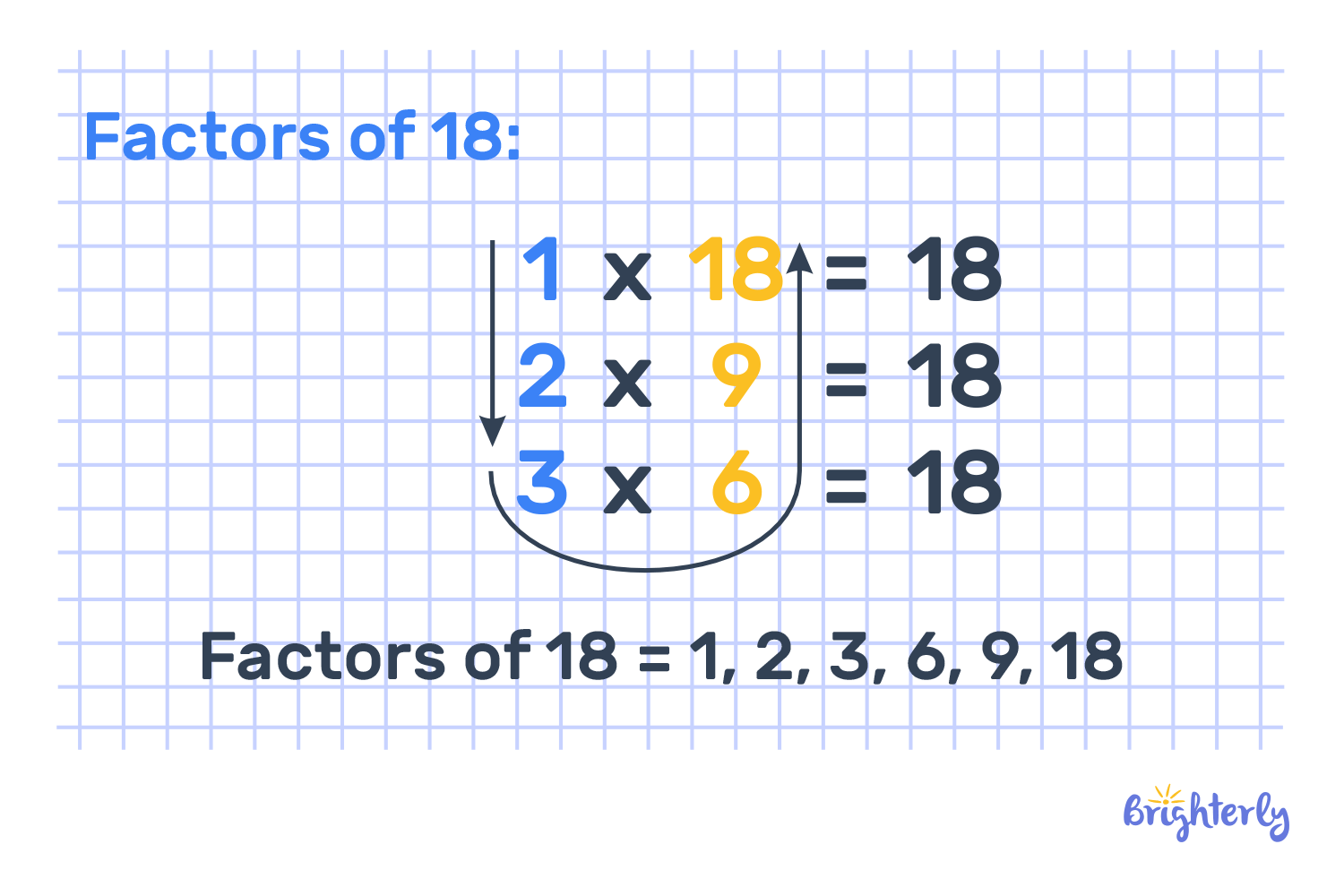
Here are all factors of 18: 1, 2, 3, 6, 9, and 18. Each of these numbers divides 18 exactly. For example, 18 / 6 = 3 and 18 / 9 = 2, leaving no remainder.
How to calculate all the factors of 18?
You can approach finding all factors of 18 through two methods: the multiplication method and the division method.
With the multiplication method, think of multiplication pairs that result in 18. Start with 1, the smallest number, and move upward from there. Here’s how:
- 1 x 18 = 18
- 2 x 9 = 18
- 3 x 6 = 18
Once the numbers start to repeat, like 6 x 3, you’ve found all factor pairs of 18.
In the division method, you need to use the reverse approach. Here, start with 18 and divide it by 1, the smallest number. Go through the numbers in order and skip any numbers that leave a remainder when dividing 18, such as 4 or 5.
What is the prime factorization of 18?
Before we look into prime factorization of 18, let’s clarify prime numbers. Prime numbers are the numbers that only have two factors, 1 and themselves. So, we can only divide a prime number evenly by itself and 1. The process of prime factorization is showing the number as a product of only prime numbers.
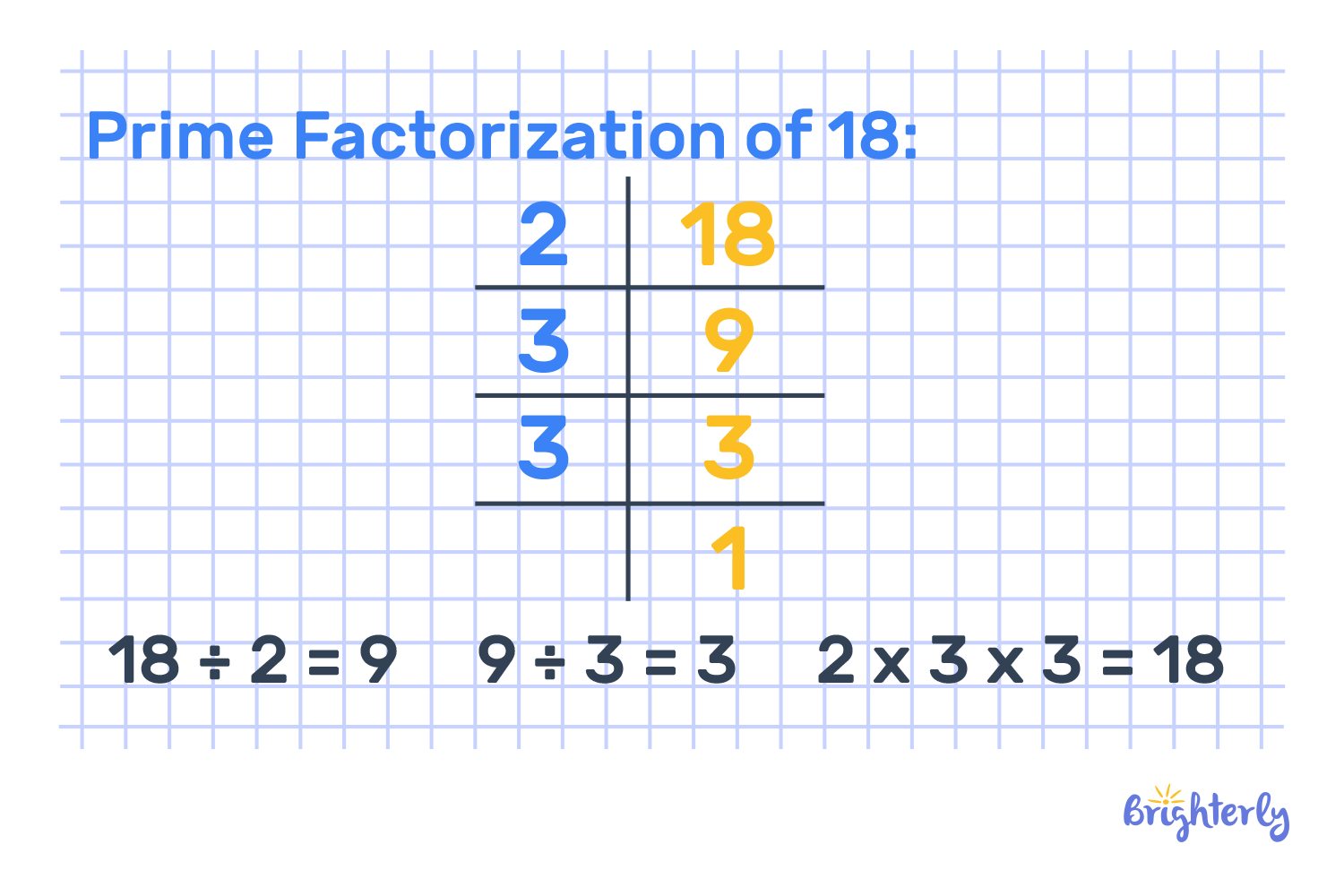
In the case of 18, let’s start by dividing it by 2, the smallest prime number.
18/2 = 9
9 is not a prime number. We divide it by 3, as 3 is the only prime number (besides 1) that divides 9 evenly.
9/3 = 3
3 is already a prime number, so we can stop here. The prime factorization of 18 will look like 2 x 3 x 3 = 18.
Properties of factors of 18
Factors of 18 follow several interesting properties worth mentioning:
- The factors of 18 are an equal mix of even and odd numbers
- Similarly, the factors are a mix of composite and prime numbers
- Except for 18 itself, all other factors of 18 are less than 18. There are no factors between 9 and 18.
Factors of 18 in pairs
Factor pairs, as you may have guessed already, are the pairs of numbers that, when we multiply them together, we get the target number. In our case, it’s 18. Looking for factor pairs instead of individual factors is actually quite a good way to make sure that you didn’t overlook any factors, as factors always come in pairs. The positive factor pairs for 18 are (1, 18), (2, 9), and (3, 6).
Did you notice the word positive in the last sentence? It wasn’t a mistake. It’s because while we focused on positive factors so far, there are also pairs factors of -18. In this case, both numbers are negative, such as (-1, -18), (-2, -9), and (-3, -6).
Solved tasks on the factor of 18
Solved math problem 1
Does 18 have prime factors? If yes, what are they?
Answer:
| Yes, 18 has prime factors. These are numbers 2 and 3. 2 is the smallest prime number. They are factors of 18, as we can break down 18 as 2 x 3 x 3. |
Solved math problem 2
What are the positive factor pairs of 18?
Answer:
| The pairs are (1, 18), (2, 9), and (3, 6). When you multiply each of these sets of two numbers, you will get 18. |
Solved math problem 3
What is the sum of all the factors of 18?
Answer:
| The sum of all the factors of 18 is 1 + 2 + 3 + 6 + 9 + 18 = 39 |
Practice problems on factors of 18
To solidify your understanding, here are some practice problems related to the factors of 18.
- Write down all the factor pairs of 18.
- What is the sum of all the factors of 18?
- Identify whether 18 is a perfect number or a composite number.
Conclusion
And that’s a wrap! Now you hopefully understand factors much better, and know more about the factors of 18. This will give you a solid base for working with divisions, multiplications, and generally a better number sense, as you are now able to look inside of a number and see how it is built.
Frequently asked questions on factors of 18
What are the factors of 18?
Number 18 has a total of 6 factors. Those factors are 1, 2, 3, 6, 9, and 18. Note that we also included 1 and 18, as the correct way to count factors of any number is by including 1 and the number itself.
Is 18 a prime number?
Is 18 a prime number or a composite number? This is one of the more common questions we receive, and the answer is no, 18 is not a prime number, because it has more than 2 factors. Prime numbers only have 2 factors, 1 and the number itself.
Is 4 a factor of 18?
No, 4 is not a factor of 18, as we cannot divide 18 by 4 and get a whole number. The answer to 18/4 would either be 4.5 or leave a remainder of 2.
Is 3 a factor of 18?
Yes, the number 3 is indeed a factor of 18. When we divide 18 by 3, we will get 6, a whole number without remainders.



Math & reading from 1st to 12th grade
Looking for homework support for your child?

Choose kid's grade

Math & Reading for Grades 1–12
Build real confidence for your child with a Brighterly math or reading tutor.