Factors of 20 – Definition With Examples
Updated on February 11, 2026
At Brighterly, we love showing that complicated things aren’t as complicated as you used to think. The factor 20 is one of those. We can complete it like a puzzle, using its factors 1, 2, 4, 5, 10, and 20.
The same number pattern holds for factors of -20, since it’s similar to 20, just with a minus sign. Let’s learn how to find prime factors, a list of all factors of 20, and the prime factorization of 20 in detail in this article.
What are factors?
In mathematics, a factor is a number that perfectly divides another number, leaving no remainder. The original number can also be found by multiplying two numbers together. In the example above, 2 and 3 are factors of 6 because their product is 6. A single number can have multiple factors.
The following are some of the key properties of a number’s factors:
- Since 0 cannot be divided by a number, it cannot be a factor of any number.
- All numbers have 1 as a factor.
- At least two factors go into every number: 1 and the number itself.
- Factors can be negative as well.
- Any positive factor of a number is less than or equal to that number.
- The smallest factor of a number is 1, and the largest factor is the number itself.
- Every even number has 2 as a factor.
- Every number with 5 or 0 in its unit place has 5 as a factor.
Now, let’s explore what are factors of 20.
Expert Math Tutors for Every Level
Connect with professional and certified educators who provide specialized support for every grade level, from elementary school basics to advanced algebra
What are the factors of 20?
The factors of 20 are:
- 1,
- 2,
- 4,
- 5,
- 10,
- 20.
Factors of 20 are integers that divide 20 completely without leaving a remainder. Factor pairs are the numbers that produce 20 when multiplied together. These factors completely divide 20 without leaving any remainder.
Help your child reach their full potential!
Answer a few quick questions about your child’s learning, and we’ll recommend next steps. 

Properties of factors of 20
Understanding the properties of factors helps you quickly identify which numbers belong in the set:
- Unlike multiples, which go on forever, factors are always a limited set. The number 20 has exactly 6 factors.
- Every whole number has at least two factors: 1 and the number itself. For 20, these are 1 and 20. Because 20 has more than these two factors, it is classified as a composite number.
- All positive factors of 20 are less than or equal to 20. A positive factor can never be larger than the number it is dividing.
- Since 20 is an even number, it must have 2 as a factor. However, even numbers can have odd factors too; for 20, the odd factors are 1 and 5.
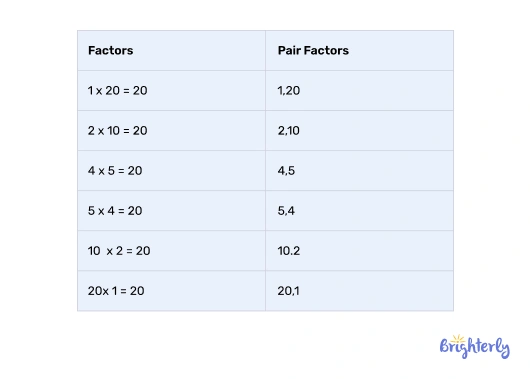
- Factors usually come in pairs. When you multiply the two numbers in a pair, the product is always 20.
- 1 × 20 = 20
- 2 × 10 = 20
- 4 × 5 = 20

Listing the factors of 20
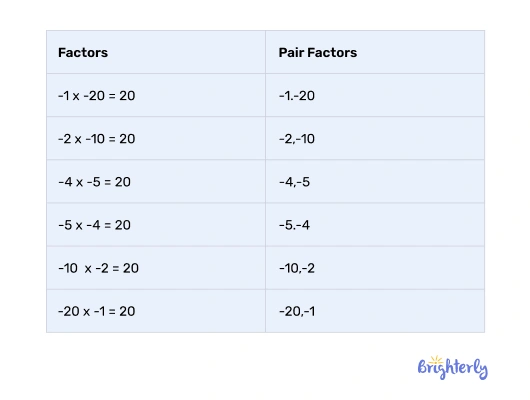
The factors of 20 in pairs consist of two numbers multiplied together to give 20. There can be both positive and negative pairs.
Positive factor pairs of 20 are:
Negative pair factors are also possible because two negative numbers multiply to give a positive number. Here are the negative factor pairs of 20:
Difference between factors and multiples of 20
Kids often mix up factors and multiples, but it’s pretty simple. The main thing they should know is that factors are limited, smaller than or equal to 20, whereas multiples are infinite, larger than 20.
Factors of 20 |
Multiples of 20 |
| They are numbers that divide 20 completely with no remainder. | They are numbers you get when you multiply 20 by whole numbers. |
| Factors 20 are found through division. | Multiples of 20 are found through multiplication. |
| Factors of 20 are limited (1, 2, 4, 5, 10, 20). | Multiples of 20 are endless: 20, 40, 60, 80, 100, … |
| 20 factors are always less than or equal to 20. | Multiples of 20 are greater than or equal to 20. They cannot be smaller than 20. |
Writing the factorization of 20
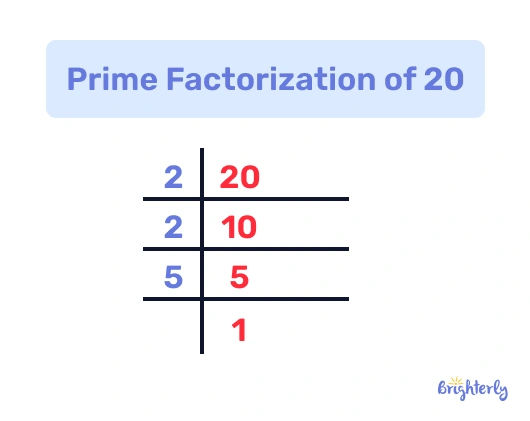
In prime factorization, a number is written as the product of its prime factors. The following are the steps for finding the factors of 20 by prime factorization:
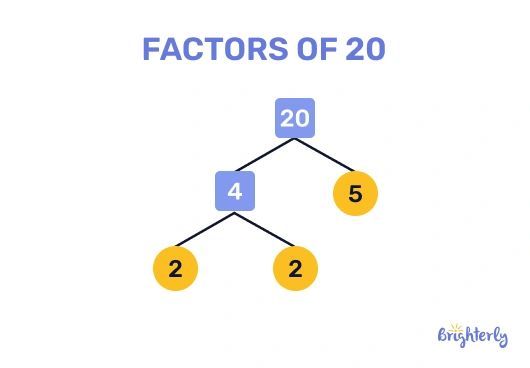
Write the pair of factors that, when multiplied, give the required number. Using 4 and 5 as factors, 20 can be factored. Check each factor to see if it is a prime.
- Step 1. 4 is not a prime number, because it can be factored further as a 2 x 2.
- Step 2. There are no more factors to factorize the number 5, so 5 is a prime number.
- Step 3. The prime factorization of 20 is: 20 = 4 × 5 = 2 × 2 × 5
- Step 4. In exponent form, it is written as 20 = 22 x 5
So, we discovered that the prime factors of 20 are those numbers that can divide 20 completely:
- 2 (20 is divisible by 2 and 2 is a prime number)
- 5 (20 can be divided by 5, and 5 is a prime number)
The prime factorization method writes the number 20 as the product of its prime factors. As a starting point, we divide 20 by the smallest prime number, 2, and continue dividing until no more division is possible:
Practice problems on factors of 20
- Which set contains all the factors of 20?
- (1, 2, 4, 10, 20)
- (1, 2, 4, 5, 10, 20)
- (2, 4, 5, 10)
- (1, 2, 5, 10, 20}
- Which factor of 20 is also a prime number?
- 4
- 5
- 10
- 20
- If you add all the factors for 20 together, what is the total sum?
- 40
- 42
- 20
- 38
- Which of these is NOT a factor pair of 20?
- (2, 10)
- (4, 5)
- (1, 20)
- (3, 7)
- What is the largest factor of 20 that is also a factor of 15?
- 2
- 10
- 5
- 1
Conclusion
Identifying factors is an important part of basic math that helps solve many types of problems. Factors help break down numbers into smaller components, which is helpful when solving problems and performing calculations. It is evident from the factors of 20, such as 1, 2, 4, 5, 10, and 20, that numbers can be divided evenly. Mathematics requires an understanding of factors of 20 that is both simple and important.
Frequently asked questions on factors of 20
What are factors of 20?
Factors of 20 are the whole numbers that divide 20 exactly, leaving no remainder. They represent all the possible ways to split 20 into equal groups. Here is the list the factors of 20: 1, 2, 4, 5, 10, and 20.
What is the prime factorization of 20?
Prime factorization breaks 20 down into only prime numbers. By using a factor tree, we find 2 x 10, then break 10 into 2 x 5. Thus, the prime factorization is 2 x 2 x 5, or 2^2 x 5.
How many factors does 20 have?
20 has 6 factors, among them are 2 prime numbers (2 and 5).
What are all the factors of 20?
All the factors of 20 are 1, 2, 4, 5, 10, 20.
What are the common factors of 20 and 24?
The common factors are 1, 2, and 4. We can find it by knowing all the factors of 20 (1, 2, 4, 5, 10, 20) and all the factors of 24 (1, 2, 3, 4, 6, 8, 12, 24).


Math & reading from 1st to 12th grade
Looking for homework support for your child?

Choose kid's grade

Math & Reading for Grades 1–12
Build real confidence for your child with a Brighterly math or reading tutor.