Month – Number of Months in a Year
reviewed by Jessica Kaminski
Updated on July 31, 2026
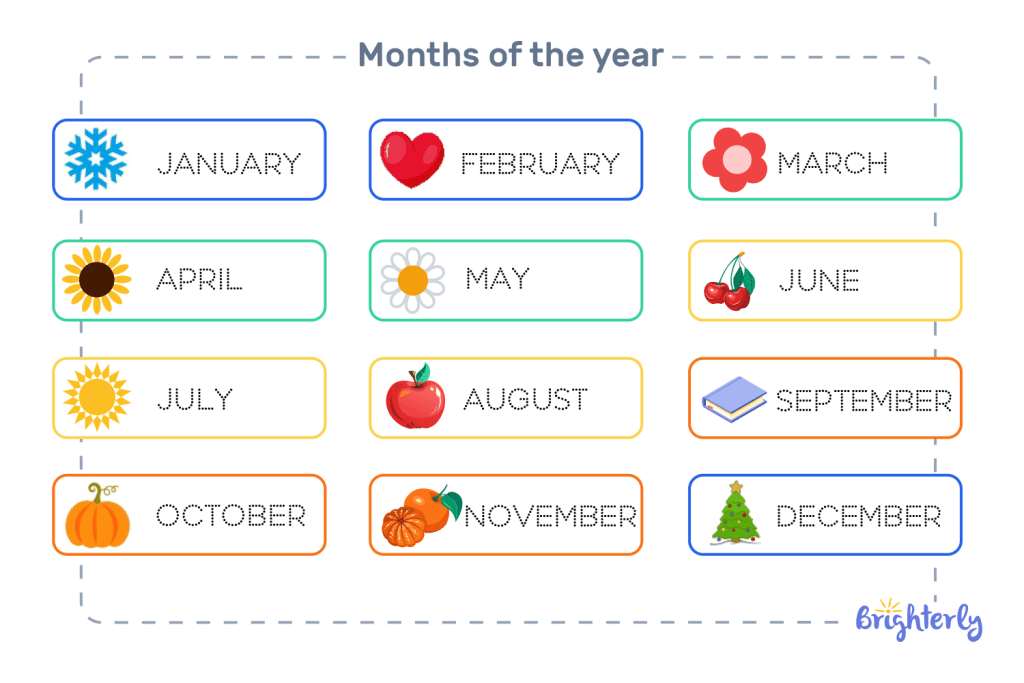
A month is a unit of time in the calendar, and there are 12 months in a year. The months are, in order, January, February, March, April, May, June, July, August, September, October, November, and December. Each month has 28 to 31 days, and together they make up one full year.
Learning the months, their order, and how many days each has is an early measurement skill. Brighterly’s elementary math tutors help young learners connect calendar time to counting and number sense.
What Is a Month?
A month is a unit of time in the Gregorian calendar, roughly based on the cycle of the Moon’s phases (about 29.5 days). Because 365 days do not divide evenly into equal lunar cycles, the months were given different lengths — some 30 days, some 31, and February 28 (or 29 in a leap year). There are 12 months in one year.
Expert Math Tutors for Every Level
Connect with professional and certified educators who provide specialized support for every grade level, from elementary school basics to advanced algebra
How Many Months Are in a Year?
There are 12 months in a year, and each one has a number based on its order. January is the 1st month, June is the 6th, and December is the 12th. Knowing each month’s number makes it easier to read dates written in number form.
- January (1), February (2), March (3), April (4)
- May (5), June (6), July (7), August (8)
- September (9), October (10), November (11), December (12)
How Many Days Are in Each Month?
The months do not all have the same number of days. Seven months have 31 days, four have 30 days, and February has 28 (or 29 in a leap year). The chart below shows each month’s number of days and the corresponding season (Northern Hemisphere).
| No. | Month | Days | Season (N. Hemisphere) |
| 1 | January | 31 | Winter |
| 2 | February | 28 (29 in leap years) | Winter |
| 3 | March | 31 | Spring |
| 4 | April | 30 | Spring |
| 5 | May | 31 | Spring |
| 6 | June | 30 | Summer |
| 7 | July | 31 | Summer |
| 8 | August | 31 | Summer |
| 9 | September | 30 | Fall |
| 10 | October | 31 | Fall |
| 11 | November | 30 | Fall |
| 12 | December | 31 | Winter |
What Do the Names of the Months Mean?
Most month names come from ancient Roman gods, festivals, leaders, or numbers. Knowing the origins makes the names easier to remember and adds a little history to the calendar.
- January (Janus, the Roman god of beginnings) and March (Mars, god of war).
- June (Juno, a Roman goddess) and May (Maia, a Roman goddess).
- July (Julius Caesar) and August (Emperor Augustus).
- September, October, November, and December come from the Latin words for seven, eight, nine, and ten.
How to Remember How Many Days Are in Each Month
Two simple tricks make the days per month easy to recall. The knuckle method and a short rhyme both highlight which months have 31 days and which have fewer.
- Knuckle trick: make a fist and count across the knuckles and dips — each raised knuckle is a 31-day month, and each dip between knuckles is a 30-day month (with February the exception).
- The rhyme: “Thirty days hath September, April, June, and November” — the months named have 30 days, most of the rest have 31, and February has 28 or 29.
How Do Months Match the Seasons?
In the Northern Hemisphere, the 12 months group into four seasons of about three months each. Winter is December through February, spring is March through May, summer is June through August, and fall (autumn) is September through November. In the Southern Hemisphere, these seasons are reversed.
Calendar and Time Worksheets
Put this into practice with related Brighterly worksheets:
Frequently Asked Questions About Months
How Many Months Are in a Year?
There are 12 months in a year: January, February, March, April, May, June, July, August, September, October, November, and December. Together they contain 365 days (366 in a leap year). Each month is numbered by its order, so January is month 1 and December is month 12.
Which Months Have 31 Days?
Seven months have 31 days: January, March, May, July, August, October, and December. Four months — April, June, September, and November — have 30 days. February is the exception with 28 days, or 29 in a leap year. A common trick is to count knuckles: the raised knuckles mark the 31-day months.
What Is the Middle Month of the Year?
Because a year has 12 months, the middle falls between the 6th and 7th months, June and July. Some people say June is the middle, while others say July, since there is no single exact center in an even number of months. Both answers are reasonable depending on how you count.
Why Does February Have Fewer Days?
February has 28 days (29 in leap years) because of how the Roman calendar was adjusted over time to keep the year close to 365.25 days. Days were shifted among the months, and February ended up the shortest. The extra leap-year day is added to February every four years to keep the calendar aligned with Earth’s orbit.
How Do the Months Match the Four Seasons?
In the Northern Hemisphere, winter covers December, January, and February; spring covers March, April, and May; summer covers June, July, and August; and fall covers September, October, and November. Each season spans about three months. In the Southern Hemisphere, the pattern is flipped, so December is a summer month there.


Math & reading from 1st to 12th grade
Looking for homework support for your child?

Choose kid's grade

Math & Reading for Grades 1–12
Build real confidence for your child with a Brighterly math or reading tutor.