Octagon – Definition With Examples
Updated on July 31, 2026
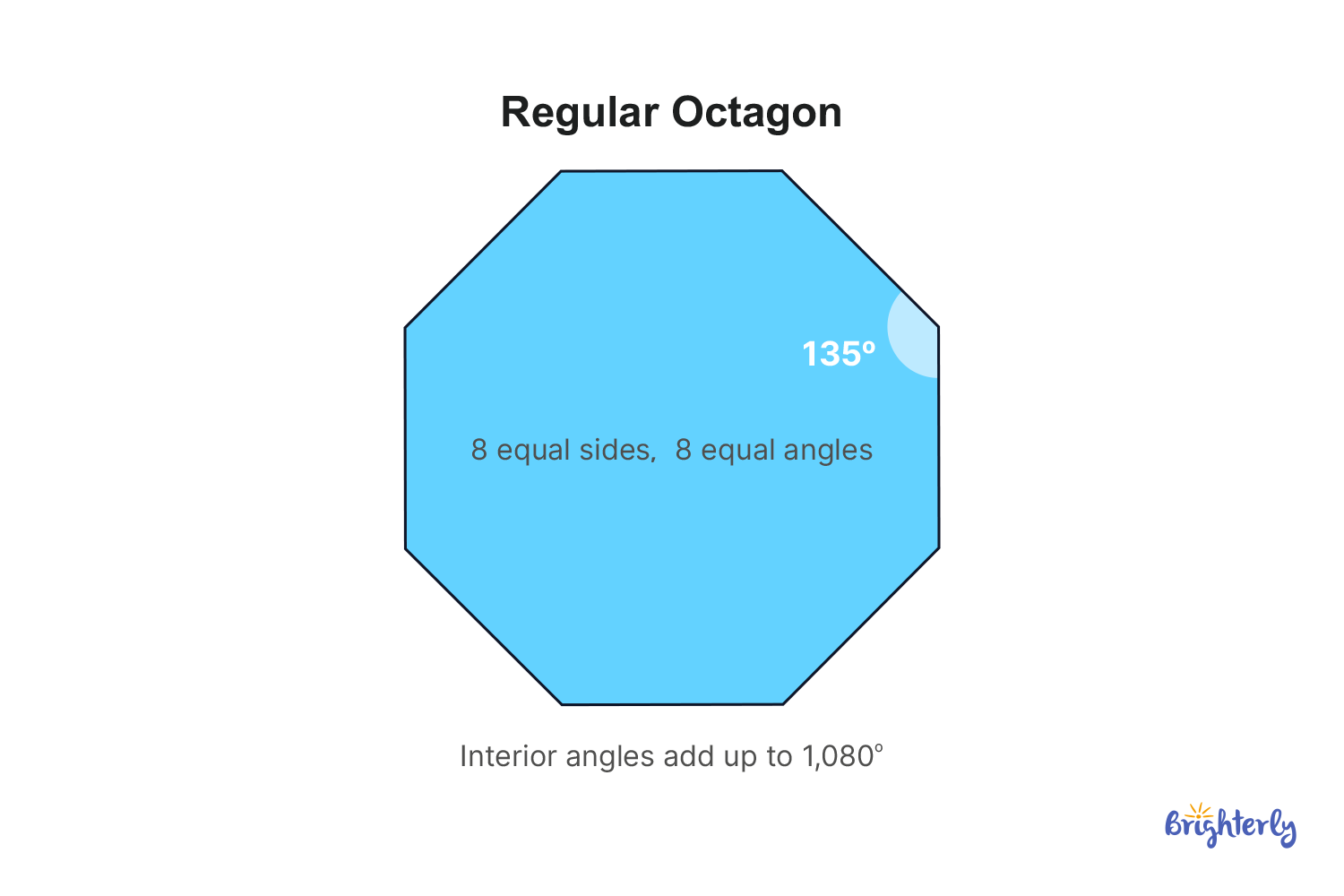
An octagon is a polygon with eight sides and eight angles. Its interior angles always add up to 1,080°, and in a regular octagon, every side is equal and every angle measures 135°. The word comes from the Greek oktágōnon, meaning “eight angles.” A stop sign is the most familiar octagon you’ll see every day.
What Is an Octagon?
An octagon is a closed, two-dimensional shape formed by eight straight sides and eight interior angles. Like all polygons, it has no curved edges and no gaps. Octagons can be regular, with all sides and angles equal, or irregular, with sides and angles of different sizes.
Expert Math Tutors for Every Level
Connect with professional and certified educators who provide specialized support for every grade level, from elementary school basics to advanced algebra
Octagon Sides and Shape
An octagon has eight sides. In a regular octagon, all eight sides are equal in length and all eight angles are equal, producing a symmetrical shape. In an irregular octagon, the sides and angles vary, so the outline can look stretched or lopsided while still having exactly eight sides.
Octagon Angles
The interior angles of every octagon add up to 1,080°, which comes from the polygon rule (8 − 2) × 180°. In a regular octagon, each interior angle is equal, so every angle measures 1,080° ÷ 8 = 135°. Each exterior angle of a regular octagon measures 45°.
Types of Octagons
Octagons fall into two main groups: regular and irregular. The difference is whether the sides and angles are all equal.
Regular Octagon
A regular octagon has eight equal sides and eight equal 135° angles. It is both equilateral and equiangular, and it has eight lines of symmetry. A stop sign is a real-world regular octagon.
Irregular Octagon
An irregular octagon still has eight sides and eight angles, but their measures differ. Its angles must total 1,080°, yet no rule forces them to be equal, so irregular octagons come in many shapes — much like irregular versions of a hexagon.
Properties of an Octagon
An octagon has several defining properties that hold for every eight-sided figure:
- It has 8 sides and 8 interior angles.
- Its interior angles always sum to 1,080°.
- A regular octagon has eight equal 135° angles and eight equal sides.
- An octagon has 20 diagonals, found with the formula n(n − 3) ÷ 2 = 8 × 5 ÷ 2.
- A regular octagon has 8 lines of symmetry.
- Octagons can be convex (all angles under 180°) or concave (at least one reflex angle).
Octagon Area and Perimeter Formulas
For a regular octagon with side length a, the area is 2 × a² × (1 + √2) and the perimeter is 8 × a. For an irregular octagon, add the lengths of all eight sides to find the perimeter, since the sides are not equal.
Area of a Regular Octagon
Area = 2 × a² × (1 + √2), where a is the side length. For a side of 4 units: 2 × 16 × (1 + √2) ≈ 77.25 square units.
Perimeter of an Octagon
For a regular octagon, Perimeter = 8 × a. For a side of 5 units, the perimeter is 8 × 5 = 40 units. For an irregular octagon, add all eight side lengths individually.
Octagonal Prisms and Pyramids
An octagonal prism is a 3D solid with two parallel octagonal bases joined by eight rectangular faces; its volume is the base area × height. An octagonal pyramid has one octagonal base and eight triangular faces meeting at a point; its volume is one-third of the base area × height.
Octagon: Practice Math Problems
Try these, then check your answers. If your child wants step-by-step help, a Brighterly geometry tutor can guide them through polygon problems.
- What is the sum of the interior angles of an octagon? (Answer: 1,080°)
- How many diagonals does an octagon have? (Answer: 20)
- Find the area of a regular octagon with a side length of 4 units. (Answer: ≈ 77.25 square units)
- Find the perimeter of a regular octagon with a side length of 5 units. (Answer: 40 units)
Octagon Worksheets
Put this into practice with related Brighterly worksheets:
Frequently Asked Questions About Octagons
What Is an Octagon?
An octagon is a two-dimensional polygon with eight straight sides and eight angles. Its interior angles always add up to 1,080°. Octagons can be regular, with all sides and angles equal, or irregular, with varying sides and angles. A stop sign is the most common octagon in everyday life.
What Is the Difference Between a Regular and Irregular Octagon?
A regular octagon has eight equal sides and eight equal 135° angles, giving it perfect symmetry. An irregular octagon still has eight sides and eight angles, but their lengths and measures differ. Both share the same interior angle sum of 1,080°; only the equality of sides and angles changes.
What Is the Sum of the Interior Angles of an Octagon?
The interior angles of any octagon add up to 1,080°. This comes from the polygon angle-sum rule (n − 2) × 180°, where n is the number of sides: (8 − 2) × 180° = 1,080°. In a regular octagon, dividing 1,080° by 8 gives 135° per angle.
How Many Diagonals Does an Octagon Have?
An octagon has 20 diagonals. You find this with the formula n(n − 3) ÷ 2, where n is the number of sides. For an octagon, that is 8 × (8 − 3) ÷ 2 = 8 × 5 ÷ 2 = 20. A diagonal connects two vertices that are not next to each other.
How Many Lines of Symmetry Does a Regular Octagon Have?
A regular octagon has eight lines of symmetry. Each line passes through the midpoint of one side and either the opposite vertex or the opposite side’s midpoint, dividing the shape into mirror-image halves. Irregular octagons usually have fewer lines of symmetry, and many have none at all.


Struggling with Geometry?

- Does your child need additional help with mastering the basics of geometry?
- Start studying with an online tutor.
Choose kid's grade

Is your child finding it challenging to grasp geometry fundamentals? An online tutor could be the answer.
Book FREE lesson