How to Calculate Percent Difference – Definition, Formula, Examples
reviewed by Jo-ann Caballes
Updated on August 4, 2026
Percent difference is used to find the relative variation between two values through the absolute difference, the average of values, and percentage.
Here, we would learn about the percent difference calculation, give relevant examples, practice questions and more to help young learners understand this topic.
What Is the Percent Difference?
The percent difference is a method that shows the relationship between two values through the use of absolute difference. The result of the percentage difference equation is expressed in percentages.
The absolute difference is found by subtracting one value from another, regardless of whether the result is positive or negative.
For instance, the absolute difference between 15 and 20 is expressed as |15 — 20| = 5.
The answer is not negative because the absolute difference is just finding the magnitude of the difference between the two values.
You may wonder “Why do we learn it and what does percent difference tell you?”. Well, it helps in analyzing data and understanding the relationship between two values. However, it does not tell us the decline or increase in the values — this is done through percentage change. We discuss the differences between the two later in the article. This kind of ratio and percentage work is typically introduced in 7th grade math.
Expert Math Tutors for Every Level
Connect with professional and certified educators who provide specialized support for every grade level, from elementary school basics to advanced algebra
Percent Difference Formula
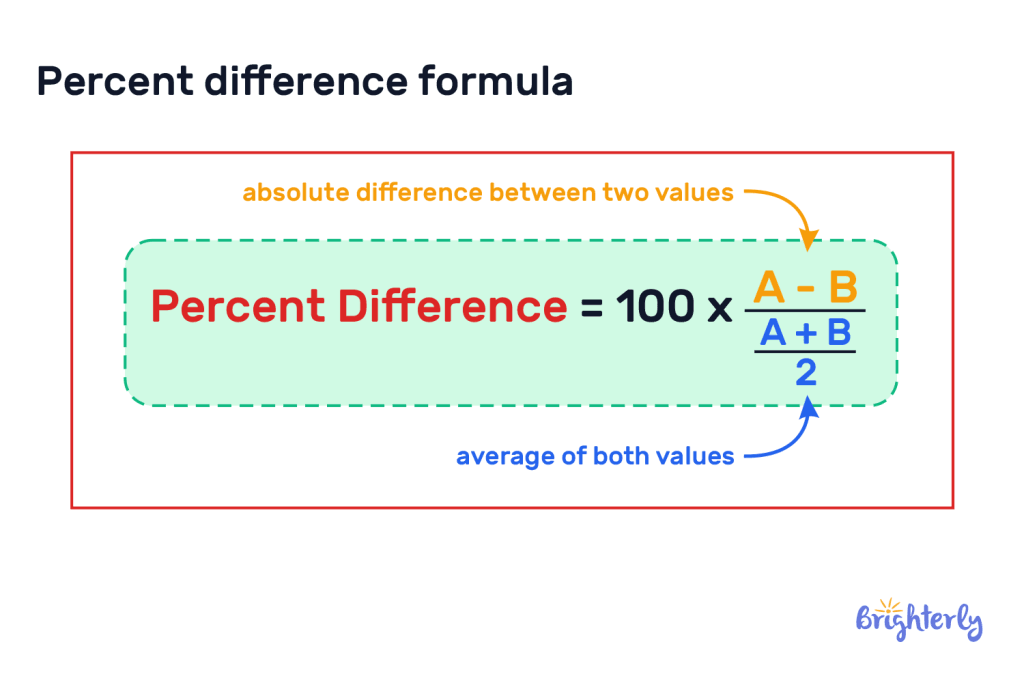
The percentage difference formula is calculated by finding the absolute difference between the two values, then dividing that difference by the average of both values and multiplying it by 100.
We find the average of both values by adding them and dividing by 2.
The difference formula can thus be expressed as:
|absolute difference between two values| / average of both values × 100%
When the values are represented as a and b, the formula is:
Calculating Percent Difference
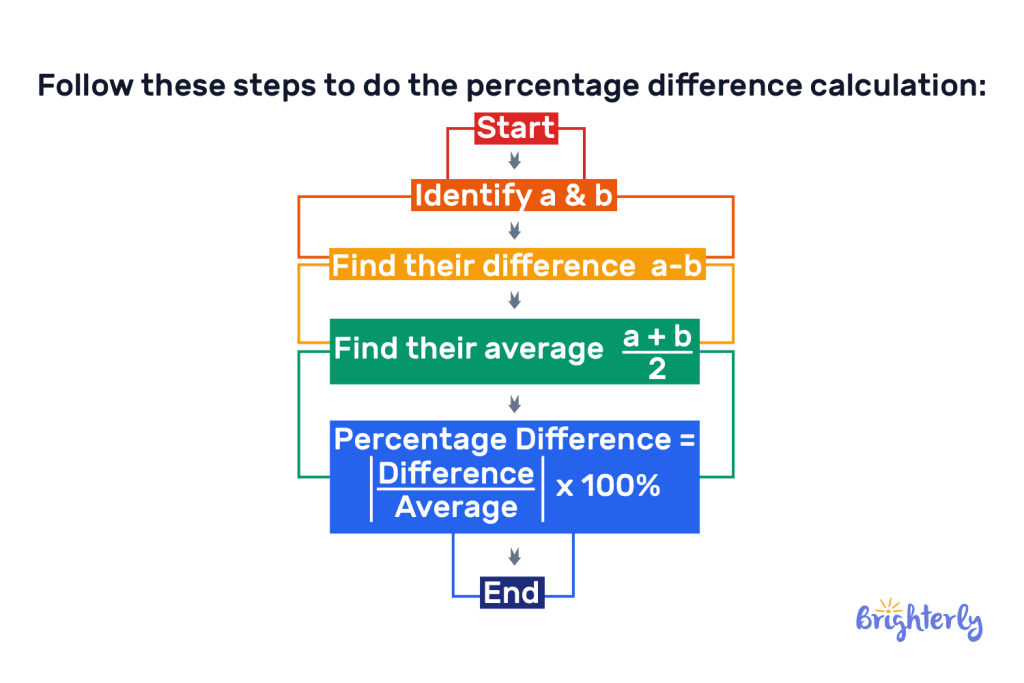
Follow these steps to do the percentage difference calculation:
STEP 1
Find the absolute difference between the two values given. If we are given 5 and 8 as our values. We solve for the absolute difference as so: |8 — 5| = 3. The absolute difference is 3.
STEP 2
We find the average of the values by adding them and dividing the result by 2. Let’s use 8 and 5 again. The average would be 8 + 5 = 13 / 2 = 6.5.
STEP 3
Finally, to arrive at the percentage difference, we would divide the absolute difference (3) by the average (6.5), then multiply by 100. The relative percent difference for 8 and 5 is 46.15%. Since percentages are just another way of expressing parts of 100, students who want a refresher on the underlying math can review guide to decimals.
Note that your answer should always have the percentage symbol (%) because the answer is in percentage.
Percent Difference vs Percent Change
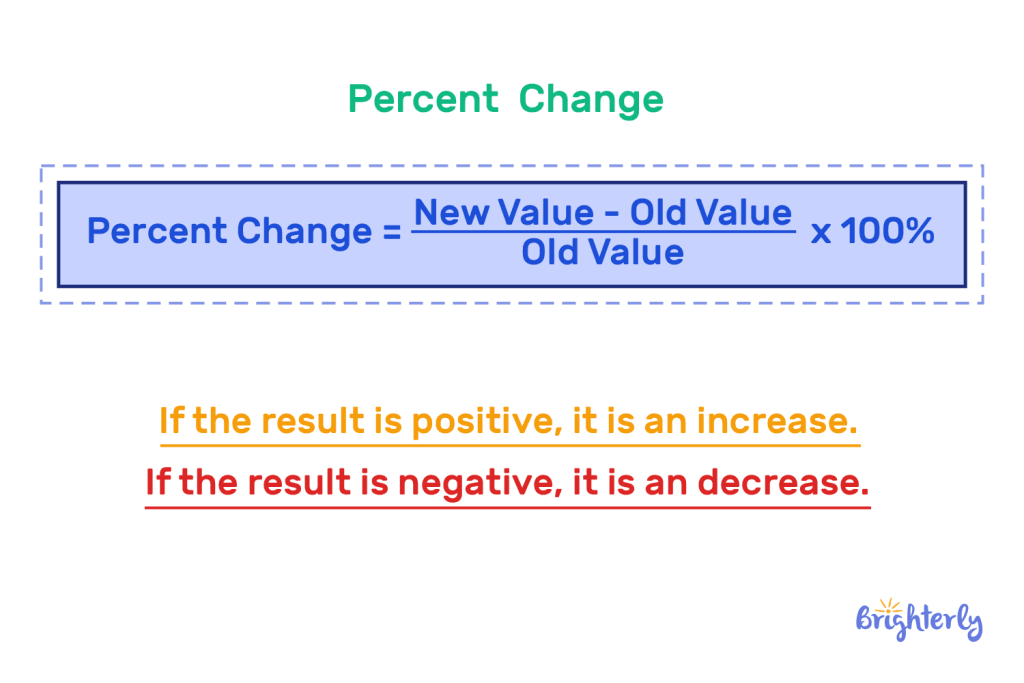
Percentage difference and percentage change are two separate concepts. We know what the percentage difference is, but what is the percentage change?
Here are their differences:
| Percentage Difference | Percentage Change |
| The equation for Percent Difference is |absolute difference| / average × 100 | The formula for Percentage Change is (Final value — Initial value) / initial value × 100 |
| The result just tells us the percentage difference between the two values without specifying which is larger. | The result tells us the amount of change from a previous value to the most recent value |
| The percentage difference is always positive | The percentage change is either positive when there is an increase in change of values or negative when there is a decrease. |
| The denominator is the average of the values | The denominator is the initial value |
| This is mostly used to show the relationship between values | This is used to show the overtime transition from one value to another |
Solved Math Tasks: Examples
Solved Math Problem 1
Using the steps for calculating the percentage difference above, what is the percentage difference between two values when a = 17 and b = 59?
Answer:
|17 — 59| / 17 + 59/ 2 × 100
First, the absolute difference: |17 — 59| = 42
Then, the average of the values: is 17 + 59 = 76 / 2 = 38.
Thirdly, we divide both and then multiply by 100; 42 / 38 × 100 ≈ 110.5% (rounded from 110.53%; the original figure of 110% was rounded down further than the calculation supports).
| The percentage difference between values 17 and 59 is approximately 110.5%. |
Solved Math Problem 2
Answer the following questions with Yes/ No answers:
- Can the percent difference be negative?
- Is percentage change different from percentage difference?
- Can we find an increase or decrease in the percentage difference?
Answer:
| No. Percentage difference is from an absolute difference which means it cannot have a negative number. Yes. Percentage change is a different concept from percentage difference. No. Percentage difference only helps us to know the relationship between two values. It doesn’t tell us of an increase or decrease in the values. |
Solved Math Problem 3
Molly sells 53 chocolate bars for her school fundraiser and Joan sells 37, what is the percentage difference?
Answer:
Again, we first find the absolute difference: |53 — 37| = 16
Then the average: 53 + 37 = 90/ 2 = 45
16 / 45 × 100 ≈ 35.6% (rounded from 35.56%; the original figure of 35% was rounded down further than the calculation supports).
| Therefore, the percentage difference between Molly’s and Joan’s sales is approximately 35.6% |
Solved Math Problem 4
In a class, a student has a cumulative grade point average of 4.7 and another student has 3.0. Find the percentage difference between their two results.
Answer:
|4.7 — 3.0| = 1.7
4.7 + 3.0 = 7.7/ 2 = 3.85
1.7 / 3.85 × 100 ≈ 44.2%.
| The percentage difference between both results is approximately 44.2%. |
Solved Math Problem 5
The Washington Monument is approximately 555 feet tall and the Statue of Liberty (base to torch) is approximately 305 ft. What is the percentage difference between these two monuments?
Answer:
|555 — 305| = 250
555 + 305 = 860 / 2 = 430
250 / 430 × 100 ≈ 58.1% (rounded from 58.14%; the original figure of 58% was rounded down further than the calculation supports).
| The percentage difference between the two monuments is approximately 58.1%. |
How to Calculate Percent Difference: Practice Math Problems
How to Calculate Percent Difference: Worksheets
Understanding the percent difference equation helps young students explore comparative statistics and relative measurement. Learn more about percentages and measurements through our free worksheets, and see our guide to fractions for more on how percentages relate to fractions:
Frequently Asked Questions About Percent Difference
Is Percent Difference the Same as Percent Change?
No. Percent difference compares two values without indicating which one is larger, using their average as the denominator, so the result is always positive. Percent change measures how much a value increased or decreased from a specific starting point, using that starting value as the denominator, so it can be positive or negative depending on the direction of change.
Can Percent Difference Be Negative?
No. Percent difference is based on the absolute difference between two values, which measures magnitude only and ignores whether the result of subtraction is positive or negative. Because the numerator is always positive and the denominator (the average of the two values) is also positive for positive inputs, percent difference itself can never come out negative.
What Is Percent Difference Used for in Real Life?
Percent difference is commonly used to compare measurements, prices, or experimental results when neither value is treated as the “correct” or original one — for example, comparing two students’ test scores, two products’ prices, or two lab measurements of the same quantity. It describes how far apart two numbers are without implying a before-and-after relationship.
Why Does the Formula Divide by the Average Instead of One of the Values?
Percent difference is designed for comparing two values where neither one is a fixed starting point, so there’s no single “original” number to divide by. Using the average of both values treats them equally, which is why percent difference works well for comparisons but isn’t meant to show growth or decline over time.
Is Percent Difference the Same as Percent Error?
No. Percent error compares a measured or experimental value against a known, true, or accepted value, using that true value as the denominator — it’s used to judge accuracy. Percent difference compares two values that are equally valid, with no accepted “correct” answer, using their average as the denominator instead.
Can Percent Difference Compare More than Two Values at Once?
No, the percent difference formula is defined for exactly two values at a time. To compare three or more values, you’d typically look at each pair separately, or use a different statistical measure, such as range or standard deviation, which are designed to summarize variation across a full set of numbers.


Math & reading from 1st to 12th grade
Looking for homework support for your child?

Choose kid's grade

Math & Reading for Grades 1–12
Build real confidence for your child with a Brighterly math or reading tutor.