Rectangular Prism – Definition With Examples
reviewed by Jo-ann Caballes
Updated on August 4, 2026
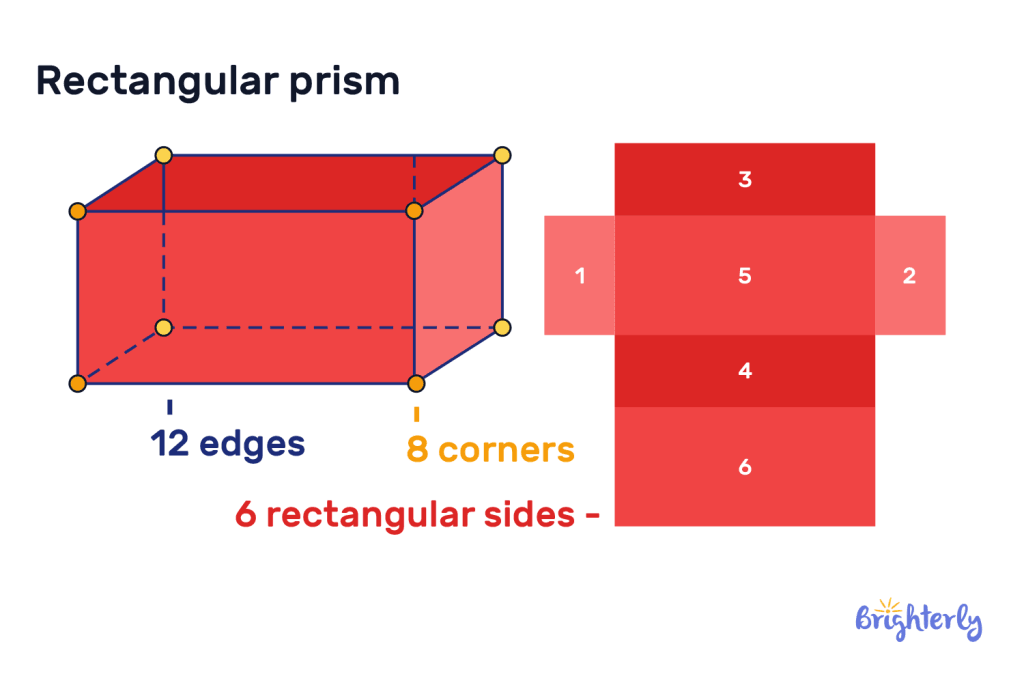
A rectangular prism is a three-dimensional shape with six rectangular faces, eight vertices (corners), and twelve edges. Its opposite faces are identical, and it is also called a cuboid. Everyday examples include a cereal box, a brick, and a shoebox.
Rectangular prisms are how students first meet volume and surface area in three dimensions. If those formulas feel confusing, a Brighterly geometry tutor can make them concrete with models and step-by-step practice.
What Is a Rectangular Prism?
A rectangular prism is a solid (3D) shape bounded by six rectangles: a top, a bottom, and four sides. It has length, width, and height, 8 vertices, 12 edges, and every pair of opposite faces is identical. Because all faces are rectangles that meet at right angles, it is one of the most common 3D shapes in daily life.
Expert Math Tutors for Every Level
Connect with professional and certified educators who provide specialized support for every grade level, from elementary school basics to advanced algebra
What Are the Properties of a Rectangular Prism?
A rectangular prism has a fixed set of features that distinguish it from other solids. Checking a shape against this list is a quick way to confirm whether it truly is a rectangular prism.
- It is three-dimensional, with length, width, and height.
- It has 6 faces, each a rectangle.
- It has 8 vertices (corners) and 12 edges.
- Opposite faces are identical (congruent).
What Are the Types of Rectangular Prisms?
There are two types of rectangular prisms: right and oblique. The difference is whether the side faces meet the base at a right angle. A right rectangular prism (like a book) stands square, while an oblique rectangular prism leans to one side like a slanted tower.
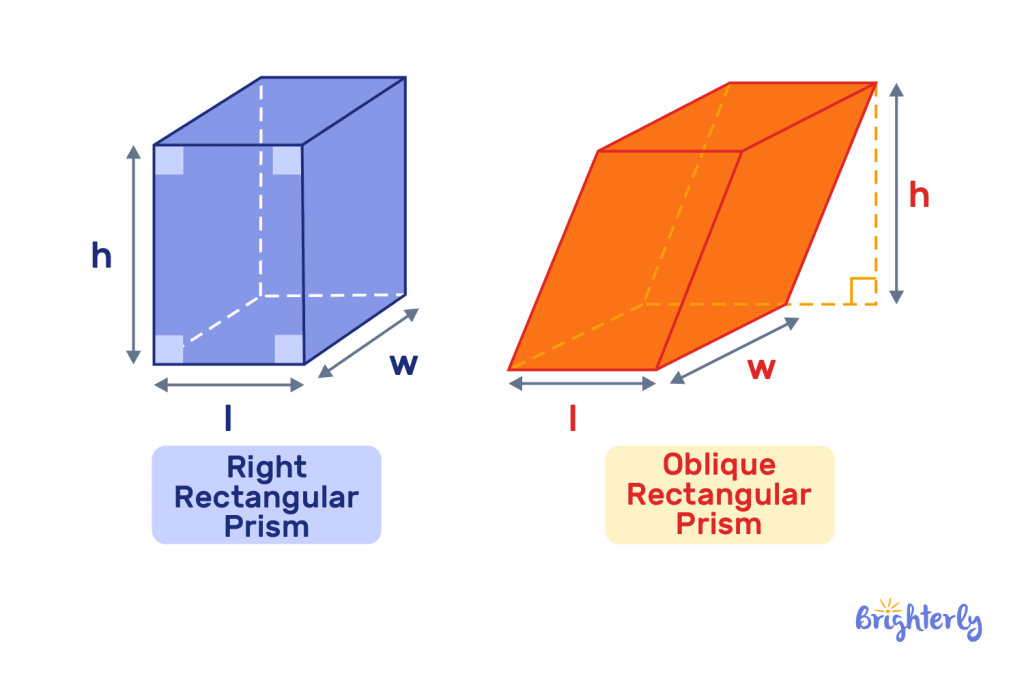
- Right rectangular prism — the sides meet the base at 90°; this is the most common type.
- Oblique rectangular prism — the sides are slanted, giving the shape a leaning, parallelogram-like appearance.
What Are the Volume and Surface Area Formulas?
A rectangular prism has one volume formula and two surface-area formulas. Volume measures the space inside, total surface area measures all six faces, and lateral surface area measures only the four sides. The table lists each formula, where l = length, w = width, and h = height.
| Measure | Formula |
| Volume (V) | V = l × w × h |
| Total surface area (TSA) | TSA = 2(lw + lh + wh) |
| Lateral surface area (LSA) | LSA = 2h(l + w) |
How to Find the Volume of a Rectangular Prism
To find the volume, multiply the three dimensions together:
- Identify the length, width, and height in the same unit.
- Multiply length × width × height.
- Write the answer in cubic units (for example, cm³).
What Is the Net of a Rectangular Prism?
A net is the flattened, two-dimensional layout of a rectangular prism, showing all six rectangular faces unfolded onto a flat surface. Nets make surface area easy to see: because the net lays out every face, adding the areas of all six rectangles gives the total surface area. Folding the net back up recreates the solid prism.
Real-World Examples of Rectangular Prisms
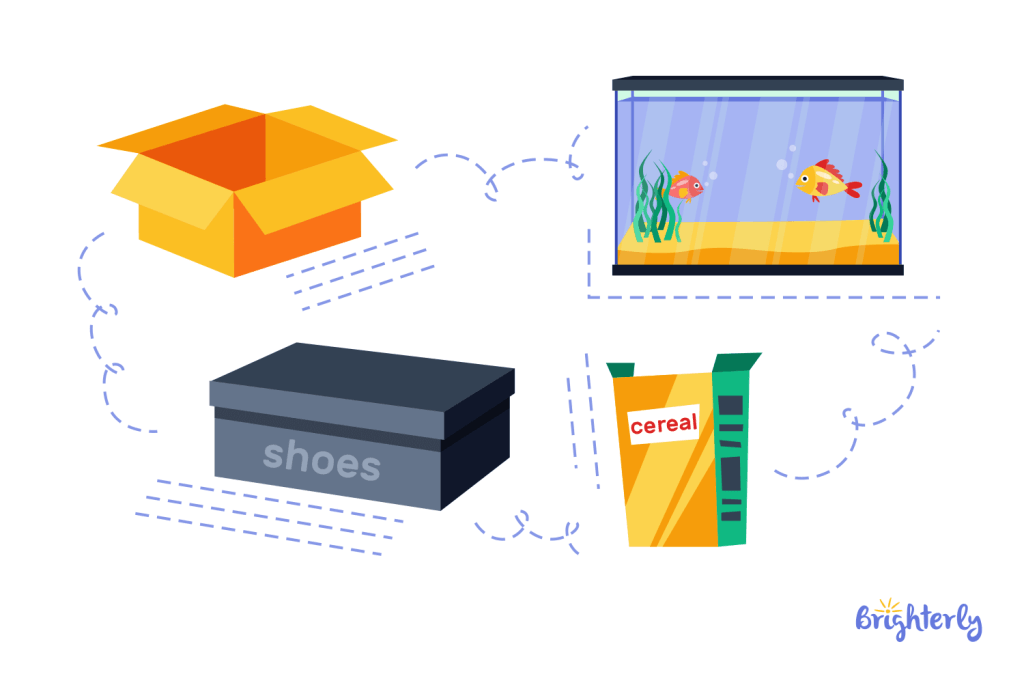
Rectangular prisms are everywhere in daily life, which makes them easy to picture. Recognizing them helps students connect the geometry to objects they already know.
- Boxes and packaging, such as cereal boxes and shoeboxes.
- Books, bricks, and wooden blocks.
- Rooms, refrigerators, and fish tanks.
- Phones, laptops, and many storage containers.
Solved Examples on Rectangular Prisms
Example 1: Find the total and lateral surface area of a prism with length 8 ft, height 10 ft, and width 9 ft. TSA = 2(9×8 + 9×10 + 8×10) = 2(72 + 90 + 80) = 2(242) = 484 ft². LSA = 2 × 10 × (8 + 9) = 2 × 10 × 17 = 340 ft².
Example 2: Find the volume of a right rectangular prism with length 3.5 cm, width 7.5 cm, and height 1.5 cm. V = 3.5 × 7.5 × 1.5 = 39.375 cm³.
A cube is a special rectangular prism in which all edges are equal; you can explore it further on the cube page.
Rectangular Prism Practice Problems
Rectangular Prism and Geometry Worksheets
Put this into practice with related Brighterly worksheets:
- 3D shapes worksheet
- Surface area and volume worksheets
- Geometry worksheets
- 2D and 3D shapes worksheets
Frequently Asked Questions About Rectangular Prisms
What Is a Rectangular Prism?
A rectangular prism is a three-dimensional shape with six rectangular faces, eight vertices, and twelve edges, where opposite faces are identical. It is also called a cuboid. Common real-world examples include cereal boxes, bricks, books, and shoeboxes. Because its faces meet at right angles, it is one of the most familiar solid shapes.
How Many Faces, Edges, and Vertices Does a Rectangular Prism Have?
A rectangular prism has 6 faces, 12 edges, and 8 vertices. The faces are the flat rectangular surfaces, the edges are the line segments where two faces meet, and the vertices are the corners where three edges come together. These counts satisfy Euler’s formula: faces + vertices − edges = 2.
How Do You Find the Volume of a Rectangular Prism?
Multiply the length, width, and height together: V = l × w × h. Make sure all three measurements use the same unit, then express the answer in cubic units. For example, a box measuring 5 cm by 4 cm by 2 cm has a volume of 5 × 4 × 2 = 40 cm³.
What Is the Difference Between a Rectangular Prism and a Cube?
A cube is a special rectangular prism in which all six faces are squares and all twelve edges are the same length. A general rectangular prism can have different length, width, and height. So every cube is a rectangular prism, but not every rectangular prism is a cube.
Is a Rectangular Prism the Same as a Cuboid?
Yes. “Cuboid” is another name for a rectangular prism — a 3D shape with six rectangular faces. Both terms describe the same solid. The word cuboid is used more often in some countries, while rectangular prism is common in U.S. classrooms, but they refer to exactly the same shape.


Need help with Geometry?
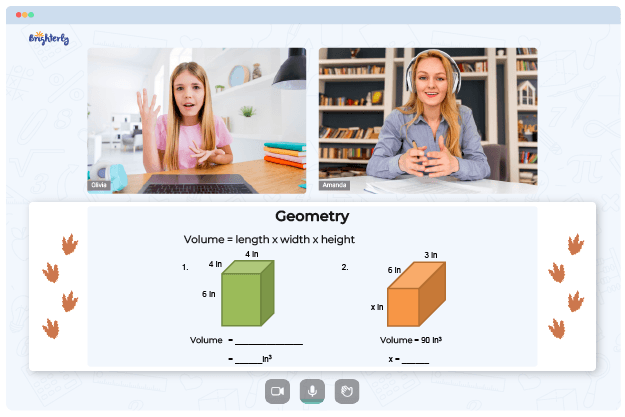
- Does your child need extra assistance with mastering geometry basics?
- Start learning with an online tutor.
Choose kid's grade

Is your child finding it hard to understand geometry lessons? An online tutor could be of help.
Book FREE lesson