Reflexive Property: Definition, Equality, and Practice Math Problems
reviewed by Jo-ann Caballes
Updated on August 4, 2026
The reflexive property states that any number, expression, or figure is always equal or congruent to itself — for example, 9 = 9 and a shape is congruent to itself. It appears in three forms: the reflexive property of equality, the reflexive property of congruence, and the reflexive property of relations. Simple as it sounds, it is a building block of algebra and of geometry proofs.
What Is the Reflexive Property?
The reflexive property says that every number, shape, line, or angle is equal or congruent to itself. It has three related forms — equality, congruence, and relations — but they all express the same core idea: a thing always matches itself. A quick example is x = x, true for any value of x.
- Reflexive property of equality
- Reflexive property of congruence
- Reflexive property of relations
Expert Math Tutors for Every Level
Connect with professional and certified educators who provide specialized support for every grade level, from elementary school basics to advanced algebra
Reflexive Property of Congruence
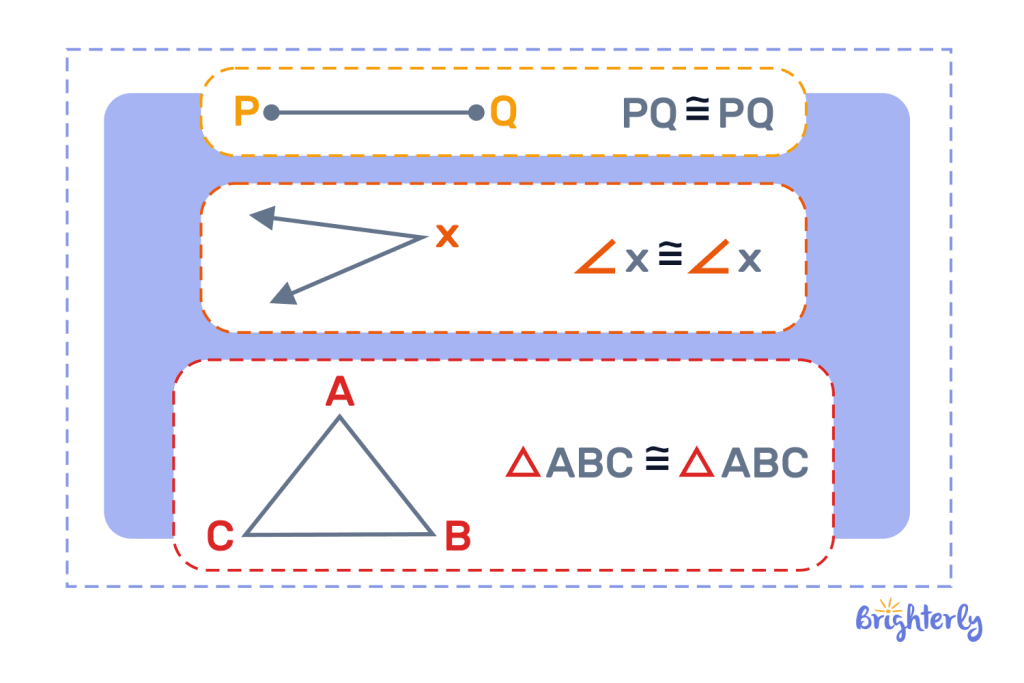
The reflexive property of congruence states that any shape, line, or angle is congruent to itself — the same shape and size as itself. It is the foundation of many geometry proofs, especially those showing two triangles are congruent when they share a side or an angle.
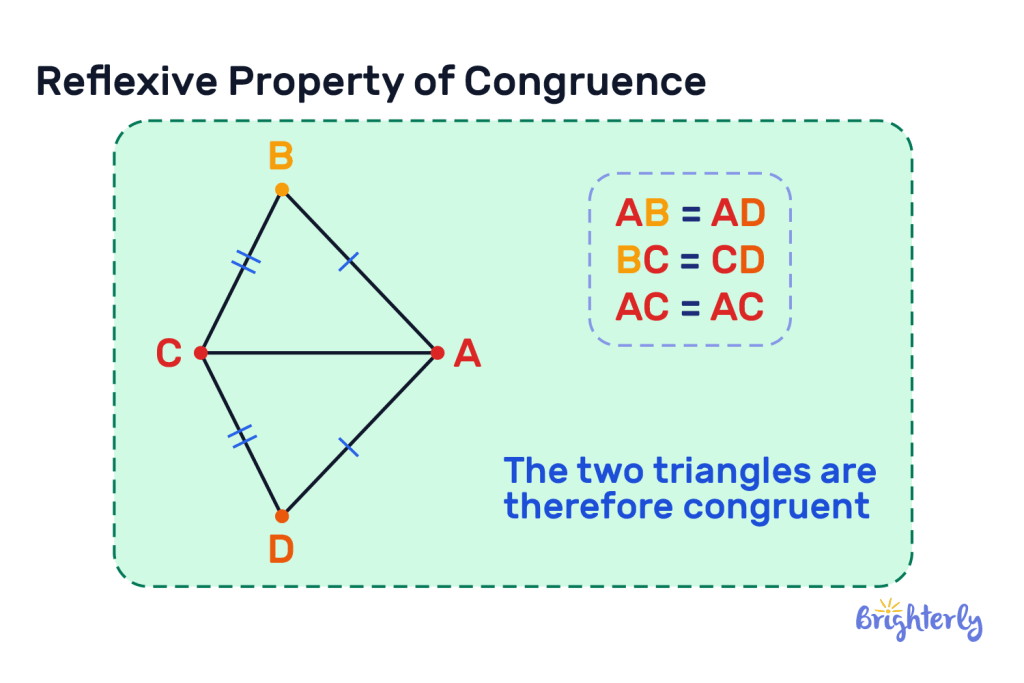
Reflexive Property of Congruence Example
In two triangles ABC and CDA that share side AC, suppose AB = AD and BC = CD. Because AC is a side of both triangles, AC = AC by the reflexive property. With all three pairs of sides equal, the two triangles are congruent.
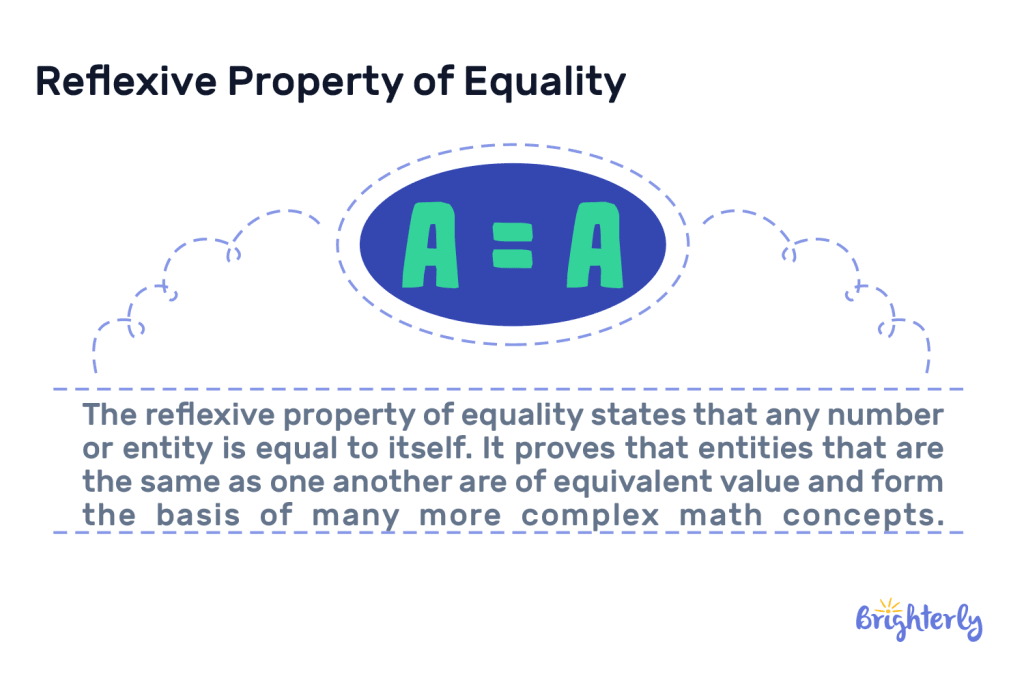
Reflexive Property of Equality
The reflexive property of equality states that any number or expression is equal to itself. It confirms that identical quantities have the same value and underpins more advanced algebra. Examples include 4 = 4, x = x, and y + 6 = y + 6.
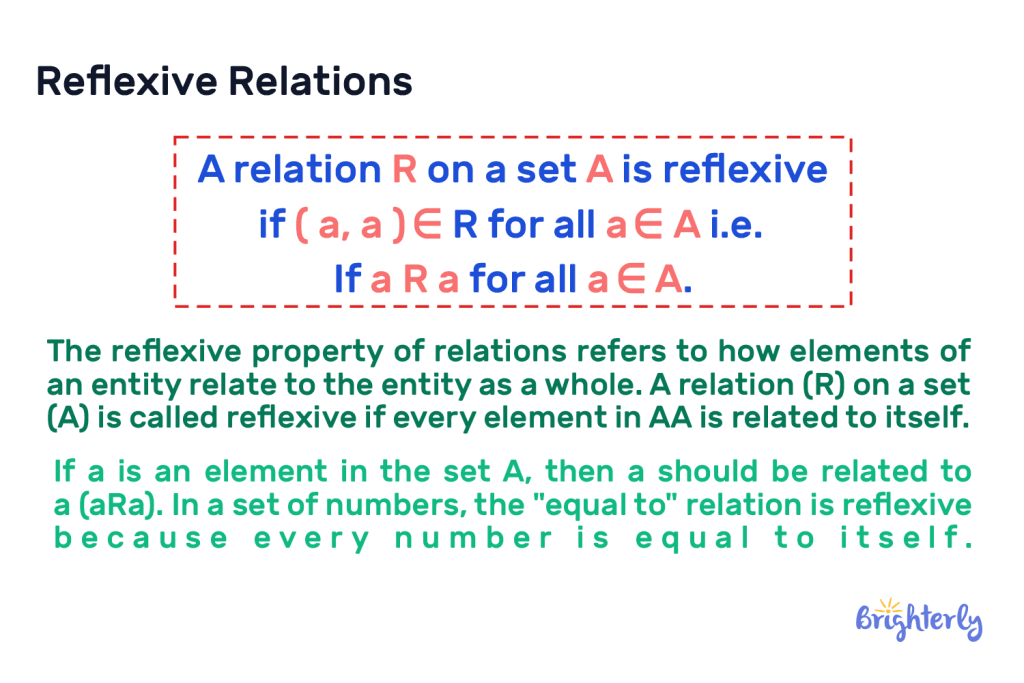
Reflexive Property of Relations
The reflexive property of relations says that a relation R on a set A is reflexive if every element of A is related to itself — written aRa for each element a. The “equal to” relation is reflexive because every number equals itself. This differs from transitive property, which links three values rather than one to itself.
Reflexive Property of Relations Example
Take the set A = {1, 2, 3} and the relation R meaning “is equal to.” Since 1 = 1, 2 = 2, and 3 = 3, each pair (1,1), (2,2), and (3,3) is in R. Every element is related to itself, so R is a reflexive relation on A.
Facts About the Reflexive Property
- It applies to numbers, algebraic expressions, angles, line segments, and shapes — not just numbers.
- In geometry proofs, it justifies that a shared side or angle equals itself, a key step in proving triangles congruent.
- It is one of the three properties of equality, alongside the symmetric and transitive properties.
- It also appears in set theory, where every element of a set is considered related to itself.
Solved Examples on the Reflexive Property
Example 1. A line measures 8 cm. A line congruent to it must be the same length, so by the reflexive property of segment congruence, it is also 8 cm.
Example 2. Tim has 3 pieces of candy in his left hand. For both hands to be equal, his right hand also needs 3, because every number equals itself.
Reflexive Property: Practice Math Problems
Reflexive Property Worksheets
Put this into practice with related Brighterly worksheets:
- Triangle congruence worksheets
- Similar triangles worksheets
- Classifying triangles worksheets
- Geometry worksheets
Frequently Asked Questions About the Reflexive Property
What Is the Reflexive Property in Geometry?
In geometry, the reflexive property states that any shape, line segment, or angle is congruent to itself. It is used constantly in proofs — for example, when two triangles share a side, that shared side is congruent to itself, which supplies one of the equal parts needed to prove the triangles congruent.
What Is an Example of the Reflexive Property?
A simple example is 9 = 9: the number nine is equal to itself. It works with variables too, such as x = x, and with expressions, such as y + 6 = y + 6. In geometry, a segment AC = AC or a triangle congruent to itself is an example of the same idea.
What Is the Difference Between the Reflexive and Transitive Properties?
The reflexive property says a value equals itself (a = a). The transitive property connects three values: if a = b and b = c, then a = c. Reflexivity is about self-equality, while transitivity chains equalities together. Both are properties of equality, along with the symmetric property.
What Is the Reflexive Property of a Triangle?
It refers to a triangle’s side or angle being congruent to itself. When two triangles share a common side, the reflexive property lets you state that the shared side is congruent to itself. That fact is often the missing piece needed to prove the two triangles congruent.
Why Is the Reflexive Property Important in Proofs?
Proofs require every step to be justified. When two figures share a side or angle, you cannot simply assume it is equal in both — the reflexive property is the official reason that lets you write “this part is congruent to itself.” Without it, many triangle-congruence proofs would have a logical gap.


Math & reading from 1st to 12th grade
Looking for homework support for your child?

Choose kid's grade

Math & Reading for Grades 1–12
Build real confidence for your child with a Brighterly math or reading tutor.