Round to the Nearest Hundredth: Definition, Method, Practice Math Problems
reviewed by Jo-ann Caballes
Updated on August 4, 2026
Rounding to the nearest hundredth means expressing a number with exactly two digits after the decimal point. For example, 68.17178 rounds to 68.17, and 26.3292973869 rounds to 26.33.
Rounding to the hundredth place trips kids up because it involves both decimals and a specific place-value rule, but once the pattern clicks, it becomes one of the easier rounding skills to apply.
This skill is taught between 4th and 5th grade — Brighterly’s elementary math tutors work through decimal rounding as part of a broader number-sense curriculum.
What Is Rounding to the Nearest Hundredth?
Rounding to the nearest hundredth means finding the closest number that has only two decimal places, using the digit in the thousandths place to decide whether to round up or keep the hundredths digit the same.
| Place | Example digit in 3.14159 |
| Tenths (1st digit after the decimal) | 1 |
| Hundredths (2nd digit after the decimal) | 4 |
| Thousandths (3rd digit after the decimal) | 1 |
Expert Math Tutors for Every Level
Connect with professional and certified educators who provide specialized support for every grade level, from elementary school basics to advanced algebra
How to Round to the Nearest Hundredth
- Identify the hundredths place — the second digit after the decimal point.
- Look at the digit immediately to the right of it — the thousandths place.
- If that digit is 5 or greater, round the hundredths digit up by 1. If it’s less than 5, leave the hundredths digit unchanged.
- Drop every digit after the hundredths place.
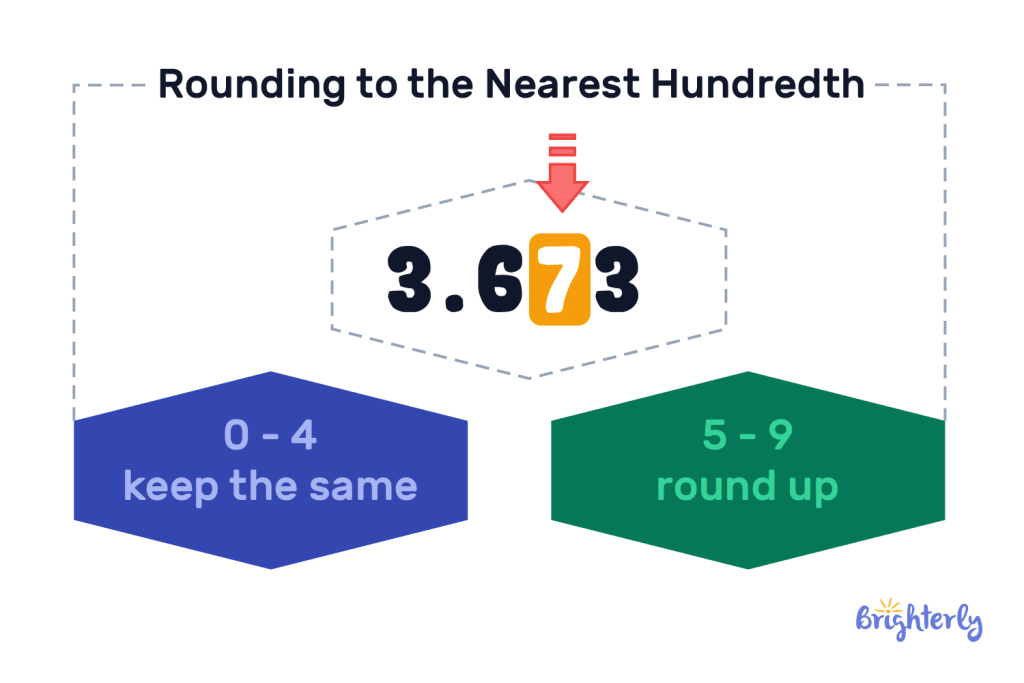
For example, to round 3.14159 to the nearest hundredth: the hundredths digit is 4, and the thousandths digit is 1. Since 1 is less than 5, the hundredths digit stays the same, and everything after it is dropped — giving 3.14. Rounding to the nearest hundredth is the same thing as rounding to two decimal places.
Rounding Decimals to the Nearest Hundredth: Place Value
Before rounding, it helps to be clear on decimal place names: the first digit after the decimal point is the tenths place, the second is the hundredths place, and the third is the thousandths place — the table above shows this breakdown for 3.14159.
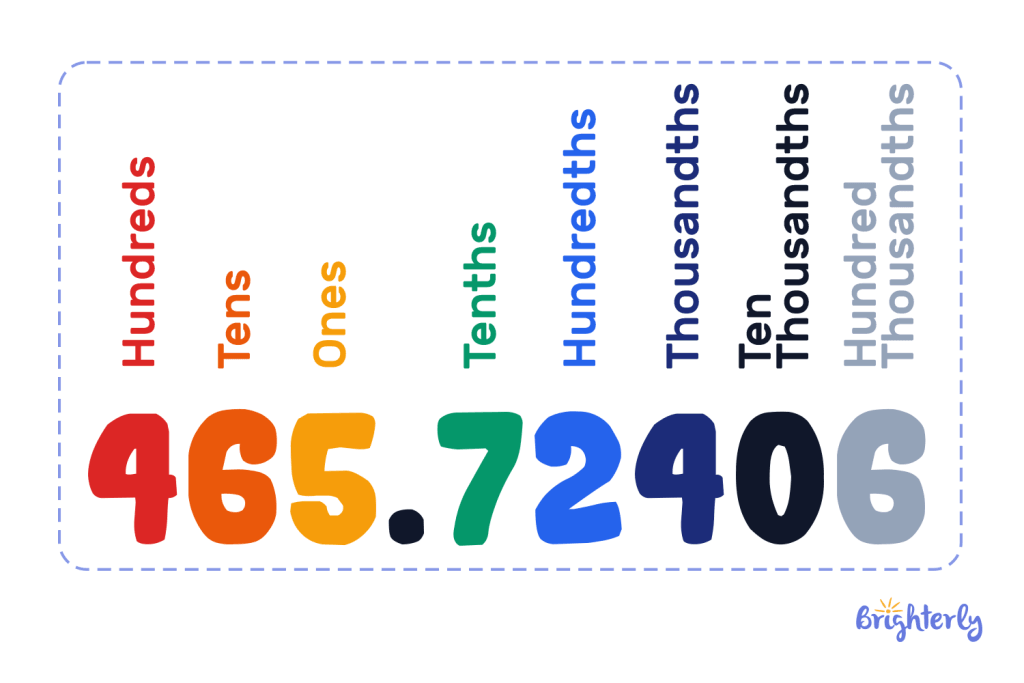
For a fuller breakdown of how each digit’s position affects its value, see our guide to decimal place value.
Rounding to the Nearest Hundredth in Real Life
- Loan and interest payments: a 12-month loan of $1,580 works out to $131.66667 per month, which rounds to $131.67 for an actual payment.
- Sports results: times and distances are commonly recorded to the hundredth, since that level of precision is enough to separate competitors without needing scientific-grade measurement.
- General measurement: a length of 6.29674 inches is usually fine to round to 6.30 inches for everyday purposes.
Once hundredths feel solid, rounding decimals more broadly — to the nearest tenth, ten, or whole number — follows the exact same process, just with a different target place.
Solved Math Problems
Solved problem 1
A 24-month loan for a $32,800 car — what is the basic monthly payment?
Answer: 32,800 ÷ 24 = 1,366.66667. The hundredths digit’s neighbor (6) is 5 or greater, so it rounds up: the monthly payment is $1,366.67.
Solved problem 2
Scientists measure a newly discovered animal at 5.2973938 centimeters and need to round it for a general audience.
Answer: the thousandths digit is 9, which rounds the hundredths place up, giving 5.30 centimeters — and since the final digit is 0, this can be simplified further to 5.3 centimeters.
Round to the Nearest Hundredth: Practice Problems
Rounding to the Nearest Hundredth Worksheets
Put this into practice with related Brighterly worksheets:
- Rounding Decimals Worksheets
- Rounding Numbers Worksheets
- 3rd Grade Rounding Worksheets
- Decimal Place Value Worksheets
Parents looking for classroom-tested strategies beyond what’s covered here can also check out our guide on how to teach decimals.
Frequently Asked Questions on Rounding to the Nearest Hundredth
What Is the Rule for Rounding to the Nearest Hundredth?
Look at the digit in the thousandths place — the third digit after the decimal point. If it’s 5 or greater, round the hundredths digit up by 1. If it’s less than 5, leave the hundredths digit unchanged, then drop every digit after it.
Is Rounding to the Nearest Hundredth the Same as Rounding to Two Decimal Places?
Yes. The hundredths place is the second digit after the decimal point, so rounding to the nearest hundredth always leaves exactly two decimal digits. The two phrases describe the same operation and are used interchangeably in most math classes and textbooks.
How Do You Round a Whole Number to the Nearest Hundredth?
A whole number, like 24, is already expressed to the nearest hundredth once you write it as 24.00 — there’s nothing to round, since it has no digits past the decimal point to evaluate. This comes up most often when a problem asks for an answer “to the nearest hundredth” and the exact result happens to be a whole number.
What Happens if the Thousandths Digit Is Exactly 5?
A thousandths digit of exactly 5 is treated the same as anything 5 or greater: round the hundredths digit up by 1. For example, 3.125 rounds to 3.13, following the standard “round half up” convention used in most U.S. classrooms.
Why Do Sports and Science Often Round to the Hundredth?
Rounding to the hundredth strikes a balance between precision and readability — it’s exact enough to separate close results (like race times or lab measurements) without requiring the extra digits that ten-thousandth-level precision would add, which most audiences don’t need to interpret the result.
Do You Round Money Amounts the Same Way?
Yes. Since money is already expressed in dollars and cents — two decimal places — rounding a dollar amount to the nearest hundredth is the standard way to convert a longer decimal result, like $1,366.66667 from a division problem, into a payable amount: $1,366.67.


Math & reading from 1st to 12th grade
Looking for homework support for your child?

Choose kid's grade

Math & Reading for Grades 1–12
Build real confidence for your child with a Brighterly math or reading tutor.