Side Angle Side: Definition, Congruence, Examples
reviewed by Jo-ann Caballes
Updated on April 7, 2026
Side angle side theorem in math is the method that helps kids compare two sides and the included angle of two triangles to determine if they are congruent.
In this article, we look into the SAS theorem, how kids can derive the side angle side formula, some other rules, and exciting practice problems.
What Is Side Angle Side Theorem In Geometry?
The SAS theorem in geometry is a theory that explains the relationships between two triangles with corresponding lengths and corresponding sides have the same length, and the included angles are equal. Below, we cover the SAS definition.
Help your child reach their full potential!
Answer a few quick questions about your child’s learning, and we’ll recommend next steps. 

Side Angle Side Definition In Geometry
The side-angle-side definition in geometry is as follows: if two triangles have two corresponding sides that are the same length, plus the angles between these sides (also known as included angles) are equal, the two triangles are congruent. In other words, they have the same shape and size.
A similar theorem is the side side angle theorem, which states that if two triangles have two of the same corresponding angles, and the connecting sides are the same length, they are also congruent. So if you’re wondering, “Is SAS congruent?”, the answer is yes.
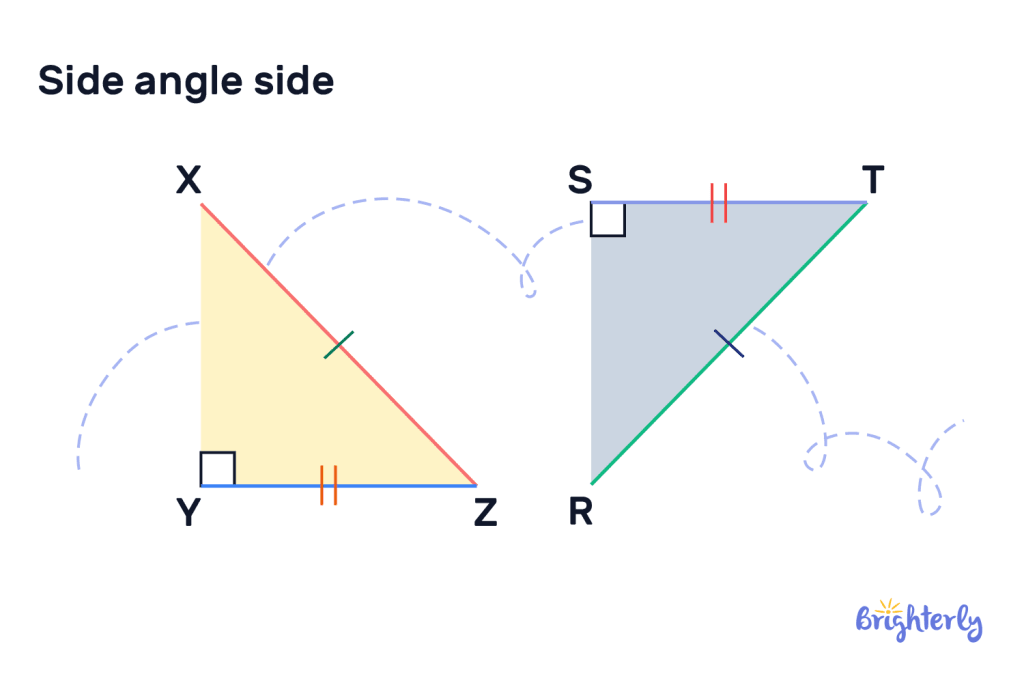
Derivation Of Side Angle Side Formula
Let’s look at how your kid can derive, or in simpler terms, prove the Side-Angle-Side rule. Luckily, they won’t need complex equations, but rather simple logical constructions step-by-step.
- Suppose you have side b and side c. These are like two straight paths that start from the same point, A.
- Next up, imagine there is a specific angle, angle A, between these two sides. The angle is locked, so the sides cannot come closer or go further.
- There is now only one way to connect the far ends of those two sticks to close the triangle. The third side, let’s name it a, is determined by the length of the other two sides.
- Since the lengths of sides b and c and the measures of angle A are identical in both triangles, the conclusion is that the gap on the third side is identical as well.
There is a slightly complicated formula for this in higher math. It’s called the Law of Cosines, and here is how it looks:
a^2 = b^2 + c^2 – 2bc cos(A)
In this formula, b, c, and angle A are known, so a is fixed.
Expert Math Tutors for Every Level
Connect with professional and certified educators who provide specialized support for every grade level, from elementary school basics to advanced algebra
What Is SAS Similarity?
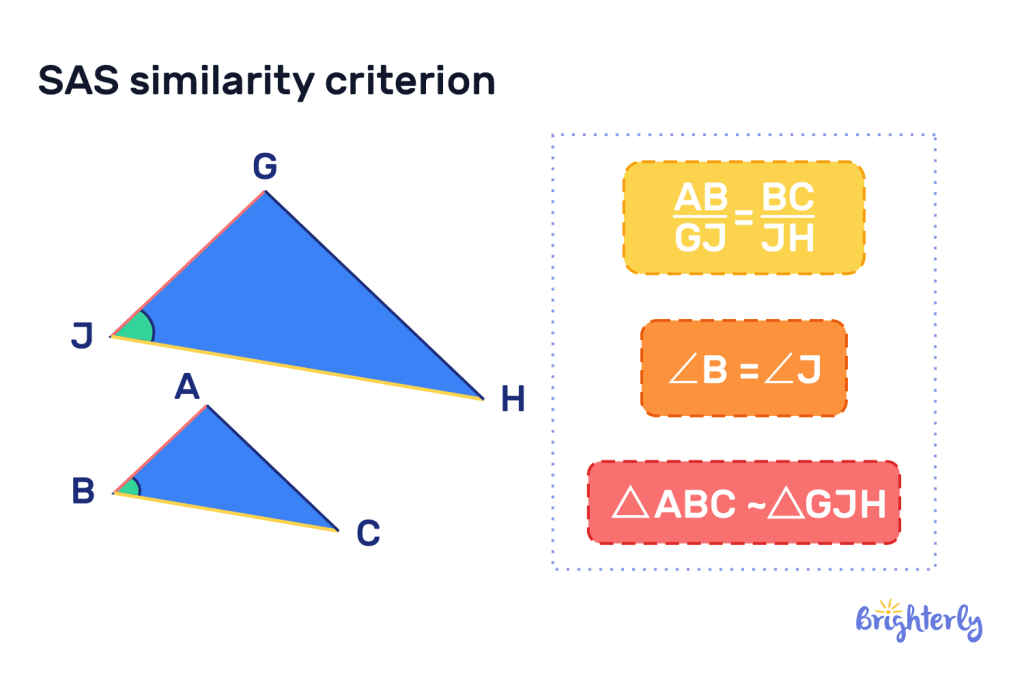
SAS math similarity is a theorem or test that highlights triangles that are similar but not congruent. If two triangles have corresponding side lengths of the same ratio, and the angles on those sides of both triangles are the same, the triangles are the same shape but are different sizes.
Side-Angle-Side Congruence Theorem
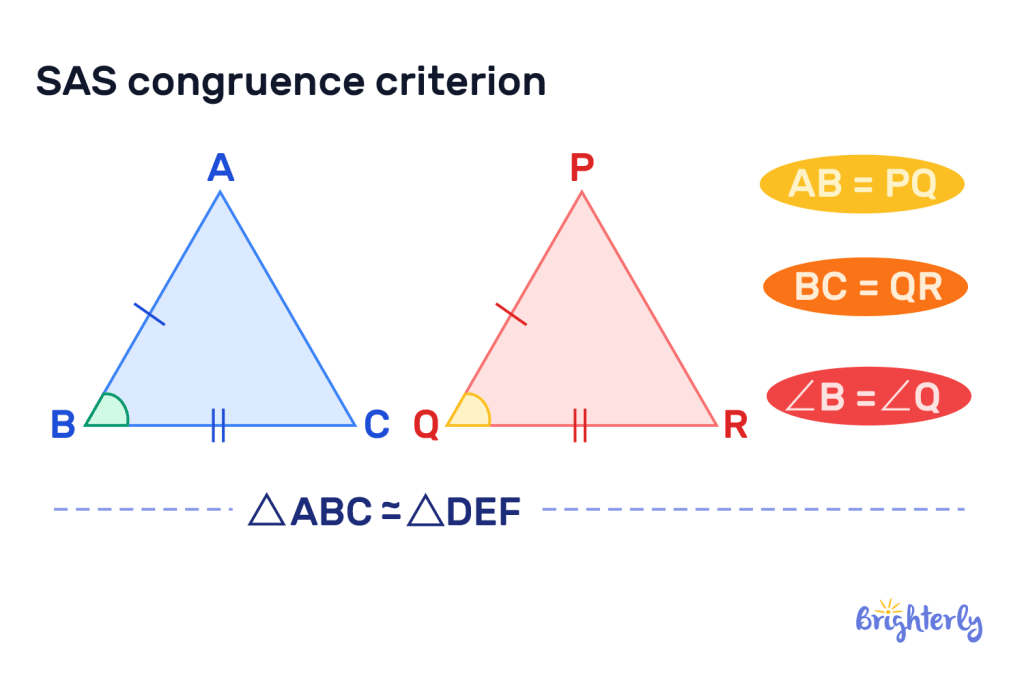
The side-angle-side congruence theorem is another name for SAS in geometry, which states that two triangles are congruent if:
- They have two sets of corresponding sides of the same length
- The angles between those corresponding sides are the same across both triangles
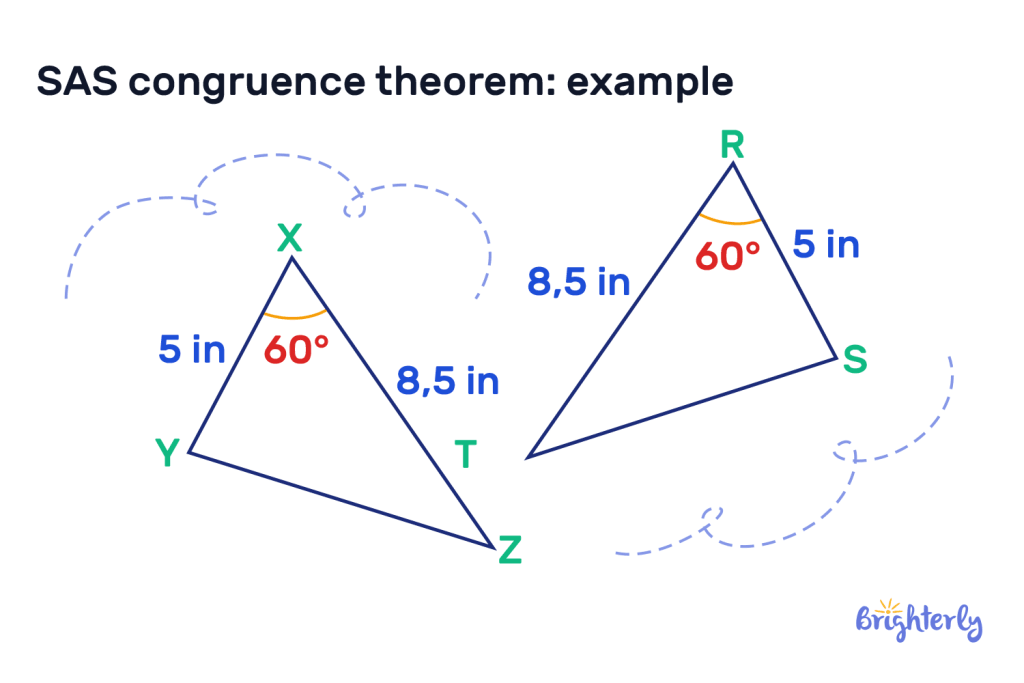
SAS Congruence Theorem: Example
Let’s take the example of two triangles that both have corresponding lengths of 5 inches and 8.5 inches, and the internal angle of those two sides is 60°. In this example, the triangles are congruent – i.e. they are the same shape and size.
SAS Similarity Rule
The SAS similarity rule states that if two triangles have two corresponding sides that are proportionate, with an internal angle that is the same across both sides, they are the same shape but in different sizes.
SAS Similarity Theorem: Example
Let’s look at a side side angle theorem example.
You have one triangle with two sides of 3cm and 6cm, with an angle of 45° between them. The second triangle has two sides of 6cm and 12cm, with an angle of 45° between them. Both of these triangles would have SAS similarity because they’re of the same ratio.
Solved Math Tasks: Examples
Here, we’ve included some solved math SAS triangle examples so you can practice your new-found knowledge of the SAS meaning.
Solved Math Task 1
If you have one triangle with two corresponding sides of 5cm and 8cm, with an internal angle of 90°, and a second triangle with corresponding sides of 10cm and 16cm and an angle of 90°, are they SAS triangles?
Answer:
| Yes, they fall under the side-angle-side similarity theorem. |
This is because 5cm and 8cm are proportionate to 10cm and 16cm.
Solved Math Task 2
Measure the lengths of the sides of these triangles and measure the marked-up internal angles with a protractor. Are they SAS triangles?
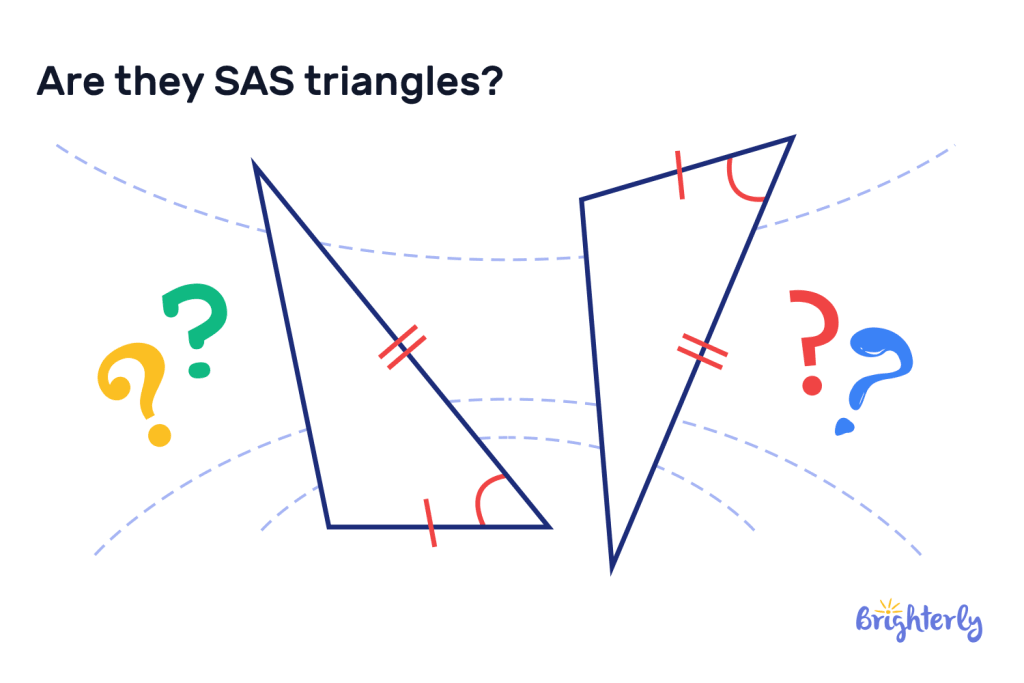
Answer:
| Yes, the triangles fall under the side-angle-side theorem, because the two pairs of sides corresponding to the angles are the same length. |
Side Angle Side: Practice Math Problems
Side Angle Side Worksheets
Now that you’ve learned about the side angle side theorem, put your knowledge to the test with our engaging math worksheets:
- Triangle congruence worksheets
- 45-45-90 and 30-60-90 triangle worksheets
- Similar triangles worksheets
- Types of triangles worksheets
Frequently Asked Questions
Is Side-Side Angle A Triangle Congruence?
No, SSA math is not a valid congruence rule. If you have two sides and an angle that is not trapped between them, you could actually draw two completely different triangles. This case is a bit more ambiguous, as it doesn’t guarantee the triangles are identical.
What Is SSS, SAS, ASA, And AAS Congruence?
These are the four shortcuts to prove triangles are identical:
- SSS – when all three sides match.
- SAS – when two sides and the angle between them match.
- ASA – for when two angles and the side between them match.
- AAS – when two angles and a side not between them match.
What Is An Example Of SAS?
Imagine two pairs of identical scissors. Both have 4-inch blades. If you open both pairs of scissors so that the angle between the blades is exactly 30°, the distance between the two tips of the scissors must be the same on both pairs.



Math & reading from 1st to 12th grade
Looking for homework support for your child?

Choose kid's grade

Math & Reading for Grades 1–12
Build real confidence for your child with a Brighterly math or reading tutor.