Transformation Geometry – Definition with Examples
Updated on July 29, 2026
Transformation geometry is the set of changes we can make to a figure’s size, shape, or position on a coordinate plane. Every transformation falls into one of two categories: rigid transformations, which keep a figure’s size and shape the same, and non-rigid transformations, which change them.
This article covers the main types of transformation, the coordinate rule for each, worked examples, and practice questions.
What Are Transformations in Geometry?
A transformation in geometry is a change made to a figure — such as a triangle, square, or circle — on a coordinate plane, altering its position, size, or shape. Rigid transformations (translation, reflection, and rotation) preserve size and shape; non-rigid transformations (dilation, and transformations of graphed functions) change them.
Transformations are one of the core building blocks of a full geometry tutor curriculum, since later topics like congruence and similarity both depend on understanding how figures move and resize on a coordinate plane.
Expert Math Tutors for Every Level
Connect with professional and certified educators who provide specialized support for every grade level, from elementary school basics to advanced algebra
Types of Transformations
There are four main types of transformation in geometry: translation, reflection, rotation, and dilation. A closely related fifth case is the transformation of functions graphed on a coordinate plane, such as quadratics, which follows similar principles but applies to a graphed equation rather than a fixed shape.
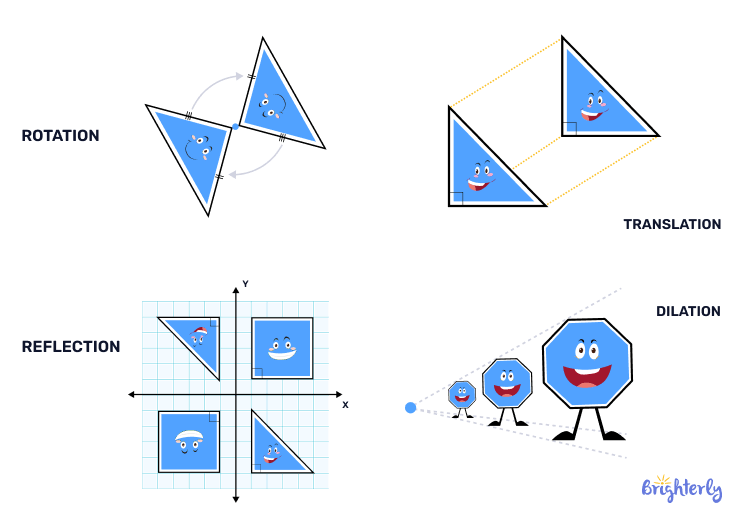
Translation
Translation slides a figure to a new position without changing its shape or size — a rigid transformation. After translating, the figure looks identical, just relocated on the coordinate plane.
Reflection
Reflection flips a figure over a line (called the axis of reflection) to produce its mirror image. Like translation, reflection is rigid — the size and shape stay the same, only the orientation flips.
Rotation
Rotation turns a figure around a fixed point, called the center of rotation, by a given angle. It’s also rigid: one point (the center) stays fixed while the rest of the figure moves to new coordinates, but the shape and size don’t change.
Dilation
Dilation makes a figure larger or smaller while keeping its proportions the same — a non-rigid transformation, since the size changes. A helpful comparison: your pupils dilate, growing larger or smaller depending on the light, while staying the same shape.
For more on how scale factors control this resizing, see our full dilation breakdown.
Transformation Rules and Formulas
Each transformation follows a specific coordinate rule that shows exactly how a point (x, y) moves. The table below summarizes the core rules for a coordinate plane centered at the origin.
| Transformation | Rule | Rigid? |
| Translation (horizontal, k units) | (x, y) → (x + k, y) | Yes |
| Translation (vertical, j units) | (x, y) → (x, y + j) | Yes |
| Reflection over the x-axis | (x, y) → (x, −y) | Yes |
| Reflection over the y-axis | (x, y) → (−x, y) | Yes |
| Rotation 90° clockwise | (x, y) → (y, −x) | Yes |
| Rotation 90° counterclockwise | (x, y) → (−y, x) | Yes |
| Rotation 180° | (x, y) → (−x, −y) | Yes |
| Rotation 270° clockwise | (x, y) → (−y, x) | Yes |
| Rotation 360° | (x, y) → (x, y) | Yes |
| Dilation (scale factor k) | (x, y) → (kx, ky) | No |
Reflection connects closely to symmetry, since a figure with a line of symmetry maps onto itself when reflected across that line.
Examples of Transformations in Real Life
- Reflection: your image in a mirror or in a still lake
- Translation: sliding a book across a table, or moving a piece on a game board
- Rotation: turning a steering wheel, or spinning a protractor around a fixed corner
- Dilation: a photo enlarged or shrunk to a different size while keeping its proportions
Hands-on geometry games for kids are an easy way to turn these four ideas into interactive practice rather than memorizing coordinate rules on paper.
Practice Questions on Geometry Transformations
- Translate the point (3, 5) by 3 units down and 5 units to the right. What are the new coordinates?
- Rotate the point (3, 3) 90° counterclockwise about the origin. Where does the point land?
- A square with side length 3 units is dilated by a factor of 2. What is the new side length?
Frequently Asked Questions on Transformation Geometry
What Is a Transformation in Geometry?
A transformation in geometry is a change made to a figure on a coordinate plane — its position, size, or shape. Transformations are either rigid (the figure’s size and shape stay the same, as in translation, reflection, and rotation) or non-rigid (size or shape changes, as in dilation).
What Are the Four Main Types of Transformation?
The four main types are translation (sliding), rotation (turning around a fixed point), reflection (flipping over a line), and dilation (resizing). Graphed functions, like quadratics, can undergo similar shifts and stretches, but that’s usually treated as a related, separate topic rather than a fifth core type.
What Are Transformation Rules?
Transformation rules are the specific coordinate changes each type of transformation applies to a point (x, y). For example, reflecting over the x-axis follows the rule (x, y) → (x, −y), while rotating 180° follows (x, y) → (−x, −y). Each transformation type has its own distinct rule.
What Is a Real-Life Example of a Geometric Transformation?
Seeing your reflection in a still lake or mirror is a reflection. Sliding a chair across a room is a translation, without changing the chair’s size or shape. Spinning a wheel around its center is a rotation, and enlarging a photograph while keeping its proportions is a dilation.
Which Transformations Are Considered Rigid?
Translation, reflection, and rotation are all rigid transformations, meaning the figure’s size and shape stay exactly the same — only its position or orientation changes. Dilation is the one common non-rigid transformation, since it changes the figure’s size while preserving its proportions.
How Do You Tell Rotation and Reflection Apart on a Coordinate Plane?
Rotation turns a figure around a fixed center point by a set angle, and every point moves along a circular path around that center. Reflection flips a figure over a line, producing a mirror image where the figure’s orientation reverses but no point travels along a curved path — comparing a few matching points to the axis of reflection usually makes the difference clear.


Math & reading from 1st to 12th grade
Looking for homework support for your child?

Choose kid's grade

Math & Reading for Grades 1–12
Build real confidence for your child with a Brighterly math or reading tutor.