What Is Mental Math? Definition and Examples
reviewed by Jo-ann Caballes
Updated on May 4, 2026
Mental math is the ability to solve math problems in your head without the use of paper, a calculator, or other tools. For example, you can add 25 + 15 by thinking “25 + 10 = 35, then + 5 = 40”. Read on what is mental math in detail, how it works, and why it is good for developing minds.
What Is Mental Math?
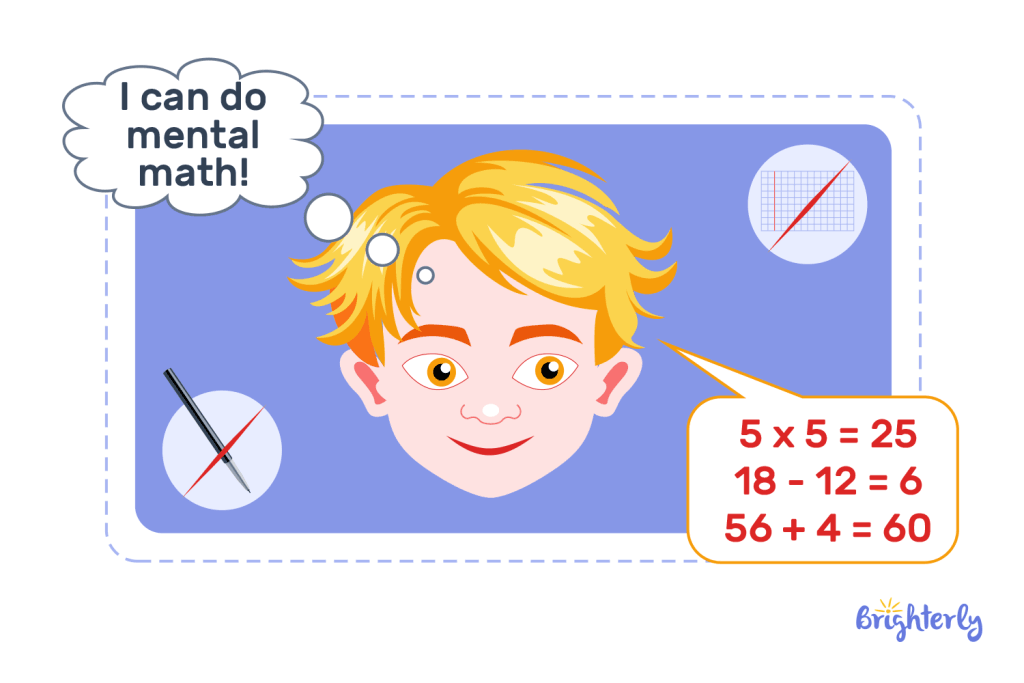
The mental math definition refers to solving math in your head without tools like pencils, paper, or calculators. When kids manipulate numbers and find solutions mentally, they rely on their understanding of numbers and basic operations rather than written methods. Mental arithmetic has practical use in everyday life as it helps calculate totals when shopping or estimating travel time.
Expert Math Tutors for Every Level
Connect with professional and certified educators who provide specialized support for every grade level, from elementary school basics to advanced algebra
Mental Math Examples for Kids
Simple Addition in Your Head
An easy way to explain doing math in head is through addition. For example, you can solve 18 + 12 by thinking “10 + 10 = 20, 8 + 2 = 10, then 20 + 10 = 30”.
Quick Subtraction Strategies
Subtraction becomes faster when you round numbers. To solve 52 – 9, think “52 – 10 = 42, then + 1 = 43 to get the final”.
Easy Multiplication Tricks
For mental math multiplication, use factorization. For instance, 25 x 4 becomes “25 x 2 = 50, then x 2 = 100”.
Basic Division Thinking
To divide in your head, break down numbers. For example, for 128 / 4, try “120 / 4 + 8 / 4 = 30 + 2 = 32”.
Math tutoring built for your little one!
Learn mental math with professional math teachers, starting from $17.70/lesson.


How Mental Math Works
Understanding Number Sense
Mental math develops from number sense – the skills to work with numbers. Number sense helps children understand how numbers relate and change and eliminates the need to calculate step by step by recognizing patterns, estimating values, and seeing that 49 is close to 50 and adding 9 is similar to adding 10. Developing math intuition supports faster, more accurate mental arithmetic.
Breaking Numbers Into Parts
Breaking down numbers is key in mental math, helping students manage operations with complex values. Decomposition requires seeing the smaller parts of large numbers, like tens and ones. For instance, subtracting 29 is the same as subtracting 20 and then 9 from what’s left. The flexibility allows faster thinking when doing math in your head.
Using Patterns and Memory
Seeing patterns and growing memory are essential in mental math as kids learn to recognize familiar number bonds instead of relying on repeated drills. Your children need to understand and instantly recall different patterns in numbers, such as common sum or multiplication facts. Recognition skills help solve mathematical problems efficiently.
Is Mental Math Difficult for Children?
Mental math is not inherently difficult for children, and how successfully kids are able to calculate in their heads depends on their age, way of thinking, and the support they have received. Some children find mental arithmetic easy, while others need time to build skills and confidence. With the right effort and help, most kids become comfortable solving questions without tools.
The difficulty of mental math for your child depends on:
- Age: Younger kids (below 5) are still developing a basic understanding of numbers, so they find it challenging to calculate in their head.
- Experience: Learners who practice regularly become faster and more accurate over time.
- Cognitive development: Skills like working memory and concentration affect how easily your child can process numbers mentally.
- Learning pace: Every child learns differently, so some kids take more time to build math fluency.
Note: Experiencing troubles with mental math may be a sign your kid needs qualified support. Brighterly math tutors recognize the importance of an adapted approach when teaching mental math skills.
Personalized mental math support for your child!
Brighterly can help your child improve their skills based on their strengths & needs.
Is Mental Math Good for Kids?
Mental math is good for kids as it:
- Improves memory and concentration. Mental math develops memory and concentration because your child is holding and manipulating numbers in their mind. A 2024 study in the PLoS One journal shows a strong link between mental arithmetic skills and cognitive functions like working memory, processing speed, and focus. When your child is adding numbers mentally, they need to remember partial results temporarily, which strengthens their ability to focus and retain information.
- Builds confidence in math. Mental math builds confidence as your kid learns to rely on their own thinking instead of external tools. Solving problems in their head, students develop a sense of control and independence. When your little one calculates the cost of groceries, they experience a small success moment.
- Supports school performance. Mental math for kids can also lead to better academic performance in math, STEM subjects, and beyond. The stronger memory, concentration, and confidence have positive spillover effects over all disciplines as key characteristics of successful learners. If your child remembers easily, they can learn a science fact and memorize vocabulary effortlessly.
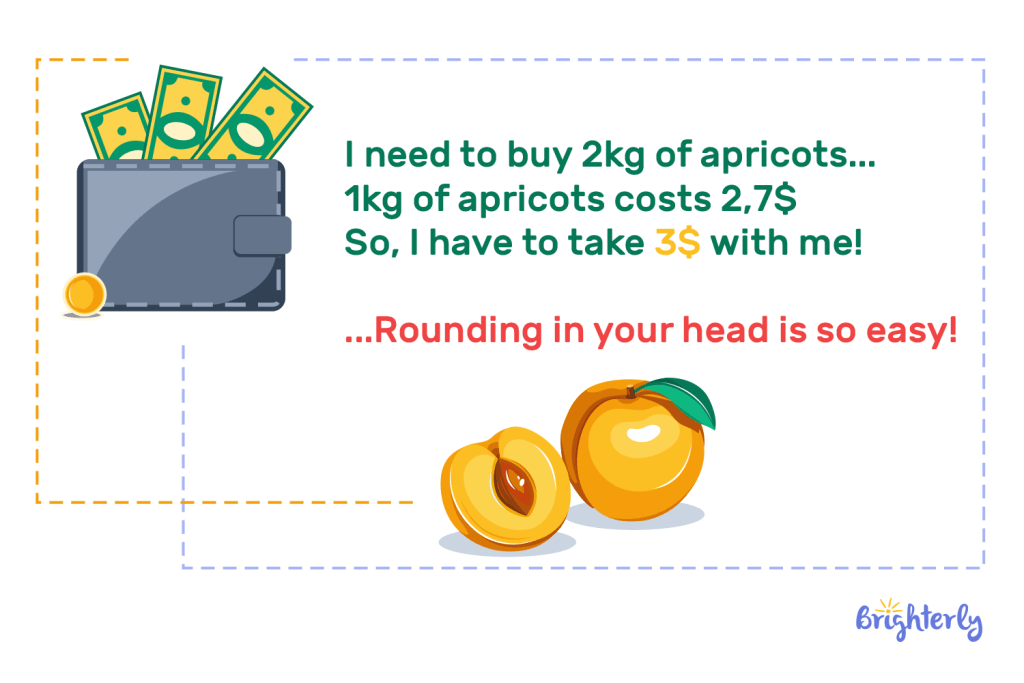
- Helps in everyday situations. What does mental math mean in everyday life? Mental arithmetic finds frequent use in everyday situations, allowing kids to make quick calculations without tools. Children can estimate totals, compare numbers, and estimate time. With mental math, your child can instantly check whether they received the correct change when shopping.
What Age Can Kids Start Mental Math?
Most kids get the mental math meaning around ages 5-6 when they develop basic number sense. You should work on skills gradually, moving from simple calculations to more flexible thinking as your child gains experience and confidence. Each kid progresses at their own pace.
| Age | Mental Math Concepts |
| 5-7 years |
Basic number understanding Simple addition & subtraction Early number sense |
| 8-10 years |
Simple mental math strategies Breaking down numbers Recognizing patterns |
| 10+ years |
Flexible thinking Combining strategies Solving more complex problems mentally |
Mental Math Techniques Explained Simply
After figuring out what’s mental math and why it matters, you should look into these 4 practical methods to build mental math skills:
- Rounding & adjusting
29 + 37 => 30 + 37 = 67, then -1 = 66
- Doubling & halving
14 x 25 => 8 x 50 = 400
- Using friendly numbers
49 + 28 => 50 + 28 = 78, then – 1 = 77
- Breaking numbers apart
36 + 27 => 30 + 20 = 50, 6 + 7 = 11, and 50 +11 = 61
Mental Math vs Traditional Written Math
| Aspect | Mental Math | Written Math |
| Speed | Faster | Slower |
| Accuracy | Dependent on skills | Generally more accurate |
| Use | Everyday life situations | Complex math problems |
| Tools | None |
Paper Pencil Calculator |
| Learning focus |
Number sense Flexibility |
Step-by-step structure & accuracy |
| Cognitive effort | Strong working memory & concentration | Less memory load |
How Children Learn Mental Math
Children learn mental math gradually, perfecting skills over time as they become more comfortable working with numbers in their head. Learning doesn’t happen at once as kids first develop a basic understanding of what is mental math for 3rd grade and beyond and then move towards more creative thinking. To succeed, match learning with your child’s age and level to avoid discouragement.
Consistency supports getting used to mental math. Regular exposure strengthens your child’s memory and helps them recognize patterns and gain confidence to progress. Steady mental math practice allows your kid to solve increasingly more complex problems efficiently without relying on written methods.
Mental Math Myths vs Reality
| Mental Math Myth | Reality |
| Mental math is for gifted kids only. | Any child can develop mental math skills with time and practice. |
| Mental math requires special tricks. | Children rely on understanding numbers, patterns, and basic concepts. |
| Mental math replaces written math. | Written math is still important for solving complex problems. |
When Kids Struggle With Mental Math
Your child might struggle with mental math despite your efforts. Signs include frustration, slow thinking, and difficulty when calculating in their head. Challenges are common and mean that your kid needs more time and support.
You can help your kid by remaining patient, focusing on basic skills, and offering short daily practice. If difficulties continue, you can try guided assistance, such as personalized help from our experienced tutors.
Solved Math Tasks: Examples
Ready to put your mental math skills to the test? We’ve put together some solved math tasks that can be answered through mental math – try them out and check your answers to see how many you’ve got right.
Solved Math Task 1
You’re buying a sweater for $15 and you need to add a 4% sales tax to work out your final price. Solve this in your head.
Answer:
| $15.60. |
One way of working this out via mental math is to first work out 1% of $15, which is 15 cents. Then, multiply that by 4 – 60 cents – and add it to your $15. $15 + 60 cents = $15.60.
Solved Math Task 2
You’re shopping for groceries and you have items with the following prices:
- $1.50
- $4.39
- $2.98
- $5.16
Using rounding to the nearest dollar, estimate how much your total will be.
Answer:
| $14. |
$1.50 rounds up to $2, $4.39 rounds down to $4, $2.98 rounds up to $3 and $5.16 rounds down to 5. $2 + $4 + $3 + $5 = $14.
Mental Math Practice Problems
Mental Math Worksheets
When it comes to mental math, practice makes perfect. These worksheets are designed to help you build your mental math skills with math equations, problems and puzzles that you’ll learn to solve using just your brain.
- Basic multiplication worksheets
- Addition without regrouping worksheets
- Multiplication tables 1-12 worksheets
- Math facts worksheets
Frequently Asked Questions FAQ
How Can Children Improve Mental Math?
Children can improve mental math skills by practicing daily, building strong number sense, and learning simple strategies like rounding and breaking numbers apart. Regular exposure to mental arithmetic develops speed and confidence, and a personal math trainer can help build the foundations required for calculating in your head.
Is Mental Math the Same as Abacus?
Mental math and the abacus are related but different math concepts. Mental math means solving problems in your head by using special techniques. Meanwhile, abacus refers to a physical tool that helps visualize calculations. Some children use abacus training to develop mental math skills, but it’s not a must.
What Is an Example of Mental Math?
A mental math example is solving a problem like 57 + 25 by thinking “57 + 20 = 77, then + 5 = 82” without writing numbers down. Mental calculations use simple strategies to break numbers apart or adjust them to make addition, subtraction, multiplication tables, and division easier.
Why Is Mental Math Important for Kids?
Mental math is important for kids because it improves working memory and concentration, supports academic development, and helps address everyday situations like shopping and playing games efficiently. Doing math in their head makes children more confident and flexible when working with numbers.
Is Mental Math Related to IQ?
Mental math is positively correlated to IQ although it doesn’t measure intelligence directly. Improving mental arithmetic skills helps strengthen thinking abilities that support working memory, processing speed, and learning abilities which also affect IQ. Your child can improve their mental math and IQ by developing the right strategies and techniques.


Math & reading from 1st to 12th grade
Looking for homework support for your child?

Choose kid's grade

Math & Reading for Grades 1–12
Build real confidence for your child with a Brighterly math or reading tutor.