Reviewed by Abigail Basilio
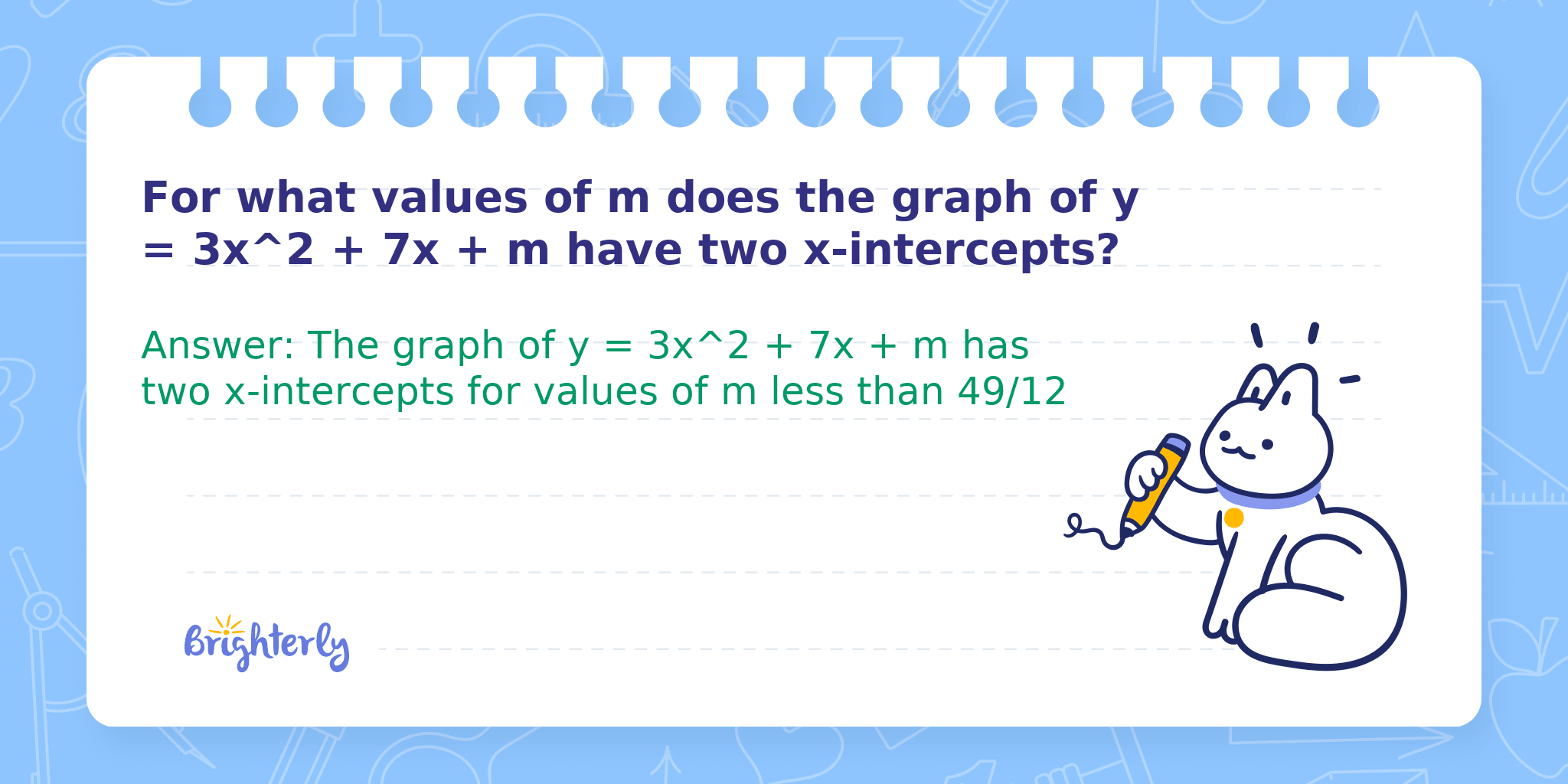
For what values of m does the graph of y = 3x^2 + 7x + m have two x-intercepts?
Answer: The graph of y = 3x^2 + 7x + m has two x-intercepts for values of m less than 49/12
The equation y = 3x^2 + 7x + m represents a quadratic function. The x-intercepts (real roots) of this quadratic occur where y = 0. For the graph to have two distinct x-intercepts, the quadratic equation must have two real solutions, which happens if its discriminant is positive.
Methods
Math Tutor Explanation Using the Discriminant Method
To determine for which values of m the quadratic equation has two x-intercepts, examine the discriminant from the quadratic formula.
Step 1: Write down the discriminant formula: D = b^2 - 4ac
Step 2: Substitute a = 3, b = 7, and c = m into the formula to get D = 7^2 - 4 × 3 × m
Math Tutor Explanation Using Analysis of the Parabola
Understand how the value of m affects the position of the graph and its intersection with the x-axis.
Step 1: Realize that the vertex moves up and down as m changes
Step 2: Two x-intercepts exist when the entire parabola crosses the x-axis twice, which depends on the value of m in relation to the discriminant being positive
Step 1:
Step 2:
Math Tutor suggests: More Practice with Quadratic Graphs and X-Intercepts
Deepen your understanding of quadratic equations, their graphs, and how to determine the number of x-intercepts by exploring these related exercises.
FAQ on Quadratic Equations and X-Intercepts
What is the discriminant and why is it important?
The discriminant determines the number and type of solutions a quadratic equation has; if it is positive, there are two real roots (two x-intercepts).
What happens if the discriminant equals zero?
The quadratic has exactly one real root, so the graph touches the x-axis at one point (a repeated or 'double' root).
What happens if the discriminant is negative?
There are no real roots, so the graph does not cross the x-axis.
Does changing m only affect the y-intercept?
Changing m shifts the whole parabola up or down, which also affects the number of x-intercepts.
How can I quickly determine the number of x-intercepts for a quadratic graph?
Calculate the discriminant (b^2 - 4ac); positive values mean two x-intercepts, zero means one, and negative means none.
Explore Math Support Options
Find the perfect academic boost for your child through our comprehensive homework assistance and engaging programs that make learning fun and effective
Math & reading from 1st to 12th grade
Looking for homework support for your child?
Choose kid's grade

Math & Reading for Grades 1–12
Build real confidence for your child with a Brighterly math or reading tutor.