Point of View Worksheets (10 Grade)
Updated on August 31, 2026
Recognizing who is telling a story—and how much that narrator can see and know—shapes how tenth graders interpret everything from a novel’s tension to an argument’s bias. Point of view worksheets give students focused practice separating first-person, second-person, and third-person limited or omniscient narration, then explaining how each choice changes what the reader learns. Because pinning down narrative perspective in dense texts takes guided practice, a literature tutor can walk a student through tricky passages until the distinctions become second nature.
Point of View Worksheets: Examples
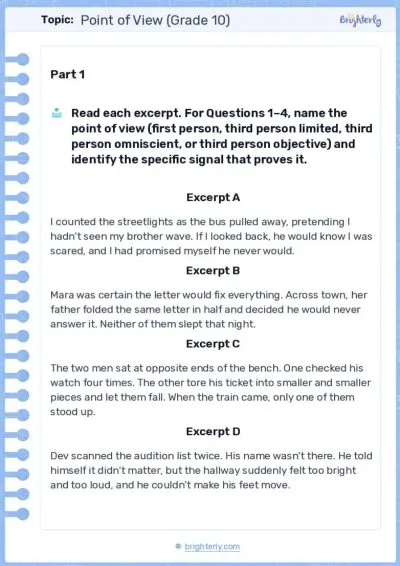
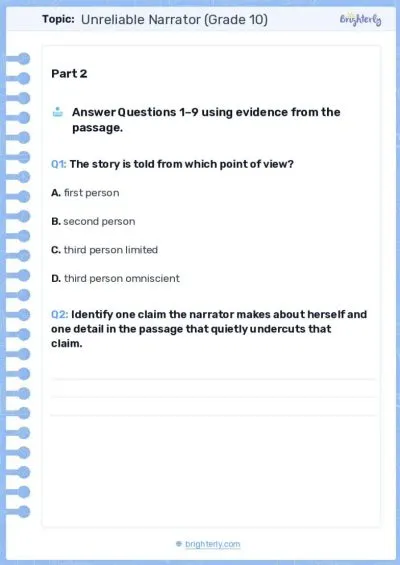
Download Point of View Worksheet PDFs
These free, printable PDFs ask students to identify the narrator, mark the pronouns and clues that reveal perspective, and judge how a shift in viewpoint would change the passage.
More story elements worksheets
Keep building the story-analysis toolkit with closely related printables on character, authorial intent, and genre—each one reinforcing how the pieces of a narrative work together.
- point of view worksheet
- character analysis worksheet
- author’s purpose worksheet
- story elements worksheets
- genre worksheets


Help your child reach their full potential!
Answer a few quick questions about your child’s learning, and we’ll recommend next steps.
Benefits of Point of View Worksheets
Working through point of view worksheets trains tenth graders to spot the narrator quickly and to explain how first-person intimacy, second-person address, or third-person distance shapes what a text reveals and withholds.
As students underline textual evidence to justify each identification, they move past plot summary and start weighing an author’s intent, bias, and reliability—the kind of close reading college coursework demands.
For teachers and homeschooling families, each sheet doubles as a quick diagnostic, showing exactly where a student confuses limited and omniscient narration or overlooks the clues that signal a perspective shift.


Math & reading from 1st to 12th grade
Looking for homework support for your child?

Choose kid's grade

Math & Reading for Grades 1–12
Build real confidence for your child with a Brighterly math or reading tutor.