Area of Polygons Worksheets
Updated on October 21, 2026
Mastering the area of polygons is an essential skill for high school geometry students working with both regular figures — hexagons, pentagons, octagons — and irregular shapes decomposed into familiar triangles and quadrilaterals.
Regular polygon problems require applying the apothem formula, while irregular polygons call for decomposition strategies that rely on the same basic area formulas used across all of geometry. Applying the apothem formula to regular hexagons and pentagons is a technique that becomes clearer when a geometry tutor explains the geometric reasoning behind why it works, not just the procedure.
Area of Polygons Worksheets: Examples
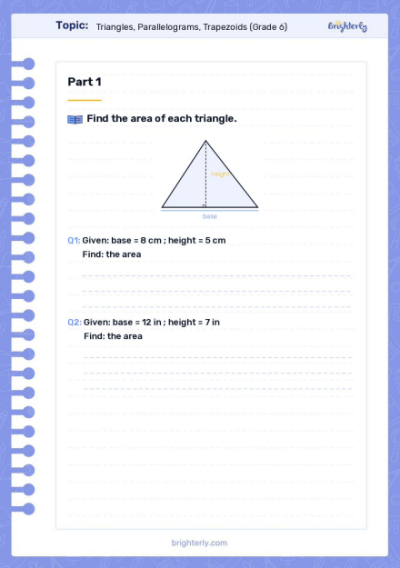
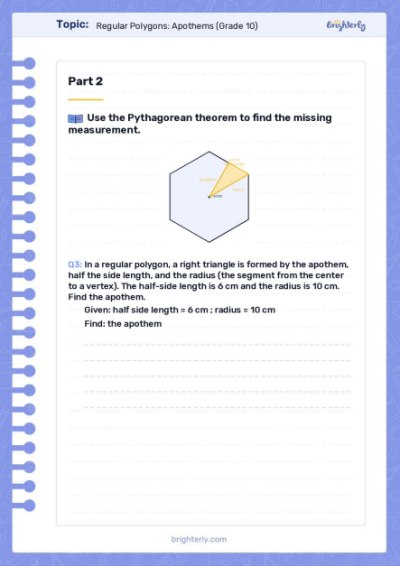
The area of a regular polygon can be found using the apothem formula: A = ½ × apothem × perimeter. For a regular hexagon with side length 10 and apothem 8.66, the area is A = ½ × a × P = ½ × 8.66 × (6 × 10) = ½ × 8.66 × 60 = 259.8 square units.
Download Area of Polygons Worksheet PDFs
Get our comprehensive collection of printable documents to help students practice finding the area of various polygons using side lengths, apothems, and decomposition methods.
More area worksheets
Build your polygon area fluency with these closely related resources — covering triangles, rectangles, trapezoids, parallelograms, and circular regions that appear as components when decomposing complex polygonal figures.
- Area of a triangle worksheets
- Area of a rectangle worksheets
- Area of a trapezoid worksheets
- Area of parallelogram worksheets
- Area of a circle worksheets
- Area of composite figures worksheets
- Parallelogram worksheets


Help your child reach their full potential!
Answer a few quick questions about your child’s learning, and we’ll recommend next steps.
Benefits of Area of Polygons Worksheet
Builds Algebraic and Trigonometric Fluency
Practicing with an area of polygons worksheet provides students with a rigorous framework for applying algebraic and trigonometric principles to geometric figures. By engaging with these problems, learners master complex calculations — including those requiring both the apothem and perimeter of a polygon — and develop critical thinking by decomposing irregular polygons into triangles and quadrilaterals. Mastery of these concepts is vital for success in calculus and trigonometry, where understanding the properties of plane figures is a prerequisite.
Builds From Basic Shapes to Advanced Decomposition
Students start by applying the standard area formulas for triangles, parallelograms, and trapezoids, then progress to composite figures — shapes made by combining or subtracting simpler ones, like an L-shaped room or a house-shaped outline made of a rectangle and a triangle. This progression mirrors how geometry is taught across grade levels: foundational formulas first, then the problem-solving skill of breaking a complex shape into pieces you already know how to measure.
Connects Geometry to Algebra on the Coordinate Plane
Later problems ask students to find the area of a polygon plotted on a coordinate grid, using the vertices’ coordinates rather than given side lengths. This bridges geometry and algebra directly, since students must first determine lengths and distances from coordinate points before applying a familiar area formula — a skill that carries forward into analytic geometry and precalculus.
Prepares Students for Real-World Applications
These activities also prepare students for real-world applications in architecture, engineering, and data science, where precise area calculations are necessary for design and analysis. Consistent use reinforces key geometric theorems while improving multi-step problem-solving accuracy and speed.
Frequently Asked Questions
What Grade Is Area of Polygons For?
Area of polygons spans Grade 6 through Grade 10 — starting with basic triangles, parallelograms, and trapezoids, progressing through composite figures and coordinate geometry, and culminating in regular polygons using the apothem formula.
What Is an Apothem?
An apothem is the distance from the center of a regular polygon to the midpoint of one of its sides, measured perpendicular to that side. It’s used in the formula A = ½ × apothem × perimeter.
Do These Worksheets Include an Answer Key?
Yes. Every area of polygons worksheet includes a complete answer key with full step-by-step solutions, so students can check their work.


Math & reading from 1st to 12th grade
Looking for homework support for your child?

Choose kid's grade

Math & Reading for Grades 1–12
Build real confidence for your child with a Brighterly math or reading tutor.