Printable Business Math Worksheets in PDF: Discounts, Interest, and Budgeting Practice
Updated on August 26, 2026
These free printable worksheets give grade 7 and grade 8 students practice applying math to real-life money situations, like calculating discounts, interest, and budgets. Each worksheet includes an answer key, so students can check their own work.
Problems are written as word problems that mirror situations students will recognize, from shopping discounts to insurance premiums. For more advanced practice, explore Brighterly’s 9th grade math worksheets hub.
Business Math Worksheets: Free Download
This topic is available as four downloadable worksheet files:
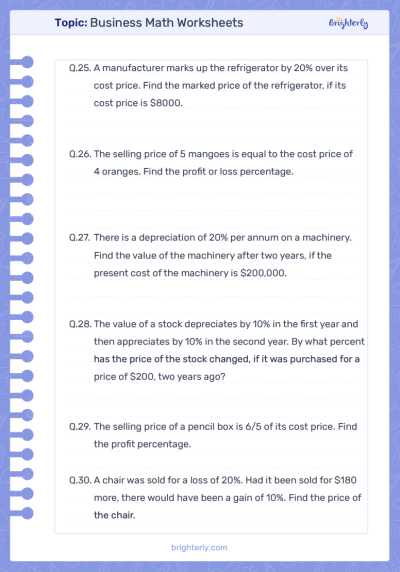
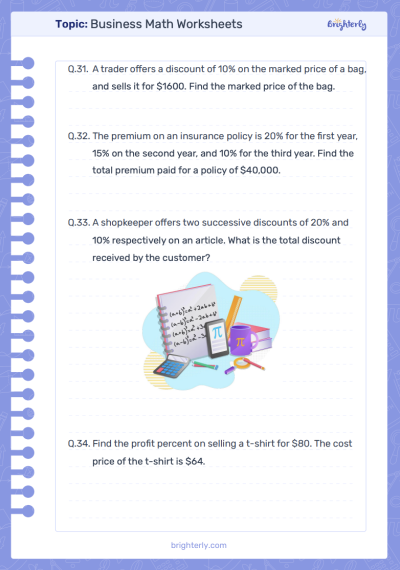
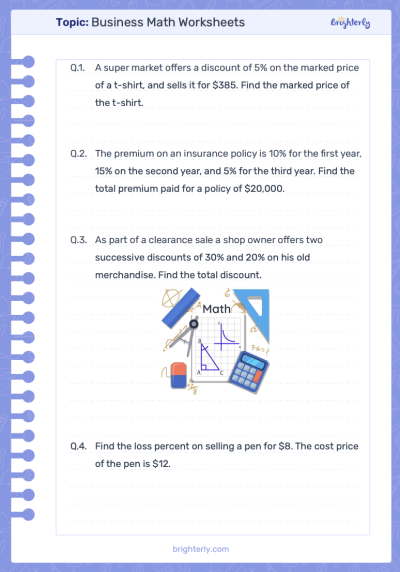
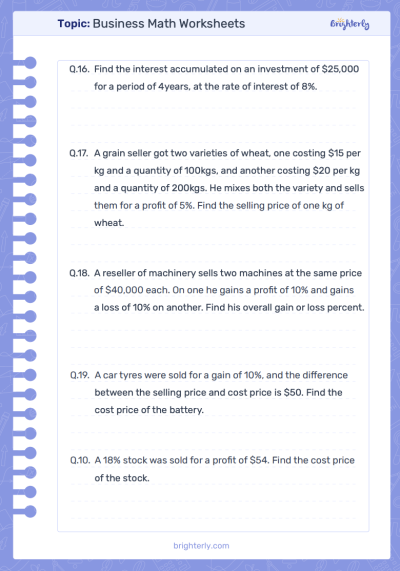
Calculating Discounts
Many business math problems ask students to work backward from a sale price to find the original price, or to combine more than one discount on the same item.
Worked Example: Finding the Original Price
Dale bought a saucepan on sale for 30% off and saved $6.75 from the original price. Find the original price.
- The $6.75 savings is 30% of the original price.
- Original price = 6.75 ÷ 0.30 = $22.50
Original price = $22.50
Worked Example: Combining Two Successive Discounts
A shopkeeper offers two successive discounts of 20% and 10% on an article. What is the total discount received by the customer?
- After the first 20% discount, the price is 80% of the original.
- After the second 10% discount, that reduced price becomes 90% of itself: 0.80 × 0.90 = 0.72, or 72% of the original.
- Since the final price is 72% of the original, the total discount is 100% − 72% = 28%.
Total discount = 28% — not the 30% you’d get by simply adding the two percentages together.
Calculating Simple Interest
Simple interest is calculated with the formula I = P × r × t, where P is the principal (the amount invested or borrowed), r is the annual interest rate written as a decimal, and t is the time in years.
Worked Example: Find the simple interest on a $2,000 deposit at an annual rate of 5% over 3 years.
- I = P × r × t
- I = 2000 × 0.05 × 3
I = $300
Budgeting Practice
Budgeting problems ask students to apply a percentage to an amount of money, such as figuring out how much to save or spend.
Worked Example: A student earns $45 from chores this month and wants to save 40% of it. How much should they set aside?
- Savings = 45 × 0.40
Savings = $18
Quick Answer Check for This Worksheet’s Problems
- Marked price of the bag (10% discount, sold for $1,600): $1,777.78
- Total premium on a $40,000 policy (20% + 15% + 10% over three years): $18,000
- Total discount from two successive discounts of 20% and 10%: 28%
- Original price of the saucepan (30% off, saved $6.75): $22.50
More Math and Business Worksheets
Once your child is confident with business math, explore more of Brighterly’s related practice:
- Percent of Change Worksheets
- Percent Error Worksheets
- 7th Grade Integers Worksheets
- 7th Grade Probability Worksheets
- 7th Grade Math Worksheets
What Kids Practice With These Business Math Worksheets
- Calculating discounts and working backward to find an original price
- Understanding how successive discounts combine
- Calculating simple interest using the formula I = P × r × t
- Applying percentages to budgeting and everyday money decisions
- Checking work against an included answer key
Each worksheet includes an answer key, so students can check their own results without waiting for a teacher to grade the page. Working through discounts, interest, and budgeting side by side shows students how the same percentage skills apply across different real-life money situations.


Help your child reach their full potential!
Answer a few quick questions about your child’s learning, and we’ll recommend next steps.
FAQ
How do you calculate a discount price?
To find a sale price, subtract the discount percentage from 100% and multiply that by the original price. For example, a 20% discount leaves 80% of the original price. To work backward from a sale price or savings amount to the original price, divide instead of multiplying, as shown in the worked examples above.
How do two successive discounts combine?
Two successive discounts don’t simply add together. Instead, each discount applies to the price left over after the previous one, so a 20% discount followed by a 10% discount leaves 72% of the original price, for a total discount of 28% rather than 30%. This is a common mistake worth double-checking.
How do you calculate simple interest?
Simple interest is calculated with the formula I = P × r × t, where P is the principal amount, r is the annual interest rate as a decimal, and t is the time in years. For example, $2,000 at a 5% annual rate for 3 years earns 2000 × 0.05 × 3, or $300, in simple interest.
What grade level are these business math worksheets for?
These worksheets are written for grade 7 and grade 8 students who already have a foundation in percentages, decimals, and basic algebra. Problems apply those skills to real-life situations like discounts, insurance premiums, and interest, matching the level where students start connecting classroom math to everyday money decisions and personal finance.
Does this worksheet include an answer key?
Yes, this business math worksheet includes an answer key. Students can check their own results as soon as they finish a problem, which helps them catch mistakes in a percentage or interest calculation right away, instead of waiting for a teacher to grade the assignment before finding out what went wrong.


Math & reading from 1st to 12th grade
Looking for homework support for your child?

Choose kid's grade

Math & Reading for Grades 1–12
Build real confidence for your child with a Brighterly math or reading tutor.