Conic Sections Worksheets
Updated on September 4, 2026
Conic sections worksheets give students practice identifying, graphing, and deriving equations for circles, parabolas, ellipses, and hyperbolas by completing the square to convert general form to standard form and locating key features including foci, vertices, directrices, and asymptotes. Students work through classifying conics from their equations, sketching graphs with correctly placed features, and writing equations from geometric descriptions. Students who can identify a conic from its equation but struggle to graph it accurately — placing foci of ellipses and other key features in the correct position — will develop that spatial precision faster when working with a geometry tutor focused on coordinate geometry applications.
Download Conic Sections Worksheet PDFs
Access our collection of printable PDF resources designed to help students practice identifying, graphing, and writing equations for all four conic types.
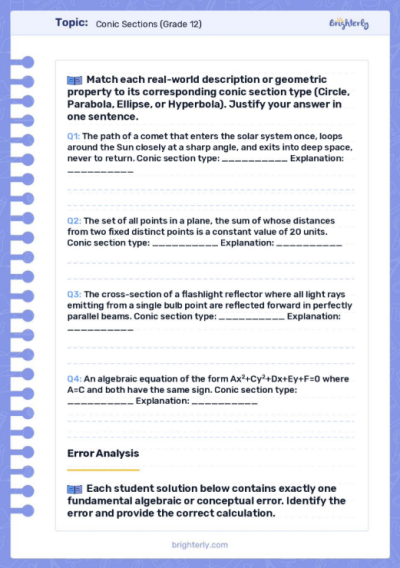
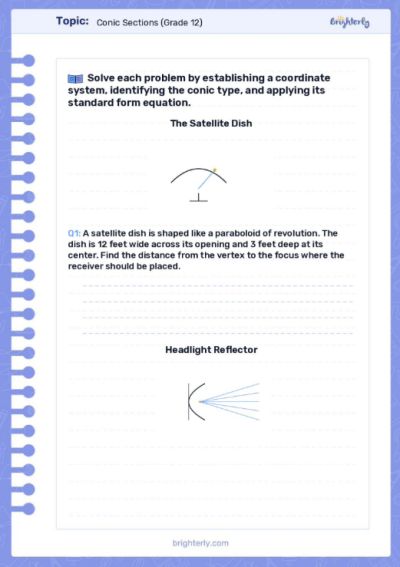
More coordinate geometry worksheets
Develop the completing-the-square skills and graphing fluency that conic sections require with these related resources covering quadratic equations, circle properties, and advanced algebra techniques.
- geometry worksheets
- algebra 2 worksheets
- circle worksheets
- circles curriculum worksheets
- completing the square worksheets


Help your child reach their full potential!
Answer a few quick questions about your child’s learning, and we’ll recommend next steps.
Benefits of Conic Sections Worksheets
Conic sections worksheets develop the ability to move fluidly between a conic’s algebraic equation and its geometric graph. Students practice completing the square to extract the standard form, then use that form to identify center, vertices, foci, and asymptotes — features that cannot be read directly from the general form equation.
Working through diverse problem sets builds proficiency in recognizing which conic a given equation represents by analyzing its coefficients, a classification skill that is fundamental in AP Precalculus and college algebra. Students also learn how changes in the equation — shifting the center or changing the eccentricity — affect the graph’s shape and orientation.
Real-world applications including telescope mirror design (parabolic reflectors), satellite dish geometry, and planetary orbit modeling (elliptical paths) give students concrete reasons why each conic type matters in physics and engineering.
Consistent worksheet practice builds the algebraic precision — particularly in completing the square and applying the distance formula — needed for success on standardized tests and in university courses where conic sections appear in analytic geometry, calculus, and physics.


Math & reading from 1st to 12th grade
Looking for homework support for your child?

Choose kid's grade

Math & Reading for Grades 1–12
Build real confidence for your child with a Brighterly math or reading tutor.