Exponential and Logarithmic Functions Worksheets
Updated on September 4, 2026
Exponential and logarithmic functions worksheets give students practice converting between exponential and logarithmic forms, applying the product, quotient, and power rules of logarithm rules, solving equations where the variable is in the exponent, and modeling exponential growth and decay scenarios. Students work through inverse relationships between exponential and log forms, change-of-base calculations, and graphing transformations of each function type. Students who can evaluate logarithms mechanically but struggle to connect exponential models to real applications — compound interest, radioactive decay, population dynamics — develop stronger intuition when they work through concrete examples with an algebra tutor.
Download Exponential and Logarithmic Functions Worksheet PDFs
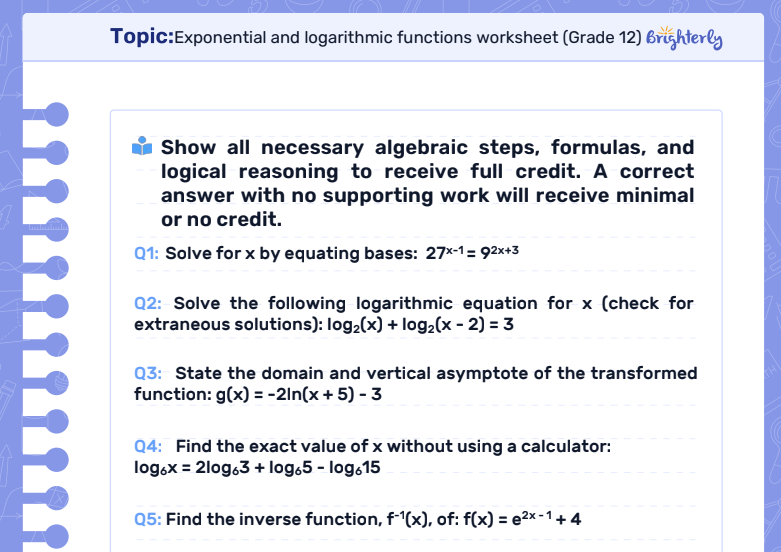
Access high-quality, printable PDF resources designed to help students practice solving exponential equations, applying logarithm rules, and graphing exponential and logarithmic transformations.
More algebra and function worksheets
Strengthen your exponent and function fluency with these related resources covering exponent rules, rational exponents, solving exponential equations, and algebraic function techniques.
- logarithmic worksheets
- solving exponential equations worksheets
- rule of exponents worksheets
- properties of exponents worksheets
- rational exponents worksheets


Help your child reach their full potential!
Answer a few quick questions about your child’s learning, and we’ll recommend next steps.
Benefits of Exponential and Logarithmic Functions Worksheets
Exponential and logarithmic functions worksheets develop fluency with the inverse relationship between these two function types — a conceptual understanding that is more powerful than mechanical formula memorization. Students practice converting freely between forms, which builds the flexibility needed for equation solving and function analysis.
Working through applications of the log rules (product, quotient, power) builds the algebraic manipulation skills needed to simplify complex logarithmic expressions and solve equations where the variable appears inside a log or in an exponent. These skills are prerequisites for calculus topics including logarithmic differentiation and integration of exponential functions.
Modeling exercises — compound interest using A = P·e^(rt), population growth, and radioactive decay — help students connect the abstract function to measurable real-world quantities. The change-of-base formula practice ensures students can evaluate any logarithm using a standard calculator.
Graphing transformations of both function types reinforces understanding of asymptotic behavior and domain restrictions, concepts that appear throughout calculus when analyzing function limits and continuity.


Math & reading from 1st to 12th grade
Looking for homework support for your child?

Choose kid's grade

Math & Reading for Grades 1–12
Build real confidence for your child with a Brighterly math or reading tutor.