Law of Sines Worksheets
Updated on September 4, 2026
Law of sines worksheets give students structured practice applying the sine rule — a/sin A = b/sin B = c/sin C — to oblique triangles where standard right-triangle methods do not apply. Students work through ASA, AAS, and SSA configurations, setting up and solving proportions to find missing sides and angles, including the ambiguous SSA case where zero, one, or two valid triangles may exist. Working through the SSA ambiguous case — where zero, one, or two valid triangles may exist — will find the reasoning much clearer when guided by high school math tutors who can walk through each configuration step by step.
Download Law of Sines Worksheet PDFs
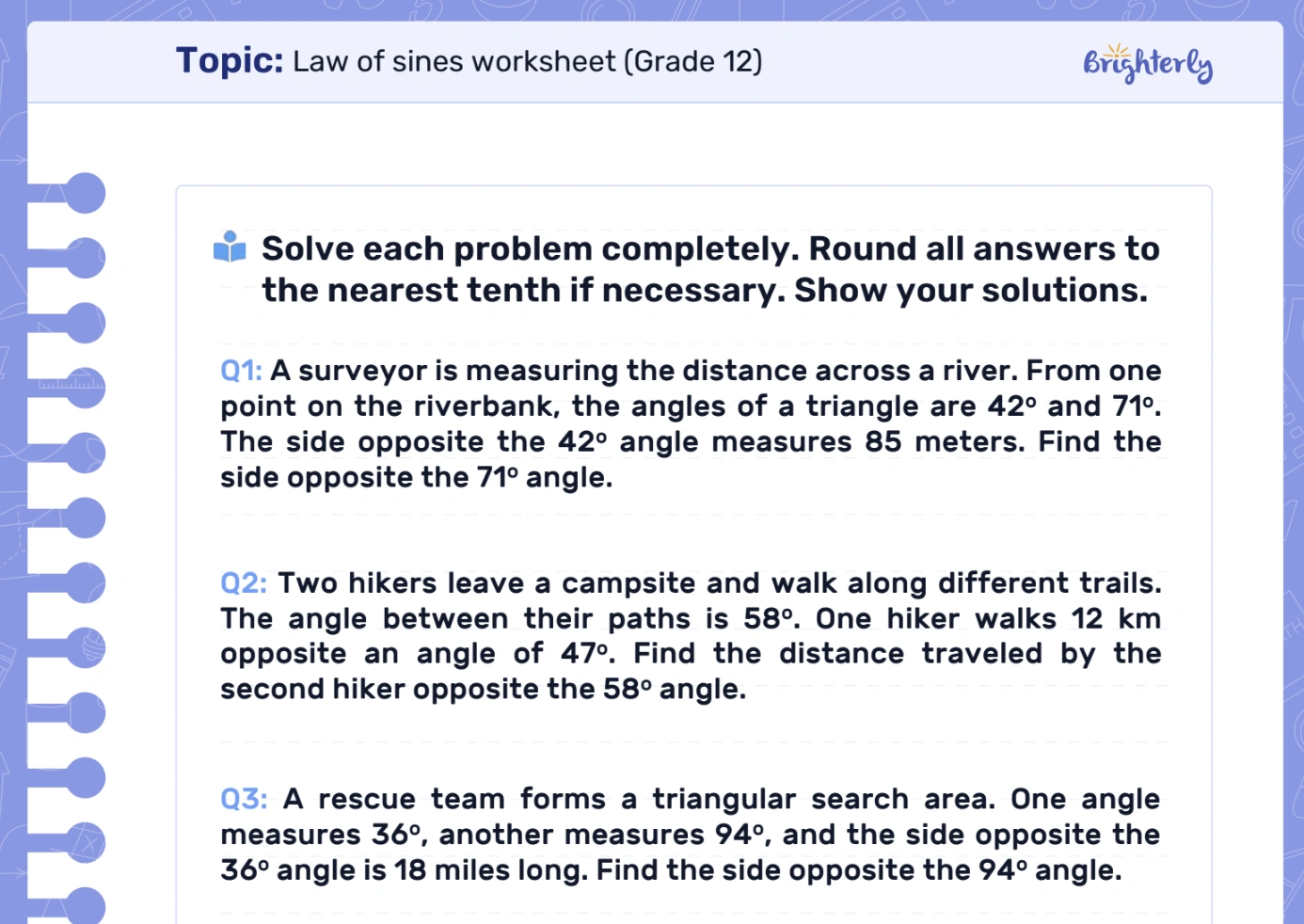
Access our collection of high-quality, printable PDF resources designed to help students practice applying the sine rule to ASA, AAS, and SSA triangle configurations.
More triangle and trigonometry worksheets
Practice solving oblique triangles and applying angle-side relationships with these closely related resources covering trig ratios, special triangles, and interior angle calculations.
- trigonometry worksheets
- special right triangles worksheets
- 45-45-90 and 30-60-90 triangles worksheets
- angles in a triangle worksheets
- missing angles in triangles worksheets


Help your child reach their full potential!
Answer a few quick questions about your child’s learning, and we’ll recommend next steps.
Benefits of Law of Sines Worksheet
Using law of sines worksheets builds fluency in analyzing non-right triangles — a skill that standard Pythagorean methods cannot address. Students learn to set up proportions between side lengths and their opposite angles, then solve for unknowns using algebraic manipulation and inverse sine functions.
Structured practice with ASA and AAS cases develops speed and accuracy in multi-step proportion solving. Students also learn to use a trigonometric table or calculator efficiently when working with non-standard angle measures.
The SSA ambiguous case — where students must determine whether zero, one, or two triangles exist — develops conditional reasoning that extends well beyond trigonometry into logic and proof-based mathematics.
These skills transfer directly to navigation, engineering, and architectural design, where oblique triangle relationships model real distances and angles that cannot be measured directly.


Math & reading from 1st to 12th grade
Looking for homework support for your child?

Choose kid's grade

Math & Reading for Grades 1–12
Build real confidence for your child with a Brighterly math or reading tutor.