Synthetic Division Worksheets
Updated on October 21, 2026
Synthetic division worksheets give students a streamlined method for dividing polynomials by linear binomials of the form (x − c). By working with numerical coefficients alone — eliminating variables from the process — learners build the speed and accuracy needed to find polynomial zeros and apply the Remainder and Factor Theorems efficiently.
Paired with a strong grasp of high school math fundamentals, synthetic division becomes one of the most efficient tools in a student’s algebraic toolkit.
Synthetic Division Worksheets: Examples
Synthetic division sets up the divisor’s root and the dividend’s coefficients in a compact table, then uses repeated multiplication and addition to find the quotient — skipping the variables that long division writes out at each step. For example, dividing (x³ − 2x² − 5x + 6) ÷ (x − 1) using synthetic division with root 1 gives a quotient of x² − x − 6, with no remainder, since (x − 1)(x² − x − 6) = x³ − 2x² − 5x + 6.
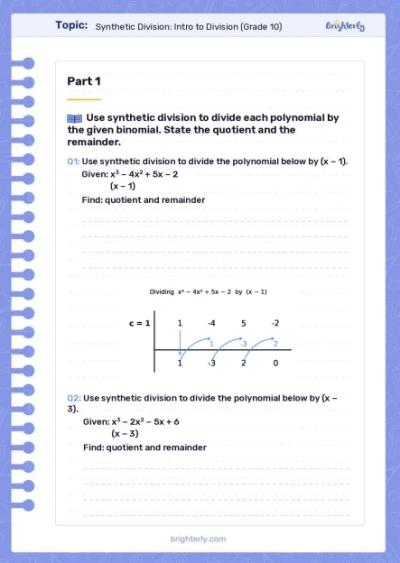
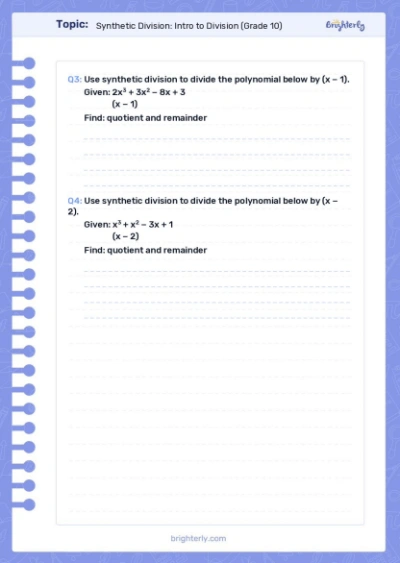
Download Synthetic Division Worksheet PDFs
Access our curated selection of high-quality printable files designed to help learners practice the setup and execution of synthetic division.
More polynomial division worksheets
Strengthen your polynomial skills with these related resources covering multiplication, factoring by grouping, and quadratic factoring — the prerequisite techniques that make synthetic division faster and more intuitive.
- Multiplying polynomials worksheet
- Factoring polynomials worksheets
- Multiplying monomials and polynomials worksheets
- Factoring by grouping worksheets
- Factoring ax²+bx+c worksheet
- Polynomial Long Division Worksheets


Help your child reach their full potential!
Answer a few quick questions about your child’s learning, and we’ll recommend next steps.
Benefits of Synthetic Division Worksheet
Builds an Efficient Problem-Solving Tool
Mastering synthetic division provides students with a powerful efficiency tool that streamlines polynomial division, saving valuable time during timed examinations and complex problem-solving sessions.
Connects Polynomials to Their Zeros
By using a structured worksheet, learners gain a deep understanding of the relationship between polynomials and their zeros, which is a foundational concept in high school algebra and pre-calculus.
Reinforces the Remainder and Factor Theorems
These practice pages reinforce the Remainder Theorem and the Factor Theorem, allowing students to quickly evaluate functions at specific values and determine if a given binomial is a factor of a larger polynomial.
Builds Procedural Fluency and Accuracy
Regular practice helps eliminate common errors, such as forgetting zero placeholders for missing terms or failing to change the sign of the divisor. The repetitive nature of these exercises also builds the procedural fluency required to tackle higher-degree equations and more sophisticated mathematical models.
Bridges to the Rational Root Theorem
This method also serves as an excellent bridge to understanding the Rational Root Theorem, helping students systematically narrow down potential zeros of a function.
Builds Mathematical Intuition
By focusing on the numerical patterns of addition and multiplication, students develop a stronger intuition for the structure of polynomials, which ultimately enhances their overall mathematical proficiency and confidence in algebraic manipulation.
Frequently Asked Questions
What Grade Is Synthetic Division For?
Synthetic division is a core Algebra 2 skill, typically covered in Grades 10–11.
What’s the Difference Between Synthetic Division and Long Division?
Both methods divide a polynomial by a linear binomial, but synthetic division uses only the numerical coefficients and skips writing out the variables at each step, making it faster once you’re comfortable with the setup. Long division spells out every term, which makes it easier to see where the process comes from — and it’s the only option when dividing by something other than a simple linear binomial (x − c).
Do These Worksheets Include an Answer Key?
Yes. Every synthetic division worksheet includes a complete answer key, so students can check their work and see exactly where a sign error or missed coefficient happened.


Math & reading from 1st to 12th grade
Looking for homework support for your child?

Choose kid's grade

Math & Reading for Grades 1–12
Build real confidence for your child with a Brighterly math or reading tutor.