Triangle Similarity Worksheets
Updated on October 21, 2026
Triangle similarity worksheets for Grade 10 help students prove that two triangles have the same shape using the AA, SAS, and SSS similarity criteria. Brighterly’s printable worksheets also give students practice identifying corresponding parts, finding scale factors, setting up proportions, and solving for missing side lengths.
Unlike congruent triangles, similar triangles do not need to be the same size. Their corresponding angles are equal, while their corresponding sides are proportional. Students who need to review this distinction can also use Brighterly’s triangle congruence worksheets.
Triangle Similarity Worksheets Grade 10: Examples
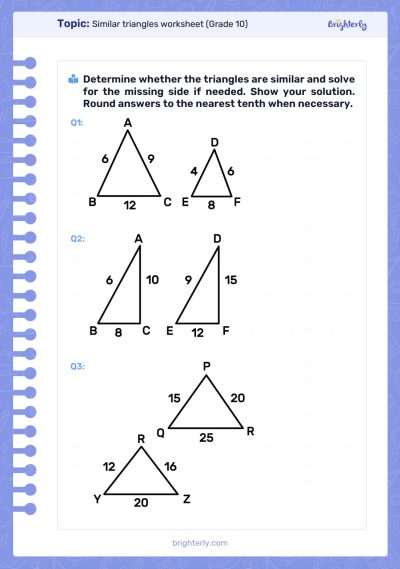
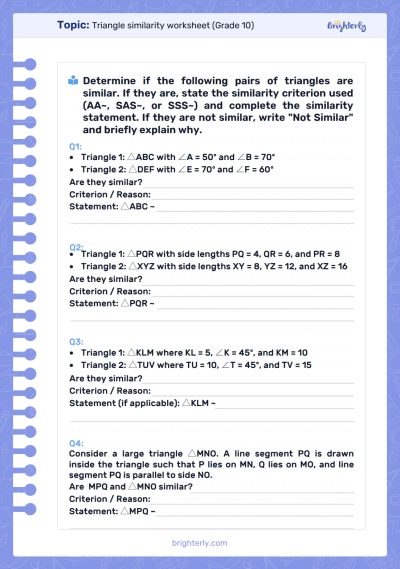
Grade 10 triangle similarity problems move beyond simply recognizing similar figures. Students analyze diagrams, decide whether AA, SAS, or SSS can be used, justify the similarity relationship, and then use corresponding sides to solve for unknown measurements.
For example, if two triangles have two pairs of corresponding congruent angles, students can conclude that the triangles are similar by AA. Once similarity is established, they can use proportional side lengths to find a missing value.
The separate similar triangles worksheets collection provides more introductory practice with corresponding sides and proportions. This Grade 10 page focuses more strongly on AA, SAS, and SSS similarity proofs and their applications.
Students who understand proportions but find it difficult to choose the correct similarity theorem can also work with a geometry tutor for targeted proof practice.


See how confidently geometry proofs come together
A quick quiz can reveal which geometry skills need more practice
Triangle Similarity Worksheets [Download for Free]
Download Brighterly’s free triangle similarity worksheets for Grade 10 practice at home or in class. The combined worksheet collection includes problems on AA, SAS, and SSS similarity, scale factors, proportional sides, and missing measurements.
For broader Grade 10 geometry practice, students can explore Brighterly’s high school geometry worksheets.
How to Prove That Two Triangles Are Similar
Two triangles are similar when their corresponding angles are congruent and their corresponding sides are proportional. Students do not need to verify every angle and side individually. Instead, they can use one of three main similarity criteria: AA, SAS, or SSS.
AA Triangle Similarity
Two triangles are similar by Angle-Angle (AA) when two angles in one triangle are congruent to two corresponding angles in another triangle.
For example, suppose Triangle ABC has angles measuring 40°, 60°, and 80°, while Triangle DEF also has corresponding angles of 40°, 60°, and 80°. Because two corresponding angle pairs are equal, the triangles are similar by AA.
Students only need two angle pairs because the interior angles of every triangle add up to 180°, so the third pair must also be congruent.
SAS Triangle Similarity
Two triangles are similar by Side-Angle-Side (SAS) when two pairs of corresponding sides are proportional and the included angles between those sides are congruent.
For example, suppose one triangle has two sides measuring 4 and 6, while the corresponding sides of another triangle measure 8 and 12:
4/8 = 6/12 = 1/2
If the included angles are also congruent, the triangles are similar by SAS.
SSS Triangle Similarity
Two triangles are similar by Side-Side-Side (SSS) when all three pairs of corresponding sides are proportional.
For example, compare triangles with side lengths:
3, 4, 5
and:
6, 8, 10
Each side of the second triangle is twice the length of the corresponding side in the first triangle. Because all three side ratios are equal, the triangles are similar by SSS.
Triangle Similarity Proofs for Grade 10
Grade 10 triangle similarity worksheets often require students to explain why two triangles are similar rather than only calculate an unknown length. This means identifying the given information, matching corresponding parts, and selecting the similarity theorem that supports the conclusion.
A proof may involve information that is not stated directly. Students might need to recognize vertical angles, use parallel lines to identify congruent angles, or determine that two side pairs share the same ratio before applying AA, SAS, or SSS.
More formal proof practice is available in Brighterly’s geometric proofs worksheets.
Finding the Scale Factor of Similar Triangles
After two triangles have been shown to be similar, students can compare corresponding sides to find the scale factor. The scale factor describes how much one triangle has been enlarged or reduced.
For example, if a side measuring 4 in the first triangle corresponds to a side measuring 10 in the second triangle:
10 ÷ 4 = 2.5
The scale factor from the first triangle to the second is 2.5. Every corresponding side length should change by the same factor.
Students can review how enlargements and reductions work in Brighterly’s scale and scale factor guide.
Using Similar Triangles to Find Missing Side Lengths
Once students know that two triangles are similar, they can create proportions from corresponding sides to calculate unknown measurements.
Suppose two similar triangles have corresponding sides:
4/10 = 6/x
Cross-multiply:
4x = 60
Then divide by 4:
x = 15
The most important step is matching corresponding sides correctly before setting up the proportion. If the sides are paired incorrectly, the proportion will not represent the similarity relationship.
Triangle Similarity vs Triangle Congruence
Triangle similarity and triangle congruence both compare corresponding sides and angles, but they describe different relationships.
Similar triangles have the same shape but can have different sizes. Their corresponding angles are congruent and their corresponding sides are proportional.
Congruent triangles have both the same shape and the same size. Their corresponding angles and corresponding side lengths are equal.
For example, triangles with side lengths 3, 4, 5 and 6, 8, 10 are similar because the second triangle is a scaled version of the first. They are not congruent because their corresponding side lengths are different.
Skills Students Practice With Triangle Similarity Worksheets
- Identify corresponding sides and angles. Students match the sides and angles that occupy the same relative positions in two triangles. Correct correspondence is essential before they can write proportions or similarity statements.
- Choose between AA, SAS, and SSS. Students examine the information provided in a diagram and decide which similarity criterion gives enough evidence to prove the triangles are similar.
- Set up proportions. Once similarity is established, students write equivalent ratios using corresponding side lengths and solve the resulting equations.
- Calculate scale factors. Students determine how much one triangle has been enlarged or reduced and apply the same scale factor to other corresponding dimensions.
- Solve for missing side lengths. Students combine geometric reasoning with algebra to find unknown measurements in similar figures.
- Write triangle similarity proofs. More advanced exercises ask students to organize given information logically and justify a conclusion using AA, SAS, or SSS rather than relying only on the appearance of a diagram.
Other Worksheets
- Triangle congruence worksheets
- Geometric proofs worksheets
- High school geometry worksheets
- Similar triangles worksheets
Frequently Asked Questions
What Do Grade 10 Triangle Similarity Worksheets Cover?
Grade 10 triangle similarity worksheets cover proving triangles similar with AA, SAS, and SSS, identifying corresponding sides and angles, finding scale factors, setting up proportions, and solving for missing side lengths. More advanced problems may also require students to justify each step of a similarity proof.
What Are the Three Ways to Prove Triangle Similarity?
The three main triangle similarity criteria are AA, SAS, and SSS. AA uses two pairs of congruent corresponding angles, SAS uses two pairs of proportional sides and their included congruent angle, and SSS requires all three pairs of corresponding sides to be proportional.
How Do You Find a Missing Side in Similar Triangles?
First, identify which sides correspond, then write a proportion using matching side lengths. Cross-multiply and solve the resulting equation for the unknown value. The ratios must be written in the same order for both triangles.
How Do You Find the Scale Factor of Similar Triangles?
Divide a side length in one triangle by the length of its corresponding side in the other triangle. For example, if a side changes from 4 to 10, the scale factor is 10 ÷ 4 = 2.5. The same factor should apply to every pair of corresponding sides.
What Is the Difference Between Similar and Congruent Triangles?
Similar triangles have the same shape but may have different sizes, so their corresponding sides are proportional. Congruent triangles have the same shape and size, meaning their corresponding sides and angles are equal.
Are These Triangle Similarity Worksheets for Grade 10?
Yes. This worksheet collection is designed for Grade 10 geometry practice, with a focus on AA, SAS, and SSS similarity proofs, scale factors, proportions, and missing side lengths.


Math & reading from 1st to 12th grade
Looking for homework support for your child?

Choose kid's grade

Math & Reading for Grades 1–12
Build real confidence for your child with a Brighterly math or reading tutor.