Trigonometric Functions Worksheets (Grade 12)
Updated on September 7, 2026
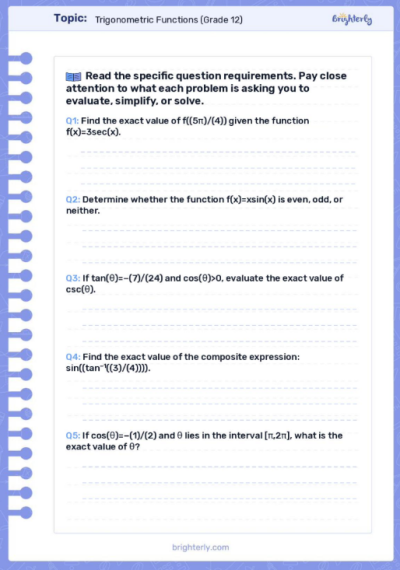
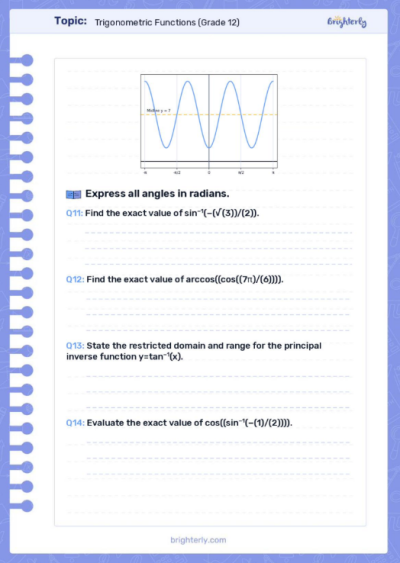
Trigonometric functions worksheets give students practice identifying amplitude, period, phase shift, and vertical displacement in sine and cosine functions, graphing transformations of the form y = a·sin(bx + c) + d, and applying reciprocal functions including the secant function, cosecant, and cotangent. Students work through evaluating all six trigonometric functions at standard angles, analyzing periodic behavior across quadrants, and solving trigonometric equations. Students who can calculate sine and cosine values but struggle to graph transformations accurately — getting the period, phase shift, and vertical displacement right simultaneously — typically progress fastest when working through graphical analysis with a precalculus tutor.
Download Trigonometric Functions Worksheet PDFs
Access our selection of high-quality, printable PDF resources to strengthen your understanding of periodic functions, transformations, and reciprocal relationships through targeted problem sets.
Download Trigonometric Functions Worksheets: Examples
More trigonometry worksheets
Deepen your understanding of periodic functions and trig relationships with these related resources covering the unit circle, special angle values, identity verification, and inverse trigonometric functions.
- trigonometry worksheets
- unit circle printable
- 45-45-90 and 30-60-90 triangles worksheets
- special right triangles worksheets
- types of angles worksheets


Help your child reach their full potential!
Answer a few quick questions about your child’s learning, and we’ll recommend next steps.
Benefits of Trigonometric Functions Worksheets
Trigonometric functions worksheets develop the ability to analyze and graph periodic functions — the mathematical models for sound waves, light waves, tides, and alternating current. Students practice identifying the four transformation parameters (amplitude, period, phase shift, vertical shift) from an equation and producing accurate graphs, building the visual-analytical connection that distinguishes rote calculation from genuine function understanding.
Working through all six trig functions — including the reciprocal functions sec, csc, and cot — builds fluency in recognizing where each function is defined, where it has vertical asymptotes, and how its graph relates to its parent function. This fluency is directly required for differentiation of trigonometric functions in calculus.
Solving trigonometric equations across all four quadrants requires using reference angles and understanding the periodic nature of solutions — skills that build systematic reasoning about infinite solution sets and connect back to the unit circle’s coordinate structure.
Consistent practice builds the computational speed and conceptual accuracy required for AP Calculus BC, where trigonometric functions appear in integration, series expansions (Fourier analysis), and polar curve analysis throughout the course.


Math & reading from 1st to 12th grade
Looking for homework support for your child?

Choose kid's grade

Math & Reading for Grades 1–12
Build real confidence for your child with a Brighterly math or reading tutor.