Vectors Worksheets
Updated on September 4, 2026
Vectors worksheets give students practice resolving force vectors into x- and y-components using trigonometric functions, computing dot products, calculating resultant magnitudes with the Pythagorean theorem, and interpreting vector operations geometrically using the tip-to-tail method. Students work through two-dimensional and three-dimensional vector problems covering addition, scalar multiplication, and direction angles. Visualizing vector addition geometrically — and connecting the tip-to-tail method to the algebraic component form — becomes much more intuitive when students work through these problems with a geometry tutor who can link the spatial reasoning to the trigonometric computation.
Download Vectors Worksheet PDFs
Access our comprehensive collection of printable resources to practice vector addition, component resolution, dot products, and magnitude calculations in physics and mathematics contexts.
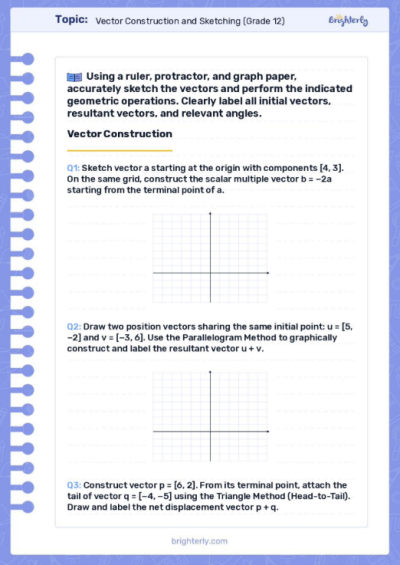
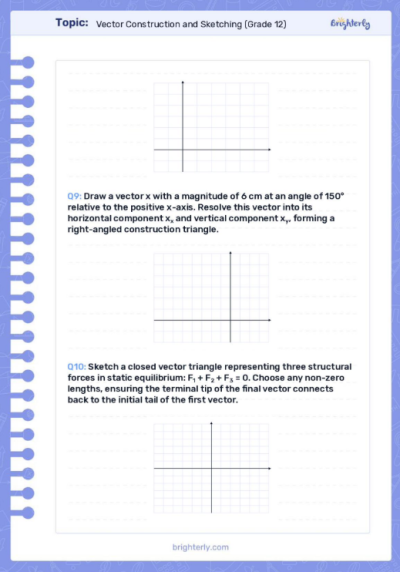
More physics worksheets
Strengthen the trigonometric and algebraic foundations that vector analysis requires with these related resources covering trig ratios, right triangle relationships, and coordinate plane operations.
- trigonometry worksheets
- special right triangles worksheets
- 45-45-90 and 30-60-90 triangles worksheets
- algebra worksheets
- graph worksheets


Help your child reach their full potential!
Answer a few quick questions about your child’s learning, and we’ll recommend next steps.
Benefits of Vectors Worksheets
Vectors worksheets develop the ability to decompose physical quantities into components — a skill central to analyzing static equilibrium, projectile motion, and electromagnetic fields. Students practice resolving vectors along coordinate axes using sine and cosine, then recombining components to find the resultant, which is the foundational operation of all vector mechanics.
Working through dot product problems builds understanding of the angle between two vectors, which determines whether two forces reinforce or oppose each other and whether two vectors are perpendicular. This concept is essential in physics, computer graphics, and machine learning.
Three-dimensional vector problems — including the cross product of two vectors — prepare students for university physics and engineering mechanics, where torque, magnetic force, and surface normals all require cross product computation.
Consistent practice with unit vector notation (î, ĵ, k̂) and polar-to-Cartesian conversions builds the computational fluency needed in engineering statics, introductory electromagnetism, and linear algebra courses where vectors underlie every matrix operation.


Math & reading from 1st to 12th grade
Looking for homework support for your child?

Choose kid's grade

Math & Reading for Grades 1–12
Build real confidence for your child with a Brighterly math or reading tutor.