-
Learning Platform
-
/
-
Blog
-
/
-
100+ Tongue Twisters for Kids – Funny, Easy, Silly, and More
100+ Tongue Twisters for Kids – Funny, Easy, Silly, and More
Key Points:
- Tongue twisters for kids – through repeating sounds and alternating patterns – stimulate the brain’s speech centers and, thus, form sharper pronunciation habits (according to a 2023 study published in PubMed).
- Literacy researchers of Indiana University (2023), University of Crete (2026), MDPI (2025), and IJRSI (2024) say that regular practice consolidates important oral muscles (tongue, lips, and jaw), improves diction, increases phonemic awareness, and enhances overall reading fluency, comprehension, and pacing.
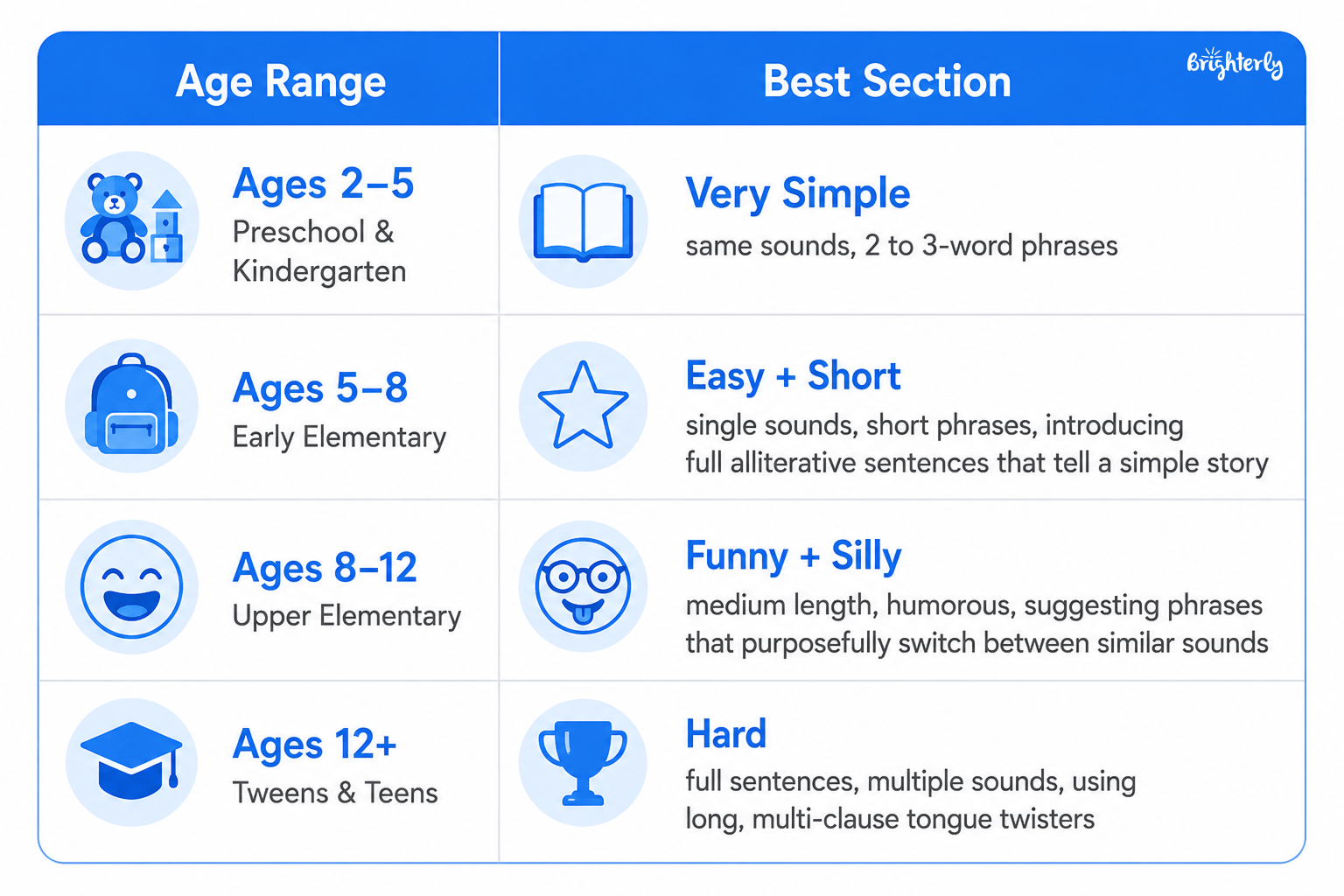
- ASHA’s speech and language milestones recommend that kids can start practicing tongue twisters at 2-3 yo with simple phrases, gradually advance to full alliterative sentences (ages 4-5) and alternating sounds (ages 6-8), and proceed with complex multi-clause phrases when they reach 9 yo.
Tongue twisters are so called because they literally twist up our mouth movements and force our vocal muscles to work harder than usual. Kids need them to reduce mumbling and improve articulation and pronunciation. These 100+ kids tongue twisters contain simple, humorous, silly, and challenging examples along with practice tips for parents.
What Are Tongue Twisters?
Tongue twisters are sequences of words or sentences deliberately created to be difficult to pronounce correctly, especially at high speed. Relying on particular linguistic patterns to disrupt normal speech movements, tongue twisters are constructed using
- Alliteration – like in Peter Piper picked a peck of pickled peppers,
- Consonance – e.g., The lucky duck got stuck in the muck, and
- Alternating phonemes – like in Pad kid poured curd pulled cod.
Benefits of Tongue Twisters for Kids
- Exercising speech-related muscles. Regular practice with easy tongue twisters helps train the muscles of the tongue, lips, and jaw – all engage in the motor control for clear speech.
- Refining diction and articulation. Repeating alliterative phrases at increasing speed forces precise mouth movements – the same motor patterns needed for clear speech in school presentations and reading aloud.
- Enhancing phonemic awareness. Exercising teaches children to grasp subtle shifts between particular speech sounds.
- Improving reading comprehension and auditory skills. Kids learn to notice letter-sound relationships and pace their reading rate.
At our learning platform, Brighterly reading tutors offer personalized 1-on-1 online lessons to improve your child’s reading comprehension, build their verbal confidence, and provide early phonics help. Our US standard-aligned curriculum prioritizes literacy support for precise articulation and decoding skills.
Easy Tongue Twisters for Kids
Here are some tongue twisters for young kids to practice individual speech sounds:
- B: Big boys buy blue balloons.
- C/K: Cute cats cook cold carrots.
- D: Digging dogs dig deep dirt.
- F: Four fat frogs flew far.
- G: Good goats eat green grass.
- H: Happy hippos hop high.
- J: Jolly jellyfish jump for joy.
- L: Little lions love licking lemons.
- M: Monkey monkeys make messy mud.
- P: Pink pigs play in puddles.
- R: Red rabbits run really fast.
- S: Six silly snakes sit softly.
- T: Two tiny turtles talk together.
- V: Vinny views very vibrant vegetables.
- W: Wet walruses walk in water.
- Z: Zigzag zebras zoom past zoos.
- CH: Charlie chews chunky cheddar cheese.
- SH: Shiny shoes shine so bright.
- TH: Three thin thieves think thanks.
- Short vowel sound: Angry ants ate an apple.


Reading program
Build reading confidence with Brighterly tutors
Personalized reading program improves fluency, comprehension, and phonics through live online lessons.
Try Free
Hilarious Tongue Twisters
Such tongue twisters help kids practice their pronunciation and, at the same time, laugh at a bit of absurdity:
- How much wood would a woodchuck chuck if a woodchuck could chuck wood?
- Fuzzy Wuzzy was a bear, Fuzzy Wuzzy had no hair, Fuzzy Wuzzy wasn’t fuzzy, was he?
- A clumsy calf cut a copper coffee cup in half.
- Splish splash, the slimy slug slid down the shiny slide.
- How can a clam cram in a clean cream can?
- A skunk sat on a stump and thunk the stump stunk, but the stump thunk the skunk stunk.
- Double bubble gum bubbles double.
- The toothless cow chewed a chewable blue shoe.
- Peter Piper picked a peck of pickled peppers.
- Which witch watched the white whales wiggle?
- Green gorillas grill great greasy garlic grapes.
- Six sheepishly short sheep sang songs out of tune.
- A toaster toasts toast, but a toaster cannot toast a toaster.
- Seven sneezing snails sailed slowly on a soup spoon.
- A flea and a fly flew up in a flue.
- A big black bug bit a big black bear and made the big black bear bleed blood.
- Which wristwatch is a Swiss wristwatch?
- Two tiny tigers tasted tasty turtle stew.
- If a dog chews shoes, whose shoes does he choose?
- Two toadstool-colored toads tried to tiptoe to Toronto.
Short Tongue Twisters for Kids
Punchy tongue twisters are good for quick daily practice for beginners:
- Red lorry, yellow lorry.
- Toy boat, toy boat, toy boat.
- Unique New York.
- Eleven benevolent elephants.
- Black back bat.
- She sees cheese.
- Daddy draws doors.
- Good blood, bad blood.
- Flash fish, fresh fish.
- Cooks cook cupcakes quickly.
- Rubber baby buggy bumpers.
- Which witch is which?
- Snap crackle pop.
- Fred fed Ted bread.
- She sells sea shells.
- Thin tin twins.
- Selfish shellfish.
- Big blue blimp.
- Zippy zebra zigzagged.
- Silly Willy wiggles.
Silly Tongue Twisters for Kids
These tongue twisters for kids from 5 to 10 years old contain playful nonsense words and absurd figurativeness:
- Giggle-gaggle goblins gobbled gooey green gravy.
- The zig-zag flim-flam flopped on a slip-slap mat.
- Bumble-wumble bumblebees baked blue bubblegum biscuits.
- Willy-nilly walruses waddled down a wibbly-wobbly walkway.
- Shadrach’s silly slippers slipped on slick, slimy sludge.
- A dinky donkey did a dorky dance in a dusty dungeon.
- Higgledy-piggledy hedgehogs hogged huge hot dogs.
- The flip-flop flipper flipped a floppy flying fish.
- Skiddle-skaddle skunks skated on skinny silver skates.
- Mish-mash monkeys mixed marshmallow mush in May.
- A plippy-ploppy raindrop plopped on a puppy’s pink paw.
- Fiddle-faddle foxes found funny fuzzy feathers.
- The bouncy-wouncy bunny bumped a big blue bowling ball.
- Splish-splash spiders spun spunky spaghetti spaceships.
- A super-duper snoozing snail snored on a shiny sofa.
- Chuckle-wuckle chickens chewed chunky chocolate chips.
- The wiggly-waggly worm wore a warm winter coat.
- Dilly-dally ducks did dizzy dives in deep dishes.
- Razzle-dazzle rabbits ran around a rotten radish.
- The hocus-pocus hippo hid a hairy hamster in a hat.
Tongue Twisters for Preschoolers
For practicing basic speech sounds, here are very simple tongue twisters for kindergarten on fun animal themes:
- Big brown bears bake bread.
- Cats chase clever mice.
- Dogs dig deep holes.
- Five funny frogs hop far.
- Goats eat green grass.
- Happy hippos hug hamsters.
- Lions love licking lollipops.
- Monkeys make messy mud.
- Penguins push pink penguins.
- Run, rabbit, run fast!
- Silly seals swim slowly.
- Tigers take two toys.
- Zebras zigzag past zoos.
- One old owl oots.
- Ten tiny turtles talk.
Hard Tongue Twisters for Kids
These tongue twisters for middle schoolers (aged 9+) feature multiple complex sounds and fit competitive challenge games:
- The sixth sick sheik’s sixth sheep’s sick.
- Pad kid poured curd pulled cod, while a bad kid poured curd pulled cod.
- Rory the warrior and Roger the ruler were reared wrongly in a rural brewery.
- Send toast to ten tense stout saints’ ten tall tents.
- A loyal warrior roller-skates really rapidly along the rugged rural road.
- The thirty-three thankful thieves thought that they thrilled the throne throughout Thursday.
- Imagine an imaginary menagerie manager managing an imaginary menagerie.
- Scissors sizzle, thistles sizzle, and clever slick slitters slit sheets smoothly.
- Yellow leather, yellow feather, red leather, red feather, lavender leather.
- Can you can a canned can into an uncanned can like a canner can can a canned can?
- Shu Shock of Chicago sells superb shoe-shining sauce to standard shoe shops.
- The pre-shrunk leather shirts shrank specifically in the flashing sunshine.
- Six sleek swans swam swiftly southwards, searching for soft sunny spots.
- Friendly flea flies flightily while a frantic fly flees a friendly flea’s flight.
- Gobie the globe-trotting gopher gobbled glowing green gelatin at the great gala.
Reading program
Personalized reading support for your kid
Brighterly reading program combines literacy practice with engaging language development activities.
Start Today
Tips for Practicing Tongue Twisters With Your Kids
- Start slowly with funny tongue twisters for kids. Have your child say each word distinctly and slowly first. Increase the speed only when they can say the entire tongue twister correctly several times in a row.
- Isolate and exercise difficult sounds. When your kid encounters a particular word or transition that stumbles them, pause the full phrase. Isolate that sound combination and let them practice just those words deliberately.
- Show correct mouth movements. Face your child and say the phrase, over-exaggerating your mouth, lip, and tongue movements – they’ll understand how to physically do it correctly.
- Include a physical rhythm. Add clapping or tapping a foot, and have your kid say one syllable or word per beat.
Conclusion
Funny tongue twisters are, in fact, practical exercises that ultimately reshape a child’s decoding accuracy and auditory confidence. Regular practice of these appealing phrases enables kids to systematically train their speech muscles and expand their cognitive processing.
Our reading program with a personalized curriculum, in particular, prioritizes foundational principles of phonemic awareness, expanding vocabulary, and sound isolation that tongue twisters introduce. Let your child pass this free reading test to figure out with what exactly they might need some professional help.
Frequently Asked Questions
What Are 5 Tongue Twisters for Kids?
These best tongue twisters are for different developmental levels and speech movements:
- Red lorry, yellow lorry.
- Silly snakes sit softly.
- Double bubble gum bubbles double.
- Fuzzy Wuzzy was a bear, Fuzzy Wuzzy had no hair, Fuzzy Wuzzy wasn’t fuzzy, was he?
- How much wood would a woodchuck chuck if a woodchuck could chuck wood?
What Age Should Kids Start Tongue Twisters?
Children can start practicing tongue twisters when they’re 2 or 3. However, the complexity of the phrases should adjust to their natural stages of speech development:
- 2-3 yo – use tiny 2-3-word phrases
- 4-5 yo – introduce full alliterative sentences that tell a simple story
- 6-8 yo – suggest phrases that purposefully switch between similar sounds
- 9+ yo – use long and multi-clause tongue twisters.
How Often Should Children Practice Tongue Twisters?
Kids should exercise short tongue twisters for 3-5 minutes per day (about 3-5 times a week). Short practice prevents vocal and mental exhaustion, given that the mouth muscles can tire if exercised for long. Short practice also optimizes neural plasticity because, according to a 2026 study in Scientific Reports, the brain learns motor sequencing better with brief yet concentrated repetition and periods of rest.
Can Tongue Twisters Help Kids With Speech Delays?
Yes, tongue twisters can be effective for children with speech delays, but use them only as a supplement to professional speech-language therapy. If a child has problems with a phoneme, for instance, a particular tongue twister isolates that movement. The over-exaggerated movements (needed for alliterative phrases) also help kids learn how mouth positions compare to particular spoken sounds.
What Is the Hardest Tongue Twister in the World?
Among all tongue twisters examples, the following two phrases can be considered the hardest in terms of phonetic difficulty:
- The sixth sick sheik’s sixth sheep’s sick. It relies on a maximum density of sibilants along with the voiceless dental fricative.
- Pad kid poured curd pulled cod. This phrase employs alternating phonemes.
Jessica is a seasoned math tutor with over a decade of experience in the field. With a BSc and Master’s degree in Mathematics, she enjoys nurturing math geniuses, regardless of their age, grade, and skills. Apart from tutoring, Jessica blogs at Brighterly. She also has experience in child psychology, homeschooling and curriculum consultation for schools and EdTech websites.
Previous article
All
Show Don’t Tell Writing: Techniques, Tips, and Examples
Show don’t tell writing implies that, instead of directly stating information, an author uses actions, dialogue, and sensory details to convey a story. To help your children master it, here are age-appropriate show don’t tell examples demonstrating and explaining practical writing techniques and a list of common mistakes to avoid (plus, their fixes). What […]
 Jessica Kaminski
May 27, 2026