Show Don’t Tell Writing: Techniques, Tips, and Examples
reviewed by Jo-ann Caballes
Updated on July 1, 2026
Key Points:
- Telling uses direct and abstract statements and labels to state facts; showing includes physical, behavioral, and sensory evidence that engages the reader.
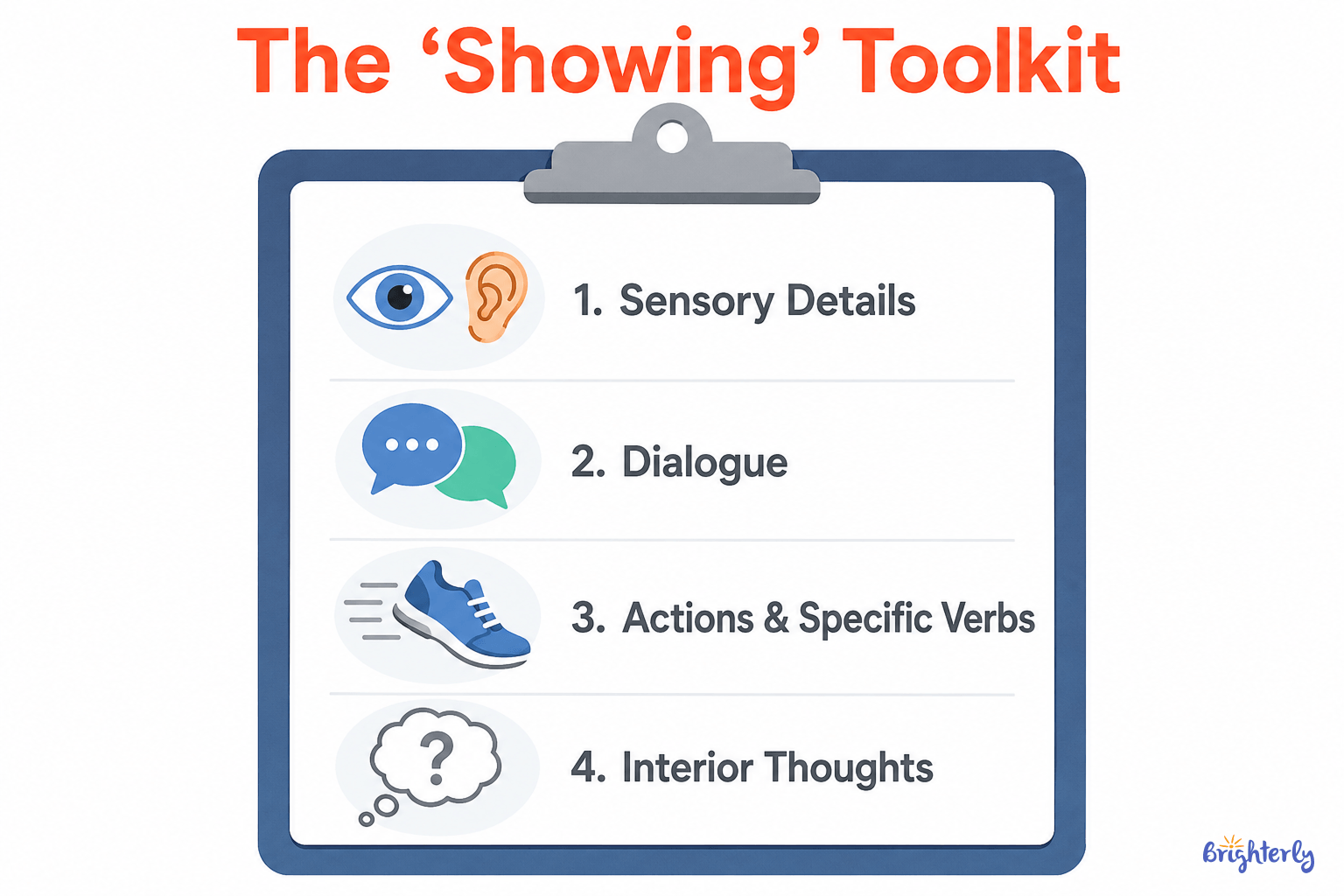
- Practical writing techniques include: sensory details, actions and reactions, dialogue, strong verbs, setting for mood, internal conflict through behavior, and knowing when telling is OK.
- Avoid common writing mistakes – over-showing, using filter words, the stage direction trap, double-dipping, and information dumps.
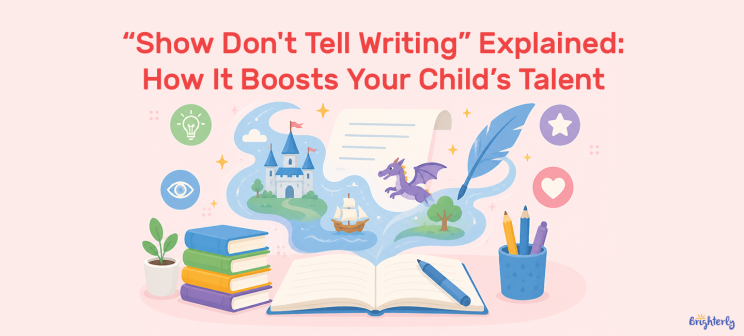
Show don’t tell writing implies that, instead of directly stating information, an author uses actions, dialogue, and sensory details to convey a story. To help your children master it, here are age-appropriate show don’t tell examples demonstrating and explaining practical writing techniques and a list of common mistakes to avoid (plus, their fixes).
What Does Show Don’t Tell Mean in Writing?
In writing, “Show, Don’t Tell” means that, instead of using exposition to summarize a story, an author employs action, dialogue, sensory details, and interior thoughts to experience it. An author doesn’t state a fact about a character or a situation; they instead provide particular details that enable the reader to infer that fact independently.
Explore Brighterly Learning Experience
Learn exactly how Brighterly helps students thrive through expert sessions, online tools, and proven feedback from thousands of satisfied parents
Show vs Tell: Key Differences With Examples
|
Telling |
Showing |
|
She was sad. |
She put her head down on her desk and sniffled, wiping her wet eyes with her sleeve. |
|
It was cold outside. |
Tim pulled his fuzzy hat over his ears and rubbed his mittened hands together. |
|
Arthur was very neat. |
Arthur put all his crayons back in the box from tallest to shortest and zipped his backpack. |
|
The storm was violent. |
The wind loudly slammed the bedroom shutters shut and knocked over a big tree in the yard. |
|
Jeniffer realized she lost her lunch money. |
Oh no, where’s my five-dollar bill? Jeniffer unzipped every pocket of her backpack, but she only found an old eraser. |
|
He was exhausted. |
Leo yawned loudly, closed his storybook, and let his head sink deep into his soft pillow. |
At Brighterly, we offer literary analysis tutoring and writing lessons for kids. Your K-12 student will study with an individually assigned certified tutor in online 1:1 lessons. Although totally aligned with the US state standards, every lesson in your kid’s learning plan will be individualized. The customization stands on the processed results of your child’s free diagnostic assessment, their learning style, pace, and educational goals.


Brighterly writing lessons from just $17.70
Expert tutors help students master descriptive writing and stronger reading comprehension.
How to Show, Don’t Tell in Writing: 7 Practical Techniques
These seven show don’t tell techniques work for all fictional genres (fantasy, science fiction, mystery, romance, thriller, horror, etc.) as well as narrative nonfiction (including personal essays, biographies, and more). Regarding age groups, they apply to writing created for and by all age categories from grade 2 to adulthood.
“One of the easiest ways to tackle showing vs telling in creative writing is to think of the five senses.”
Use Sensory Details to Paint the Scene
Sensory details describe what can be seen, heard, smelled, tasted, or felt through touch. Employing this writing strategy enables writers to avoid such generic words as nice, bad, scary, or pretty. They instead view a scene through their characters’ eyes and report specific physical details. To create a mental picture and make the setting feel real and present for the readers, focus on describing the texture of an object, the particular pitch of a sound, or a distinct odor to trigger their own memories of those sensations.
|
Telling |
Showing |
|
The school cafeteria was a total mess during lunchtime. |
Splashes of red tomato sauce stained the long white tables, and sticky puddles of chocolate milk dotted the floor. The room smelled like greasy pizza and burnt tater tots, while the loud clatter of plastic trays banging together filled the air. |
Show Emotions Through Actions and Reactions
To avoid naming the emotion directly with words like happy, sad, mad, or scared, this show not tell writing technique entails depicting how a character feels by describing what their body is doing. In real life, people express feelings through facial expressions, posture, gestures, and automatic bodily reactions (like shivering or sweating). To help the reader figure out the emotion on their own, emphasize, for instance, a stomping foot, a wide smile, a trembling chin, etc.
|
Telling |
Showing |
|
Katie was very angry when her little brother broke her toy spaceship. |
Katie squeezed her hands into tight fists until her fingernails dug into her palms. She stomped her foot hard against the rug, wrinkled her nose, and glared down at her brother without saying a single word. |
Let Dialogue Reveal Character
Letting dialogue reveal character means using speech – what a character says, how they say it, how they react to others, etc. – to show personality traits, feelings, and manners without explaining them. This technique of showing not telling in writing teaches students to listen to the way people talk. For example, a character who uses polite words like please and excuse me shows they’re well-mannered. On the contrary, a character who interrupts or yells shows they might be impatient or upset.
|
Telling |
Showing |
|
Coach Miller was a loud, strict baseball coach, but Toby was a shy player who lacked confidence. |
“Drop your bags and give me ten laps around the field right now!” Coach Miller barked, clapping his hands together twice. Toby pulled his baseball cap low over his eyes and looked down at his sneakers. “Um, excuse me, Coach,” he whispered, squeezing his glove tightly. “Should I… do I go first?” |
Use Strong, Specific Verbs
Weak verbs only tell the reader that an action occurred, forcing them to guess the details. Strong verbs carry an embedded description. Using strong, specific verbs means replacing weak and ordinary ones (like went, walked, said, or got) or verbs that need a helping adverb (like walked slowly or cried loudly) with a single, powerful action word.
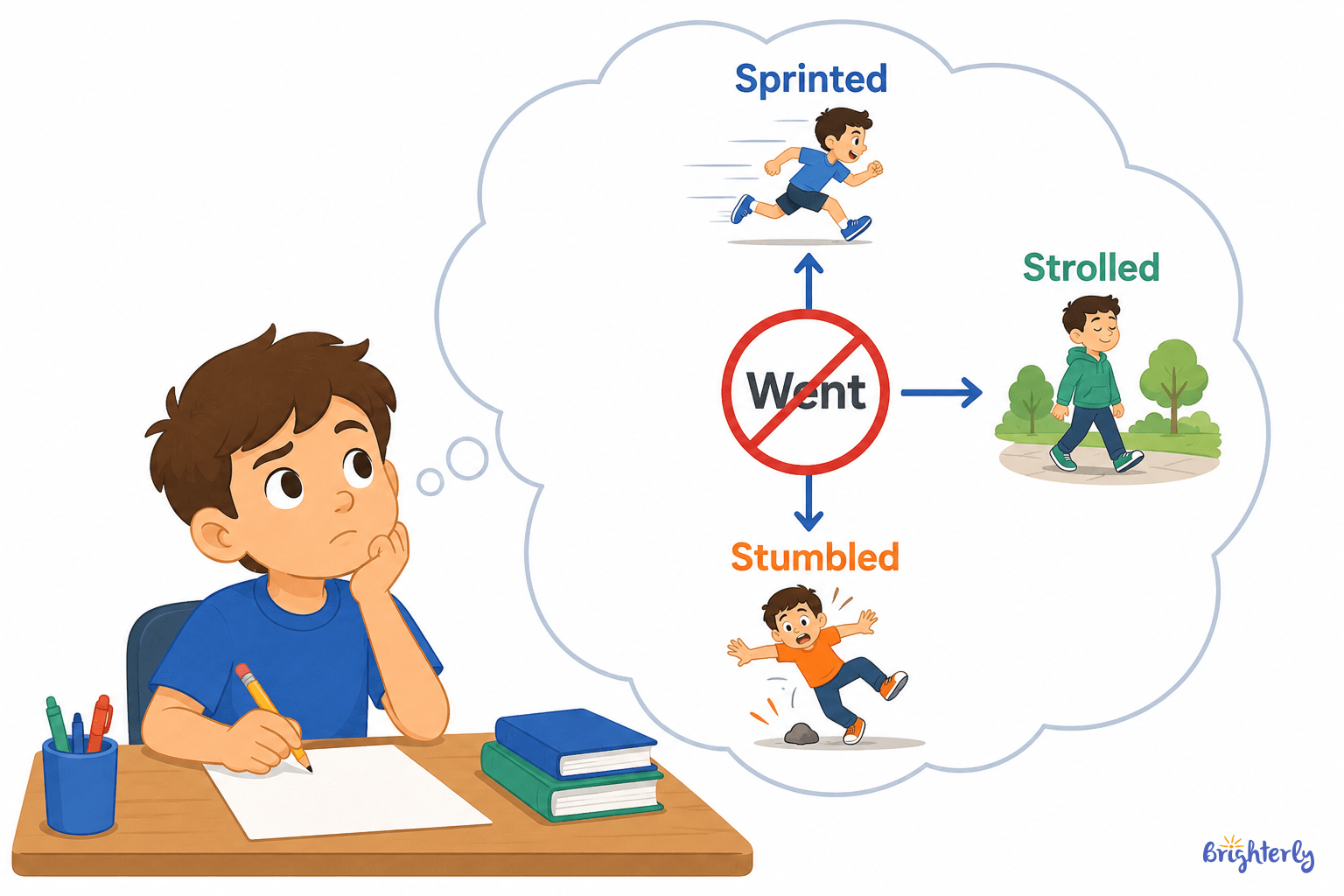
As in one of the show not tell examples: instead of writing that a character went down the hallway, use the verb scooted, marched, tiptoed, or shuffled to describe to the reader the character’s speed, energy level, and emotional state.
|
Telling |
Showing |
|
The tired dog walked slowly across the living room and lay down on the floor. |
The tired dog shuffled across the living room and collapsed onto the rug. |
Describe the Setting to Build Mood
The setting means when and where a story is happening. The mood is the overall feeling or atmosphere that the reader gets from reading the story (e.g., feeling cozy, spooky, excited, or lonely). Building mood through setting means carefully choosing which parts of a room or an outdoor scene to describe so that the physical environment mirrors the emotional tone of the story.
|
Telling |
Showing |
|
The old treehouse was a very spooky and lonely place to visit at night. |
Moonbeams cut through the gaps in the rotting wooden walls, lighting up spiderwebs floating in the corners. Outside, the night wind groaned through the empty branches, making the rusty hinges of the treehouse door creak back and forth. |
Show Internal Conflict Through Behavior
Internal conflict is a battle that happens inside a character’s mind. It occurs when a character has to make a tough choice, faces a difficult problem, or feels two different ways about the same situation (like wanting to tell the truth but being afraid of getting into trouble). How to show and not tell in writing about the internal conflict through behavior? Let the reader see the mental struggle via the character’s physical hesitation, nervous habits, or changing choices.
|
Telling |
Showing |
|
Sam couldn’t decide if he should share his rare shiny card with his best friend or keep it for himself. |
Sam reached into his pocket and slid the shiny card halfway out, watching his best friend’s sad face. He stopped, pushed the card back down out of sight, and rubbed his chin. Then, he slowly pulled the card out again and held it out with a trembling hand. |
Know When Telling Is Actually OK
Writing texts entirely in ‘showing’ mode can make a story slow down too much or become confusing. To avoid that, use summary statements to handle less important information and transition between scenes. For the balance, telling is totally acceptable for routine actions, background facts, or when covering large amounts of time.
|
Too much showing |
Correct telling |
|
Maya took one step down the sidewalk. Then she took another step. She passed a red house, then a blue house, and then a green house. She walked for fifteen whole minutes until she finally reached the library door. |
Maya walked fifteen minutes down the street until she reached the library. |
If your child is struggling with expressing their thoughts creatively, structuring ideas, or finding the right word altogether, consider creative writing tutoring. With the professional ELA tutor, your kid will be able to improve their reading comprehension, strengthen writing skills, and boost grades in English class.
Writing lessons personalized for every learning style
Interactive tutoring at Brighterly improves storytelling structure, vocabulary, and reading comprehension skills.
Show Don’t Tell Writing Examples: Before and After
|
Before (telling) |
After (showing) |
|
He was angry. |
He slammed his fist on the desk and glared. |
|
The room was hot. |
Sweat dripped down her neck in the stuffy air. |
|
She was excited. |
She squealed and jumped up and down. |
|
The dog was scared. |
The puppy tucked its tail and hid under the bed. |
|
It was loud. |
Fireworks boomed, making the windows rattle. |
|
He was clumsy. |
He tripped over his own sneakers and dropped his tray. |
Common Mistakes Writers Make With Show Don’t Tell
|
Common mistake |
What it means |
The fix |
|
Over-showing the unimportant stuff |
Showing every single boring or routine action that doesn’t matter to the plot. |
Use a quick ‘telling’ sentence to skip the boring parts and get to the action faster. |
|
Using ‘filter’ words |
Using words like saw, heard, noticed, or felt. |
Delete the filter words and describe the sensory details directly. |
|
The ‘stage direction’ trap |
Listing mechanical body movements (like sitting down or standing up) that don’t reveal any real feelings. |
Only include physical actions that give the reader a clue about a character’s mood. |
|
Double-dipping |
Telling the reader the exact character emotion right before or after showing it to them. |
Delete the ‘telling’ label and let your ‘showing” example’ stand alone. |
|
Information dumps |
Stopping the story completely to write a giant paragraph of facts, history, or background rules. |
Sprinkle the background details naturally into the story using dialogue or quick actions. |
Note: Opinion writing is another writing type which needs mastery in all grades. Learn more about it in this guide.
Conclusion
Ultimately, mastering show don’t tell in writing entails learning to trust your readers in the first place. At your side, though, using well-chosen details – like sensory descriptions, realistic dialogue, physical actions, and body language – will give readers the clues they need to build the story’s world and feel its emotions for themselves.
If your child wants to strengthen their reading and writing foundations, our literacy program can help them master descriptive writing, expand their vocabulary, and improve reading comprehension at their own pace through interactive 1:1 online sessions.
Frequently Asked Questions
What Is an Example of Show Don’t Tell?
One of the classic examples of show don’t tell in writing is the difference between simply stating an emotion versus demonstrating it using physical actions:
Telling: Sarah was terrified of the dark basement.
Showing: Sarah gripped the handrail until her knuckles turned white, staring into the pitch-black room as her foot shook over the squeaking stairs.
Can You Show and Tell in the Same Piece of Writing?
Yes, absolutely. In fact, the best stories must use both showing and telling. Show the important moments – the exciting parts, the emotional turning points, the big arguments, the main action scenes, etc. Tell the transition moments, like when you need to cover a lot of time or explain routine actions.
How Do You Practice Show Don’t Tell Every Day?
- When you see someone feeling a strong emotion in real life, turn things around in your mind.
- Take any simple, boring sentence, set a timer for two minutes, and write 2-3 sentences that prove that statement without the original descriptive words.
- Take a random object and try to describe it to someone else without using visual words.
What Are the Best Books to Study Show Don’t Tell?
- Owl Moon by Jane Yolen. A picture book that shows kids how to express weather and atmosphere.
- The One and Only Ivan by Katherine Applegate. Written as if by a gorilla living in a shopping mall circus, the book processes deep emotions through behavior.
- Charlotte’s Web by E.B. White. Good for learning how dialogue reveals character traits and relationships.
How Does Show Don’t Tell Help Readers Connect With Characters?
Just telling a reader how a character feels creates an emotional distance because they draw conclusions based on simply receiving a factual report. Showing, on the other hand, changes this relationship entirely, given that it triggers empathy, makes readers active participants, and makes characters real altogether.
At What Age Should Kids Start Learning Show Don’t Tell?
According to Applied Corpus Linguistics researchers (2024), children can begin learning the foundational concepts of show not tell in writing when they reach 7 or 8. In grades 2 and 3, kids study to replace feeling words with action ones, focusing on adding the five senses to their phrases and sentences. Later, in grades 4-5, they learn to apply more advanced techniques.




The Ukrainian-founded math and reading educational platform joins ASU+GSV event for leaders in the education and skills sector. Las Vegas, NV – May 12, 2026 – The CEO of Brighterly, Eugene Kashuk, joined the 17th annual ASU+GSV Summit in San Diego. Established in 2010, ASU+GSV Summit is the premier global forum for leaders reshaping the […]

May 27, 2026
Tongue twisters are so called because they literally twist up our mouth movements and force our vocal muscles to work harder than usual. Kids need them to reduce mumbling and improve articulation and pronunciation. These 100+ kids tongue twisters contain simple, humorous, silly, and challenging examples along with practice tips for parents. What Are Tongue […]

May 27, 2026
Math & reading from 1st to 12th grade
Looking for homework support for your child?

Choose kid's grade

Math & Reading for Grades 1–12
Build real confidence for your child with a Brighterly math or reading tutor.