How to Get a High SAT Score in 2026: 10 Proven Strategies
reviewed by Jessica Kaminski
Updated on July 10, 2026
Key Points: A high SAT score is 1350 or more as it places you among the top 10% of SAT takers, according to the College Board. This guide provides 12 proven strategies to prepare for the SAT that work for different types of learners – from setting a timeline and a weekly schedule to developing math- and reading-specific techniques. A high SAT score is 1350 and above as this is in the 90th percentile according to the College Board – the association managing the test. As of June 2026, the organization reports the average SAT score to be 1050. Generally, a higher SAT score allows you to go to a better college and study more competitive fields. SAT Score Range National Percentile Performance Level 1500-1600 98th Exceptional 1400-1490 93rd Very high 1300-1390 86th High 1200-1290 75th Above average 1100-1190 61st Average 1000-1090 43rd Below average Source: The College Board, 2026 SAT Score Range Typically Good For College Examples 1500-1600 Most highly selective universities Harvard, Princeton, Stanford, Yale, MIT, Columbia 1400-1490 Highly selective universities & top public colleges Georgetown, New York University (NYU), University of Virginia, University of Michigan, Boston College 1300-1390 Selective public & private universities Pennsylvania State University, Syracuse University, University of Miami, Rutgers University, Texas A&M University 1200-1290 Many well-regarded four-year colleges Michigan State University, University of Arizona, University of Kansas, University of Oregon, DePaul University 1100-1190 Regional universities & many state colleges Pace University, University of North Texas, East Carolina University, Georgia State University, University of Nevada, Reno 1000-1090 A wide range of colleges with less selective admissions Texas State University, University of Central Oklahoma, Southern Illinois University Carbondale, University of Memphis, Marshall University Source: BigFuture of the College Board, 2026 Note: Achieving a high SAT score doesn’t guarantee acceptance into a certain college. Universities don’t have official SAT requirements and consider many other factors when making acceptable decisions. Explore Brighterly Learning Experience Learn exactly how Brighterly helps students thrive through expert sessions, online tools, and proven feedback from thousands of satisfied parents Improving SAT scores requires following a strict study schedule, targeting your weak areas with structured practice, and learning test-taking techniques. These 12 strategies on how to score high on SAT cover everything from diagnostic tests to your mindset. The first step is to do a diagnostic standardized test in the format that you plan to take – digital or paper. Early diagnosis will reveal your starting point, strengths, and weaknesses to know where to concentrate your efforts. You can find SAT practice tests on the College Board website. Based on the results of your diagnostic SAT, work out:
Personalized math & reading support for your child!
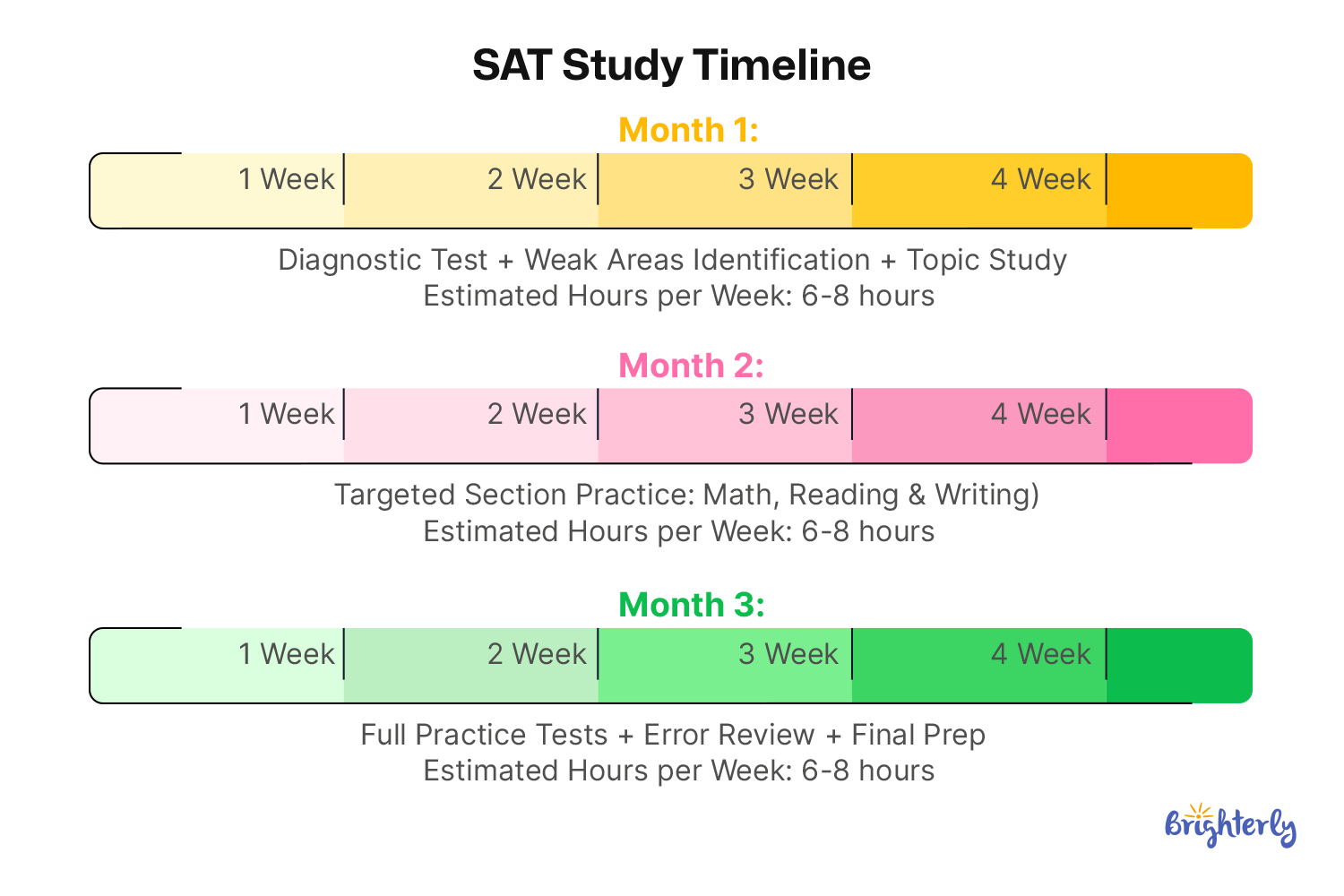
Brighterly tutors offer SAT instruction & practice to build your kid’s knowledge & confidence. Do research to find out what SAT score you need to get into your dream college while being realistic. For instance, if you’d like to get into an Ivy League school, you need an SAT score of 1500 or more. Set a SMART goal for your performance – an ambitious, yet achievable score that corresponds to your college plans. This goal will help keep you motivated. Work out a detailed SAT prep timeline based on the amount of time you have until the test date. In your SAT study schedule, allocate time to: This timeline will help you stay on track. Note: Preparing the study schedule is half the work. Then you have to stick to the timeline to score high. Plan to study 5-8 hours per week for 12 weeks, for a total of 60-96 hours of SAT prep before the exam. This schedule avoids cramming all studying into a few short weeks. Here is what an example weekly SAT study schedule can look like: Break the necessary SAT study material into categories that make sense to you and organize your most common mistakes into them. After the diagnostic test, group errors into: See in which category most of your missed questions fall and focus your learning efforts on them. Look for the best SAT prep courses for the areas you need most support in. Lindsey Wander, Founder and CEO of WorldWise Tutoring, stresses the importance of grouping your mistakes into relevant categories: “Don’t rely too heavily on the categories in the score reports. For instance, a student might think they struggle with geometry, but in reality, they might face difficulties with fractions or vocabulary.” Learn the most-tested topics for the SAT math section: Here are some practical SAT math tips on how to get a good SAT score on this section: Build your SAT reading strategies to improve your score on this section. Here are some tips for retaining more crucial information to answer questions correctly: Master the skills tested in the writing and language section of the SAT: Follow these tips in your language-related standardized test prep: Learn elimination of wrong answers as one of the most effective SAT test-taking strategies. Instead of looking for the correct answer right away, get rid of what’s obviously wrong. There are 4 main types of wrong SAT answers: Geillan Aly, Founder and CEO at Compassionate Math, explains how to increase your SAT score by better understanding questions: “The SAT may seem complicated for many students because of the wording problems. To eliminate the issue, you need to get used to the language of the SATs.” Here is what you can do: Starting with the diagnostic test, apply timed practice to get enough time on the real SAT test. Set up a timer for each practice exam. Apply these rules: Work on active strategies to minimize test anxiety during practice and on the day of the exam. Some practical strategies to reduce exam-related stress include: Another strategy on how to boost your SAT score is to practice with real SAT questions and past exams provided on the College Board website. You’ll get used to the exact formatting of the questions, the types of things being asked, and the structure of the answers. Geillan Aly, Founder and CEO at Compassionate Math, highlights this strategy: “The best way is to practice with authentic questions written by the College Board, not ones written by other companies.” Private tutoring accelerates improvement by targeting your exact weak points – something that a generic course can’t do. Working 1:1 with a professional teacher experienced in the SAT test is the best way to improve your SAT score as they can help you identify knowledge gaps and close them through individualized instruction and relevant practice. A qualified tutor can help you address your weakest points, and Sean Ivester, Owner of Pivot Tutors, emphasizes how important this step is: “One of the most important things students can do to improve their SAT scores is to focus on their struggles.” At Brighterly, we can pair your child with an online high school reading tutor and high school math tutor specialized in SAT prep for 1:1, personalized online lessons. Our tutors will evaluate your child’s level and focus on their weak spots through real-time instruction and interactive practice. Our affordable tutoring plans start at $17.70/lesson with a 12-month plan, 2 lessons/week, 20% discount included.
Math & reading tutoring for SAT skills!
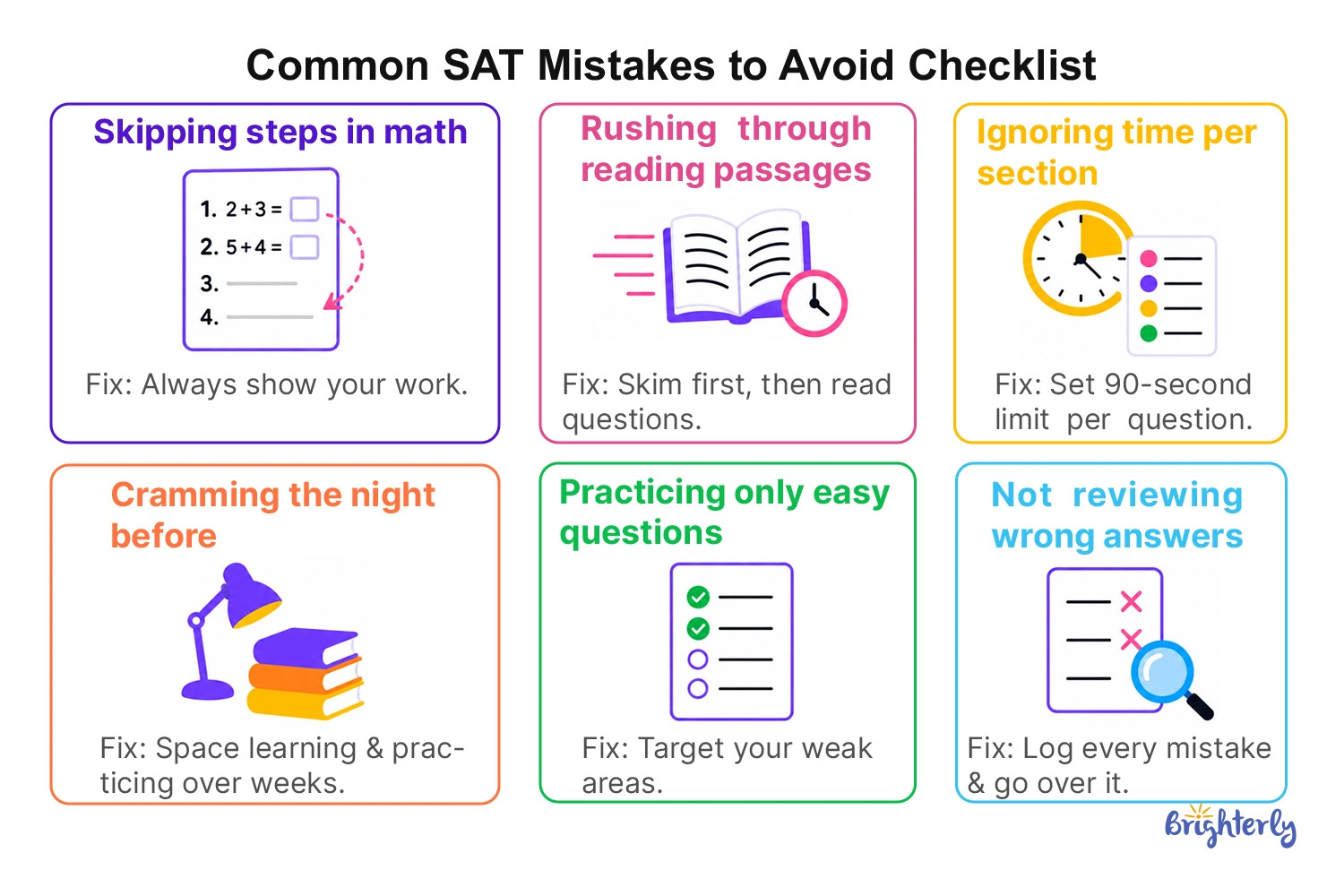
Our teachers combine proven strategies with engaging lessons to close your child’s gaps. All your work on how to get a perfect SAT score can go to waste if you fall for common, avoidable mistakes. Here are the most frequent mistakes SAT takers and how to skip them: You can print out this visual representation of the common SAT mistakes and use it as a reminder during your SAT prep: Achieving a high SAT score requires clear priorities, a strategic approach, and consistency. Even if you’re stuck, a plan allows you to have a set of instruments and tools to overcome gaps and challenges, To boost your score, identify weaknesses and target them. At the same time, develop a plan around structured practice and stay disciplined. Nevertheless, knowing formulas and math concepts, as well as writing and reading, is not enough. Thus, think of test-taking strategies and test time management tricks. Do you feel that you need guidance and support? It may be a signal to resort to Brighterly tutoring. Book free lesson to know how tutors can help. According to 2017 data from the College Board, students achieved an average SAT score improvement of 115 points with 20-hour free practice on Khan Academy. Meanwhile, by completing 1, 2, or 3 full-length practice tests children raise their score by 25, 45, and 60 points, respectively, also based on College Board data. Note: The study above predates the new SAT digital adaptive format, introduced in 2024, so improvement rates might differ now. You should start preparing for the SAT test 3-6 months before the test date. As you can see in the recommended SAT prep timeline above, this schedule gives you enough time to devote 6-8 hours per week to learn weak topics, practice timed tests, and review key materials. The digital SAT is shorter than the paper SAT and is adaptive, which means that questions change based on the answers already submitted by the student. The digital test takes 134 minutes and covers 98 Math and ELA items, while the paper test lasts 180 minutes and includes 154 items. Both tests use the same 400-1600 scale. The College Board doesn’t impose limits on the number of times you can take the SAT. The association recommends taking the test at least twice – once in the spring of junior year and once in the fall of senior year. The organization offers the exam 7 times per year. Most colleges consider your highest SAT score. Private tutoring like Brighterly is one of the most effective ways to get a high SAT score as it targets your weakest points in a personalized manner. Sean Ivester, Owner of Pivot Tutors, reports that his students improved their score by 60-80 points through tutoring sessions. What kind of math is used in computer science? Generally, computer scientists need to be comfortable with binary mathematics, linear algebra, calculus, discrete math, and statistics. Computer science is a broad field. The type of math needed depends on the specific career path. Let’s see how math is involved in computer science. How it helps […] May 22, 2024 If your kid has dyscalculia, you shouldn’t despair. I’ve put together 8 strategies on how to help a child with dyscalculia that I’ve seen work most effectively during my career as a math teacher. They’re easy to implement at home and will definitely make math more accessible to your little learner. Key points Dyscalculia affects […] May 23, 2024
What Is a High SAT Score?
SAT Score Ranges by College Type
How to Improve Your SAT Score: 12 Proven Strategies
Take a Diagnostic Practice Test First


Set a Target Score and Study Timeline
Build a Weekly Study Schedule
Identify and Fix Your Weaknesses


Master SAT Math Strategies
Learn Reading Passage Techniques
Improve Writing and Grammar Skills
Use the Process of Elimination

Practice Time Management
Reduce Test Anxiety and Stay Calm
Use Official College Board Practice Tests
Consider SAT Tutoring

Common SAT Mistakes to Avoid
Conclusion
Frequently Asked Questions
How Much Can You Realistically Improve Your SAT Score?
How Long Before the SAT Should You Start Studying?
What Is the Difference Between the Digital SAT and Paper SAT?
How Many Times Can You Take the SAT?
Does SAT Tutoring Actually Help Improve Scores?






Math & reading from 1st to 12th grade
Looking for homework support for your child?

Choose kid's grade

Math & Reading for Grades 1–12
Build real confidence for your child with a Brighterly math or reading tutor.