SMART Goals for Kids: What They Are And How to Write Them

SMART Goals for Kids: What They Are And How to Write ThemParenting

Key Points

  • SMART goals are Specific, Measurable, Achievable, Relevant, and Time-Bound.
  • 87% of people believe they’ll achieve goals, but only 7% do, so you should use a SMART goals template for kids to boost motivation (ASU Prep Digital, 2024).
  • Align goals with your child’s age and interests for better results.
  • Write clear objectives together with your kid and mark each milestone to succeed with SMART goals.
  • SMART goals support executive function skills by helping kids break tasks into steps, stay focused, and track their progress, while personalized 1:1 tutoring from Brighterly can help them work toward academic goals.

SMART goals for kids are things that your child hopes to achieve through a well-organized plan. Your child can use the SMART principles for both academic tasks and personal habits. This guide shows parents how SMART goals work and how to help your kid write them, including examples by category and age.

SMART goals for kids are things that your child hopes to achieve through a well-organized plan. They help children understand what they want to achieve and how to get there. This guide shows parents how SMART goals work and how to help their kids write them, including examples by category and age.

What Are SMART Goals for Kids?

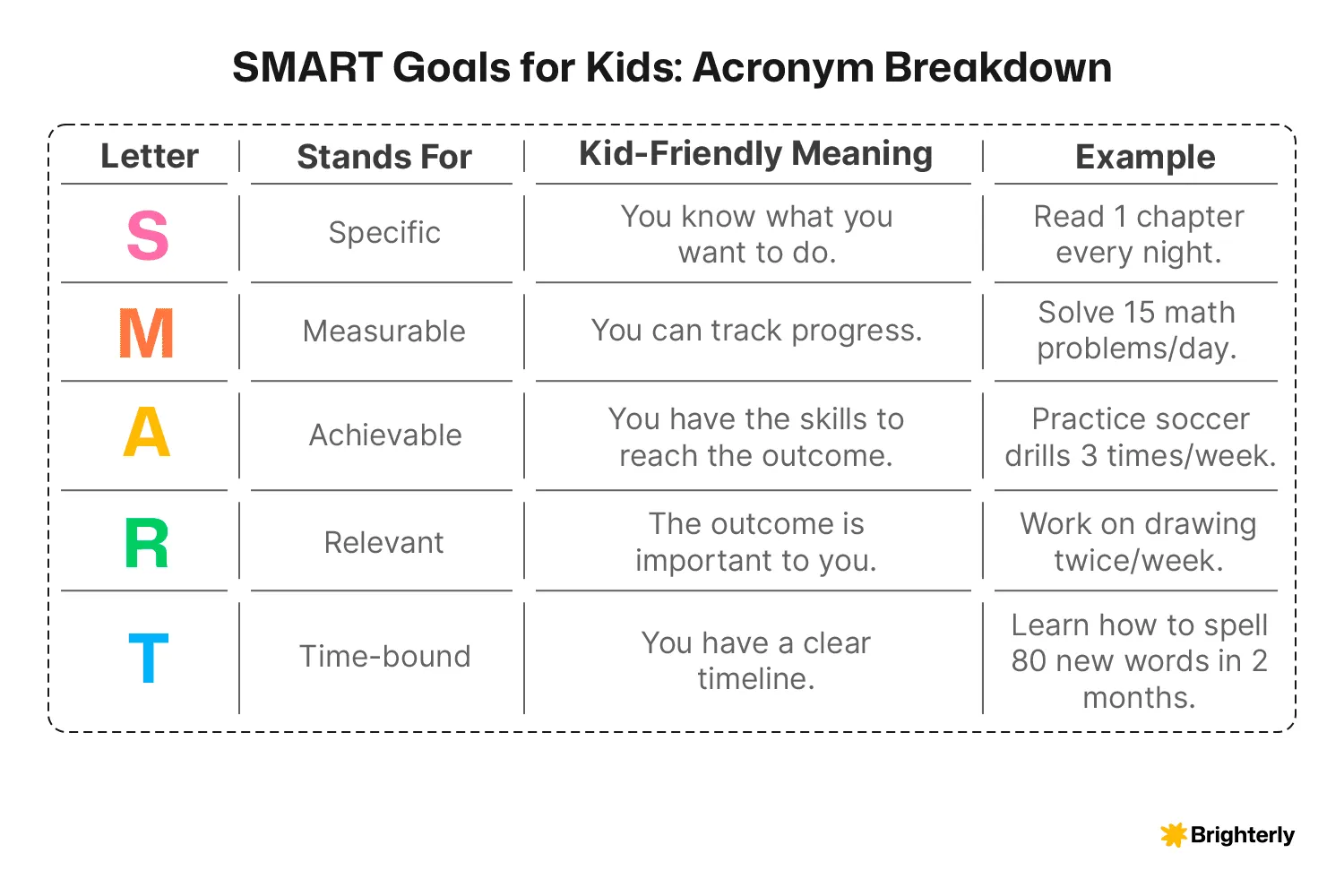
SMART goals for kids are Specific, Measurable, Achievable, Relevant, and Time-Bound objectives that your child plans to work on. Using the SMART framework helps build a growth mindset for your kids by enhancing study habits, personal skills, and self-esteem. SMART goals improve focus and build lifelong organizational capacities.

S – Specific

A specific goal states exactly what your child plans to do. Kids understand and follow clear goals better. Help your child set up a specific goal by asking “What do you want to improve?” and “What will success look like?”

Example: I will read 1 book chapter every night before bed.

M – Measurable

Measurable goals can be tracked numerically to see how close your child is to the aim. Kids feel motivated when they cross off steps and see progress. Make goals measurable by adding numbers and progress tracking.

Example: I will complete 15 math practice problems every weekday.

A – Achievable

When your child has the skills to complete a goal, it’s achievable. Kids don’t want to work on things they don’t believe they can complete. So, make aims tangible and attainable by breaking them into small, concrete action.

Example: I will practice soccer drills for 20 minutes 3 times/week.

R – Relevant

Relevant goals matter to your child. Kids want to work on things they care about. Help in setting SMART goals by connecting them to your child’s interests.

Example: I will practice drawing twice a week to get into the art club.

T – Time-Bound

A time-bound goal has a clear timeline for implementation. Deadlines help kids build routines, stay focused, and avoid procrastination. Add a specific deadline and realistic weekly schedule to make goals timely.

Example: I will learn how to spell 10 new words every week for the next 2 months.

What Are SMART Goals for Kids?

Why SMART Goals Work for Kids

SMART goals work for kids because they provide a concrete means of linking effort to outcomes. Children have an incentive to persevere when they observe that consistent practice makes them better at something they are passionate about. Additionally, the process enables kids to take ownership of their education and identify the methods that are most effective for them.

When children understand what they are working toward and why it matters, they are more likely to stick with a goal. SMART goals give them a straightforward framework for accomplishing what they set out to do. They also give children a chance to practice skills they use far beyond school.

SMART goals work because they help children

  • focus on one task instead of trying to do everything at once
  • know what to work on next
  • recognize when they need to change their approach
  • see their progress and feel more confident about their abilities

A 2024 study published in Frontiers in Education examined how goal-setting prompts and progress tracking affected fifth-grade students during math practice. Students who received this support solved more problems and answered more accurately than those who practiced without it. However, the approach did not lead to greater overall learning gains. These findings suggest that setting goals and tracking progress can help children stay focused during practice, although they do not guarantee better academic results.

How to Write SMART Goals with Your Child

For setting SMART goals for kids, start by choosing a goal that your kid feels close to their heart. Then make the goal precise, easy to track, and achievable before adding a clear deadline. Write down the goal and track progress together to boost motivation and build confidence over time.

Start with What Your Child Cares About

Choose a goal your kid genuinely wants to achieve and that supports their well-being. Don’t force objectives that matter to you, because your kid might push back. Children feel more motivated when goals match their aspirations, interests, and hobbies. Ask questions to find out what really matters to your kid.

Make It Specific and Measurable

Turn loose ideas into actionable steps that your child can keep track of. The examples of SMART goals for kids below show how to turn broad ideas into specific actions.

Add numbers, routines, and small milestones to make progress easier to see and keep your child encouraged. Rather than thinking “Read more”, create a goal like “Finish a 100-page book every month”.

Use the examples below as examples of SMART goals for students to turn a vague idea into a goal your child can follow.

Vague goalSMART goal
Do better in schoolI will finish my homework before dinner, 5 nights a week, for the next month.
Read moreI will finish one 100-page book every month for the next 3 months.
Be more organizedI will clear my backpack every Friday for the next 6 weeks.
Get better at soccerI will practice soccer drills for 20 minutes, 3 times a week, for the next 2 months.
Get better at spellingI will practice 5 new spelling words every weekday and spell them correctly by Friday.

SMART Goal Template

Assist your child in creating a goal that is time-bound, meaningful, quantifiable, feasible, and detailed.

Use this formula to turn your child's goal into a clear, trackable plan:

By [date], my child will [specific action], measured by [how we'll track it], because [why it matters to them].

  • My goal: What do I want to achieve?
  • My steps: What will I do to reach it?
  • My target: How much or how often will I practice?
  • My reason: Why is this goal important to me?
  • My deadline: When do I want to achieve it?

This planner helps your child understand what they need to do to accomplish their goal.

Example: I want to get better at multiplication, so for the next month, I'll use my goal planner to practice ten multiplication problems four days a week after school.

Check That It’s Achievable and Relevant

Write goals that challenge your child to go outside their comfort zone without feeling overwhelmed. Realistic goals create an incentive and avoid frustration, especially when balancing school, extracurricular activities, and family routines. Make sure the objective feels meaningful to your kid so that they persist long enough to complete it.

Set a Deadline

Timelines with milestones and deadlines give your child a clear target and prevent procrastination. Time limits make goals easier to organize into daily activities. Depending on your child’s age, the deadline could be a week, a month, or the end of the year. For example, turn “Do more math” into “Memorize the multiplication table by the end of the month”.

Write It Down and Track Progress

Putting goals on paper makes them real and helps remember them. Progress charts, checklists, and weekly check-ins keep your child on track and encourage them by recognizing small wins. According to research cited by Arizona State University (ASU) Prep Digital in 2024, 87% of people setting SMART goals are confident they’ll complete them, while only 7% actually do. So, keeping track matters for success.

To identify your child’s math learning gaps, you can start with a grade-appropriate free diagnostic math test or reading test. Next, you can decide to download a SMART goals worksheet for kids and complete it each week (free printable math worksheets and reading worksheets are available here).

SMART Goals Examples for Kids by Category

Every child has different objectives. One may want to improve their multiplication skills, while another may want to finish a book without being reminded. These school SMART examples can help children turn everyday academic tasks into clear and manageable goals. This week, choose something your child enjoys to complete as a mini-assignment.

The following samples represent various age groups in schoolwork, daily routines, friends, and hobbies. These SMART goals for kids cover examples in common areas such as schoolwork, habits, social skills, and hobbies.

CategoryAges 5–10Ages 11–13Ages 14–18
ReadingRead a bedtime story with a parent 4 nights a week for the next month.Finish one chapter book by the end of each month for the next 3 months.Write a few sentences about each assigned reading chapter on school days for the next 4 weeks.
MathPractice addition for 10 minutes, 4 days a week after school.Work on fractional problems for 20 minutes every Monday and Wednesday this month.Raise my math grade from a C to a B by practicing with a tutor twice a week.
Health and habitsPut toys away before bed every night this week.Take a water bottle to school and choose water instead of soda on school days for the next month.Fit in a 30-minute workout 5 days a week for the next 12 weeks.
Social skillsAsk a classmate to play at recess twice a week this month.Talk to a classmate I don't know well at least once a week for the next month.Take charge of one task during each group project this semester.
Sports and hobbiesDraw for 10 minutes after school, 3 days a week this month.Practice basketball free throws for 15 minutes, 3 times a week, for the next 6 weeks.Practice guitar for 20 minutes, 4 days a week, for the next 2 months.

Note

Our online learning platform offers fully personalized 1:1 math and reading tutoring that can help your child set and achieve grade-appropriate SMART goals for middle school students. Our experienced tutors customize K-12 online math and reading program to the gaps and needs of your child to hit their SMART goals on time.

SMART Goals for Kids by Age Group

Age groupSMART goal examples
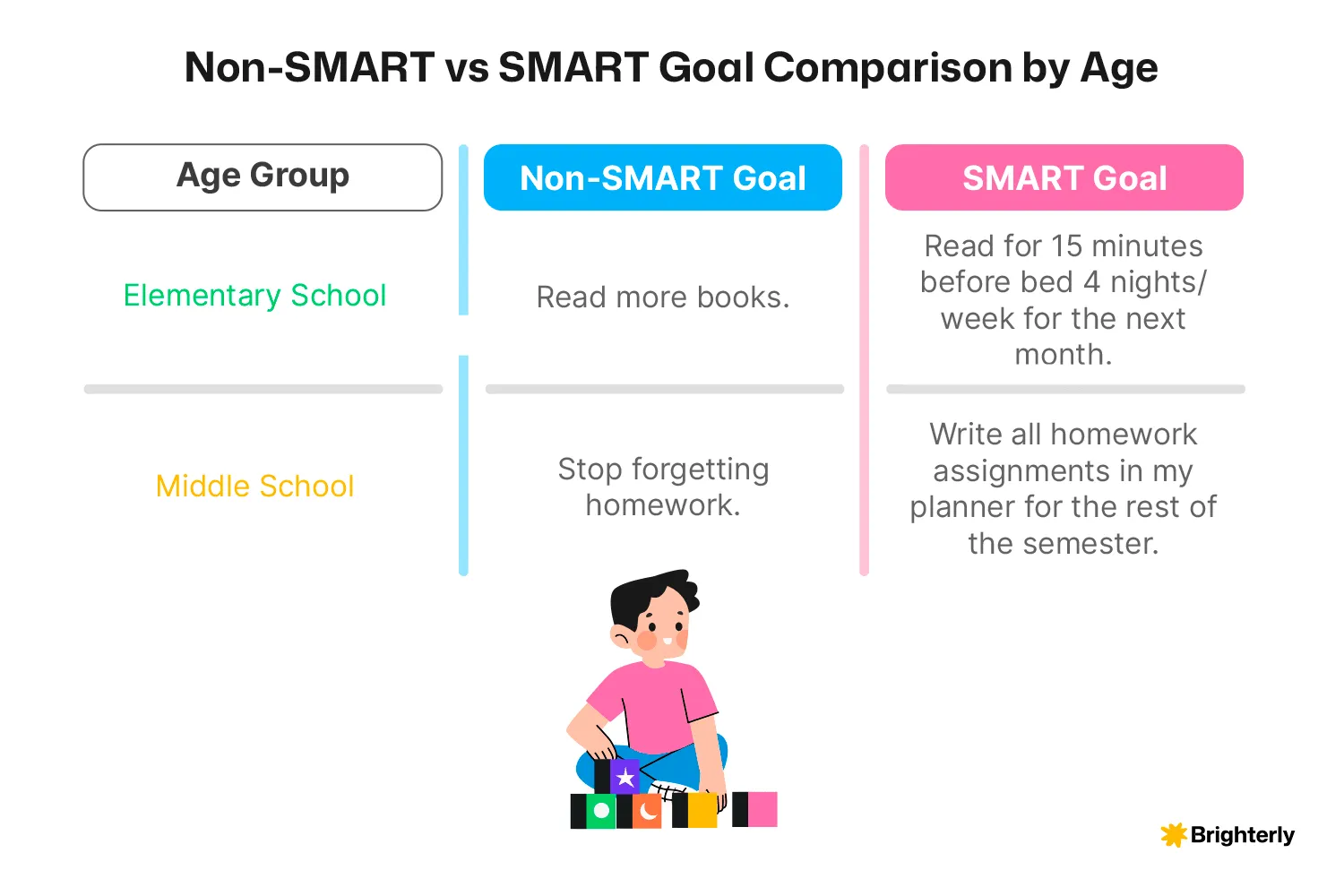
Elementary school (ages 5–10)

I will read one short story before bed every night for the next month.

I will practice science facts for 10 minutes a day, 4 days a week, for the next 2 months.

Middle school (ages 11–13)

The following SMART goals examples for middle school students can help children build better study habits and stay on track with their schoolwork. To raise my average from 70% to 80%, I will study ELA for 20 minutes every weekday for the next two months.

I will practice baseball hitting three times a week for 20 minutes for the next eight weeks.

The right learning format can also help children work toward their academic goals. Explore the differences between online or in-person tutoring to find an option that suits your child’s needs.

SMART Goals for Kids by Age Group

Common Mistakes Parents Make When Setting Goals with Kids

Despite your efforts, sometimes SMART goals examples for students fail because your kid feels disconnected or pressured. Parents often make goals too broad, difficult, or kid-unfriendly. Avoid the most frequent mistakes when goal setting for your kid with the tips below.

Making the Goal Too Vague

Sometimes parents use general statements like “Do better in math” when setting personal goals for kids, which makes it hard for children to understand what they should do. Kids can’t complete something they don’t understand.

Fix: In goal-setting activities for kids, focus on specific actions. Use numbers and deadlines, such as “Solve 1 addition worksheet/night 3 nights/week for the next month”.

Setting the Goal for Them Instead of With Them

Some parents choose goals for their children without involving them in the decision-making, making the objective impersonal. Brigida Aversa, Co-Owner and Founder at Tiny Hoppers, explains why not involving your child is a major mistake and how to help kids set goals that are meaningful to them:

“The most common mistake is setting a goal that doesn’t actually belong to them.”

Kids being kids, they can see someone doing something and decide that’s what they want, without any real motivation behind it, which can feel disconnected from the start. It might sound like a good goal on the surface, something they think they should want, like getting better grades or improving at a sport. But if it doesn’t feel personal, there’s no real connection to it, so it’s easy to lose motivation or give up quickly.

To fix this and get back on track, they have to make sure the goal connects to something they genuinely care about. Even a small reason can make a difference. Once it feels like their goal, they’re much more likely to stay engaged and follow through.

Brigida Aversa
Brigida AversaChief Operating Officer / Co-Owner & Founder at Tiny Hoppers

Not Celebrating Small Wins

Some parents forget to recognize small achievements while their children are accomplishing a big goal. When parents don’t reward progress, children lose ambition and quit early.

Fix: Praise your kid’s efforts. Use a printable SMART goals template to track advancements and give small rewards to encourage your kid.

Conclusion

A SMART goal for students helps them organize their plans into manageable steps they can easily follow. When you create clear, age-appropriate goals together with your child and track progress consistently, the process becomes more organized, satisfying, and successful.

Explore Brighterly Learning Experience

Learn exactly how Brighterly helps students thrive through expert sessions, online tools, and proven feedback from thousands of satisfied parents

  • Online math tutor

    Get personalized math tutoring from experts who help kids master math concepts

  • Parents reviews

    Read parent feedback to see how Brighterly helps kids build strong foundation

  • Online reading tutor

    Boost reading and language skills with engaging lessons from ELA tutors

Frequently Asked Questions

“I will practice multiplication for 15 minutes after school 4 times/week for the next 6 weeks” is a SMART goal example for students aged 10. The goal creates an understandable, achievable objective with a definite deadline. Your child knows what to do to reach the goal.

Use simple language, colorful charts, and playful stickers to have SMART goals explained for your kids in a fun way. Use a child goal setting worksheet to gamify goals into challenges with rewards. Your little child can color in a chart whenever they complete a reading session or a chore.

Most children can handle 1-3 SMART goals at a time, depending on age, personality, and schedule. At elementary school, start with 1-2 specific objectives and see whether your kid can manage them. As your child moves to middle school, add an extra goal. Your high schooler can successfully work on 3-5 goals at once.

SMART goals can help students with learning differences because they break large tasks into small, manageable steps. Using milestones, routines, and trackers can improve the focus of neurodivergent kids and teach patience. With SMART goals, you can adjust difficulty and timelines to your kid’s learning pace.

The best age to start setting SMART goals is 5–7 years old, making this a good time to introduce SMART goals for elementary students. Begin with short term, simple goals so your child can learn the SMART framework and how to implement it. As your kid grows, gradually introduce longer timelines, more detailed planning, and independent progress tracking.

If your child can’t achieve a goal, be supportive. Find out together what made the goal impossible. Maybe the timeline was too long, the goal was too hard, or your child wasn’t interested. Help your kid adjust the goal into smaller, easier steps and start again without putting pressure on them.

An attainable SMART goal means that your child can achieve it with their current skills. A good goal is challenging enough to encourage improvements, but not to the point where it becomes impossible to achieve. For example, practicing piano for 15 minutes a day is more attainable than mastering an entire song in a week.