What Is Scaffolding in Education? Definition, Types, and Strategies for Teachers
reviewed by Jo-ann Caballes
Updated on July 13, 2026

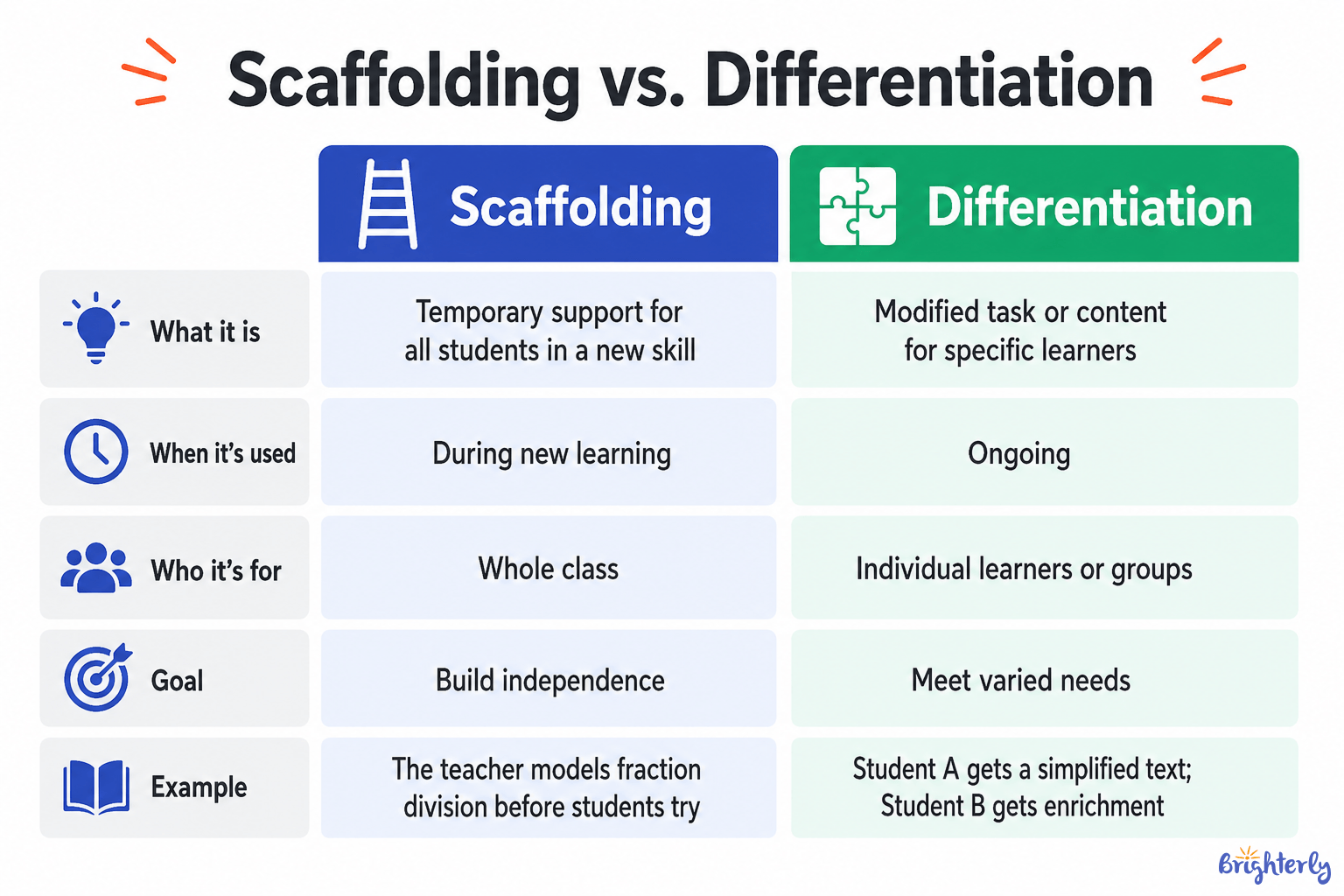
Key points: When a student finds new material hard, the teacher’s guided support is what helps them first understand it, then apply it independently. This is what scaffolding in education is: the ladder set by a teacher allowing them to go on the next level. From this guide, you will learn how scaffolding works, get effective strategies, and know when to take that ladder away. Scaffolding in education is a teaching approach in which an educator provides temporary support to help children learn a new skill, then gradually withdraws this support as the learner becomes more confident. You can compare this method to the construction scaffolding. Under it, a builder brings the support that, later, when the structure stands on its own, will be removed. The same idea is behind the instructional scaffolding, but the structure is the new knowledge and skills. “Scaffolding is not the materials. It's not the sentence starter, the graphic organizer, the word bank, or the multiplication chart.” To trace the roots of scaffolding in teaching, you can turn to the work of Soviet psychologist Lev Vygotsky, particularly his concept of the Zone of Proximal Development (ZPD). Vygotsky explained it as the gap, or line, between what a student can do independently and what they can do with the guidance of a person who has expertise. As a 2025 Simply Psychology post shows, Vygotsky called such a person a More Knowledgeable Other (MKO) and saw their role in sharing their superior knowledge and know-how. In education, differentiation is when a teacher continuously modifies content, tasks, and learning paths to meet the needs of specific students or groups of them. In contrast, what is scaffolding in teaching? You can look at it as temporary support given to all students during the learning of new material, but then, taken away as their competency grows. Explore Brighterly Learning Experience Learn exactly how Brighterly helps students thrive through expert sessions, online tools, and proven feedback from thousands of satisfied parents Scaffolding is important in education as it allows closing the gap between what a student “can’t do yet” and “what they can do independently.” When the technique is well implemented, it becomes impossible not to see the actual benefits of scaffolding in education:
Scaffolding done right, every lesson
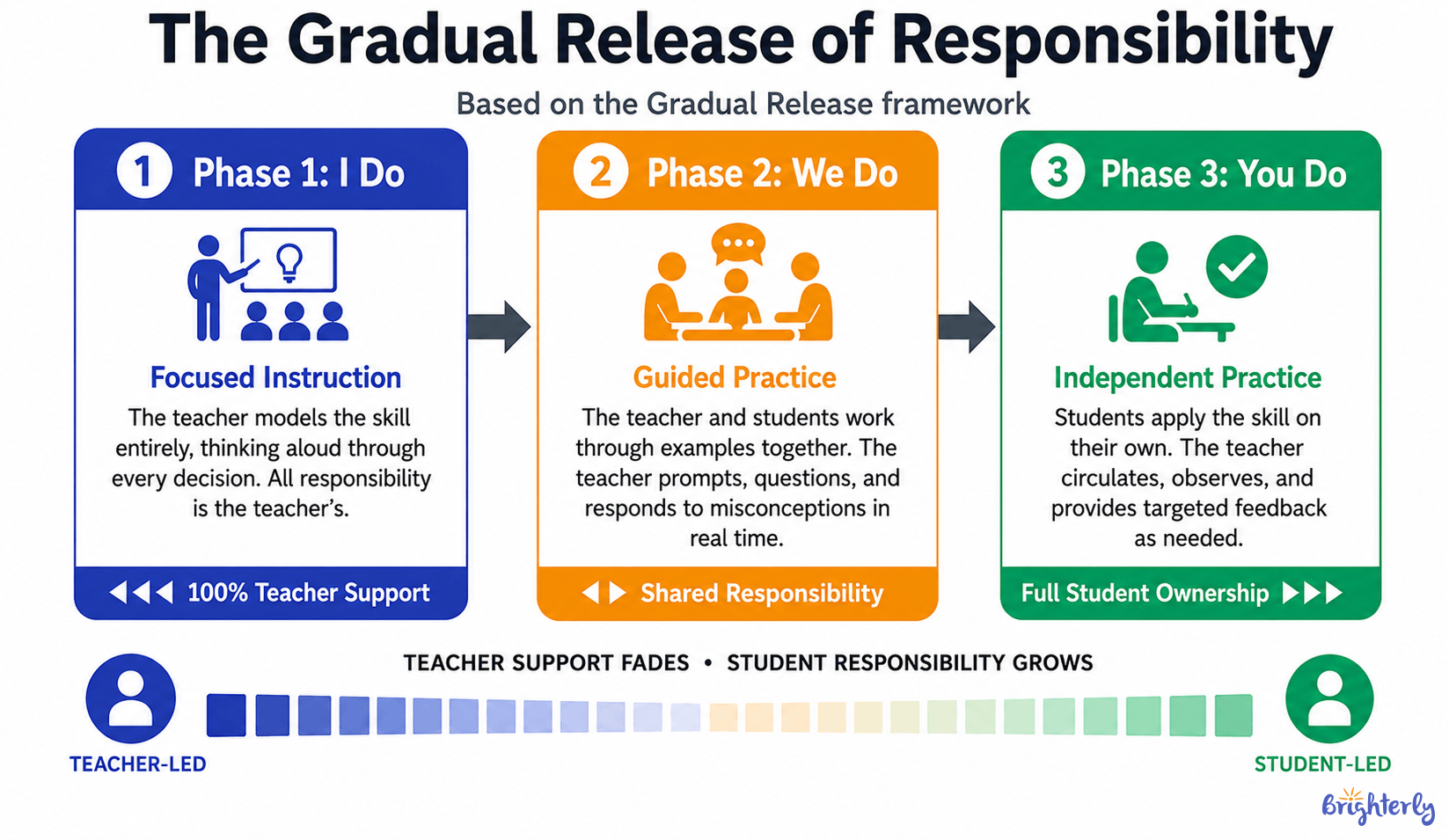
See how Brighterly's personalized math tutoring meets your child exactly where they are. Note. Understanding these types of scaffolding in education will help you to adapt scaffolding strategies to different formats. Sensory scaffolding is concerned with using multisensory objects and physical and hands-on materials to back skill or concept learning. In other words, it’s about provisioning perceptual cues and having an anchor for new ideas. Such cues are good in supporting the explanation of new concepts, managing the task, or regaining focus. Graphic scaffolding involves using visual tools, from graphic organizers to concept maps and sentence frames, to support thinking and make it more visible for a student. For example, teachers may bring frameworks that clarify the shape of the task or offer hints on how to start it. It’s effective when educators teach text structures in reading or to show conceptual relationships. Compared to the previous two, interactive scaffolding is about using conversation and peer collaboration as means for supporting. It allows using a social dimension that Vygotsky mentioned in his works to rehearse language or abilities. Within it, peers who are slightly more advanced in a given area can scaffold one another. Think-pair-share, jigsaw method, and structured peer feedback are the techniques that allow scaffolding to happen. The technological scaffolding type involves using digital tools and technologies as an additional layer of support. Any adaptive learning tool, platform, or service, from text-to-speech support to interactive problem sets that adjust in real time, can ensure the scaffolding. Such means can reduce cognitive load, provide relevant feedback, or present materials that reflect the right level of challenge. Note. At an adaptive tutoring platform, like Brighterly, 1:1 tutors target each student’s Zone of Proximal Development, gradually withdrawing support as mastery develops. Note. Each of the scaffolding strategies in education has specific stages when fading or transfer of responsibility takes place, so when applying, think about what should happen for you to withdraw the support. Modeling is the primary scaffolding strategy where a teacher demonstrates the thinking process, decisions, or results. In other words, they make the reasoning, knowledge, and skills visible. So, as a teacher, try to show students what they are expected to do. Activating prior knowledge is about setting the ground for the new material to stick. For students, it’s easier to retain knowledge if it connects to something they already know. Breaking tasks into smaller steps allows making complex tasks manageable for a student. When they encounter the new task, it may be scary for them. Yet seeing parts rather than one big task will reduce their cognitive load. So, divide the task into small steps or give the students a checklist. They will be able to focus on one part at a time and take the next step. Besides, such a technique would promote the comprehension of a scaffolded instruction and would add to the confidence of a kid to move forward. Well-planned questions help explain thinking and make connections. As a teacher, you can support thinking towards an answer rather than giving an actual answer. At the same time, questioning is one of the key classroom strategies to check understanding and identify whether students may move forward. Visual tools can be a great support in breaking tasks, explaining concepts, and guiding and shaping how students think. Such tools refer to anchor charts, graphic organizers, sentence starters, and word walls, making a great supplementary option. According to a 2021 article in the Journal of Educational Psychology on the benefits of interactive graphic organizers, students who used graphic organizers showed better results in retention and comprehension of knowledge compared to those who used text-only tools. Pre-teaching vocabulary is a strategy that introduces students to the definitions of challenging reading terms and provides them with a basis to start. With pre-teaching, teachers help students break the barrier that influences comprehension of the text they see for the first time. Photos, word maps, analogies, or metaphors to provide context or spark discussion and pre-teach vocabulary. When they know the context, students are frustrated less and can start or go through the text more easily. To implement scaffolding, you should provide the support and instruction, and know when it’s time for a teacher to withdraw. In this regard, the Gradual Release of Responsibility (GPR) is a key framework for teachers to use, as it explains the stages, defines roles and structure, and determines when a teacher should withdraw. The GPR model divides the “I Do, We Do, You Do” teaching process into 3 or sometimes 4 phases: To put theory into practice, here’s one of the typical scaffolding in education examples from an ELA lesson, as provided by the Brighterly Educational Advisor, Claire Smizer: “Say a fourth grader is learning to write a paragraph that explains an idea from something they read.” Long division can serve as a scaffolding technique example in a math lesson. There, a teacher or math tutor writes a problem and solves it step-by-step, saying every step aloud: “First, I…then I write 2 above the line, multiply, subtract…”. Next, the teacher gives the students a checklist and three problems to solve. If they complete it, a teacher can take the checklist away and offer five problems to work on on their own.
Help your kids close learning gaps with guided support
Brighterly tutors identify learning needs and customize instructions to address them Teachers should remove scaffolding as soon as learners demonstrate consistent results, mastery, and autonomy, but do it gradually. Nevertheless, it’s often quite hard to determine the right point or time, so the right approach is to consider signs: You can also use an alternative “Least Help First” approach: when you see progress, you minimize support and provide more if you see that it’s necessary, or they struggle. Within the same classroom, scaffolding may look different, as it takes different forms depending on the subject, task, or concept. Yet, they all follow the same flow as scaffolding starts with the instructions, implies structured support, and then moves towards students’ autonomy. At Brighterly, our phonics tutors often use picture cards and read aloud to teach phonics. If a child is learning the “sh” sound, our tutor starts with a picture of a shell and clearly says, “Shell.” The student repeats it and points to the letters. After it, the tutor and student would repeat the activity with new words and cards, and then sentences from these words. If a student succeeds in naming the sounds, our tutor would make the cards disappear and ask the student to read a completely new sentence with the “sh” sound, but independently. Most of the sessions of the 1st grade reading program follow the same logic. Students won’t move to independent reading until the skill holds on its own. The same applies to math students; our pre-algebra tutors won’t lift scaffolding and move to procedural fluency until students have conceptual understanding. The difference between scaffolding and differentiation lies in the method, continuity, and focus. The former term means temporary support for all the students in the class when they learn a new concept or topic, a certain gap. In contrast, the latter term is about making changes in content, tasks, and expectations to meet the needs of specific learners. The concept of scaffolding in education derives from Lev Vygotsky and his idea of the Zone of Proximal Development, which explains the gap between what a learner can do alone and with support. The common examples of scaffolding in math include using base-ten blocks before solving problems, think-alouds performed by a teacher, display of completed practice problems, guided questioning, step-by-step checklists, and visual aids and graphic organizers related to formulas or operations. Scaffolding should last until a student needs it or begins to master a skill or concept independently, so there’s no fixed timeline. The signals that indicate that teachers should withdraw are consistent accuracy, a high success rate, independent skill use, and the ability to explain things without prompts. Yes, scaffolded instruction is an effective tool to teach students with learning disabilities. As the 2025 IJRISS article on scaffolding strategies and the academic success of students with learning disabilities suggests, the visual aids, questioning strategies, and prompting are common tools to do so. Teachers use them to improve the academic achievement of such students. Have you ever felt overwhelmed with chalk pieces, worksheets, books, pens, and pencils at random places at the end of the class? If yes, you know how exhausting it can be to sort them all out every day. If you can’t take it anymore and seek simple classroom organization tips on how to organize a […] May 25, 2022 When focus collapses mid-lesson, children can easily disengage or get frustrated. That’s the impact of cognitive load, as the brain is craving for a focus restore. And brain breaks are one of the most research-backed tools to provide it. Discover 20+ examples to use to ensure a cognitive reset, focus breaks on quiet mindfulness, or […] May 31, 2022
What Is Scaffolding in Education?


The Zone of Proximal Development and Scaffolding
Scaffolding vs Differentiation: What’s the Difference?
Why Is Scaffolding Important In Education?


4 Types of Scaffolding in Education
Sensory Scaffolding
Graphic Scaffolding
Interactive Scaffolding
Technological Scaffolding
6 Scaffolding Strategies Teachers Can Use in the Classroom
Model First (“I Do”)
Activate Prior Knowledge
Break Tasks Into Small Steps
Use Guided Questioning
Provide Visual Supports
Pre-Teach Vocabulary
How to Implement Scaffolding: The Gradual Release of Responsibility

When Should Teachers Remove Scaffolding?
Scaffolding in Education: Classroom Examples by Subject
Scaffolding Example: How Brighterly Tutors Run a Lesson?
Frequently Asked Questions
What Is the Difference Between Scaffolding And Differentiation?
Who Invented the Concept of Scaffolding in Education?
What Are the Examples of Scaffolding in a Math Classroom?
How Long Should Scaffolding Support Last?
Does Scaffolding Work for Students with Learning Disabilities?




Math & reading from 1st to 12th grade
Looking for homework support for your child?

Choose kid's grade

Math & Reading for Grades 1–12
Build real confidence for your child with a Brighterly math or reading tutor.