130 Fun Science Facts for Kids
reviewed by Laila A. Lico
Updated on May 3, 2026
Key points
Kids are natural scientists – they spot, question, and wonder about everything around them. These 130 fun science facts for kids deliver real “wow” moments across animals, space, the human body, and beyond. Read one fact, and your child will want to share it with everyone at the dinner table.
What Are Science Facts for Kids?
Fun science facts for kids are little pieces of knowledge about the world that make kids go “Wow!” They help students understand how everything works, from our own bodies to the stars in the sky. Each fun STEM fact is like a tiny treasure that shows how amazing our world is.
Did you know that sharks never run out of teeth? They can grow up to 30,000 teeth in their lifetime! Or that a baby kangaroo, called a joey, is smaller than your thumb when it’s born? Fun facts about science like these help your child see the magic in everyday life and remind you that even the smallest things can be full of wonder.
Brighterly takes that spark of science curiosity and turns it into a genuine love of learning. Our online program helps K-12 students master math and reading – one exciting lesson at a time. Every online math tutor on our team is a certified professional who brings games and animated presentations to each session. Plus, your child can try creative reading worksheets for kids. Because every child deserves to look forward to their next lesson.


Does Your Child Love Discovering New Things?
Brighterly's certified tutors make every lesson personal, fun, and built around your child.
Explore Brighterly Learning Experience
Learn exactly how Brighterly helps students thrive through expert sessions, online tools, and proven feedback from thousands of satisfied parents
Human Body Facts
- Our body can do some unbelievable things, for example, the heart beats around 100,000 times a day. That implies a total of almost 3 billion times in your life as the heart never rests, not even for a second.
- Your brain can generate more ideas per day than there are stars in the whole sky.
- The human body is made of about 37 trillion cells, all working together as a perfect team.
- Our bones are stronger than concrete, while the stomach acid is powerful enough to dissolve metal.
- Your body contains enough iron to make a small nail.
- If stretching out, our blood vessels are so long that they’d wrap around Earth four times.
- Human lungs can effectively float on water because they contain millions of tiny air sacs called alveoli that trap air.
- Meanwhile your left lung is some 10% smaller than the right in order to have space for your heart.
- 99.9% of human DNA is identical across all people onthe planet, – that’s the remaining 0.1% that makes all the difference.
- Our nervous system can send signals at 120 meters per second, or ~430 km/h, which is faster than any Formula 1 car.
- When we read silently, the muscles in your mouth, tongue, and throat still activate (as per a 2026 BBC article).
- Your nose is automatically erased from the field of vision by your brain. The nose is always there, it’s just your brain decides it’s not that important to show you.
- Your body produces a new skeleton roughly every 10 years – old bone cells break down, and new ones rebuild continuously.
- Did you know science facts about bones? The three smallest bones are located inside your ear, which together are smaller than a grain of rice. But due to them we could hear.
- We can detect over one trillion different scents by our smell, and the brain’s electricity could power a small light bulb.
- And an interesting fact about the teeth: tooth enamel is the hardest part inside the body. Still, if you don’t brush, more than 300 kinds of bacteria can live on one tooth. Yuck! Better grab that toothbrush!
Animals Facts for Kids
- Polar bears have black skin under their white fur – it helps them soak up the sun’s warmth. In addition, tigers have stripes not only on their fur but also on their skin, and every tiger’s pattern is unique, just like your fingerprints!
- Sharks never run out of teeth. They can grow up to 30,000 teeth in their lifetime!
- Some frogs can freeze solid in winter and come back to life when they thaw out in spring!
- The mole is a digging champion; it can dig tunnels faster than a person can run!
- A giraffe’s tongue can be almost half a meter long. It’s perfect for grabbing leaves high up in trees.
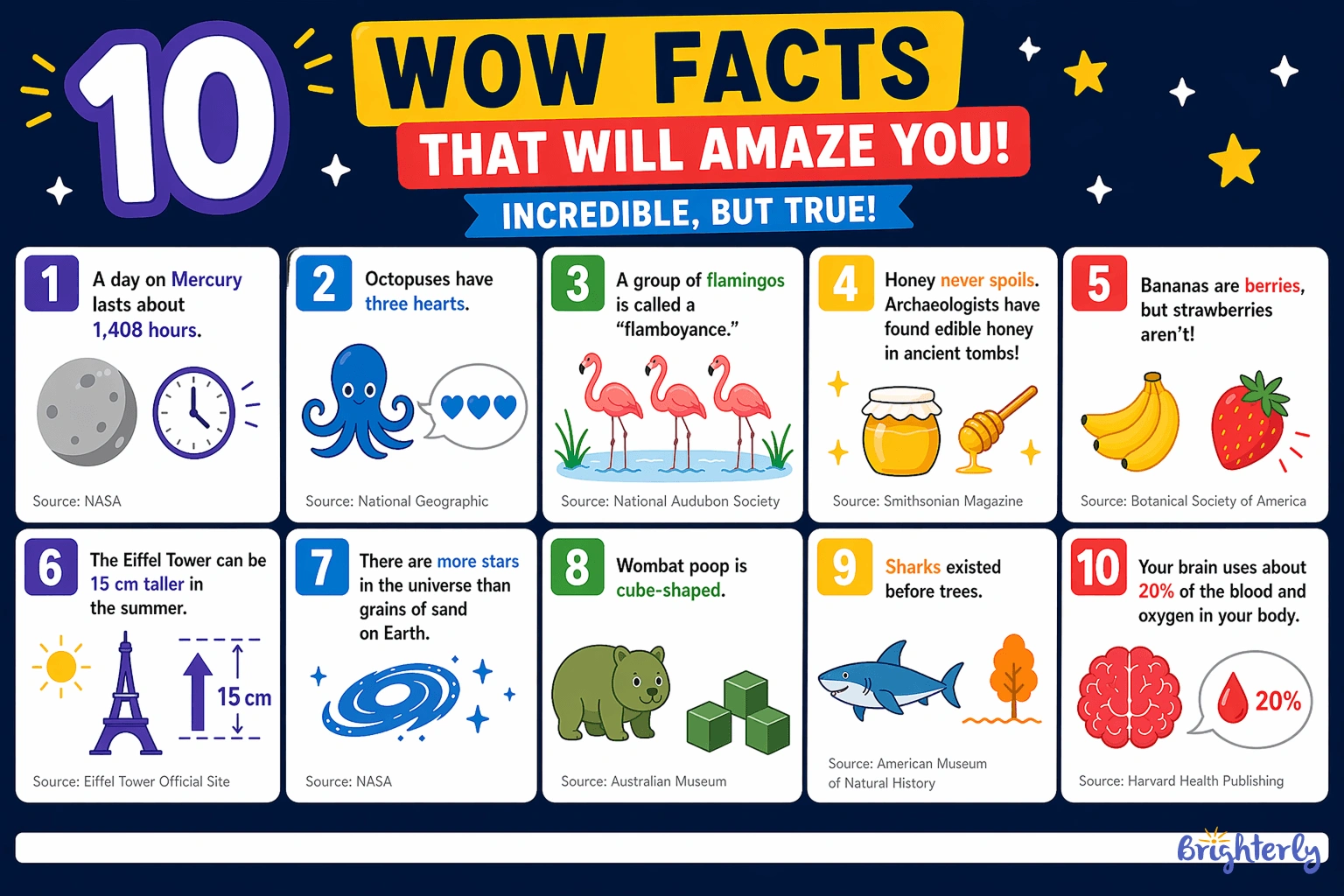
- Octopuses have three hearts and blue blood. Two hearts pump blood through the gills, while the third sends it to the rest of the body.
- When a male penguin courts a female, he may offer her a pebble, as specified in the Deccan Herald in Education article. If she accepts, they bond and build a nest together; the stones help keep their eggs off the cold ground.
- Elephants are the only mammals which cannot jump because their massive body needs to keep all four feet on the ground even when moving fast.
- The only bird that knows how to fly backward is the hummingbird, which wings beat 80 times per second to make it possible.
- Crows have in fact very good memory and can recognize and remember human faces for years and retaliate for harm done.
- Flamingos are actually white but turn in pink colour from eating algae and shrimp that are rich in pink natural pigments.
- Axolotls are unique in their ability to regrow lost limbs, parts of their heart, and even sections of their brain.
- Ants can carry up to 50 times their own body weight. That’s like a child lifting a car!
- It’s the dad who gives birth in seahorse families; the female deposits eggs into the male’s pouch, and he nurtures them until they hatch.
- A turtle’s shell is made of 50 bones, all fused together. It’s actually part of the skeleton, not a separate shell.
- Lizards use their tongue to smell. They flick it out to collect scent particles from the air.
- When you talk, your dog tilts its head to better locate different familiar sounds around and read your tone of voice more accurately (according to BBC).
- The vast majority of ginger cats are male. There is a special gene for orange fur that typically sits on the X chromosome, so that female cats need two copies to turn ginger, and males need only a single copy.
- Tardigrades, microscopic water creatures, are called indestructible as they can survive in outer space with extreme radiation, and temperatures ranging from -270°C to 150°C.
- Sharks often get paralysis if flipped upside down that is used by scientists to handle them safely.
- Frogs are breathing using their skin to absorb water and oxygen.
- The heart of a blue whale is so large that a child would be able to swim through its arteries, while the heartbeat can be heard from a distance of 3 km.
Earth & Nature Facts for Kids
- Oceans cover 71% of Earth’s surface. The water mass is so massive that we humans explored less than 5% of the total and many unimaginable creatures are still hiding in deep-deep waters.
- Tornadoes and hurricanes create the strongest and fastest winds on Earth that spin faster than a racing car.
- Some trees can live for thousands of years. For example, the oldest known tree, a bristlecone pine, is older than 5,000 years old, so that it was already growing during the construction of the Egyptian pyramids.
- Earth is spinning at the speed of around 1,600 km/h at the equator. While we don’t feel that speed we can only observe how the night changes the day. A typical airplane travels at the speed of 800 km/h on average.
- The South American Amazon rainforest produces 20% of the world’s oxygen and is justly called the “lungs of the Earth.” There grows more than 400 billion trees and is home to 2.5 million of animals.
- Snake Island which is located near the coast of Brazil houses between 2,000 and 4,000 venomous snakes. That’s roughly one snake per each square meter. It’s forbidden to visit the island except for scientists with special permit.
- Mount Everest is not the tallest mountain on Earth when measured from its base. In fact, Mauna Kea in Hawaii rises 10.2 km from its underwater base on the ocean floor, while Everest sits at 8.8 km.
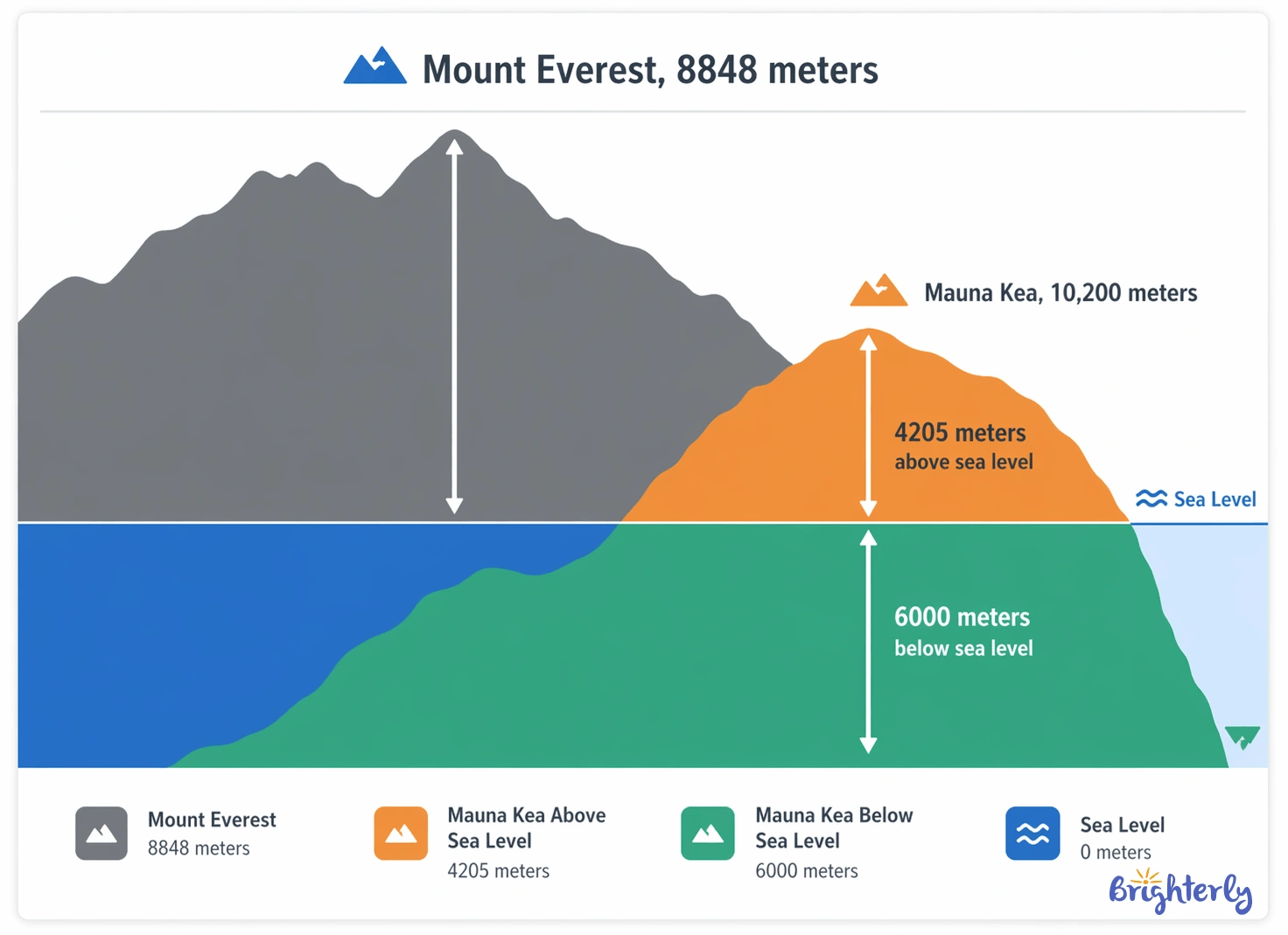
- The deepest known seabed point Challenger Deep in the Mariana Trench amounts 10,935 meters below sea level.
- There are about 2,000 thunderstorms happening across Earth at any given moment, which create 40 to 100 lightning flashes every second which is confirmed by NASA studies.
- Unknown fact that the driest point on Earth is not the Sahara but McMurdo Dry Valleys in Antarctica. This place hasn’t received rainfall for nearly 2 million years as strong polar winds evaporate any moisture before it can settle that created a white desert which looks more like Mars.
- During the 1883 eruption of Krakatoa in Indonesia people heard the explosion from 3,000 kilometers away, making it the loudest recorded sound in history.
- Well-known that the large asteroid wiped out the dinosaurs population 66 million years ago. Its speed was 43,000 km/h and released energy billions of times more powerful than any nuclear bomb.
- There is a regular visitor to Tiwi Islands, Northern Australia called Hector the Convector. It’s a thunderstorm that arrives every day at around 3 PM, reaches the height of over 19 km and shows up so promptly that sailors have used it for navigation (according to the 2026 BBC article by Ceri Perkins).
- The tectonic plates on Earth constantly move at roughly the same speed as our fingernails grow. This movement has shaped every continent and mountain range.
- Permafrost covers about 25% of the Northern Hemisphere’s land surface. In some places, it has stayed frozen for over 700,000 years, preserving ancient plants, animals, and even air bubbles from prehistoric times.
- Earth takes exactly 23 hours, 56 minutes, and 4 seconds to complete one full rotation. The extra minutes add up, which is why we occasionally need a leap second to keep our clocks accurate.
- The Finke River in Australia is considered one of the oldest rivers on Earth, formed around between 300 and 400 million years ago (according to a 2026 publication at Live Science by Victoria Atkinson). It was flowing long before dinosaurs ever walked the planet.
Space Facts
- Our solar system is just one tiny part of a galaxy with billions of stars!
- The Sun is enormous. It’s so big that more than a million planets the size of Earth could fit inside it.
- To reach the closest star after the Sun, called Proxima Centauri, we would need to travel over 4 light-years, which is more than 40 trillion kilometers, or about 75,000 years with today’s fastest spaceship!
- The International Space Station (ISS) has been orbiting Earth for more than 25 years. Astronauts live there for months, floating in weightlessness, doing experiments with plants, animals, and humans, and observing Earth’s weather and oceans from space.
- Saturn’s rings are made mostly of ice and rock. Despite looking solid, they are surprisingly thin.
- A day on Venus lasts longer than a full year there. It rotates so slowly that it completes one orbit before finishing one spin.
- Mars has two moons, Phobos and Deimos. Night temperatures can drop to-125°C.
- Jupiter’s Great Red Spot is a storm that has raged for at least 350 years. The entire Earth could fit inside it.
- A light-year measures distance, not time. It’s roughly 9.5 trillion kilometers. When you look at stars, you see light from thousands of years ago.
- Black holes form when massive stars collapse. Their gravity is so strong that not even light can escape.
- Stars are born inside giant clouds of gas and dust called nebulae, when gravity pulls material together until nuclear fusion ignites.
- The James Webb Space Telescope, launched in 2021, can see galaxies that formed just after the Big Bang. It’s one of the most powerful space telescopes ever built.
- Astronauts sleep in bags attached to the wall so they don’t float around the cabin at night.
- Comets smell like rotten eggs and burning matches. Scientists found hydrogen sulfide and ammonia in comet 67P.
- Possibly, there is a planet made mostly of diamonds, called 55 Cancri e, located about 40 light-years away.
- The Moon drifts about 3 centimeters away from Earth every year, as per NASA data.
- An Apollo 16 astronaut left a family photo on the Moon in 1972. It is still there today.
- Earth’s atmosphere burns up most incoming meteoroids before they reach the surface. That streak of light you see? That’s a shooting star.
Fuel Curiosity With Smart Learning
Support your child with interactive math lessons and guided reading activities.
Food Science Facts for Kids
- Apples float in water because they consist of 25% air which is why they bob like little boats.
- Chocolate was once used as money. Imagine buying toys with chocolate beans!
- Carrots were originally purple, not orange!
- Potatoes have been to space.
- Honey never goes bad – archaeologists found 3,000-year-old honey in Egyptian tombs that’s still edible.
- Milk can change its color depending on what cows eat, sometimes slightly yellow or even bluish.
- In Japan, farmers grow square watermelons so they can fit better in the fridge.
- Popcorn was made by Native Americans thousands of years ago – right over the fire!
- Cucumbers and tomatoes are actually fruits
- Every color of fruits and veggies means different vitamins. So, please eat a rainbow every day!
- Lemons taste sour because they contain citric acid, which activates sourness receptors on the tongue.
- Onions make you cry because cutting them releases a chemical called syn-propanethial-S-oxide, which irritates the eyes and triggers tears.
- Bread rises because yeast feeds on sugars in the dough and releases carbon dioxide gas. Those tiny bubbles make the dough expand and turn light and fluffy.
- Chocolate starts as cacao beans, which are fermented, dried, roasted, and ground into a paste before becoming the chocolate we know.
- Bananas contain a small amount of naturally radioactive potassium. The dose is completely harmless, but it’s enough that ripe bananas glow faintly blue under black light.
Weird & Surprising Science Facts for Kids
- The water in your glass today may have once splashed on a dinosaur, as per 2010 NASA data. Every drop on Earth moves in a continuous cycle through oceans, clouds, and rain for millions of years.
- Sharks existed on Earth more than 50 million years before trees appeared. They are among the oldest surviving species on the planet.
- Cleopatra lived closer in time to the Moon landing than to the construction of the Great Pyramid of Giza. She is far more “modern” than most people expect.
- Neil Armstrong’s footprints from 1969 are still on the Moon. With no wind or weather, they may remain there for millions of years.
- Space smells like seared steak and hot metal. Astronauts report this distinct scent after spacewalks.
- At a special condition called the triple point, water can exist as ice, liquid, and vapor all at the same time.
- There are over 3 trillion trees on Earth, believed to outnumber the estimated stars in the Milky Way.
- About 80% of all living creatures on Earth are insects. They outweigh all wild mammals and birds combined.
- Inside Earth’s core, scientists have just estimated there is currently more than enough gold to coat the entire planet’s surface in a layer about half a meter deep (according to the 2025 report at Science Alert).
- Your nose is one of the few body parts that never stops growing throughout your life.
- In Mexico, chocolate-covered ants are considered a popular street food treat.
- Many Egyptians shaved their heads and wore wigs to avoid lice and stay cool in the desert heat.
- Every hydrogen atom in your body is believed to be about 13.5 billion years old, formed shortly after the Big Bang.
- A rubber tire is technically one single giant molecule, formed through a process called polymerization.
- The Eiffel Tower grows about 15 cm taller in summer (as per Federico de Isidro Gordejuela’s 2025 article published at The Independent). Heat causes the iron to expand slightly.
- A cloud can weigh over a million pounds, despite looking light and fluffy in the sky.
- Otters hold hands while sleeping so they don’t drift apart in the water.
Did You Know? Mind-Blowing Science Facts
Here are some interesting science facts that nobody knows — from how your brain works at night to why you can’t sneeze with your eyes open.
- Over a lifetime, the average person spends about 25 years asleep. That’s roughly a third of your entire life.
- Most people cannot lick their own elbow. Go ahead and try!
- It is physically impossible to sneeze with your eyes open. Your body closes them automatically every single time.
- Female hearts beat slightly faster than male hearts on average, a difference scientists believe is linked to heart size.
- Samsung once tested phone durability using a robot shaped like a human bottom, because so many people accidentally sit on their phones.
- Your body replaces most of its cells every 7 to 10 years. You are literally not the same person you were a decade ago.
- Humans share about 60% of their DNA with a banana. With chimpanzees, that number rises to about 98%.
- Your brain is more active at night than during the day. While you sleep, it processes memories and clears out waste from the day.
Chemistry & Physics Facts for Kids
Cool Chemistry Facts for Kids
- Gold and copper are the only non-silver-colored metals. Most metals reflect light evenly across all colors, which gives them a silver look. Gold absorbs blue light, so it appears yellow. Copper does the same, giving it a reddish tone.
- Diamond and graphite are both made of the same material – pure carbon. The difference between them is only in how the atoms are arranged – yet, they look completely different.
- When you add salt to water, the water level actually drops slightly. Salt molecules fit into the spaces between water molecules, making the mixture denser.
- Mars is red because its surface is covered in iron oxide, the same compound we call rust. The entire planet is essentially rusting.
- Among the most unbelievable science facts in chemistry, diamonds can be made from peanut butter. Scientists have created synthetic diamonds by applying extreme pressure to carbon-rich materials, including peanut butter.
- Soap works because one end of its molecule attracts water and the other attracts oil. It traps grease in tiny bubbles and rinses it away with water.
Cool Physics Facts for Kids
Physics hides some of the most interesting facts about science in everyday moments – clouds, rainbows, and even ice have stories most people never think to ask about.
- Clouds are not weightless. A typical cumulative cloud can weigh around 500,000 kg, yet it floats because the water droplets inside are spread over a huge volume of air.
- Most of the planets rotate counterclockwise when are viewed from the above. Venus is the clearest exception – it spins clockwise, so the Sun rises in the west there (as per NASA information).
- On the Moon, you would weigh about six times less than on Earth. The Moon’s gravity is much weaker because it is smaller and less massive.
- Rainbows form when sunlight enters water droplets, bends, and splits into seven colors. You can only see a rainbow when the sun is behind you, and rain is ahead.
- Hot water freezes faster than cold water under certain conditions (as per the 2024 How Stuff Works report by Dylan Ris). Scientists call it the Mpemba effect, and despite decades of research, nobody fully agrees on why it happens.
- The sky is blue because air molecules scatter shorter blue light waves more than other colors. At sunset, light travels through more atmosphere, scattering blue away and leaving red and orange.
- Ice is slippery because pressure and friction from a skate blade create a thin layer of liquid water on the surface. That layer acts like a lubricant between the blade and the ice.
History Science Facts
Some of the best science fun facts for kids come straight from history – one curious mind changed everything.
- Ancient Egyptian women and men both wore makeup for sun protection. The dark kohl around their eyes also helped reflect harsh sunlight.
- Isaac Newton began developing his theory of gravity after observing a falling apple in 1666. The apple didn’t hit his head – that part is a myth, but the sight genuinely sparked his thinking.
- Marie Curie was the first person to win two Nobel Prizes, in physics and chemistry. She made a scientific discovery of polonium and radium, and coined the term “radioactivity.”
- Chemist Glenn Seaborg discovered so many elements that he could write his address using only chemical symbols: Seaborgium, Lawrencium, Berkelium, Californium, and Americium.
- The current US flag was designed by a 17-year-old student named Bob Heft in 1958 as a school project. His teacher gave him a B-minus – until President Eisenhower chose the design, and the grade changed to an A.
Science Facts for Kids: Conclusion
Which of these 130 amazing science facts surprised your child the most? Maybe this was the moment they looked up and thought – “Wow, I want to be a scientist someday!”
Every new fact a child learns makes their brain a little stronger, and the best way to learn science is to stay curious, keep reading, and never stop asking questions.
And if your children are ready to take that curiosity further, Brighterly’s math or reading program for kids is a great next step. Our certified tutors offer one-on-one lessons that follow US school standards, making learning genuinely fun.
Frequently Asked Questions (FAQ)
What are Some Easy Science Facts for Kids to Remember?
Start with facts that connect to everyday life. The heart beats about 100,000 times a day. Apples float because they are 25% air. Carrots were originally purple. Facts with a visual or surprising twist stick in a child’s memory far longer than anything read from a textbook.
What Is the Most Fun Science Fact for Kids About the Human Body?
Your body contains enough iron to make a small nail, enough carbon to fill thousands of pencils, and enough water to fill a large tank. Yet all of it works together as one system. According to researchers, the human body runs on roughly 37 trillion cells operating simultaneously.
How Do You Make Random Science Facts Fun for Kids?
Turn facts into questions and let kids guess the answer before revealing it. Connect facts to things they already love: animals, food, space. Try simple science experiments for kids at home that bring facts to life. Our math and reading worksheets also include science-themed content that keeps kids genuinely engaged.
What Are Some Weird Science Facts that Most People Don’t Know?
Sharks existed before trees. The water in your glass today may have once touched a dinosaur. A day on Venus lasts longer than its entire year. Neil Armstrong’s footprints are still on the Moon.
What Are Good Science Facts for a School Project?
These science trivia facts work especially well for school projects – they’re specific enough to impress, but easy enough to explain to classmates. For biology, explore how the human body works or how animals survive extreme conditions. For earth science, look at tectonic plates or the water cycle. For space projects, black holes and the James Webb Telescope are always impressive topics that teachers love.
Why Is Learning Science Facts Important for Children?
Science facts build curiosity, critical thinking, and a habit of asking “why.” Children who engage with science early develop stronger reasoning skills and perform better across all subjects. Understanding how the world works gives kids confidence not just in science class, but in every area of learning.

Statistics about social media show that most teens use digital platforms, with YouTube being the most popular option, attracting as much as 92% of U.S. teenage users. See how much time teens usually spend online, which other apps they prefer, and how their digital habits vary by age and gender to understand how your kid […]

Oct 31, 2025
Official literacy statistics, about both children and adults, are presented here by state, in their dynamics over the years, explaining the reasons for illiteracy and how it might affect kids’ future and the US economy altogether. Spoiler? Personalized reading tutoring can help your kid further avoid unfavorable illiteracy stats. US Literacy Rate: Key Statistics […]

Oct 31, 2025
Math & reading from 1st to 12th grade
Looking for homework support for your child?

Choose kid's grade

Math & Reading for Grades 1–12
Build real confidence for your child with a Brighterly math or reading tutor.