Extracurricular Activities Examples: The Complete List for Students
reviewed by Marvi M. Andres
Updated on September 7, 2026

Key Points:
- Extracurricular activities develop what no lesson in school can teach: leadership, teamwork, and the confidence to pursue something beyond grades.
- Younger children (K-5) start best with creativity and team games; teenagers (6-8 grades) with clubs and volunteering; high school students (9-12) with leadership roles and competitions.
- The best extracurricular is often not the most impressive to show off, but the one that makes your child lose track of time.
- How to find the perfect activity? First, write down everything that interests your child, try 1–2 options, and keep the ones that the child enjoys most.
Soft skills useful in adult life, such as teamwork, leadership, and initiative, cannot be simply “taught” at school. These are the skills to be built through extracurricular activities. This article discusses everything about such activities, what extracurriculars to choose for your child, and how those can affect college admission and kids’ future.
What Are Extracurricular Activities?
To define extracurriculars simply: that is, everything that students do outside of school: sports, clubs, vocal lessons, and more. These activities arenʼt necessarily organized by the school; they can be a part-time job, weekend volunteering, or a hobby at home. This is important because this is an activity that the child chooses independently. After all, schools and grades are compulsory and show what a child has learned, and extracurriculars show who they are.
Explore Brighterly Learning Experience
Learn exactly how Brighterly helps students thrive through expert sessions, online tools, and proven feedback from thousands of satisfied parents
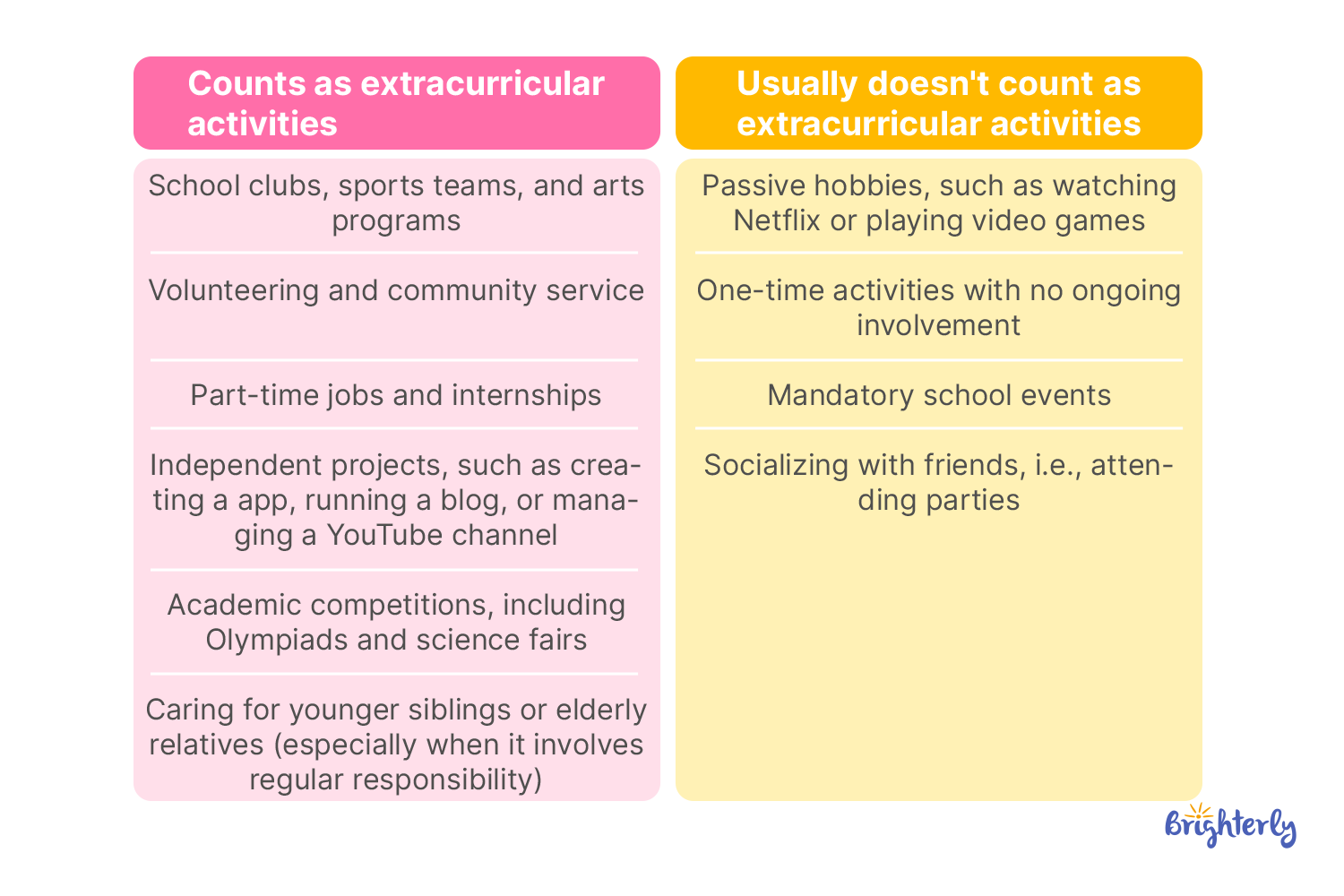
What Counts as an Extracurricular Activity (and What Doesn’t)?
Not every hobby automatically qualifies as an extracurricular activity. There are a few questions that can help you determine if your child’s pastime is a quality extracurricular:
- Does my child regularly invest time in this activity? (weeks, months, years)
- Does this activity require meaningful effort?
- Does this activity benefit the child or somebody else?
If the answer is “yes” to all three, it’s a decent extracurricular activity. Here’s a visual breakdown of what counts:
Why Are Extracurricular Activities Important?
Extracurricular activities matter because they develop skills, confidence, and well-being that no classroom can fully replicate. And when it comes to concrete benefits, these activities signal to colleges that a student is genuinely engaged in the world beyond grades
Benefits for Skills, Confidence, and Well-Being
School activities list builds up various soft skills. First, children acquire leadership and self-organization in theater clubs; endurance and the ability to work in a team in sports; empathy in volunteer communities.
Secondly, extracurricular activities build confidence. After all, when a child achieves something outside of school, they begin to believe in their abilities. Many kids may not be good at chemistry or physics, but can have an edge in sports or art. In addition, out-of-school clubs provide alternative communication channels. If your child doesn’t have friends in the school, there is a high probability that they will find them among those who share similar interests.
Third, result-oriented activities contribute to well-being. Extracurriculars reduce stress and give the child a space where they can just be themselves. The 2024 study in Behavioral Sciences confirmed that participation in sports and art helps teenagers to understand themselves better and build relationships with others.
Note: A review in MDPI Sustainability (2024) proved that physical activity outside of school improves students’ concentration, memory, and self-esteem.
Benefits for College Applications
College admissions increasingly pay attention to extracurriculars as those arenʼt just a line on a resume, but a character-building experience. Colleges prefer well-rounded students who demonstrate achievements early in their lives as a sign of future determination and strive for success in their professional lives.
In fact, according to the WEF Future of Jobs Report (2025), the most in-demand skills for the future include analytical thinking, leadership and social influence, resilience, and creative thinking — precisely those that extracurricular activities may help to develop.
How to Choose the Right Extracurricular Activities
Short five-step checklist:
Step 1. Brainstorm: Write down everything your child is interested in right now. No filters, no “that’s not serious enough.”
Step 2. Match interests: Look through our list of extracurricular activities and see which activities come closest to those interests.
Step 3. Try: Sign up for 1–2 activities and give them at least a month as first impressions can be deceiving.
Step 4. Narrow down: Keep what truly excites a child. One activity done with heart beats five done for the sake of it.
Step 5. Go deep: Support your child along the way as there will be periods when their hands drop. Colleges value depth far more than quantity.
Types of Extracurricular Activities
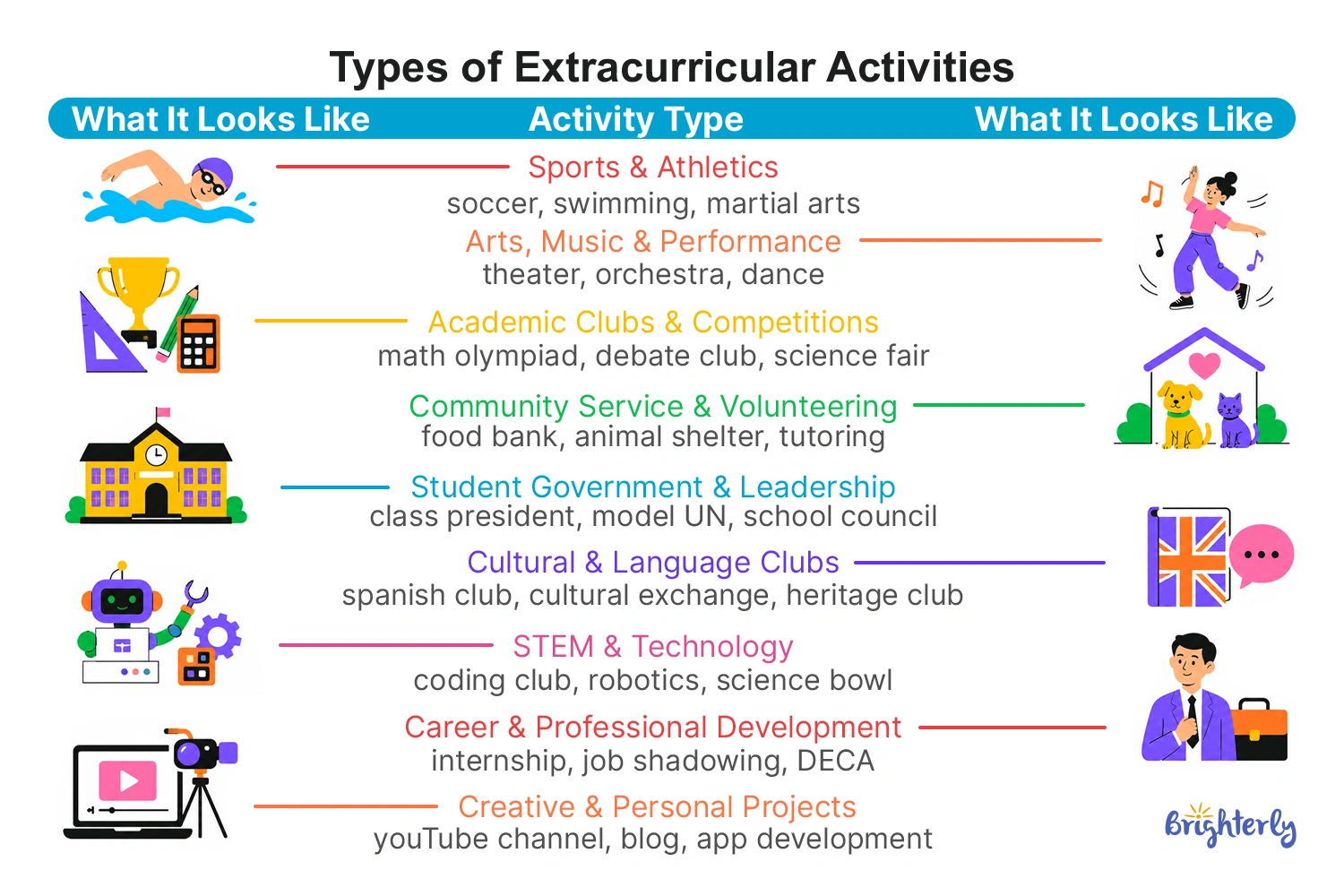
Extracurricular activities fall into several broad categories: academic clubs, sports, arts, volunteering, student government, STEM, media, entrepreneurship, and cultural interests. Whatever type your child chooses — that’s the set of skills they will build. So, it’s worth taking a closer look at each one.
Extracurricular Activities Examples by Category
Academic Clubs & Competitions
Best for: kids who want to prove they’re not just chasing a good test score, but passionate about the subject. School Olympiads build competitiveness, the ability to work under pressure, and in-depth knowledge of a chosen topic.
Examples:
- Science and Math Olympiads: Сompetitions for those who want to measure themselves against the best. Mathletes, AMC, and Science Olympiad are a few of those that admissions committees recognize immediately.
- Debate Club, where students learn to defend any position, even one they disagree with. Ideal for future lawyers, journalists, or those willing to speak persuasively.
- Quiz Bowl: Team competitions where the one who knows more and thinks faster wins.
- Study Clubs are a group of peers who meet after school to work through complex topics together or learn about science facts.
Note: A good idea is to use Brighterly’s free math worksheets and reading worksheets.
- Academic Summer Camps intensive programs during the holidays where children refresh and deepen their knowledge.
- Science Fair is original research from idea to presentation. One of the strongest signals to a college is that a child can think independently.
Note: Olympiads and science fairs require months of preparation to understand the subject in depth. For example, if your child wishes to prepare for math competitions seriously, Brighterly’s educational platform will be of help.
Our tutors make additional math practice engaging for students from K-12 as we use interactive game boards, presentations, and fun activities. And our math courses do work, since every lesson is 1:1 with a tutor and the program is built around your child.


Math that clicks — results that show
Brighterly's 1:1 lessons are built around your child from K to 12th grade
Sports & Recreation
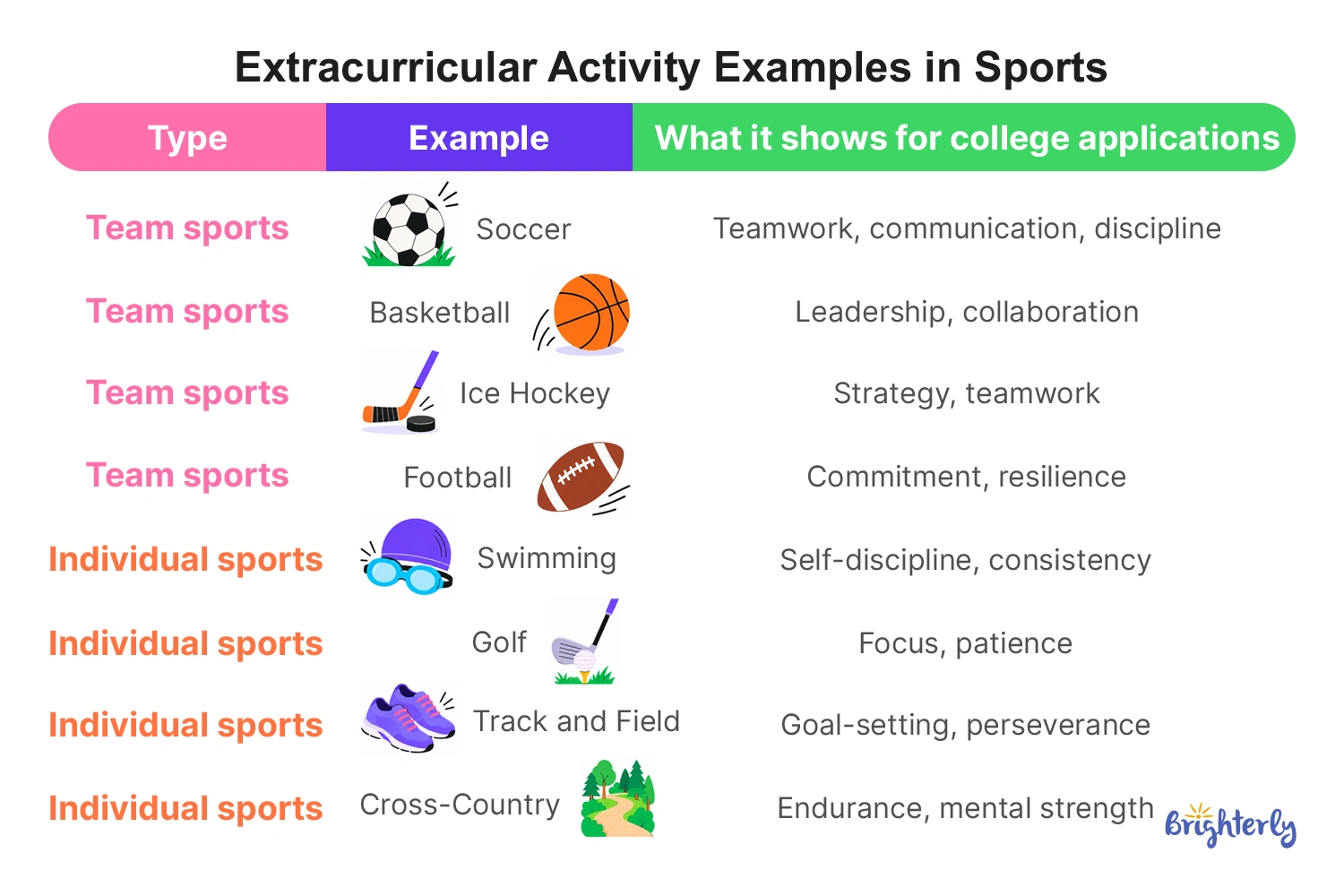
Best for: kids who enjoy collaborating in a team, take responsibility, and who don’t give up when it’s hard. Sports are one of the most convincing signals to a college about a child’s discipline.
In addition, it gives a real chance to study for free, as many American colleges offer sports scholarships to high-achieving athletes. The NCAA, the main student sports organization in the U.S., distributes over $3.7 billion in athletic scholarships among athletes annually! So if your child is seriously involved in sports, don’t let them waste that talent.
In the picture below you’ll quickly see how each sport builds different skills:
Arts, Music & Performance
Best for: Children with a creative mindset who like to express themselves through singing, dancing, acting, or other forms of art. Arts programs are especially effective at developing emotional intelligence, as illustrated by a 2024 study published in Acta Psychologica.
Activities outside of school examples:
- Playing a musical instrument teaches patience and perseverance. A 2024 meta-analysis in Cognition found that music training improves fine-motor skills and auditory memory in children.
- A school orchestra or choir is a great combination of art and teamwork.
- Theater club: The stage can do more to overcome shyness than any confidence workshop. Public performances, memorizing scripts, and expressive reading help children build lifelong skills.
- Dance, from ballet to contemporary, develops discipline and body awareness.
Community Service & Volunteering
Best for: Kids keen to make a real difference in their community. Unlike many other after-school activities, volunteering teaches you to work for others rather than for awards. It also contributes to time management and leadership skills, skills that are valuable in virtually any profession.
Examples:
- Volunteering in charitable organizations, for instance, helping in soup kitchens, charity shops, or shelters, teaches empathy and responsibility.
- Key Club or other school volunteer organizations are a great opportunity to implement your own social initiatives and organize events.
- Tutoring or mentoring younger students or classmates will not only deepen a child’s own knowledge but will teach them to explain complex topics in plain language.
- Environmental projects such as planting trees or cleaning parks form a responsible attitude towards the environment and an active civic position.
- Organizing charitable events from collecting items to school fairs allows to develop teamwork and project management skills.
Leadership & Student Government
Great leaders aren’t born overnight; they grow through experience. Certain organizational extracurricular activities for kids build confidence, responsibility, and many other key skills that will open the door to future opportunities.
Extracurricular examples:
- When participating in a student council, your child will see how ideas turn into actions. Students work together to organize school events, represent classmates’ opinions, and collaborate with school administration.
- Through club or camp leadership roles, e.g., being the captain of something, your kid will learn how to motivate a team, delegate tasks, and solve inevitable conflicts.
- Peer mentoring develops patience, empathy, and the ability to explain complex ideas simply.
STEM, Coding & Robotics
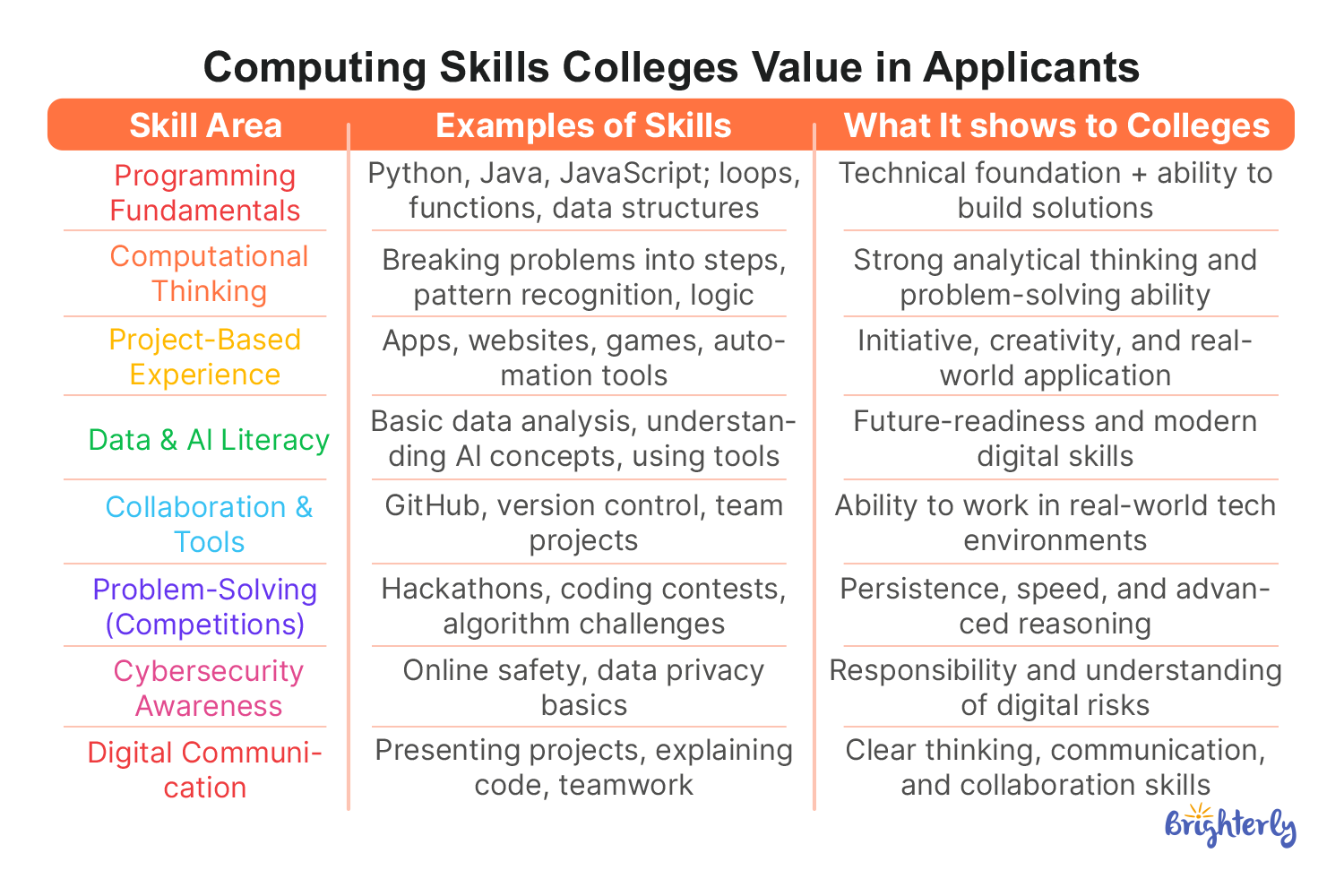
Best for: Kids who want to build a career in tech, science, or engineering. According to the World Economic Forum’s The Future of Jobs Report 2025, technology remains the biggest driver of the job market, so a child who knows how to code will be ahead of most peers.
Computing classes and coding courses will show colleges that a child doesn’t just use technology but wants to understand how it works. Should it be Python, Java, web development, or even basic coding — each of these is a decent skill to acquire nowadays.
Science and robotics clubs go even further there, as children solve real engineering problems. FIRST Robotics, for example, is not just a club but a competition where students have to build a robot that completes a specific task.
Media, Writing & Content Creation
Best for: Children who have something to say to the world and are looking for a place to do it. Writing, practice in school media, and working with content aren’t just hobbies – it is a real portfolio creation.
Examples of extracurricular activities:
- Think about a school newspaper where your child will create reports, interviews, or news stories. Writing is needed for everyone, and ELA tutoring can accelerate the development of this skill.
- Podcasts or school radio will teach a dedicated child to speak confidently, think on the go, and keep the listener’s attention. Moreover, public speaking improves their vocabulary.
- YouTube channels and blogs became globally popular among children. Those who shoot and edit videos master storytelling, technical tools, and audience understanding.

Words matter — help your child find theirs
Brighterly builds reading and writing skills that last a lifetime
Work, Internships & Entrepreneurship
Best for: Pupils who want to get early practical experience or earn some money along the way. A part-time job, professional internship, or self-started business, each of these gives a real baggage of life experience that no classroom can replicate.
Examples:
- Whatever the type of part-time job, it will ultimately teach time-planning and responsibility.
- A monthly internship in a newsroom or at a startup is a great practical experience for youth.
- Self-started business teaches initiative like nothing else, and colleges go crazy for such entrepreneurial candidates.
Cultural, Language & Special Interest
Best for: Children who want to explore the world through culture or languages. In this section, there is a place for any hobby, from ancient mythology clubs to chess, and all of this speaks of curiosity
What are some extracurricular activities here:
- Language clubs in Spanish, French or Japanese are a multi-year commitment that quietly shapes a person.
- Model UN is one of the most famous clubs for those who dream of a diplomatic career or simply want to learn how to negotiate and defend their position.
- Chess is a unique, most famous board game. As Sherlock Holmes pointed out, “Amberly excelled at chess – one mark, Watson, of a scheming mind.”
Extracurricular Activities for Different Ages
Choosing the right extracurriculars for kids depends on age just as much as on interests. Here is a rough guide to what works best at each stage:
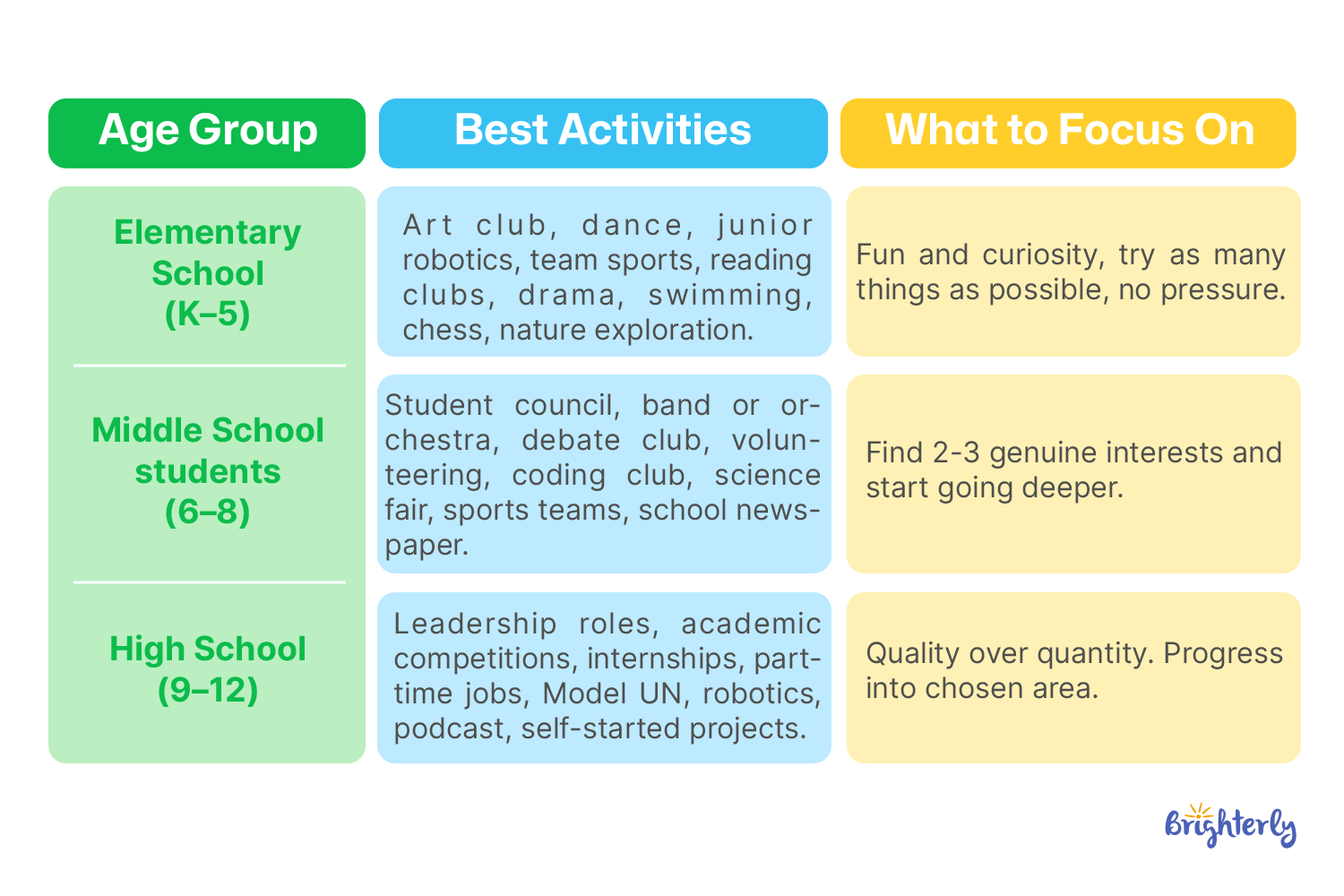
Whatever stage your child is at, Brighterly works with students across all K–12 grades. If they need extra support in math or reading alongside their extracurriculars, our online math tutors and reading tutors are here to help.
How to Choose the Right Extracurricular Activities
Short five-step checklist:
Step 1. Brainstorm: Write down everything your child is interested in right now. No filters, no “that’s not serious enough.”
Step 2. Match interests: Look through our list and see which activities come closest to those interests.
Step 3. Try: Sign up for 1–2 activities and give them at least a month, as first impressions can be deceiving.
Step 4. Narrow down: Keep what truly excites a child. One activity done with heart beats five done for the sake of it.
Step 5. Go deep: Support your child along the way, as there will be periods when their hands drop. Colleges value depth far more than quantity.
Conclusion
To note again, the best extracurricular activities are the ones your child loves to pursue, but not necessarily those that will impress a college someday. As a parent, your major goal is to help your child to find that one thing, support along the way, and then everything else will fall into place. In case these activities lead to poorer academic results, Brighterly is here to help with applied math or reading tutoring. Book a free lesson and test our approach for yourself.
Frequently Asked Questions
What Is the Difference Between Extracurricular and Co-Curricular Activities?
When asking “What is an extracurricular activity?” the right answer is everything a child does outside of the compulsory curriculum. Co-curricular is something that supplement the curriculum, including a school orchestra, a debate club, and a literary magazine. So the difference is simple: one exists independently of school and learning, whereas the other complements it.
How Many Extracurricular Activities Should a Student Have?
There is no magic number, as only what matters is dedication and depth. According to PrepScholar, one truly meaningful activity is enough. A child who develops something they genuinely love over the years will always stand out more than the one who collects activities just to fill the list.
What Is the Most Popular Extracurricular Activity?
According to a 2025 Pediatric Research study, soccer is the most popular extracurricular activity, followed by musical instruments and swimming. But popularity is not the same as the right fit. Look for the activity where your children can express themselves best.
Can Hobbies Count as Extracurricular Activities?
It depends on how seriously the child pursues it. An activity that occasionally exists with no commitment is just a minor hobby. But the same hobby that grows into a club, an exhibition, a competition, or a self-started project counts.
What Are Some Tier 1 Extracurriculars for College?
Tier 1 extracurriculars for college demonstrate exceptional achievement in students’ subject or chosen area, namely:
- National ranking as an athlete
- Prestigious academic competition victory
- Attendance at prestigious summer programs
Are Activities Outside of School Considered Extracurricular?
Absolutely. After school activities don’t have to be organized by the school. A sports club in the local community, an online coding course, volunteering at a shelter, or running your own small business are all valid. What matters is not where it happens, but how seriously your child takes it.


Kindergarteners can start showing signs of stress. The issue may occur when children feel pressure from their parents and classmates. When kids start to take their play into serious competition at a young age, it may lead to a vicious cycle as they’ll be anxious about failing to meet expectations, dampening their enthusiasm for learning. […]

Jun 14, 2022
Life skills affect everyday situations at school, work, home, and in social settings. In today’s world, success isn’t just about what you know — it’s about how you communicate, manage money, stay organized, control emotions, and stay safe online. The following is a comprehensive breakdown of 110+ life skills everyone should know across 8 categories. […]

Jun 14, 2022
Math & reading from 1st to 12th grade
Looking for homework support for your child?

Choose kid's grade

Math & Reading for Grades 1–12
Build real confidence for your child with a Brighterly math or reading tutor.