Learning Gaps: What They Are and How to Address Them (2026)
reviewed by Jo-ann Caballes
Updated on July 10, 2026
Key points
- A learning gap is either a skill or a piece of knowledge that a student was expected to know by a certain grade or age, but has failed to learn.
- Learning gaps in education may occur across different subjects, yet you can classify them into types: knowledge, skills, motivational, communication, and environmental.
- To identify gaps, a teacher or a parent can use formative assessments, observations, progress monitoring, and students’ self-reflection.
- Addressing the gaps always starts with an assessment; only after that can you offer targeted support.
When your child or a student in the class fails to keep up despite their best efforts, a learning gap may be a primary reason. They may develop quietly and become an issue all of a sudden. That’s why it’s important to know what they are, what causes them, and how to approach them.
What Is a Learning Gap?
A learning gap is a skill or piece of knowledge that a student should have acquired at a certain level, grade, or age, but has failed to. A gap forms when a student lacks instruction, is not ready to advance further, or disengages during a developmental window.
In other words, the learning gap meaning is the distance between what the students know and what they should or are expected to know. Importantly, it’s a sign that a student needs targeted support.
In the long term, this distance can create a snowball effect. Because a student doesn’t know or understand certain areas, the gap will block them from learning newer or more advanced topics.
“Learning gaps can be difficult because they snowball very quickly, especially if they go unaddressed for an extended period of time.”


Learning Gap vs Achievement Gap: What’s the Difference?
- A learning gap is a skill that a student hasn’t mastered yet and has a direct relation to the instructional issue or the student’s learning.
- An achievement gap is a difference in academic performance between certain groups; it’s systemic and refers to race, income, or access to resources.
Learning and achievement gaps are about different problems, even though some educators use them interchangeably.


Make sure your kid is not falling behind
Brighterly helps to identify gaps and find the best strategy to close them
Explore Brighterly Learning Experience
Learn exactly how Brighterly helps students thrive through expert sessions, online tools, and proven feedback from thousands of satisfied parents
What Causes Learning Gaps in Students?
The causes of learning gaps in education are concerned with a lack of understanding of foundational concepts, inconsistent instruction by teachers, absences of students, and socioeconomic factors limiting access to educational resources.
- Pandemic-related learning loss. One of the systemic causes was COVID-19, which closed schools, widened the achievement gap, and disrupted learning for millions of students. As the 2021 McKinsey report provides, the pandemic made students fall 5 and 4 months behind in math and reading, while the points dropped by 10 and 9 upon testing in 2021, compared to matched students in previous years.
- Large classes. When teachers have classes with more than 30 or more students, they find it hard to provide individualized instruction or support. In the long run, a lack of attention may result in undetected knowledge gaps, which then appear as a more significant learning gap.
- Frequent absences. Missing lessons can lead to gaps in foundational skills, especially if students learn some math or reading concepts, where they build on one another.
- Learning differences. If a student has unrecognized learning conditions, knowledge and skill gaps can accumulate. Dyslexia and ADHD are examples of such conditions.
- School transitions and life disruptions. Learning gaps may appear when certain events disrupt academic continuity. Changes in schools, family emergencies, or personal events can cause students to miss content and lessons.
“There is no 'cure-all,' but by addressing issues at the systems level, we are more likely to move the needle for a larger number of students.”

5 Types of Learning Gaps
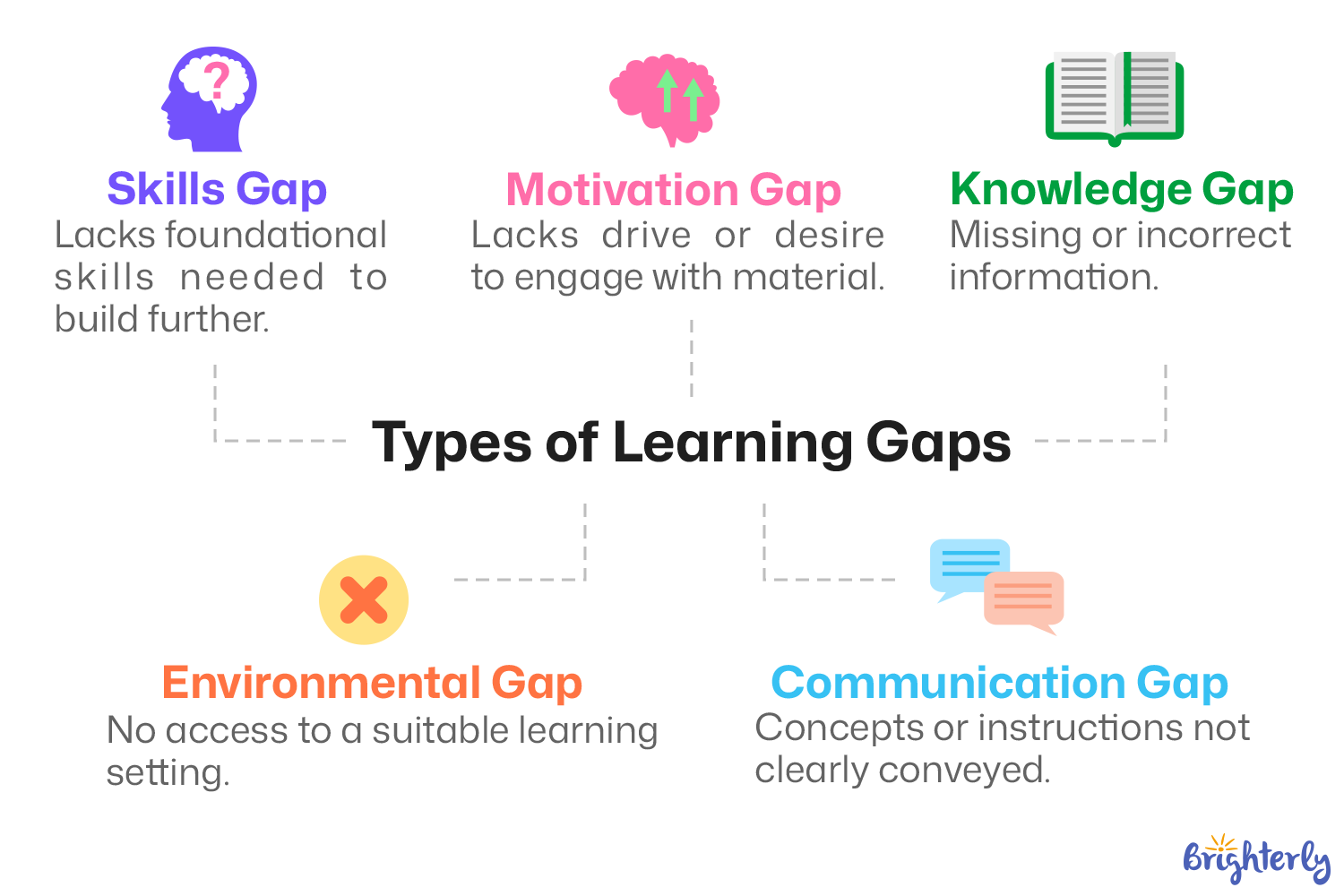
The 5 types of learning gaps include knowledge, skills, motivation, environmental, and communication gaps.
They reflect a certain deficit that students have or link to the causes behind it.
- Skill gaps. Such gaps emerge when students lack foundational skills and can’t acquire new ones as a result.
- Motivation gaps. They appear when students don’t have a decent level of motivation to learn, even though they know what they should do.
- Knowledge gaps. They occur when a student doesn’t have the necessary information to progress.
- Communication gaps. This type of learning gap happens when students lack clear communication or instruction.
- Environmental gaps. This type appears when students have no access to information and materials, or external circumstances prevent them from learning.
10 Examples of Learning Gaps
Learning gaps appear across any subject. Have a look at these ten examples:
- What is a gap in math? A student who lacks understanding of the place value concept will struggle with addition and subtraction that involve multiple digits, and eventually decimals.
- Another math knowledge gap refers to multiplication tables. If a student doesn’t memorize them, divisions and fractions may be more difficult.
- In other classes, students with weak reading comprehension won’t interpret word problems, instructions, or content from across subjects.
- In writing, not understanding subject-verb agreement will lead to consistent grammatical errors.
- A student may struggle with spelling, which will impact essay writing or other assignments that require writing fluency.
- For STEM subjects, not understanding the concept of force and motion will prevent understanding physics when it becomes abstract or focuses on formulas more.
- In a history class, not knowing the location of countries or states on a map can make it hard to bring context to the historical events.
- Moreover, if a student fails to place historical events chronologically, they will find it hard to explain and use cause-and-effect relationships in history.
- In advanced grades, not understanding atomic structure or the periodic table will make it impossible to solve chemical equations.
- If learning a foreign language, the inability to change the forms of the verbs correctly will affect speaking and writing fluency from the very start.
How to Identify Learning Gaps in Your Child or Classroom
To identify a learning gap, educators and parents can combine multiple methods. They include evaluation of results of the standardized tests, direct observations, deliberate tracking, and students’ self-reflections.
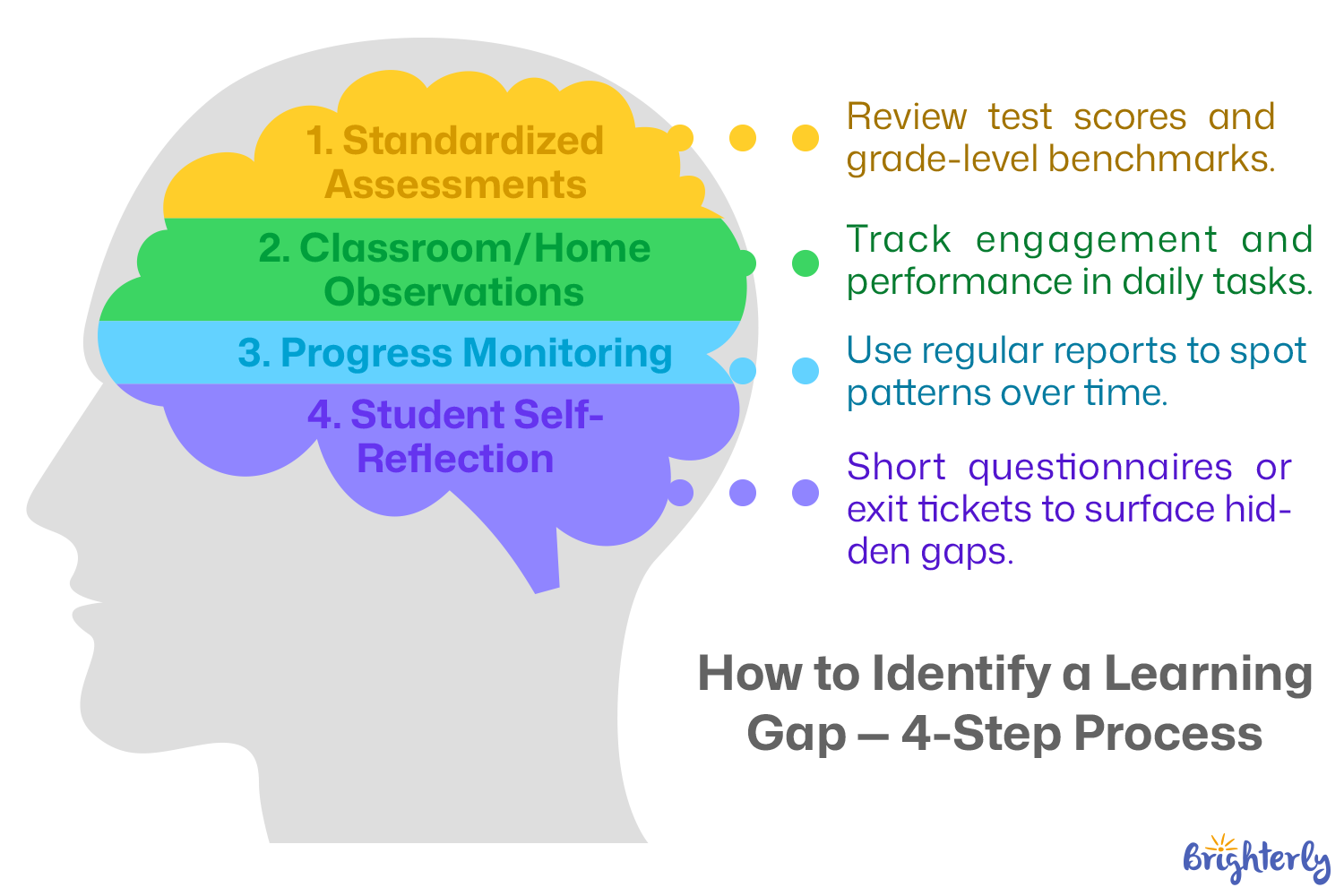
Standardized Assessments
Within the education system, standardized tests are the primary tool to evaluate kids’ performance and thus identify gaps. So, the results or data from such assessments may be a great starting point.
Upon them, you can compare a student’s performance against national or grade-level expectations and highlight certain areas where gaps may exist.
Nevertheless, the tests may fail to show why a student is struggling, which is more important for finding the right strategy. That’s why standardized assessments serve as a great diagnostic tool. There, you can resort to high school tests like SAT or ACT, State Accountability Tests, benchmarks as NAEP or NWEA provide, or Interim tests like Star Assessments.
Classroom and Home Observations
Another way to spot a learning gap is via observations. In the classroom, the teachers should watch for disengagement, errors on specific types of problems or questions, and hesitation in regard to certain tasks.
What about home? Parents can look for the same patterns when their children do homework. Parents should ask themselves:
- Which topics does a child avoid?
- When and where do they ask for help most often?
- How quickly or when do they get frustrated?
Note: At home, parents can see what teachers won’t see in the classroom because of social dynamics.
Progress Monitoring
Progress monitoring involves tracking students’ performance over time. In this regard, regular check-ins are one of the tools that teachers and parents can use. They allow them to see whether the learning gap is closing or widening, or staying the same.
On the other hand, teachers and parents may resort to lesson reports. For instance, in the 2025 report, the Northwest Evaluation Association shares what the Family report looks like, providing data and questions to guide conversations with a student.
Note: At Brighterly, an online math and reading tutoring platform, our tutors share structured progress reports to parents and feedback on their kids’ performance. Our reports include the topics covered, progress made, and areas for improvement.
Student Self-Reflection
Students themselves often know more about what confuses them than adults realize. There, teachers and parents can resort to short questionnaires, weekly check-ins, and end-of-class exit surveys.
They all can answer the questions like “What is still unclear?” Or “What felt easy?” Such questions won’t appear in formal tests. At the same time, they can be a crucial part of reports and build important habits for students.
What Are Common Learning Gaps in Math?
- Place value. Missing this foundational concept brings struggles with every subsequent operation, from regrouping within addition to understanding percentages and decimals.
- Multiplication tables. In this regard, the gap meaning in math is concerned with the automatic use of tables. When kids can’t do it, students expend considerable cognitive effort on the operation, making complex problem-solving unbearable.
- Fractions. It’s just one of the most widespread gaps in elementary math, being crucial for algebra and ratios.
- Algebra prerequisites. What are gaps in math that high schoolers often have? Arithmetic foundations. They are crucial for approaching variables, equation structure, and abstract algebraic thinking.
Note. If you see your kid having one of these gaps, working with an advanced math or trigonometry tutor is a solid option that can help with the foundational skills.
How to Address Learning Gaps in Students
Addressing learning gaps starts with identifying and assessing what a student misses, while the next steps refer to delivering targeted support, building the right environment, and backing the learning with the right tools. Once students can proceed with the task independently, then you can gradually withdraw the support.
Work With a Tutor
A professional tutor is a common but effective approach for families to address a learning gap in their child. The rationale is that a specialist can easily identify the type of gap and find an appropriate solution.
At Brighterly, our tutors start with a diagnostic test and then proceed with a customized learning plan that answers your child’s needs, pace, and worries. For instance, if your kid has a phonics issue, our spelling tutor will provide a detailed interactive plan at the center. If it’s writing, like grammar issues, we have online writing classes for kids.
Help your kid combat a learning gap
Our experienced tutors identify the gap first and offer a customized plan
Use Targeted Assessment First
You should first identify the specific skill that is missing. For instance, a student may struggle with fractions, but the reason behind this will be a gap related to place value. So, actively practicing fractions would be wrong. That’s why formative assessment is the primary and key step when you consider an intervention strategy.
Note: You can quickly test your kid’s skills with Brighterly’s grade-specific reading tests and math tests.
Build a Safe and Supportive Environment
Create an environment where students feel confident and comfortable to learn and ask for help. If a child doesn’t feel safe or connected, they will probably try to resolve their issues independently, which is not ideal in this particular case. Make sure kids can say “I don’t understand it” freely, and it would be much easier for you to fix unfinished learning.
Use Technology and Interactive Tools
Using technology-based activities can make learning more interactive and engaging for students. So, resort to gamified learning. Such an approach is motivational because of achievement, immersion, and social factors.
You can easily try it on computers and tablets, boosting children’s interest and making the lessons more accessible. Besides, they may be a great tool to combat motivational gaps.
Frequently Asked Questions
What Is the Most Common Learning Gap in Math?
The most common learning gap in math relates to fractions and number sense concepts. In particular, these gaps appear when students use procedural memorization and leave behind conceptual understanding. As the math is cumulative, if kids only memorize rules and do not focus on why these rules work, the math becomes abstract.
Can Learning Gaps Be Fixed at Any Age?
Yes, you can fix learning gaps at any age. Due to the brain’s neuroplasticity, it develops new pathways and reorganizes itself. Even though early intervention is the best for foundational skills, adolescents, adults, and even older learners can close academic gaps with the right strategies, like targeted or differentiated instruction, tools, and commitments.
What Is the Difference Between a Learning Gap and a Learning Disability?
The difference between a learning gap and a learning disability is in the root of why a student fails, the strategies used, and the support provided. In other words, a learning gap is a difference between what a student should know but doesn’t because of the missed instruction or absence. A learning disability is neurological in nature, meaning a gap occurs because of how the brain processes knowledge.
How Long Does It Take to Close a Learning Gap?
It may take from a few months to multiple years to close a gap, depending on its size, the frequency of practice or strategies used, and available support. For instance, a focused instruction can help bridge a gap in skills and knowledge within a few weeks or months. If skill gaps refer to multiple grade levels, it may take a semester.
What Is the Difference Between a Learning Gap and a Knowledge Gap?
The difference between a learning and a knowledge gap lies in the amount of missed material. A knowledge gap is narrower, referring to missing specific facts or information. A learning gap is broader, like missing a foundational skill. Thus, the first needs direct instruction and several lessons to close a deficit, while the second may mean rebuilding the skill.


Math is a challenging subject, so even the best students can face some academic difficulties here and there. However, the proper elementary and middle school math intervention can help seal your kid’s potential knowledge gaps, developing a strong math foundation. Let’s find out how effective interventions are and what strategies you can use to ensure […]

Oct 01, 2024
Given that Russian Math, Kumon, and Brighterly are all some of the widely used math programs in the United States, they still differ in teaching approach, lesson format, prices, flexibility, and parental involvement. This comparison will help you figure out which will be best for your child. Kumon vs Russian Math vs Brighterly: Comparison […]

Oct 14, 2024
Math & reading from 1st to 12th grade
Looking for homework support for your child?

Choose kid's grade

Math & Reading for Grades 1–12
Build real confidence for your child with a Brighterly math or reading tutor.