Is the ACT Easier Than the SAT? Key Differences and How to Choose 2026
reviewed by Laila A. Lico
Updated on July 10, 2026
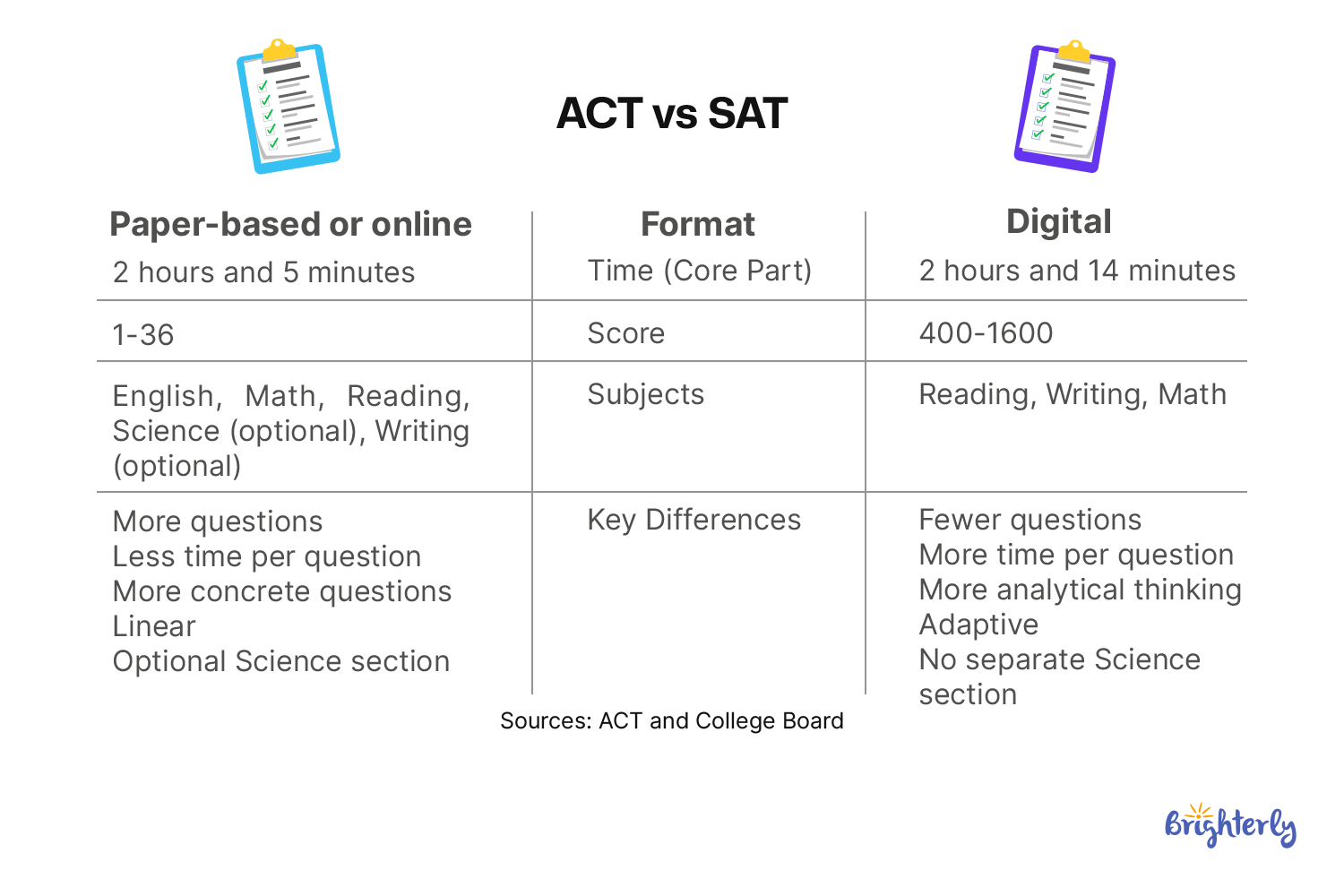
Key Points The answer to “Is the ACT easier than the SAT?” depends on your skills, strengths, weaknesses, and testing style. This guide highlights the main differences between the two tests and what each one requires to help you decide where you can score higher to get into a better college. Neither the ACT nor the SAT is definitely easier – it depends on your personal strengths and preferred test-taking style. The ACT asks more straightforward questions but allows less time per question. The SAT features more math and deeper logical thinking, while offering more time per question and allowing the use of a calculator for the entire math section. Explore Brighterly Learning Experience Learn exactly how Brighterly helps students thrive through expert sessions, online tools, and proven feedback from thousands of satisfied parents Colleges in the US use the SAT and ACT as standardized tests to compare applicants on a common scale. Both the SAT and the ACT assess whether students are prepared for college, but in different ways: Note: Building math and ELA skills early through an online math program for kids that blends algebra, geometry, and statistics, and an online reading program that combines reading comprehension, writing fluency, and critical thinking, gives test-takers a head start. Understanding standardized testing gives students a real advantage when planning their SAT and ACT prep. The SAT and ACT test a lot of the same basic skills, but in different ways. The differences in the content, subjects, and question style can make one test seem easier. The SAT covers: The Reading and Writing section has short passages, and you only have to answer one question for each. The short-test format helps students who have trouble focusing on long essays. The test includes different texts from science, history, and literature. The SAT places more weight on math skills than the ACT. Half of your final grade is based on math. You can use a calculator for all questions in the SAT Math block. The SAT Math section tests: If you focus on these main topics, you’ll feel more confident and score higher on the SAT. Check out the best SAT prep courses for different learners. Students who need more structured, comprehensive support can benefit from Brighterly’s one-on-one math homework help to enhance their weak areas. Tutors work with your child on topics from 10th grade math, 11th grade math, and 12th grade math. The math program covers core algebra, geometry, and advanced math topics that appear on both tests.
1:1 personalized math & reading support!
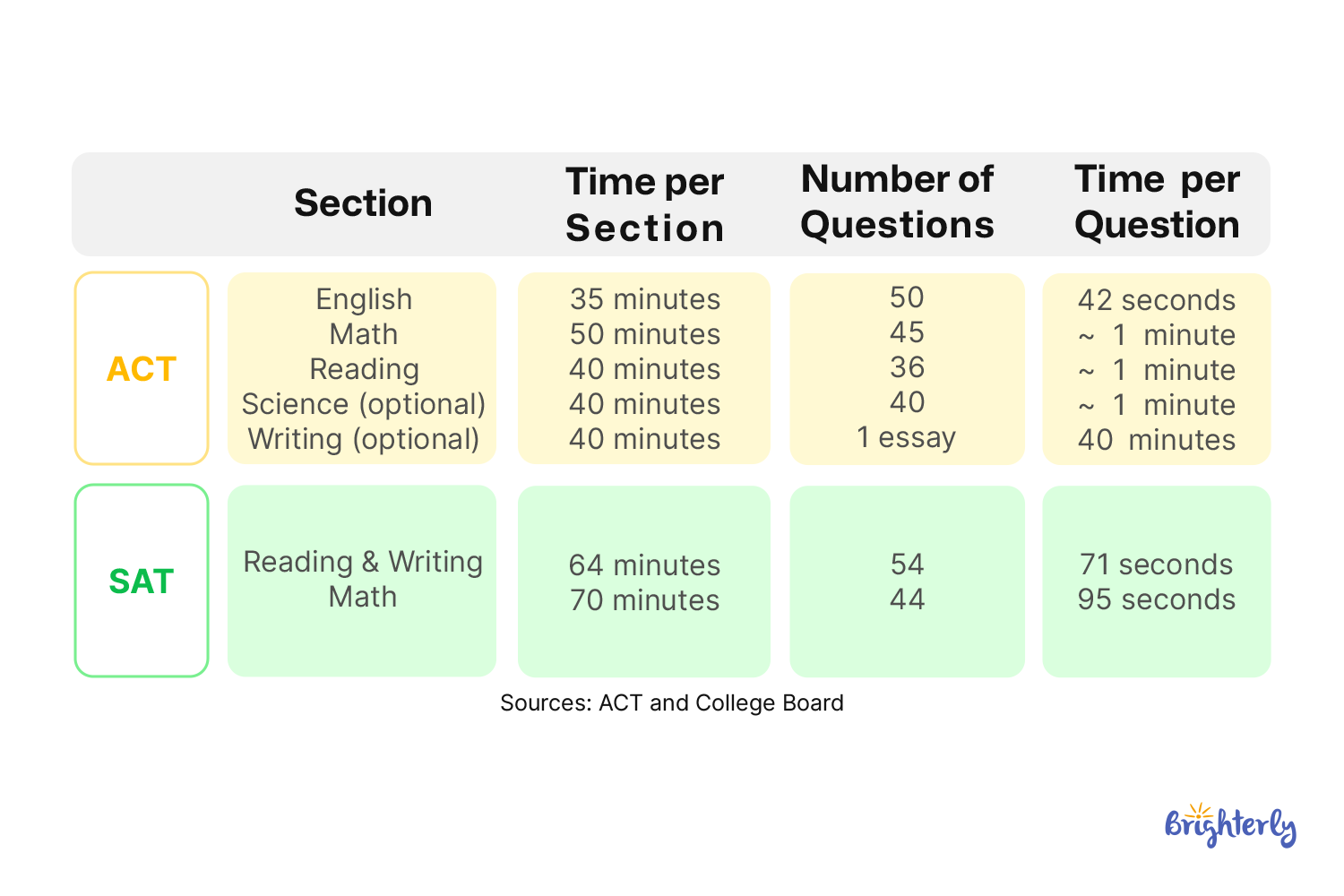
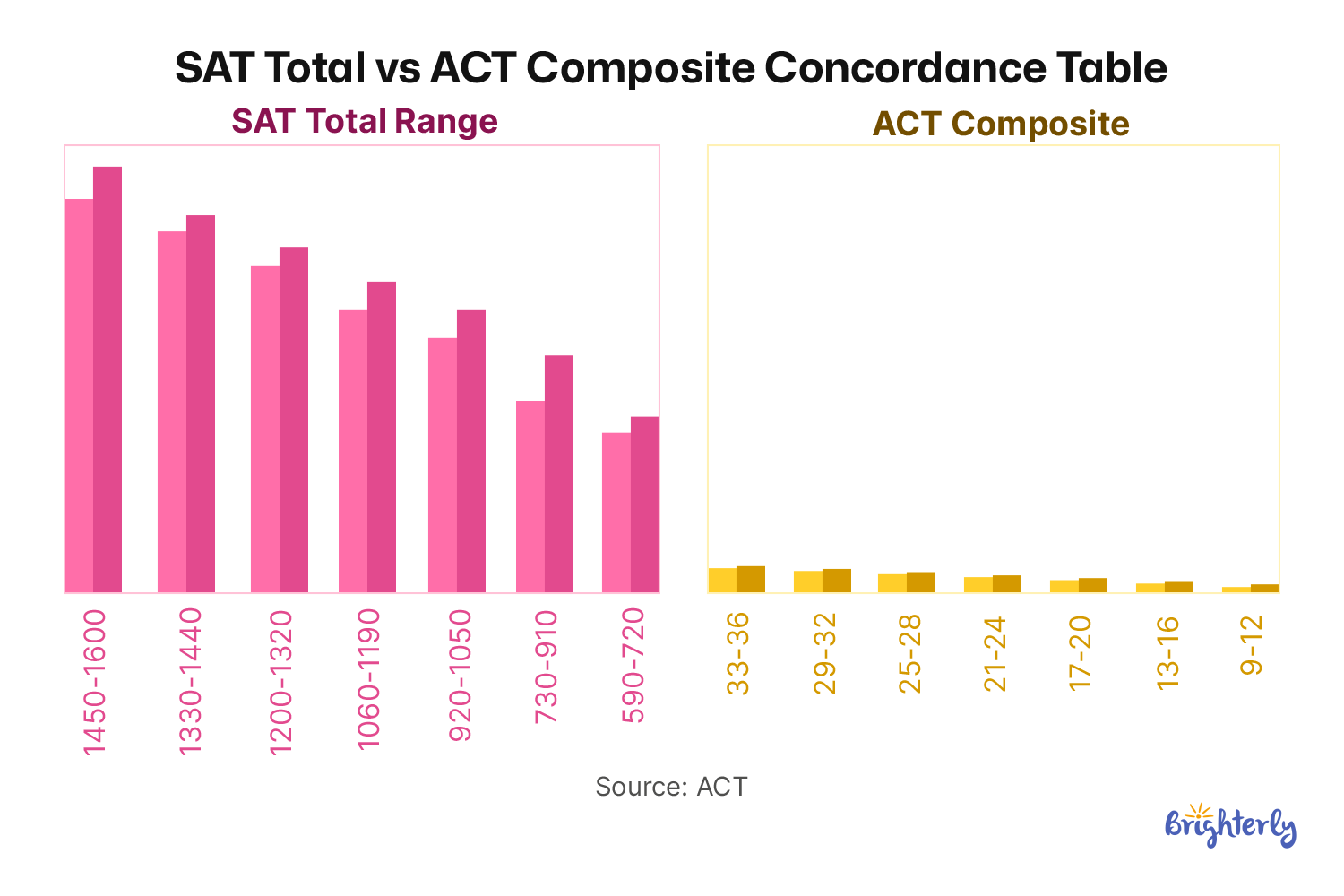
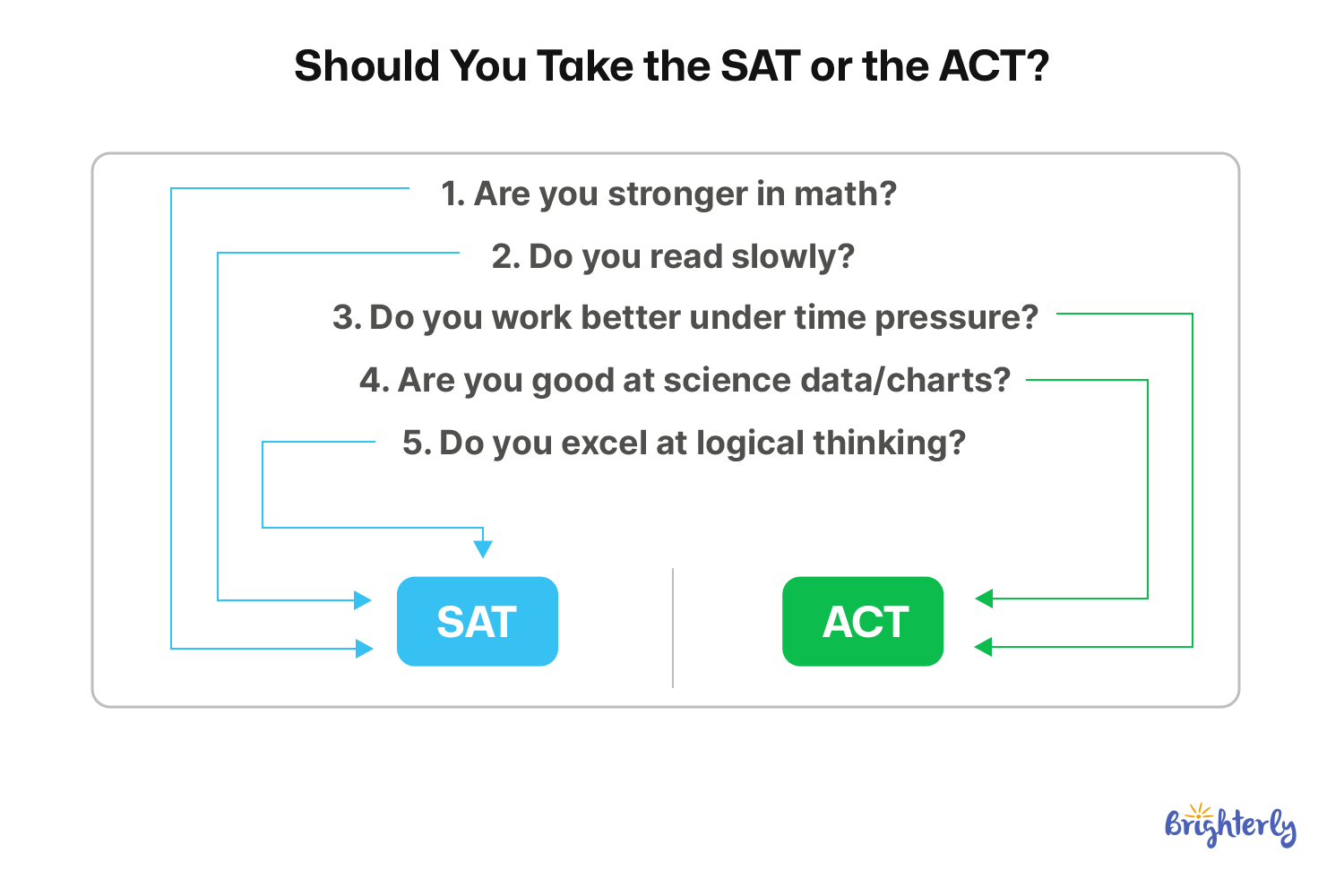
Our tutors combine real-time instruction with gamified practice targeted at your child’s needs. The ACT has the following sections: So, is the ACT or SAT harder? Many students find that the answer depends on their speed. The English section of the ACT asks you to edit long essays for grammar and punctuation. The reading section consists of four long passages, each with ten questions. You must quickly find facts and main ideas. The math section of the ACT covers more topics than the SAT. You will find more geometry and some trigonometry. However, math only counts for 25% of your total score, which is a key difference between ACT and SAT for students who find math difficult. The ACT is usually easier for students who manage their time well and prepare thoroughly for each section. Note: Kids who struggle with the reading speed the ACT demands can boost comprehension and fluency through 1:1, individualized reading and writing tutoring. Our online reading tutors can help your child work with long, detailed passages more confidently. While children struggling with critical thinking may respond “The SAT.” to the question “Is the SAT or ACT harder?”, the pacing of the ACT may pose a bigger challenge to students who need more time to read and think. Here are the SAT vs ACT timing differences per question: The SAT is an adaptive test: Your performance on the first SAT module determines how challenging the second module will be. If you do well, the second module will be harder but will result in a higher grade. If you struggle with the first part, the second part will be easier, but your score potential will be lower. You can take the SAT on a laptop or a tablet at a designated testing center. The ACT is a linear test: On the ACT, you get the same questions in the same order no matter how you perform. You can take the ACT on paper or in a digital format at some centers. As of 2026, the Enhanced ACT is shorter than it used to be, taking 2 hours and 5 minutes to complete the core sections. The ACT has become easier for those who disliked the 3-hour marathon. Note: Review 2025-2026 standardized testing statistics for more insights on the ACT and SAT. The following table summarizes the differences between the exams in the 2026-2027 academic year to help you compare “Is the SAT or ACT easier?”. Feature SAT ACT Format Fully digital, computer‑based, multistage adaptive format Paper and digital formats; linear structure Test Structure 1. Reading & Writing 2. Math 1. English 2. Reading 3. Math Optional: Science and/or Writing Test Time (Core Part) 2 hours and 14 minutes From 2 hours and 5 minutes to 3 hours and 25 minutes Max Score 1600 36 Total Number of Questions 98 131 171 (with optional Science) + 1 essay (with optional Writing) Pacing Slower = More time per question Faster = Less time per question Reading Style Short passages Long, detailed passages Math Weight 50% of the total score 25% of the total score Math Focus Advanced math Pre-calculus, geometry, trigonometry Science No separate section Optional separate section Writing In the core part Optional separate section Testing Dates August, September, October, November, December, March, May, June September, October, December, February, April, June, July Cost (US Student) $68 registration fee Additional fees may apply $70 for core test $5 for Science add-on $25 for Writing add-on Additional fee may apply Cost (International Student) $111 total ($68 base + $43 international fee) Additional fees may apply $188.50 for core test $10 for Science add-on $25 for Writing add-on Additional fees may apply US colleges don’t have preferences between the ACT and the SAT and treat both tests equally. Universities use an official, standardized concordance table introduced by the College Board and ACT, Inc. in 2018 to compare results. For instance, an SAT score of 1500 is equivalent to an ACT composite score of 34. So, taking one of the tests doesn’t give you an advantage over taking the other. Since the answer to “Do colleges prefer ACT or SAT?” is “Neither,”, which test you choose should depend on your strengths and weaknesses and your own answer to “Is ACT or SAT easier?”. According to FairTest 2025, more than 90% of US four-year colleges and universities are test-optional for Fall 2026, which means that they don’t require the submission of SAT or ACT scores and don’t penalize you if you do so. However, submitting high scores can boost your application. Meanwhile, prestigious universities are test-required, demanding a high score on a standardized test, seeing both options as equal. Here is the currently official score concordance table for comparing SAT and ACT scores from 2018: Superscoring – taking the highest individual section scores from multiple test dates to create the best possible composite score – applies to both the SAT and ACT. So, if you have an SAT score of 650 on Reading & Writing and 700 on Math on one date and 720 on Reading & Writing and 600 on Math, your total score would be 1420 (720 + 700). Note that as of 2025, the ACT Composite Superscore includes English, Math, and Reading and excludes Science. However, the superscoring practice depends entirely on each college’s admissions policy, not on the College Board or ACT. While most colleges superscore standardized tests, more competitive schools might look at all SAT and ACT test scores. So, when choosing “ACT vs SAT – how to decide which test to take?”, consider your math and ELA powers carefully, learning gaps, and your preferred testing style. The possibility of retaking each test and superscoring should help ease your test anxiety. But still, you should aim for the highest possible score if you’d like to apply to prestigious institutions. When deciding “Should I take the SAT or ACT?”, the first step is to do a timed, real practice test for both and see where you score higher without any prep. This initial score is a strong indicator of the right college admissions test for your level of knowledge, skills, and testing style. Note: Take note of all errors to make on the diagnostic math test and reading test to know where to focus your studying efforts. To choose the right test for you, consider the following factors: ✅You’re stronger in math than in reading and grammar. ✅You’re a slow reader struggling with long texts. ✅You prefer to have slightly more time to read and answer questions. ✅You do well on evidence-based reading and analytics questions. ✅You prefer an adaptive format that adjusts to your answers in real time. ✅You’re a fast reader who can go through and analyze long passages. ✅You enjoy straightforward questions that examine what you’ve learned at school. ✅You have strong pacing skills and don’t lose track of time. ✅You’re confident with science data and want to take a science test too. ✅You’d rather take a linear test that doesn’t adapt to your previous responses. To decide whether ACT is harder than SAT for you or vice versa, use this chart: Need test prep help?
Individualized math & ELA tutoring for test prep!
Our teachers customize learning to your child’s preferred test & unique needs. The SAT is a digital adaptive test in which math accounts for half the total score. The ACT is a paper-based or online test that includes a 35-minute optional science section, and math accounts for 25% of the total score. The time to answer a question on the ACT is more limited. According to the score concordance table compiled by ACT, Inc. and the College Board in 2018, a score of 25 on the ACT corresponds to 1200-1220 on the SAT. These SAT and ACT scores are equivalent for admissions offices at US colleges and universities. A score of 1450 on the SAT corresponds to a score of 33 on the ACT. A score of 32 on the ACT corresponds to 1420-1440 on the SAT scale. The difference between these SAT and ACT scores is minor. At most schools, SAT scores in the 1400-1500 range place students in the same applicant pool. Students can take both the SAT and the ACT in the same year, and they can even take them multiple times. Since colleges treat the two tests the same, you can take advantage of your personal answer to “Which is easier – ACT or SAT?” to maximize your performance. In 2018, the College Board and ACT, Inc. developed a concordance table that provides official conversions between SAT and ACT scores. Based on this chart, an SAT score of 1100 is equivalent to 22 on the ACT, while an ACT score of 34 is equivalent to 1500 on the SAT, for instance. Neither the SAT nor the ACT penalizes wrong answers, so you should aim to answer every single question on the test, as you have a 25% chance of getting a question right when you’re not sure. Before 2016, the SAT deducted points for wrong answers, but this is no longer the case. The College Board doesn’t limit the total number of times you can take the SAT in your high school junior and senior years, and similarly, ACT, Inc. doesn’t have official caps on the ACT. From a practical point of view, most students take the test up to 2-3 times to allow for enough time to study between test dates. You can even take the PSAT as a first step on your way to college readiness. You should take the SAT or ACT if you’re applying to test-optional colleges because the test-optional policy doesn’t mean test-blind. Even if your dream college doesn’t require a standardized test, a high score can enhance your application and put you in front of other students with similar GPAs and other achievements. The digital ACT and the paper ACT are absolutely the same in terms of topics, sections, questions, order, and scoring. Both formats are linear and non-adaptive. The only difference is that in one case you write your answers on paper, while in the other you use a laptop or a tablet. An online platform like Quizlet can be a great learning support. But once it no longer meets your specific requirements, you will most likely be searching for a better fit. To simplify that process, here’s a Quizlet alternatives guide to help you decide on the one that’s the perfect match. Quick Comparison of the […] Mar 12, 2026 Reading comprehension games make the reading process more focused, engaging, and productive. Their use allows kids to better grasp the gist and deeper understand the meaning. This article lets you grab 12 interactive reading games to help kids understand what they’re reading. You can use these games in class, at home, or online. Key points […] Mar 22, 2026
Is the ACT Easier Than the SAT?
What Are the SAT and ACT?
ACT vs SAT: Content, Subjects, and Question Types
Types of Questions and Subjects on the SAT


Types of Questions and Subjects on the ACT
SAT vs ACT Differences in Timing and Pacing
ACT vs SAT Difference in Format and Test Experience
SAT vs ACT: Full Comparison Table
Do Colleges Prefer the SAT or ACT?
Does Superscoring Apply to Both Tests?
How to Choose the Right Test: A Quick Checklist
Choose the SAT If…
Choose the ACT If…
Frequently Asked Questions
What’s the Difference Between the ACT and SAT?
Is a 1200 SAT or a 25 ACT Better?
Is a 32 ACT or 1450 SAT Better?
Can Students Take Both the SAT and ACT in the Same Year?
How Do SAT and ACT Scores Compare to Each Other?
Is There a Penalty for Wrong Answers on the SAT or ACT?
How Many Times Can a Student Retake the SAT or ACT?
Should Students Take the SAT or ACT If Colleges Are Test-Optional?
How Is the Digital ACT Different from the Paper ACT?

Math & reading from 1st to 12th grade
Looking for homework support for your child?

Choose kid's grade

Math & Reading for Grades 1–12
Build real confidence for your child with a Brighterly math or reading tutor.