What Is ELA (English Language Arts) and Why It Matters
reviewed by Laila A. Lico
Updated on September 16, 2026
Key Points:
- ELA is a school subject that teaches how to use English in an academic setting.
- The core principles of ELA include reading, writing, communication, collaboration, and creativity.
- Supplemental tools and personalized ELA tutoring, such as those provided by Brighterly, offer structured guidance to connect classroom learning with continued literacy practice.
English Language Arts, or ELA, is a crucially important academic subject that students learn throughout school. Therefore, you need to figure out what is ELA (below – in simple terms), the common benefits of this class your child can get, and why it’s worth putting effort into helping your kid master ELA.
What Is ELA in School?
ELA is a core academic subject in the United States education system, which is taught independently in elementary and middle school and integrated with other subjects in high school. ELA covers the learning and usage of the English language – crucially important for students’ success in all academic subjects.
NYC Public Schools describes ELA as teaching reading, writing, vocabulary, and discussion, employing complex fiction and nonfiction, and highlights that students learn to use textual details and evidence. The Common Core organizes ELA around four interconnected areas: reading, writing, speaking, listening, and language, describing them as a unified integrated model of literacy. DoDEA’s ELA curriculum also features analyzing literature and informational texts, writing arguments and informative or narrative pieces, supporting claims with evidence, and using standard English.
Kathryn Starke, National Literacy Consultant and Founder of Creative Minds Publications, explains why ELA is not just reading, as many parents think.
“ELA is the school-based definition of language arts, which includes everything literacy.”


So, related to this – What is an ELA teacher? – consider a qualified educator who specializes in English Language Arts and is an expert on teaching vocabulary, grammar, reading, writing, and communication to students. They usually work within specific grade levels.
Help your child build stronger ELA skills
Personalized 1:1 lessons help kids strengthen reading, writing, vocabulary, grammar, and communication.


What Does ELA Stand For in Education?
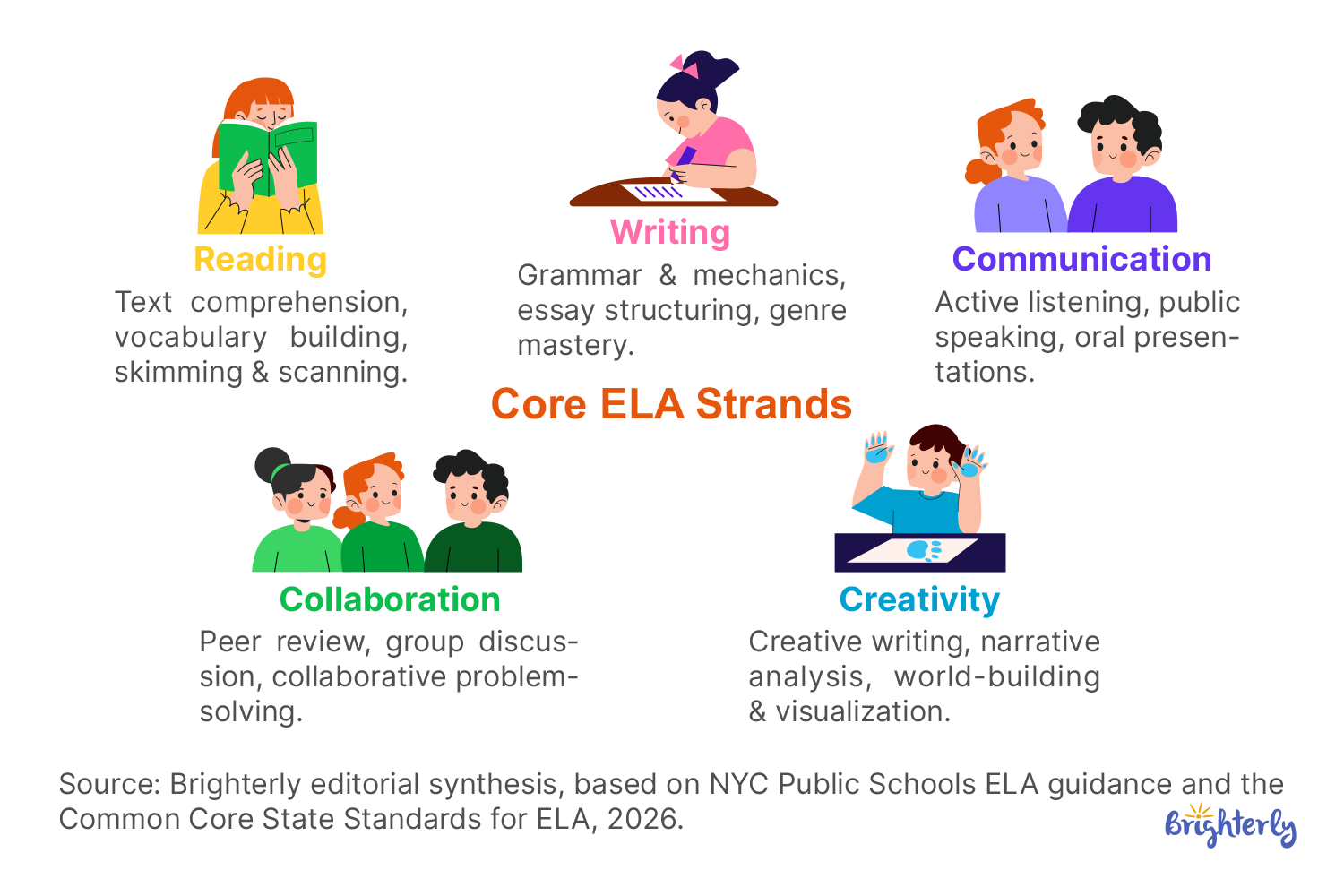
ELA stands for English Language Arts in the United States academic system. The abbreviation is official and is widely used within the US school domain. Typically, English Language Arts has five strands, or evaluation standards, listed below.
What Do You Learn in ELA?
Reading
Reading is the first basic skill that the study of ELA subjects at school develops. Students need to be able to read different types of texts in order to comprehend and learn new information and communicate effectively in the classroom and outside of it.
During an ELA class, children learn not only how to increase reading speed (to absorb new facts faster) but also how to boost reading comprehension (to extract more knowledge from texts). Teachers help kids achieve it by practically applying various strategies, like skimming, scanning, building sight word vocabulary, and reading daily.
Without solidifying reading capabilities, you cannot move forward with the other ELA strands.
Writing
Building writing skills is the second of the nationwide ELA goals in the US. Children need to learn how to structure their ideas and express them clearly, fluently, and eloquently in written form in order to be able to communicate effectively. While writing is learned at school, it’s a lifelong skill that determines success in higher education and at work, too.
In the ELA school subject, students work on both grammar and vocabulary. They learn how to put their ideas into words, develop coherent written messages, and write different genres. They need to practice writing daily for the acquisition of much-needed lifelong skills.
Communication
The third strand on which ELA in school works is communication. The ultimate goal of studying this subject is to build effective communication skills that will serve you both at school and beyond – in your personal and professional life. Being able to communicate your ideas coherently is key to success in all academic subjects and all areas of life.
ELA classes teach communication skills to students through active and tentative listening, speaking, presenting, and writing exercises. Communication abilities are developed both during individual work and group projects that require coordination among group members.
Collaboration
To answer the question “What is an ELA?” comprehensively, we have to consider the fourth aspect of the subject – collaboration. In particular, through learning and using English, children become accustomed to working with others, whether classmates, teachers, tutors, or even parents. That’s how they put the foundations of teamwork, which plays a key role in all future endeavors.
ELA helps develop cooperation skills when kids work in groups, speak in pairs, or review each other’s work. The class provides the grounds for lots of peer interactions.
Creativity
The fifth ELA class meaning is to enhance students’ creativity and imagination. These skills are highly valued in today’s world of continuous innovation and the necessity to think differently.
Reading is important in this regard, as exposure to different texts, writing styles, and made-up stories helps children develop their imagination as they try to create pictures of characters and settings in their brains. Another way in which ELA supports creativity is through creative writing, where students can train their imagination to come up with new realities.
The combination of these five strands forms the basis of ELA in education.
What Does ELA Mean in US School Stats and Facts?
- As a core subject, ELA is studied in all school grades in the US education system, from PreK to 12th grade.
- Both national and state standards specify what students learn in ELA classes.
- The development of adequate ELA skills supports academic success across all other subjects, such as social studies, science, and even computers.
- According to data from the National Center for Education Statistics (NCES), in 2025, 35% of 12th graders were at or above a proficiency reading level, while 32% were below basic reading proficiency.
- National University publishes the most recent stats for 2026 based on the latest OECD data, stating that the average American reads at a 7th-8th grade level, and 54% of adults in the US read below 6th grade. Meanwhile, 21% are functionally illiterate.
Explore Brighterly Learning Experience
Learn exactly how Brighterly helps students thrive through expert sessions, online tools, and proven feedback from thousands of satisfied parents
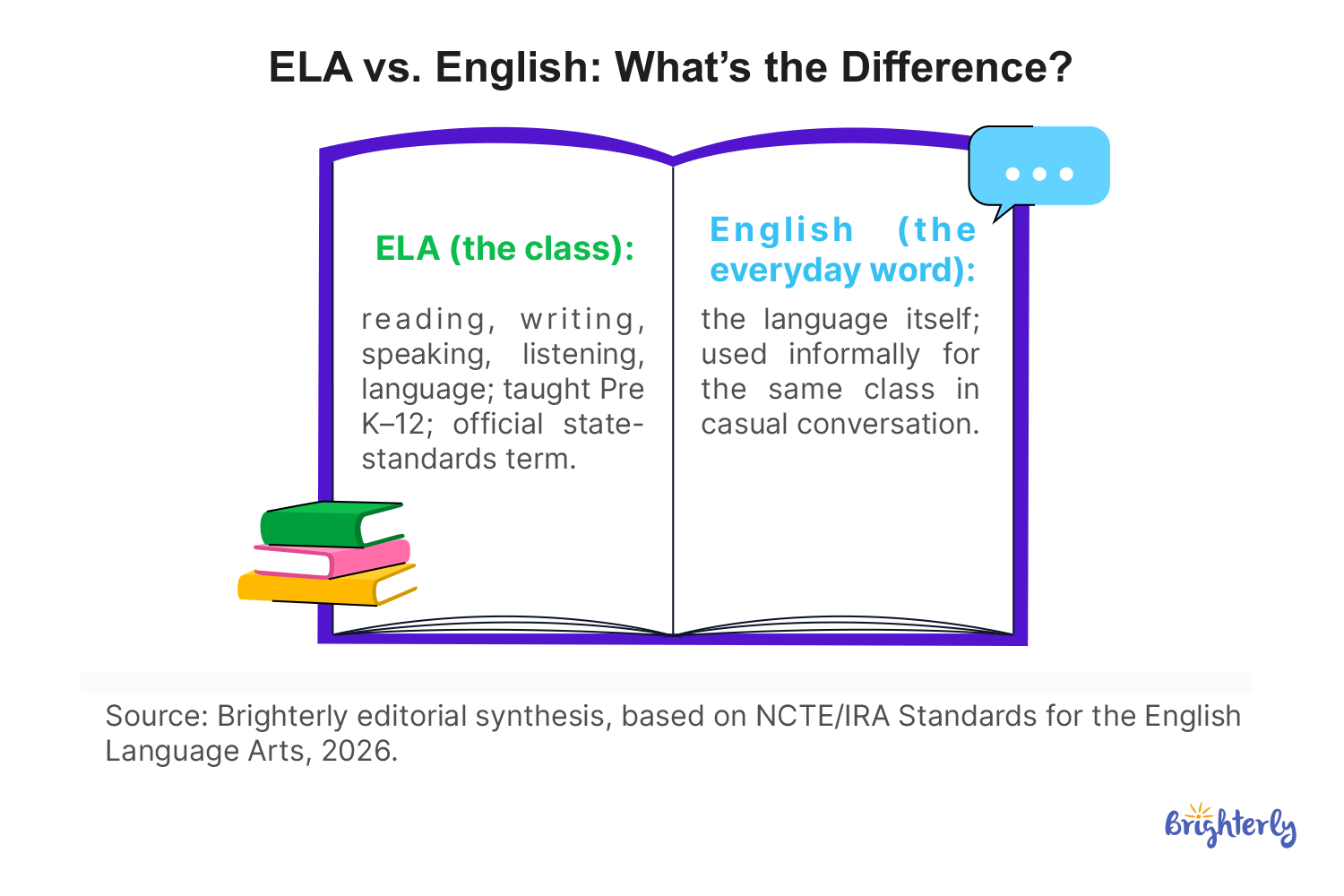
ELA vs. English: What’s the Difference?
ELA is a comprehensive educational subject that includes reading, writing, speaking, listening, and critical thinking. English is a broader term that can relate to the academic discipline, the language itself, or separate high school and college courses on literature and writing composition.
Main Differences
English Language Arts (ELA)
English
Level of use
Kindergarten – grade 8
High school (grades 9-12) and higher education
Instruction
Phonics, vocabulary, fluency, grammar, listening, writing, reading
Literary analysis, rhetoric, creative writing, world literature
Curriculum focus
Development of skills and mastery of practical communication
Analysis of different text genres, themes, arguments, and historical literary contexts
Educational Progression and Practical Application in Schools
ELA – elementary and middle school
- Combines different skills in learning.
- Daily unifies and integrates mechanics, phonics, spelling, guided reading, and basic writing (narrative, informational, opinion).
- Evaluates foundational literacy, comprehension skills, and oral presentation.
English – high school and post-secondary
- Builds deeper subject knowledge and teaches students how to apply it.
- Divides content into separate courses – English I-IV, AP language and composition, British literature, etc.
- Emphasizes analyzing complex texts, writing academic essays, employing research methods, and understanding rhetorical strategies.
Why Do Students Struggle With ELA?
Students may struggle with ELA because they need to simultaneously apply their cognitive, linguistic, analytical, and other skills, compared to subjects that assume relying on memorization or linear problem-solving only.
Note: If you already know what exactly your child struggles with in ELA, check out this detailed guide on tips and strategies you can employ to improve it at home.
- Math or science problems often have a definitive correct answer, but ELA assignments frequently entail open-ended interpretation and subjective evaluation – students may struggle to understand what makes an argument strong or a tone effective.
- Reading comprehension depends on subject-specific vocabulary and background knowledge about historical, social, or cultural contexts. When students are dealing with texts featuring unfamiliar terminology or references to concepts they have little personal experience with, their ability to process and analyze the content falls significantly.
- For expressing thoughts in writing, students need fine motor coordination and working memory. If your child has a weak processing speed or short writing endurance, they can know what they want to say, yet physically and mentally, organizing their thoughts and working on texts can be exhausting.
What students may struggle with
Reading comprehension
Understanding figurative language and making logical inferences.
Writing and composition
Structuring paragraphs coherently with a main claim and supporting ideas with relevant text evidence.
Grammar and mechanics
Understanding syntax rules and using appropriate punctuation in complex sentences.
Speaking and listening
Processing spoken information in real time and articulating analytical points orally.
What Is ELA in Elementary School?
ELA class for elementary school emphasizes the early development of simple reading, writing, and communication skills. This helps build the foundation for English language learning and more advanced abilities later at school.
What Does ELA Mean for Elementary School? Topics Covered
- Introduction to reading, writing, and communication
- Prolonged silent reading
- Simple text comprehension
- Vocabulary growth
- Basic grammar and syntax
- Oral language development
- Literary skills foundation
What Is ELA in Middle School?
In middle school, ELA students focus on the development of advanced literacy skills that include all five evaluation standards listed above. One of the most important facts about ELA at this stage of education is that the subject is still taught independently, as a separate class.
What Does ELA Stand For in Middle School? Topics Covered
- Advanced reading comprehension
- Literary analysis of longer, more complicated texts on different topics
- Understanding diverse literature genres
- How to write both analytical and creative pieces
- Finding your own writing style and voice
- Development of research skills
- Integration of research findings in written and verbal communication
- Effective communication in various academic and non-academic settings
What Is ELA in High School?
ELA for high school means that the subject is integrated with other classes, such as history or even science, supporting the application of language arts-specific skills across different academic subjects and preparing students for real life, where English is rarely used on its own unless you become a writer.
What’s ELA Meaning in High School? Topics Covered
- Advanced literary comprehension and interpretation
- Argumentative writing
- Academic writing on various grade-appropriate subjects
- Understanding different literature genres and their meaning
- Learning about and appreciating diverse cultures and perspectives
- Development of college and career-ready skills
Struggling with reading, writing, or grammar?
Target the skills your child needs most with personalized, US state-standard-aligned lessons.
How Can Parents Help With ELA?
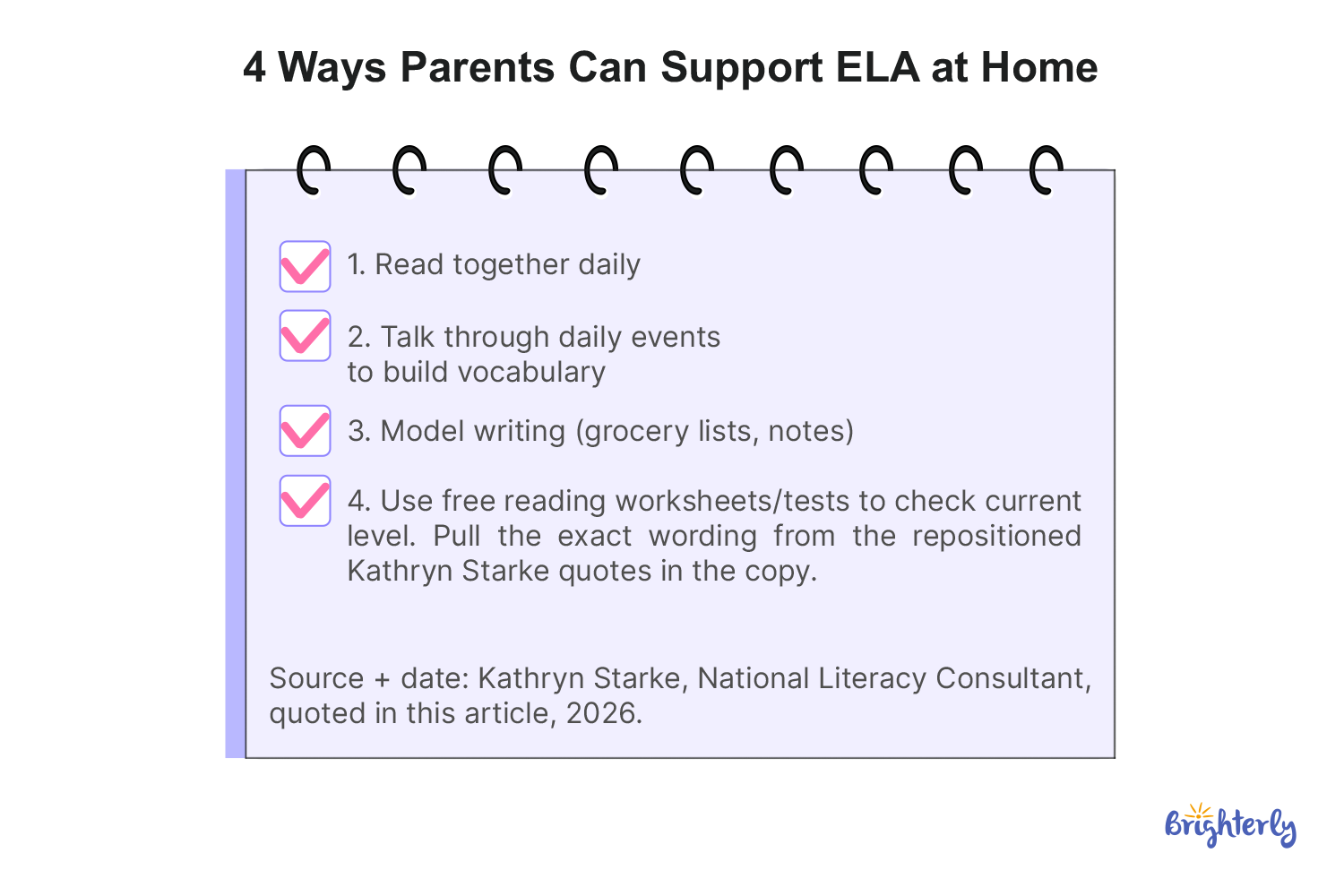
1. Discuss daily events to build vocabulary. Detailed conversations during everyday activities (errands or evening meals) – with describing actions and asking open-ended questions – expand a child’s spoken vocabulary and understanding of the underlying ideas. You may introduce several more sophisticated words daily (like using ‘exhausted’ instead of ‘tired’, ‘fragile’ instead of ‘weak’, etc.) and ask your child to use them accordingly.
Kathryn Starke also offers practical recommendations on how parents can support relevant skills at home.
“When families have conversations about the world, daily life, and books, vocabulary is increased, as is background knowledge and comprehension.”
2. Read together daily. Regular shared reading teaches kids how to read smoothly and fluently and strengthens comprehension (given the immediate discussion). Stop at important moments in a story to ask questions, alternate reading pages aloud, discuss character motivations, or have your child summarize what occurred in a chapter using their own words.
3. Show how writing is used in real life. Let your child help you write grocery lists, family notes, thank-you cards, daily reminders, etc. – they’ll see how sentence structure and spelling apply in real-life situations.
Kathryn Starke explains that writing exercises to support ELA skills can go beyond the classroom.
“Modeling writing is a great way to support writing at home.”
4. Practice with structured worksheets, evaluate with free tests. Occasionally assess your child’s skill levels with free reading tests to figure out particular areas that might need extra practice. Browse our printable reading and writing worksheets – classified by grade and topic – for extra home practice of precisely those skills. Consider our literacy program for kids or 1:1 online lessons with our reading experts that start at $17.70/lesson (2 lessons/week, 12-month plan, 20% discount as of September 2026).
Why Is ELA Important?
Supports Academic Success Across All Subjects
First and foremost, the English Language Arts goal at school is to develop crucial skills that students need to succeed in all academic subjects. You need to use English efficiently to read quickly, understand deeply and comprehensively, write convincingly, and communicate effectively to score excellent grades in math, science, history, social studies, and all other core and elective disciplines.
Builds Strong, Effective Communicators
ELA classes are crucial for establishing communication skills, including both verbal and written communication. An ELA tutor can really help students learn how to organize their thoughts and present their ideas in the most efficacious manner. Needless to say, being able to communicate is of indispensable importance both at school and for the rest of your life.
Enhances Critical Thinking and Analysis
Through literary analysis and delving into different genres and texts, students grow and expand their abilities to think critically and analyze various texts and situations. Creativity and critical thinking are some of the most valuable skills in the 21st century, where innovation and thinking outside the box are needed in any college specialization and career.
Prepares Students for Life After School
Finally, learning ELA helps children not only succeed at school but also beyond. Good reading, effective writing, strong communication, real collaboration, and outstanding creativity are in demand in all college disciplines and jobs.
ELA Subject and Its Significance: Conclusion
Now you know what is ELA in school and why it is so important. As a core academic subject, ELA helps your child learn how to read, write, communicate, collaborate with peers, and be creative, not only to cover the school requirements but to gain real-life skills. If your child needs some extra help, you can try the Brighterly ELA tutoring program.
What you get with the Brighterly ELA program:
✅ Tailor-made ELA tutoring aligned with the US state standards
✅ Interactive 1:1 tutoring sessions with professional teachers
✅ Customized reading and writing learning materials matching your kid’s level and interests
Ready to help your child boost their ELA skills? Book 1st free lesson today to test if Brighterly is the right ELA program for your family.
Frequently Asked Questions
What Grade Levels Include ELA Classes?
- Elementary school (PreK-Grade 5): Instruction covers foundational literacy – phonics, spelling, sight words, guided reading, and basic writing.
- Middle school (Grades 6-8): Students learn advanced reading comprehension, introductory literary analysis in diverse genres, structured essay writing, employing research skills, and collaborative communication.
- High school (Grades 9-12): ELA skills are integrated in the broader curriculum (including social studies and science) and offered in specialized academic courses that concentrate on rhetoric, complex text analysis, and pre-collegiate academic writing.
Is ELA the Same as Reading?
No, reading is a foundational skill for understanding information, and English Language Arts (ELA) is the holistic academic subject built around that skill.
Reading covers decoding words and comprehending written text. ELA school meaning implies taking those reading abilities and putting them into practice – students write analytical essays, learn to speak persuasively, listen critically, collaborate in team discussions, and evaluate diverse media.
Reading is the receptive means to absorb information; ELA is the comprehensive discipline that teaches students how to process, express, and apply that information in all modes of communication.
Is ELA Only About Reading and Writing?
No, ELA covers much more than only reading and writing – it eventually prepares students for all academic disciplines with:
- Reading – developing text comprehension and vocabulary acquisition to extract meaning from diverse literary and informational texts.
- Writing – learning to structure ideas, master grammar and syntax, compose arguments and narratives, and create research-based pieces.
- Communication – improving active listening and public speaking abilities to explain concepts (be it for academics or everyday life).
- Collaboration – building teamwork skills via group discussions and work in pairs (reviewing written assignments).
- Creativity – enhancing imagination and critical thinking due to creative writing and visualizing complex narratives.
Who Created the ELA Standards?
ELA standards in the United States are established at both national and state levels:
- National Guidelines. The organizations that defined the core literacy standards and goals for language arts education nationwide are the National Council of Teachers of English (NCTE) and the International Literacy Association (ILA).
- State Standards. Individual state departments of education establish and adopt their own specific academic standards. State boards of education work with teams of literacy specialists and curriculum experts to determine the particular criteria and grade-level expectations for students from PreK to grade 12.
What Does a Typical ELA Class Look Like?
A typical ELA class usually consists of the following instructional phases:
- Lesson starter – the teacher introduces a concept or strategy (like identifying thesis statements or mastering particular grammar rules) with short model texts or direct instruction.
- Guided and independent reading – students read assigned texts individually or in small guided groups, applying comprehension strategies and answering analytical questions.
- Writing practice – students draft and revise (or peer-edit) written responses ranging from quick-write journal entries to multi-paragraph analytical essays and creative assignments.
- Group discussion – students participate in structured peer interactions: Socratic seminars, literature circles, group presentations, etc., to discuss ideas and evaluate classmates’ arguments.
Why Do Some People Call It “English” Instead of “ELA”?
Some people call it ‘English’ in everyday conversation because it’s shorter and more natural to say than ‘English Language Arts.’
In elementary and middle school, institutions officially name the class ‘ELA’ to highlight an integrated focus on foundational mechanics, reading, writing, and speaking. During the high school and college years, courses are divided into separate literature and rhetoric classes under the official department title – ‘English.’
‘ELA’ is an administrative term used mostly by educators and school boards, and in everyday life, most people simply say ‘English’, meaning the language itself as well as any school class taught as part of it.

When choosing the best homeschool reading curriculum, consider programs that go beyond reading speed and focus on reading comprehension too. This guide compares and contrasts the top options for homeschooling families based on methodology, features, age coverage, and pricing to help you select the right one for your child. Best Homeschool Reading Curriculum: Comparison *Pricing […]

Aug 13, 2025

To cancel your ABCmouse subscription, sign in through the app or website, navigate to the Parent Section (or Settings), open “Manage My Account” (or “My Account”), and select “Cancel Membership.” If you originally signed up through a third-party platform like Apple or Google Play, you’ll need to cancel through that device’s subscription settings instead. This […]

Aug 14, 2025
Math & reading from 1st to 12th grade
Looking for homework support for your child?

Choose kid's grade

Math & Reading for Grades 1–12
Build real confidence for your child with a Brighterly math or reading tutor.