How to Increase Reading Speed: 12 Best Methods in 2026
reviewed by Franz Jerby Delos Santos
Updated on September 7, 2026
Key Points:
Reading too slowly can prevent students from keeping up with academics. The good news is that the speed at which children read is not set in stone. Check the 12 effective strategies on how to increase reading speed without compromising comprehension. Usually, these strategies work better when combined.
Take a reading speed test to know where to start.
How Can I Increase My Reading Speed?
Some proven strategies for increasing reading speed include working with an ELA tutor, practicing daily, expanding your sight-word vocabulary, and avoiding distractions during reading time. Learning how to skim and scan, tracking text with a pointer, and increasing your horizontal peripheral vision can also help you start reading faster.
While there are many ways to improve reading speed, the efficacy of these techniques depends on each child’s individuality and the unique reasons that are slowing them down. Still, the application of multiple techniques simultaneously tends to give better results as each one works on a different potential cause.
While you focus on reading speed, you shouldn’t forget it’s not the same thing as reading fluency. Kathryn Starke, National Literacy Consultant, explains the difference between reading fluency and reading speed:
“In reading, we only discuss reading fluency and include speed under the rate of words per minute.”


This expert explanation clarifies that while the number of words that a child can read per minute matters, it should be analyzed in the context of wider reading level metrics.
What Is the Average WPM Reading Speed?
An average adult reads 260 WPM of fiction when doing so silently, according to the 2019 research by Brysbaert. Meanwhile, the silent reading speed for kids ranges between 80 WPM in grade 1 and 250 WPM in grade 12, based on Taylor’s 1965 work. This article shows details on the average reading speed by age.
Explore Brighterly Learning Experience
Learn exactly how Brighterly helps students thrive through expert sessions, online tools, and proven feedback from thousands of satisfied parents
How to Increase Reading Speed? 12 Effective Strategies
- Work with a reading tutor
- Try skimming
- Give scanning a shot
- Practice repeated reading
- Track words with a pointer or a finger
- Build your sight word vocabulary
- Establish daily speed reading practice
- Expand your horizontal peripheral vision span
- Minimize distractions during reading time
- Get books with more spacing between letters and colored overlays
- Reduce subvocalization
- Timed reading practice and progress tracking
Increase Reading Speed with a Reading Tutor
Age: All ages
Best for: Children who require professional guidance and support
How to Read Faster with a Tutor’s Feedback?
A private tutor can hear your child’s hesitations that they can’t hear themselves. Thus, a professional teacher can identify the exact reasons behind your kid’s slow reading and design a tailored educational and practice plan to work on unique gaps.
Our school-supplemental K-12 learning platform offers 1:1 online reading tutoring by professional ELA teachers that focuses on each student’s exact needs. After an initial assessment, a qualified tutor prepares a personalized learning plan that incorporates individualized reading materials and exercises. We cooperate with parents to match everything with the child’s preferences and interests for an engaging experience.
Meanwhile, our online reading program, as well as the homeschool curriculum, align with the US state standards to make sure that students cover the nationwide requirements for their grade level. During the 1:1 sessions, reading tutors mix teacher-led instruction with level-appropriate speed reading techniques, exercises, and fun, gamified activities. This personalization makes lessons exciting and effective.

Our program works not only on increasing reading speed but also on reading comprehension strategies for an integrated approach to the subject.
Finally, we offer a pretty good price, starting at $17.70/lesson, with an annual subscription plan and 20% discount (the price is actual if you book 2 weekly lessons). Moreover, children can benefit from free reading worksheets, sorted by grade level, for additional speed reading practice.


Increase your child’s reading speed with professional tutors!
Help your child read faster & comprehend more with our personalized tutoring.
Increase Reading Speed with Skimming
Age: 8-14 years
Best for: Strong readers dealing with informational texts and building learning skills
How to Skim Headings and First Sentences to Read Faster
Another strategy on how to improve reading speed and comprehension is the so-called skimming method. According to the University of Tennessee, skimming is a popular technique that helps learners extract more information from a text in less time. This is a structured approach where you read the first couple of paragraphs of a text, after which you read in full only the first (topic) sentence of each paragraph before quickly going through the remainder of the paragraph.
Skimming is particularly useful for older students who deal with longer, non-fictional texts and need to get a general understanding to be able to discuss topics and answer questions.
Increase Reading Speed with Scanning
Age: 8-14 years
Best for: Students who need to navigate long textbooks and prepare for exams
How to Improve Reading Speed with Scanning
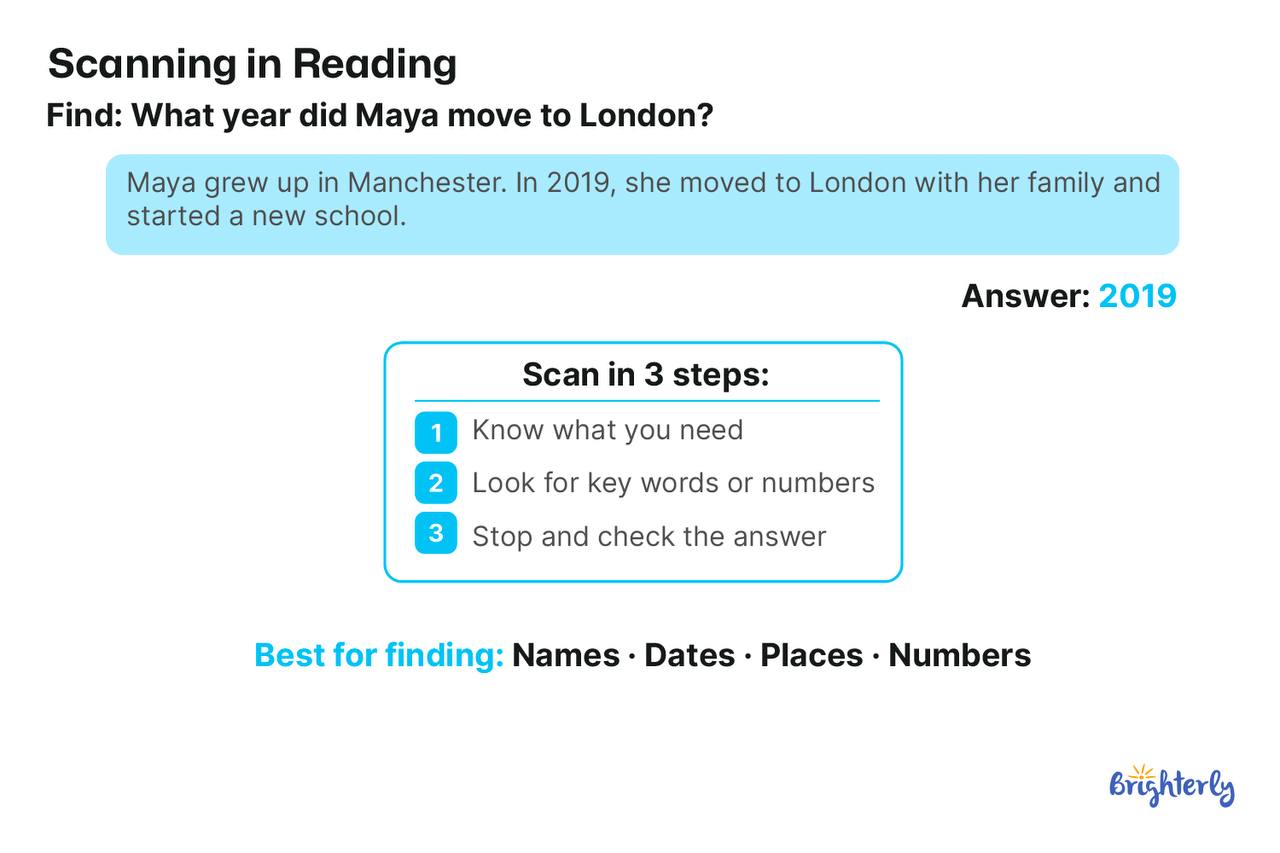
To increase your speed of reading with scanning, first identify the type of information that you need to extract from the text. This depends on why you’re reading this particular material – to gain new knowledge on a topic, to respond to questions, or for fun. When scanning, you move your eyes over the text to quickly locate specific information, such as characters or a setting. According to Las Positas College, scanning helps save time by focusing only on the important details that you need from the book.
Scanning is a speed reading practice that usually works well for students in grades 3-9. While it is similar to skimming, there are important differences, so these are two distinct strategies.
Increase Reading Speed with Guided Repeated Reading
Age: 6-12 years
Best for: Young students who read slowly or lack reading fluency
How to Build Speed Through Short, Repeated Passages
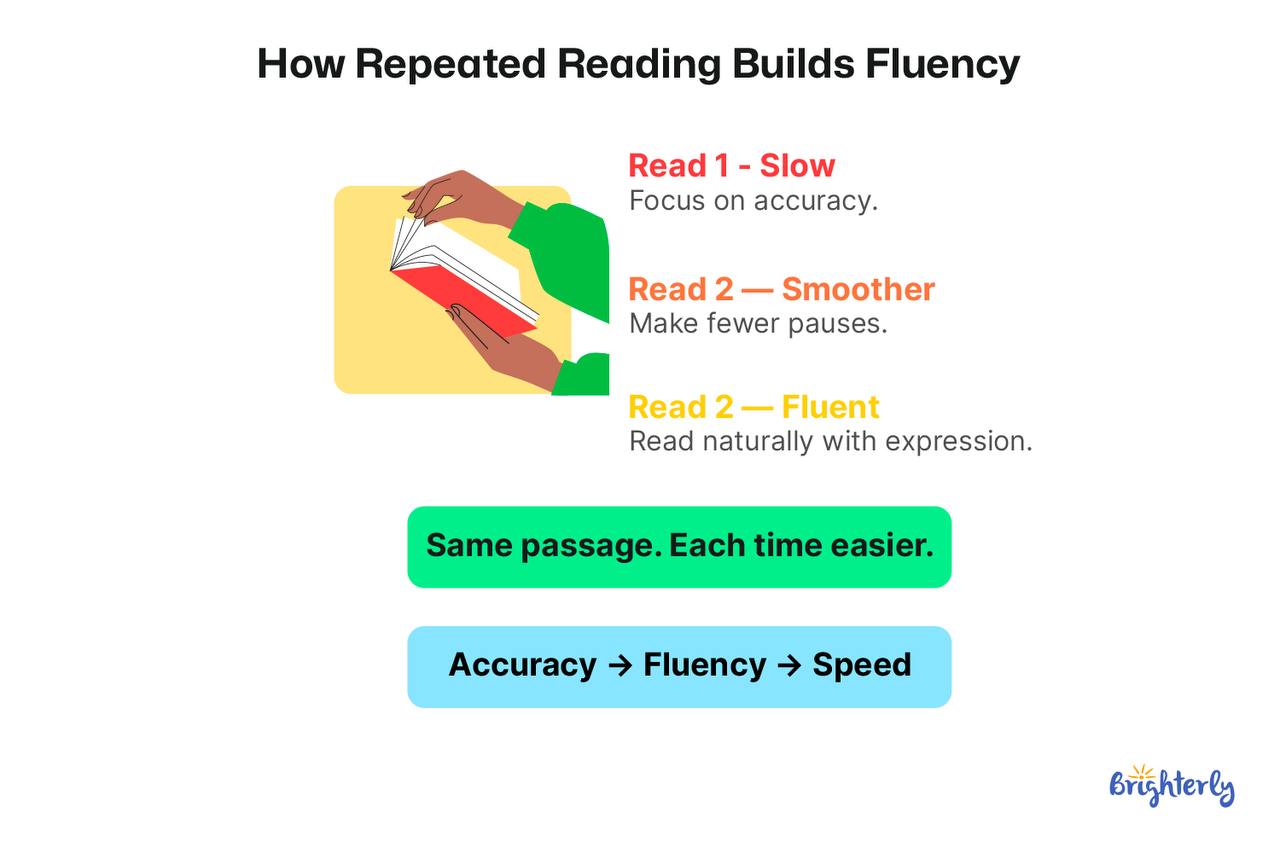
Guided repeated reading or the rereading of short passages is a simple speed reading exercise. This means that a student reads the same text several times under the guidance of a teacher or a parent. It helps develop automaticity so that the reader starts recognizing words visually instead of decoding them each and every time.
To learn to read faster and develop reading automaticity, the Center for Literacy Training & Instructional Leadership at Lesley University provides the following tips:
- Reading aloud with your natural voice so that the teacher can monitor pronunciation
- Receiving support from an adult when needed
- Getting continuous feedback from the instructor in the process (so that reading doesn’t sound like a monologue) to improve both speed and accuracy
The repeated reading of the same text helps with reading fluency in general and reading speed in specific. That’s why it’s a good strategy for kids who are behind their grade level, especially young learners.
Increase Reading Speed by Tracking Words with a Pointer or a Finger
Age: 5-9 years
Best for: Early readers learning to track and students with attention difficulties
How to Use a Finger or Pointer to Keep a Faster Pace
To increase speed of reading, students can adopt the finger tracking method. This strategy helps young students, as well as students with attention deficit, increase the number of speed reading words per minute. Plus, the technique is easy to implement. All that the student needs to do is to use their finger, pen, or another sharp object to track the line they are reading and pace themselves.
The approach is so effective because it helps avoid distraction and regression. It is particularly good for small kids and those with attention challenges, as it helps keep their attention on the book and reduces the habit of back-skipping to words they have already read.
To practice it, ask your child to move their finger smoothly under each line as they read. Once they are comfortable, turn it into a short speed drill. You can ask them to try to move through each line in about two seconds. If you notice that reading comprehension drops, reduce the speed. This is a controlled pacing technique that will train their eyes to move forward more steadily instead of stopping on every single word.
Start with easy texts, avoid challenging school reading. With this practice, your goal is helping your child build rhythm and confidence first. Once they can follow the line smoothly, they can gradually move to using the same method with more complex texts.
Improve your child’s reading speed with 1:1 tutoring!
Brighterly boosts your child’s reading skills with personalized materials & lessons.
Increase Reading Speed by Building Your Sight Word Vocabulary
Age: 5-10 years
Best for: Beginner readers working on automatic word recognition
How to Recognize Common Words Instantly to Read Faster
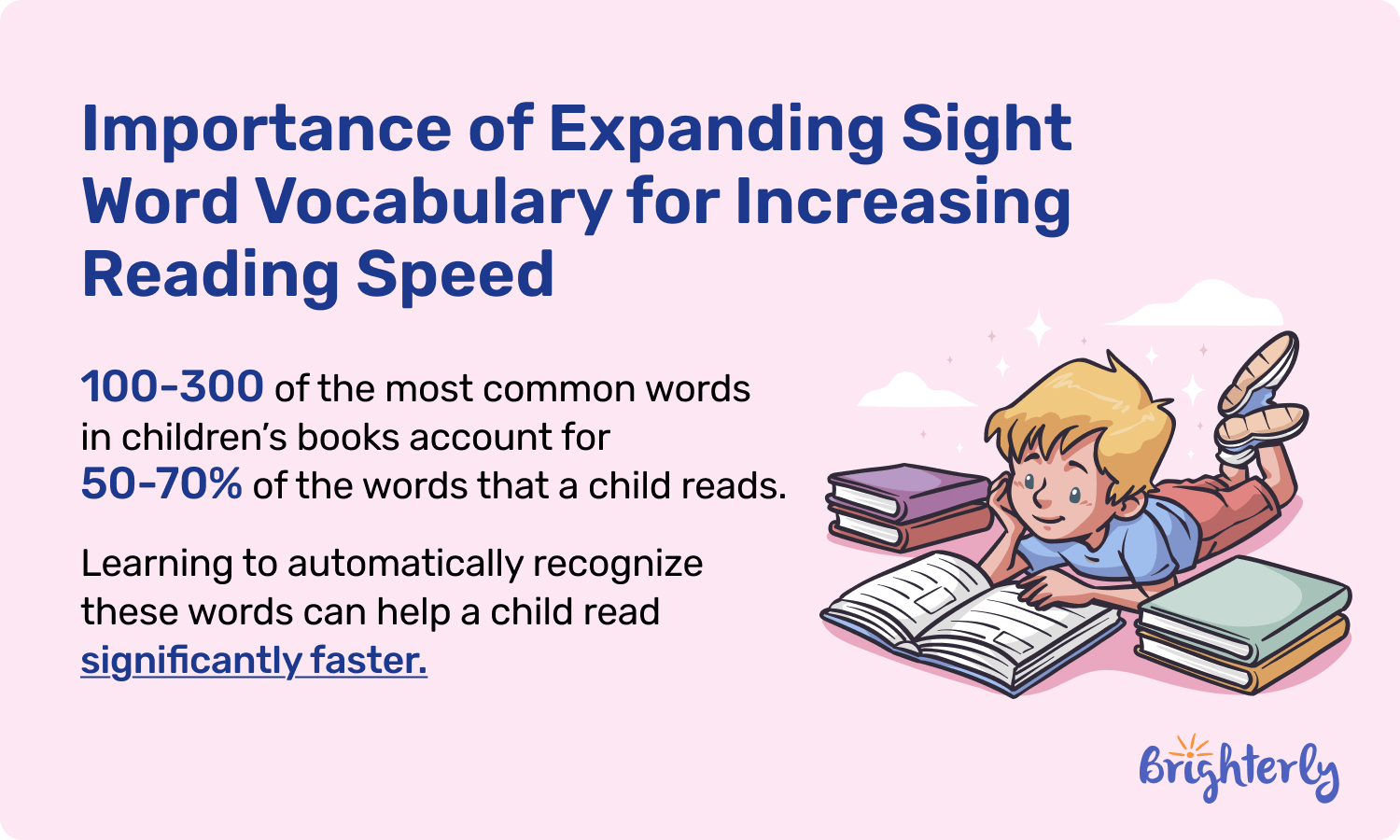
To increase WPM reading, you can work on learning commonly used words, also known as sight words. Sight words refer to the words that you are able to recognize automatically without the need to decode them letter by letter. As a student becomes visually familiar with more words on the paper or the screen, they naturally start reading faster.
Building your child’s sight word vocabulary should be done gradually. Start with a short list of words and expand over time. Make sure that you read repeated texts, use flashcards, make use of pictures and visual manipulatives, and search for these words in the world around you.
Wondering why sight words are so important for reading speed? Simple statistics explain the reason.
Note: According to Clarence Green, Kathleen Keogh, and Julia Prout’s 2024 research, the 100-300 of the most frequently used words in children’s literature make up about 50-70% of the total reading that a child does.You can boost the number of reading words per minute by adding these words to your sight word vocabulary.
Increase Reading Speed by Practicing Reading on a Daily Basis
Age: 5-15 years
Best for: All students, especially during the summer and other vacations
How to Improve Your Pace with 15-20 Minutes of Daily Practice
One of the best ways to improve reading speed is to develop daily reading habits. Students need to allocate at least 15-20 minutes per day to reading. Regular reading helps expand vocabulary, build a reading process, and turn reading into one of the healthy daily habits of a well-rounded individual. All these factors contribute to increasing speed, accuracy, comprehension, and overall fluency.
Daily reading is particularly important during the summer vacation and other prolonged breaks to prevent summer slide and avoid reverting to slow reading. Families can enjoy the benefits of summer reading programs and speed reading apps for kids that help them practice between lessons.
Increase Reading Speed by Expanding Your Horizontal Peripheral Vision Span
Age: 9-14 years
Best for: Students with decoding skills and reading capabilities who want to improve efficacy

How to Take in More Words at Once and Read Faster
To improve reading speed, you can also work on being able to see a larger number of words with one look. This is known as horizontal peripheral vision span expansion, and to achieve it, you have to do special reading exercises.
Untrained readers practice central focus, which means that they don’t use their peripheral vision. According to 2023 research by Ming Yan & Jinger Pan, unskilled readers can see and read about 11 characters to the right of fixation (after the letter on which their eyes are placed), while this number goes up to 15 for trained readers. By unlocking your peripheral vision, you gain the potential to see and read more words at once, which increases your reading speed.
To grow your peripheral vision, you have to do exercises, such as moving your eyes in the shape of the number eight. In addition, it helps to use a finger or a pointer to guide your eyes during reading. These techniques for increasing reading speed for students also work for older children who have already developed basic reading skills and want to work on speed.
Increase Reading Speed by Minimizing Distractions During Reading Time
Age: 5-14 years
Best for: All students, particularly those with attention challenges or sensory sensitivities
How to Set Up a Distraction-Free Routine for Faster Reading
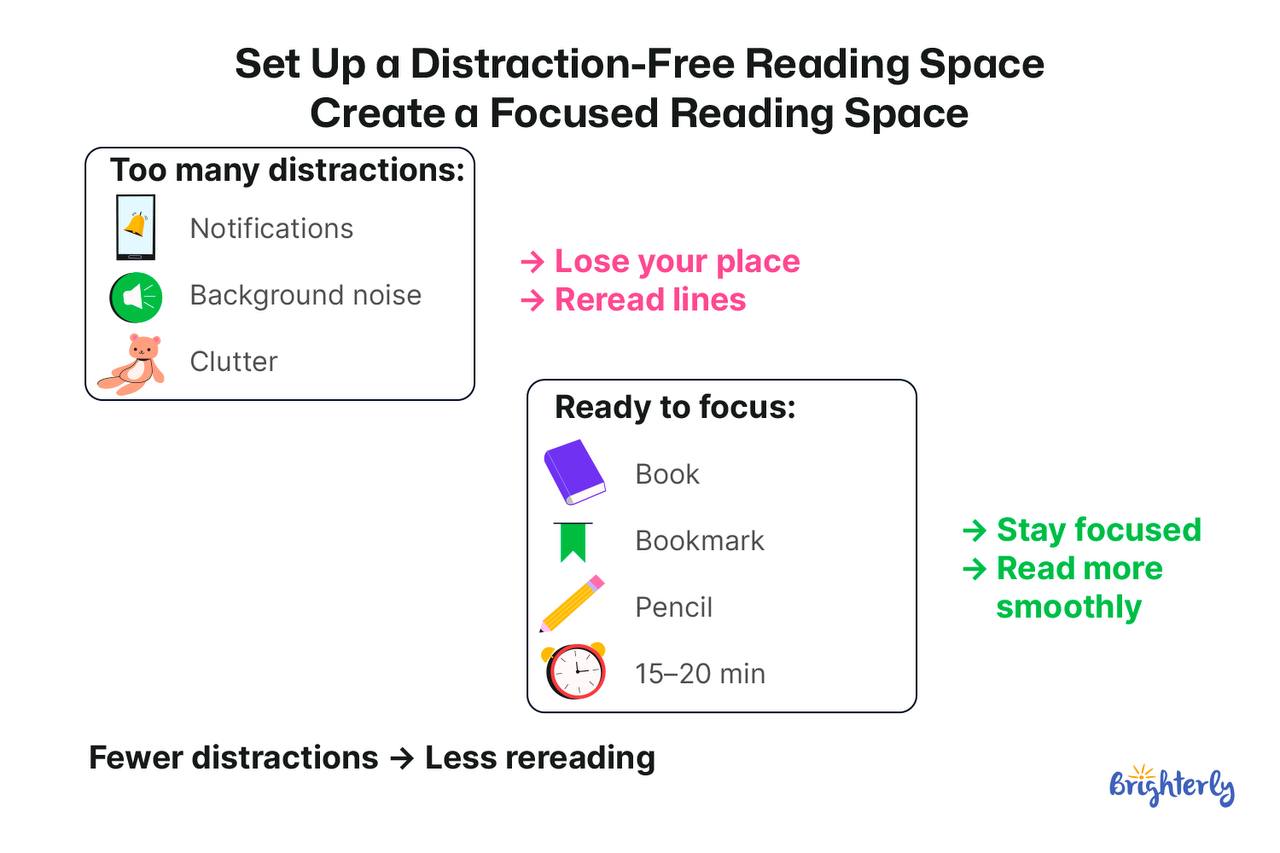
To increase reading speed online or offline, it is crucial to provide your child with a quiet, conducive environment. This means removing all possible distractions so that your kid can focus on reading without unnecessary noise and movement.
Students, especially young ones, are easily distracted during study and reading time. This means that they lose the meaning, forget where they’ve reached, and need to reread the same sentence over and over again. That’s why minimizing sources of distraction during reading time is one of the simplest and yet most effective methods to help them go through books faster.
To make this work, create a short reading routine. For example, put phones and tablets in another room during a 15-20-minute reading session, clear the table, and keep only the book, bookmark, and a pencil nearby. If your child is sensitive to background noise, and the area is not completely silent, you can try soft white noise or quiet instrumental music to block sudden sounds without adding new distractions.
It also helps to choose the same reading spot and time each day. When your child knows where and when reading happens, they spend less energy worrying about the practice and settling down and focus on the text more.
Increase Reading Speed with More Spacing Between Letters And Colored Overlays
Age: 10-19 years
Best for: Students with dyslexia
How to Test Spacing and Overlays to Support Faster Reading
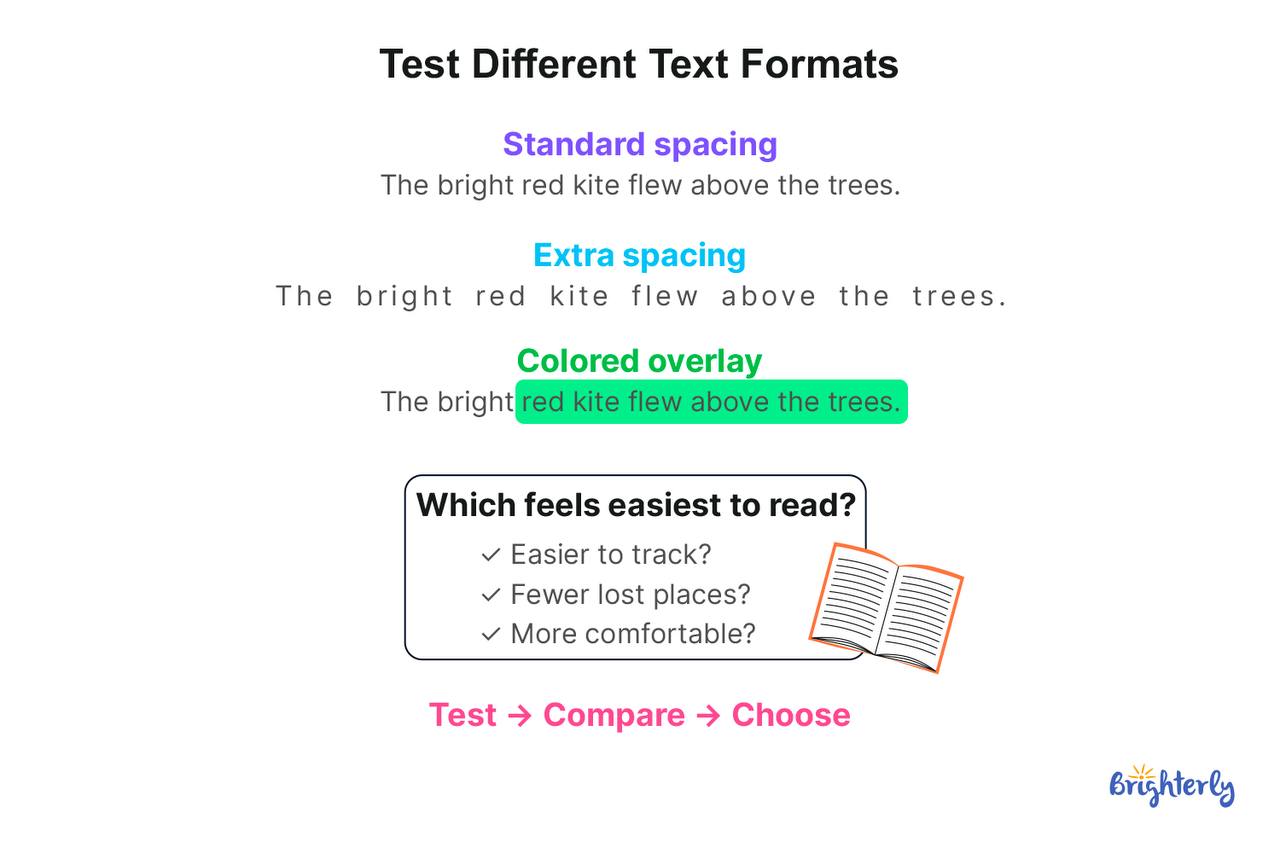
To improve reading speed of your child with dyslexia, you can provide them with specialized books that use extra spacing between letters and colored overlays. A 2021 study by Steven Stagg and Nathan Kiss shows that reading materials with extra-large spacing between the letters and colored overlays help individuals with certain types of reading disabilities read faster and more accurately.
While this strategy on how to increase your reading speed is usually recommended for children with dyslexia, it can work for other learners too. Young kids, for example, also benefit from larger print, more spacing, and strategically used colors.
Reduce Subvocalization
Age: 10-18 years
Best for: Older students who read accurately but want to improve reading pace
How to Stop Sounding Out Words Silently to Read Faster
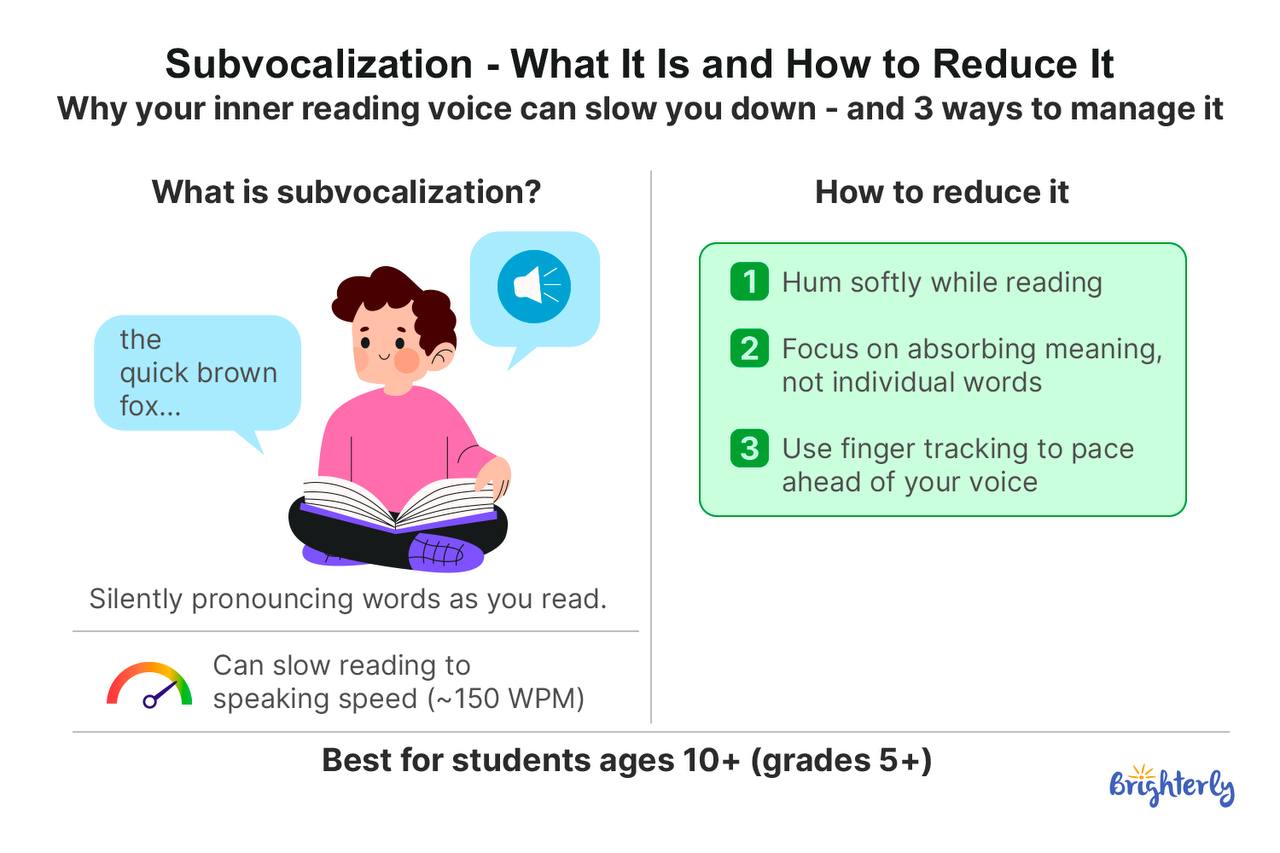
Subvocalization is the inner voice your child hears when they read. It is the habit of silently “saying” every word in your head while reading. If you think to yourself “how to increase my kid’s reading speed”, reducing subvocalization is one of the most effective ways to do it.
It is a natural part of learning to read, especially for younger children and developing readers. However, once your kid is older and a more accurate reader, subvocalization can become a speed limiter. Helping your child reduce subvocalization can help improve their reading speed significantly.
To help your child practice this, start with short and easy texts. Ask them to read the text in small word groups instead of word by word. For example, instead of reading “The / little / dog / ran / across / the / yard,” they can train their eyes to read “The little dog / ran across / the yard.” This way, they will process the meaning in chunks instead of individual words.
The next method is a bit counterintuitive at first, but an effective one nonetheless. You can give your kid something simple to occupy their mind. This can be humming a song, counting 1-2-3 mentally on a loop, or even chewing gum. This can help to partially block their inner narrator without disrupting the reading comprehension.
Another useful method your child can use is pointer pacing, which was already discussed. They can use a finger, a pencil tip, or a cursor as they read each line to pace their eyes slightly faster than their inner voice naturally moves. This trains their brain to understand the meaning of the text without having to pronounce every word.
With that said, if your child starts missing the meaning, slow down again. Reading faster is not a goal in and of itself; it’s only useful when your kid still understands the text.
Timed Reading Practice and Progress Tracking
Age: 7-18 years
Best for: All students, particularly those working on reading fluency
How to Measure WPM at Home and See Real Progress
For timed practice at home, get your child to read a passage for exactly one minute, count the number of words they read correctly, and record the result. This exercise will give you the base score that you can compare to typical WPM by grade. You can track your kid’s progress on a simple chart, which can even be hand-drawn, which may include the date, passage title, words read correctly, and any notes you may have. You can keep the chart somewhere visible, as most kids respond well to seeing their own progress, and knowing that they are getting better at reading will make even reluctant readers want to practice more.
If you notice that your child’s reading speed doesn’t improve even with regular practice, or if they read faster but stop understanding the text, you may want to look into getting external help. An online elementary or middle school reading tutor can help you understand whether the issue is fluency, decoding, vocabulary, or comprehension, and work to fill the gap.
What Actually Works vs What Doesn’t: Speed Reading Myths
Strategies on how to increase reading speed and comprehension can produce real results, but be careful with programs promising that your child will suddenly read 1,000+ WPM while understanding everything. Research shows that reading speed and comprehension have limits, and faster is not always better.
Rayney et al. (2016) found a trade-off between reading speed and accuracy, so the answer to how to read faster and comprehend more is not simple. The researchers concluded that readers can’t boost their typical rate of 250 WPM to 500-750 WPM while maintaining the same level of comprehension. At an extremely high pace, readers may skim and pick up selected information, but that’s different from thoroughly reading and understanding the text.
Realistic reading speed improvement depends on age and starting level. According to the Hasbrouck-Tindal oral reading fluency chart (2017), a student at the 50th percentile progresses from 50 WCPM to 100 WCPM (50-WCPM increase) across grade 2. Median growth slows down in later grades – from 132 WCPM to 146 WCPM (14-WCPM increase) in grade 6. These figures highlight an important point – meaningful improvement develops gradually, and expected growth differs by age.
Research also challenges some popular speed reading shortcuts. How our visual system processes text doesn’t support claims that students can train their peripheral vision to read a whole sentence, line, or page at a glance. Rayner et al. found that readers primarily process text around the center of their vision and that information further into peripheral vision becomes increasingly difficult to identify.
What does work? Regular reading practice, developing a larger vocabulary, improving automatic word recognition, and becoming a more skilled language user can help how to speed read with comprehension. Skimming can also help students locate key information quickly — as long as the goal is getting the gist rather than comprehending every detail.
How to Increase Reading Speed for Teens and Older Students
To help your teen read faster, encourage them to adjust their strategy to their purpose rather than pushing themselves to read every word faster. For students in grades 8-12, combine chunking, reduced subvocalization, previewing, and scanning to handle textbooks, assignments, and exam prep more efficiently while maintaining comprehension.
Teach Your Teen to Read in Chunks
Older students can practice processing meaningful groups of words rather than treating every word separately. For example, instead of focusing individually on “the results / of / the experiment / showed”, they can process “the results of the experiment showed” as a meaningful phrase. Chunking makes reading smoother and reduces unnecessary pauses.
Reduce Subvocalization Selectively
Teens who silently pronounce every word may try to reduce inner narration when reading easy or familiar material. However, fully eliminating subvocalization shouldn’t be a goal of its own. For complex books and unfamiliar vocabulary, slowing down may support better understanding. Research consistently shows a trade-off between extreme reading speed and comprehension.
Preview Before Reading Closely
Before your high schooler starts a chapter, encourage them to examine the title, headings, bold terms, charts, and questions. Previewing provides a roadmap and helps students identify what deserves the most attention while supporting good reading speed. Cornell University’s Reading Strategies Center recommends previewing assignments with the purpose of the reading in mind.
Scan Strategically for Studying and Exams
Scanning is a particularly useful strategy when your teen already knows what information they need, such as a date, definition, formula, or supporting fact. Bowdoin College recommends scanning for specific information and fact-heavy tasks rather than reading every word.
If your teen wants to learn how to read a book fast, teach them how to vary their pace instead of racing from beginning to end. Eventually, older students should aim for a reading speed that lets them work efficiently without losing the meaning they need for class, assignments, or exams.
How Long Does It Take to Increase Reading Speed?
When you start putting effort into improving your reading speed, it takes a few weeks to notice the first signs of faster reading. Within a few months, you can read significantly faster if you combine a few effective strategies.
The required time depends on:
- Initial reading speed
- Strategies applied
- The effort exercised by a student
- The presence of any learning disabilities
To succeed, you have to be persistent and put deliberate effort into increasing your reading speed. Working with a private tutor, reading daily, and using a tracker can accelerate the process and enhance results.
Improving Reading Speed with Consistency
These 12 strategies can help students of different grades and with different needs increase reading speed. These methods usually work best when applied in combination. For example, reading daily while growing your sight word vocabulary and practicing peripheral vision expansion can help you achieve faster results than one of these techniques alone.
If you want your child to start reading quickly without unnecessary stress, we offer 1:1 tutoring that can help. Ready to try it out? Book free reading lesson with no commitment to check whether this is the right choice for your child.
Frequently Asked Questions
What Causes Slow Reading Speed in Children?
Slow reading speed can happen for several reasons, including weak sight word vocabulary, subvocalization, back-skipping, decoding difficulties, attention issues, or simply not enough reading practice. Before choosing how to increase your kid’s reading speed, the first step is to understand which skill exactly is slowing them down.
Can Speed Reading Techniques Be Learned at Any Age?
Yes, your kid can learn speed reading techniques at different ages, but the right method depends on their level. For example, if younger children in K-4 can benefit the most from sight words and repeated reading, subvocalization and peripheral vision training can be important additions to older students in grade 5+.
Is There a Difference Between Reading Speed and Reading Fluency?
Yes. Reading speed is the number of words a child reads per minute. Reading fluency, on the other hand, also includes reading accuracy, phrasing, expression, and smoothness. As reading expert Kathryn Starke explains in the article, reading speed is only one part of fluent reading.
How Many Words Per Minute Can a Child Realistically Gain in a Year?
According to the Habsrouck-Tindel oral reading fluency norms, a 2nd grader can improve reading speed by 50 WPM over the course of an academic year, and a 6th grader – by 14 WPM. Generally, the ability to gain words per minute decreases with grade level but also depends on the initial level and strategies used.
Does Reading Aloud Slow a Child Down?
Children usually read slower aloud than silently, and the gap increases with grade level and fluency. When kids read aloud, they need to subconsciously coordinate additional processes, including speech planning, articulation, and coordinating eyes with voice, which takes more time.
Should a Child Read Faster or Read More?
A child should focus on reading well and practicing regularly rather than on chasing a higher WPM. To understand how to improve fluency in reading, prioritize accuracy, fluency, and comprehension, along with speed. The National Reading Panel found that guided reading practice can improve word recognition, fluency, and comprehension.



Miacademy vs Time4Learning are two popular homeschool platforms with different approaches to learning. Miacademy is a self-paced homeschooling program based on teacher-led prerecorded videos, while Time4Learning is a parent-led homeschool curriculum with animated lessons. Brighterly offers live tutoring for homeschooled and public-school-educated students. Time4Learning vs Miacademy vs Brighterly: Side-by-Side Comparison Time4Learning and Miacademy are self-paced […]

Jul 07, 2025

Reading comprehension strategies can make a real difference for kids’ growth. Why? They offer ways to learn to comprehend texts and words, gain new knowledge, and perform well at school and at home. Wonder how to apply them? Read on to get an insightful overview of key methods and useful tips to implement them. Top […]

Jul 08, 2025
Math & reading from 1st to 12th grade
Looking for homework support for your child?

Choose kid's grade

Math & Reading for Grades 1–12
Build real confidence for your child with a Brighterly math or reading tutor.