How to Teach Sight Words: Research-Based Methods That Actually Work
reviewed by Laila A. Lico
Updated on May 28, 2026

Key Points:
- As 85% of sight words follow phonics patterns, the word mapping is an effective strategy for teaching sight words (Miles et al, 2024).
- Compared to drilling, phonics and word mapping allow for a deep connection between sounds and letters, and that way, they stay in long-term memory.
- Resort to reading aloud, songs, movements, and games as reinforcement tools that allow practicing sight words after kids understand the phonics foundation.
- Finding how to teach sight words to struggling readers begins with understanding their learning needs; then, you can try slowing down the pace, applying multi-sensory techniques, or resorting to a tutor.
Imagine your kid comes home with a sight word list to memorize. You do the job together, drill for weeks, yet, after some time, the kid remembers only half of the words. What’s the problem? The method.
You should know that children can decode most sight words via phonics and mapping, which helps words stay in long-term memory. This guide explains why phonics outperforms memorization and how to support it with songs, games, and read-alouds.
What Are Sight Words?
Sight words are high-frequency words that children should recognize instantly without sounding them out. These short, common words appear in almost every sentence – for example, the, is, and, you, at, can.
Importantly, to teach sight words, teachers often use the Dolch or Fry sight word lists, which group these words by grade level. Learning them helps kids read faster and more fluently, as they no longer need to pause to decode every simple word.
Examples of Common Sight Words
|
Level |
Examples |
|
Preschool |
I, me, up, go, no |
|
Kindergarten |
the, and, can, see, said |
|
where, before, again, could |
Explore Brighterly Learning Experience
Learn exactly how Brighterly helps students thrive through expert sessions, online tools, and proven feedback from thousands of satisfied parents
How to Teach Sight Words to Struggling Readers
To teach sight words to struggling readers, you should consider their learning needs, the pace at which they want to progress, and the application of multi-sensory support.
When a kid fails to retain sight words, you should consider such changes:
- Change the pace. Slow down the sequence by introducing 1-2 new words per week. If words don’t stick, try focusing on depth and understanding.
- Try hands-on activities. Back original instruction with activities like tracing letters in sand, forming them from clay, and writing with a finger. Any physical exercise can deepen the phoneme-grapheme connection.
- Introduce activities with movement at the core. You can set associations with gestures, so a kid could create a second path for a memory to stick.
- Revise phonics basics. If kids struggle, the reason may be a foundational gap in phonics. So revising materials may be a solution.
- Break words and segment sounds explicitly. Assuming that you see things the same way may be wrong. Thus, be deliberate in explaining the connection between letters and sounds, name and map them explicitly.
Note. As a 2023 article published in the MIER Journal of Educational Studies Trends & Practices provides, around 80% of readers have issues with accuracy and fluency in word recognition, resulting from phonological processing imperfections.
Make learning sight words easy for your child
Brighterly tutors focus on phonics and adjust plans to kids' needs and interests.


How to Teach Sight Words Using Phonics and Word Mapping
- Identify the regular sound in the word
- Highlight the tricky part
- Use word mapping to build lasting memory
Note. When teaching sight words using phonics and word mapping, offer children a complete strategy under which parts can be decoded; that way, even the comprehension of tricky words for kids would be easier.
Identify the Regular Sound in the Word
First of all, you should start by saying the word slowly and help your kid spot the sounds they already know from phonics-based sight word instruction. For instance, take the words ‘said’ and ‘again’ as examples. There, the sounds /s/ and /d/, and /g/ and /n/ are predictable.
In this step, your goal is to isolate these parts to activate the knowledge they already have and reduce the memory load. After it, you can switch to the irregular part.
Highlight the Tricky Part
Once you identify the regular sounds, it’s time to circle, underline, or ‘heart’ irregular letters.
In the words ‘said’ and ‘again,’ the tricky parts are:
- ‘ai’ in said: it makes the short /e/ sound instead of making a long /a/ sound.
- ‘a’ and ‘ai’ in again: ‘a’ makes a short /u/ sound instead of /a/ sound, while ai makes /e/, not /a/.
Next, name the irregular part aloud instead of skimming it over. By doing this, you will help a kid to remember this part and provide a basis for high frequency words recognition.
Use Word Mapping to Build Lasting Memory
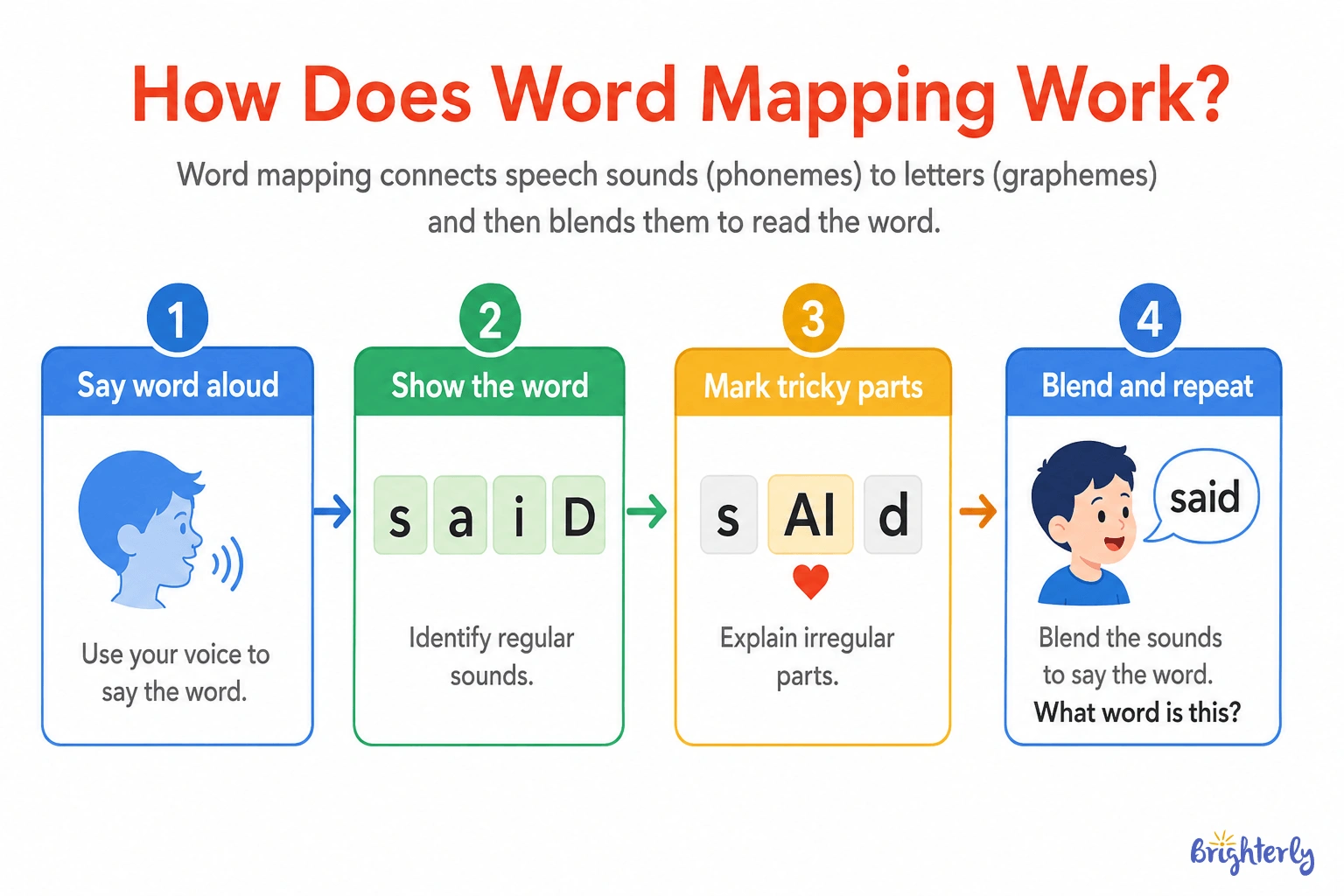
Word mapping is one of the key phonics strategies for teaching sight words. You can view it as the process under which you facilitate a child to connect a spoken word to the grapheme that indicates its print.
Here’s how it works:
- Say and define the word. Start by saying the word aloud to present it. For instance, “The word is said.”
- Count and segment the sounds. Ask a child to count sounds they hear and break them down. For the word ‘said’, it will be /s/ – /ĕ/ – /d/.
- Draw boxes for sound on paper. Draw a series of boxes or lines on paper to help the kids link sounds and letters with visualization.
- Map each sound to the letter. Make a kid map or show how sounds and letters correspond, for ‘said’ word example, it’s /s/ – s; /ĕ/ – ai (underline as irregular), and /d/ – d.
- Blend and read. Next, ask a kid to combine the sounds back and make a complete word.
- Write and repeat. To help retain the word, ask a kid to write it from memory and compare it with the original.
Note. You can use this technique, also called “Heart Word Method,” with 2-3 words per session, but remember that children don’t need to get every rule; they simply need to know how letters connect to sounds.
Teaching Sight Words Through Read-Alouds and Repeated Exposure
Exposure to the words and reading practice are what allow your child to retain the information and automate the recall of it from memory. So, as soon as the child understands the phonics structure of a word, it’s time to use read-alouds as a reinforcement tool.
Besides, it’s a natural way to expose kids to the words, and thus, effective. According to a 2024 study on CPB Sight Words, children’s books are full of sight words for toddlers, so introducing them while reading, even practicing a few words each time, can be great for teaching and building a daily routine.
Yet, consistency is the answer to how to teach sight words to kindergarten kids; even five minutes a day for a story can make a difference in the long run.
How to Use Read Aloud for Sight Word Practice
To use read-aloud for sight word practice, you would need a book, a small list of words, and the right mood of the child. It’s important to make it natural and engaging, even to build it around interaction.
So, here are some ways showing how to practice sight words at home:
- Show or board the small list with words beforehand and try spelling them together.
- Keep the sight words lists as references so you can refer to, play a game, trace a word with a finger, or spell during a story.
- When you start the story, point out and repeat those words. Make them central in interactive parts and questions about their favorite parts.
How We Support Sight Word Learning at Brighterly
At Brighterly, we focus on interaction and engagement, making lessons playful and memorable. During the phonics tutoring sessions, our tutors make sure that children don’t just listen to a story, but actively participate by using sight words in the following way:
- Co-writing pieces with target words.
- Drawing their own pictures for each sight word.
- Playing digital bingo boards and word-matching games.
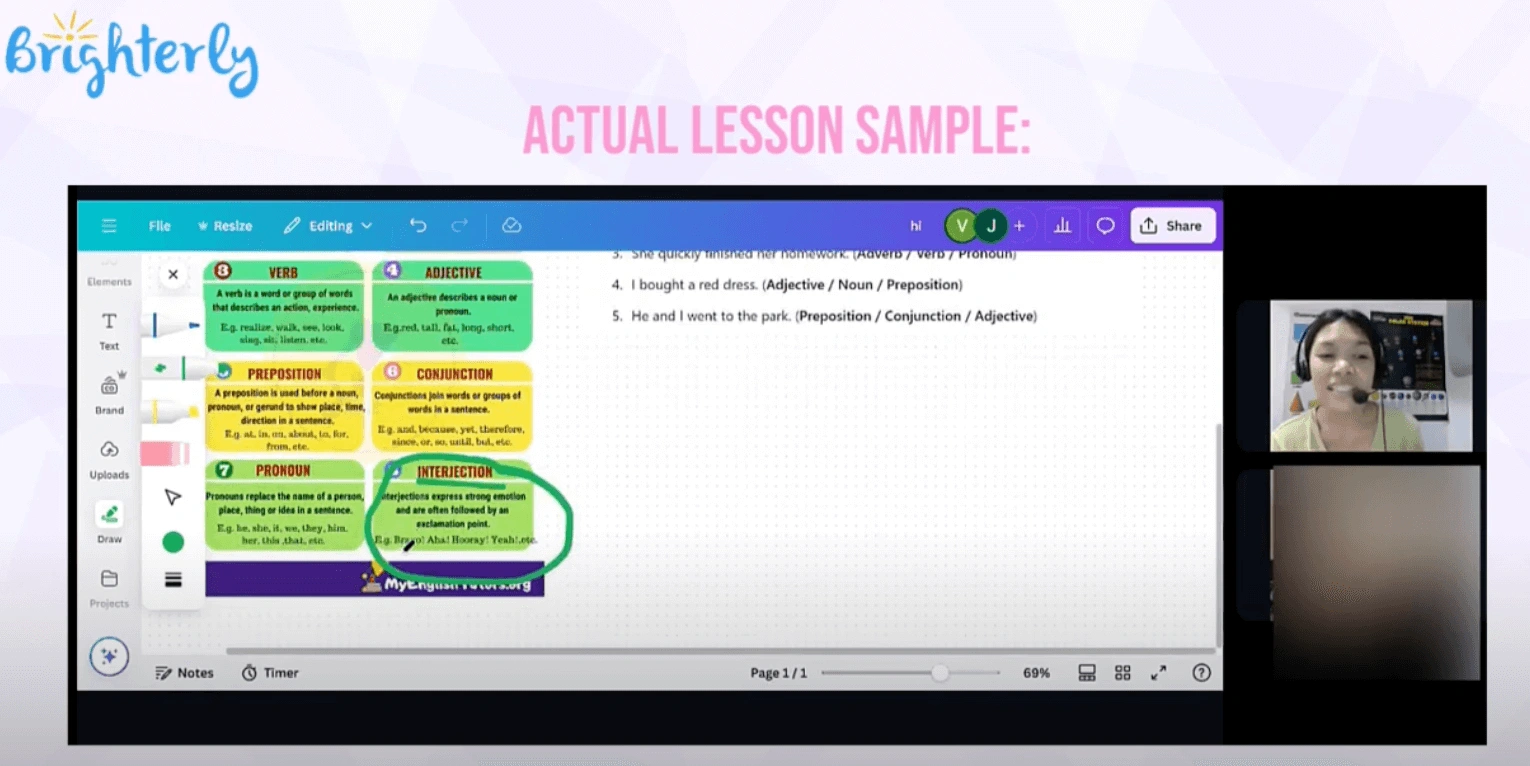
At the same time, our reading tutors for elementary students customize reading programs specifically to kids’ grades, needs, and reading goals. That way, teaching sight words is consistent and aligns with best practices, including reading worksheets and tests.
Your kid would love learning sight words!
Get a phonics tutor to make reading lessons interactive and practical.
Using Chants, Songs, and Movement to Reinforce Sight Words
Chants, songs, and movements are powerful reinforcement tools as music and movement have a profound impact on children’s engagement. They help kids practice sight words by backing and building upon the phonics foundation they already have.
As this 2024 study published in the Journal of Effective Teaching Methods suggests, using music can advance cognitive development. When a song supports teaching, it’s easier for a child to learn clear and correct pronunciation, while an action supports memory consolidation.
Here are some ways to teach sight words with chants, songs, and movements:
- Don’t simply spell out the sight words. You can create a song about the word or merely sing these words.
- Draw inspiration from a song and simply clap to the tune. Take a “What is this? What is that?” song as an example.
- Set up a question-and-answer structure. Start by singing “What is this?” and encourage your kid to reply “This is IS!’
- Mix up the words, gestures, questions, and answers. Make songs interactive and don’t forget stumps and arm taps to reinforce rhythm.
Sight Word Games to Practice at Home
Games, whether adventures, quiet puzzles, or fun activities like ‘floor is lava, are a powerful way to reinforce phonics knowledge or back instruction. Why? They help to build speed and turn recall of words automatic.
At home, you can support research-based strategies for teaching sight words with such activities:
|
Game |
Rules |
Players |
|
Floor is Lava |
Place 5–6 sight words on the floor as “stones,” and call one out. The child should step only on that word. If misread, restart. |
1–2 |
|
Sight Word Go Fish |
Make duplicate sight word cards. Players ask for words to make pairs (similar to “Go Fish”). |
2–4 |
|
Scavenger Hunt |
Hide word cards around the room. Call out a word; the child should find and read it before collecting it. |
1–3 |
|
Mix and Fix |
Scramble the letters of a sight word. The child rearranges them into the correct order and reads them aloud. |
1–2 |
Note. You can use sight words worksheets, digital flashcards, or reading apps for phonics practice as well, yet remember that reading target words in context affects long-term retention better.
Dolch vs. Fry Sight Words: Which List Should You Use?
To teach sight words, parents find it hard choosing between the Dolch and Fry sight words.
If you found yourself in such a Dolch sight words / Fry sight words dilemma, pick a Dolch list to teach reading comprehension to earlier readers (up to 3rd grade reading) and combine with phonics exercises and games; select the Fry list, a more universal one, to teach broader concepts and gradually expose kids to more complicated words throughout higher grades.
|
Dolch words |
Fry words |
|
|
How many words are in a list? |
335 (220 service words and 95 nouns) |
1,000 |
|
How are they grouped? |
By grade |
By frequency (sets of 100) |
|
Which parts of language are included? |
Nouns separated |
All parts of speech |
|
How may it affect reading? |
Covers up to 75% of words that are common in texts for kids. |
Covers 90% if a child masters all 1,000 words. |
|
Best for |
Structured, grade-by-grade learning |
Broad building of vocabulary |
When Do Kids Learn Sight Words?
Children typically start learning sight words between the ages of 4 and 5. Usually, they learn sight words in kindergarten or at any time up to 1st grade. Yet, much depends on the child and their journey. It means that sight words learning can begin before school or after first grade – in any case, it should take place when kids are ready.
What Order Should You Teach Sight Words?
You can start with phonetically decodable words and then introduce irregular ones. There’s no established order in teaching practice, while you can resort to the one that comes in line with the principles of the science of reading.
In particular, to teach sight words, you should:
- Either group words by phonics patterns
- Or introduce by frequency using the Dolch lists/Fry lists.
These two approaches will do. Yet, what order to teach sight words? You can follow this step-by-step technique:
- Teach phonetically decodable words. They include short vowels, consonant-vowel-consonants, magic ‘e’ words.
- Introduce irregular words. Once kids have enough phonics knowledge, teach them words that don’t follow regular patterns.
- Use a Dolch or Fry list. Afterwards, shift to teaching by lists, implying teaching words separately as the instruction doesn’t follow a certain timeline.
- Progress by grade level. Next, you can expose them to more words with each grade. Start with the first 40 simplest words for Kindergarten, and add the next group of words like ‘can,’ ‘said.’
- Practice words. After introducing each new group of words, ensure that kids are learning to read sight words in sentences or can recognize them in books.
Note. If you use the Fry list, start with the first 100 words, then the other 100 words.
Why Simple Memorization Doesn’t Work (And What Research Shows)
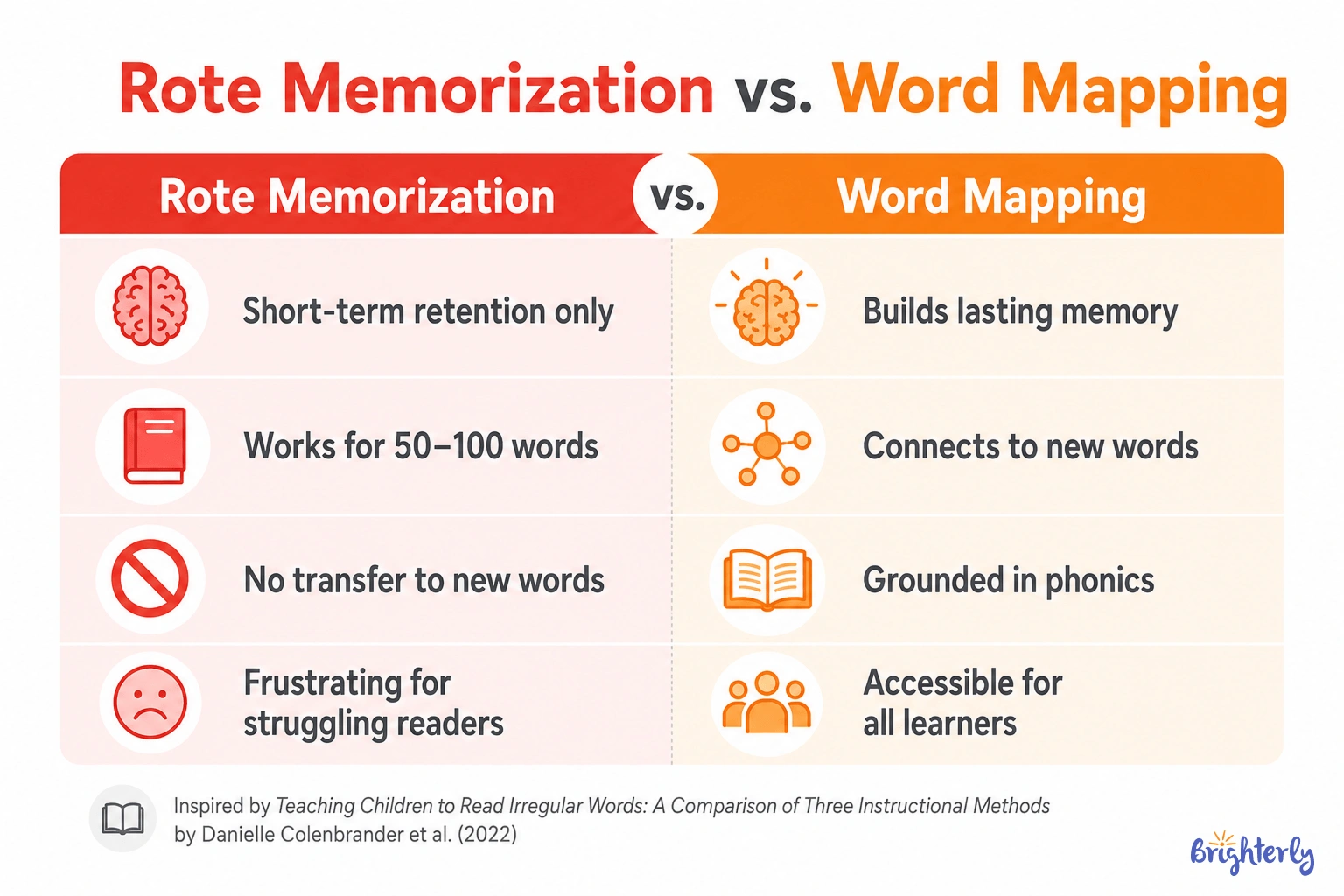
Even though simple memorization is quite popular, it’s not as effective as the word mapping technique. The rationale is that looking at a word and remembering it takes a significant part of the working memory of kids and gives no tool to reconstruct it. So once it’s out of working memory, kids forget it.
Simultaneously, pieces of research in the science of reading underline that students can decode words instead, offering a more effective strategy.
- As a 2024 article on The Regularity of High-Frequency Words (Sight Words) by Miles et al. suggests, around 85% of words follow regular phonetic patterns, while most irregular words have only one confusing grapheme-phoneme correspondence.
- As a 2022 study supported by the Australian Research Council shares, children in kindergarten who analyzed irregular words’ spelling and pronunciation could read these words more accurately compared to the children who memorized them.
- A 2025 article, “Heart Words” by Carlin Graveline Ku, underlines that while rote memorization is not harmful, children are more successful at learning words when they can analyze the spelling more carefully.
That’s why word mapping is the best way to teach sight words. Word mapping allows connecting spoken sounds (phonemes) to written letters (graphemes) that support orthographic memory. With mapping, kids retain words longer and connect new words to the existing knowledge, something that memorization fails to do.
Common Mistakes When Teaching Sight Words
While teaching sight words, parents can make mistakes. They often refer to the nature of sight words or a lack of understanding of phonics. As a result, parents happen to overuse or overrely on flashcards, teach decodable words as sight words, or teach new words without breaks.
So, what are the common mistakes?
- Overreliance on drilling and flashcards. As you already know, memorization is not as effective as many think. So, memorizing flashcards with no phonics analysis or use of sight word teaching strategies simply overloads the child’s memory.
- Ignoring or skipping the basis. For a parent, phonics may sound obvious, but not for kids. Thus, before introducing sight words, build phonemic awareness of early reading first.
- Teaching too many words. Besides, as a parent, you should consider the energy and cognitive abilities of a kid. If you are to introduce 15 words in a single week, they will be extremely overwhelmed by the end of it.
- Offering no practice. When learning brings no practice, the result may be a lack of comprehension or poor reading. Don’t isolate learning, back it with card practice or book reading.
- Expecting linear progress. Be ready that children forget words, especially after a break. You should anticipate drawbacks and integrate daily practice to prevent them.
Frequently Asked Questions
How Many Sight Words Should a Child Know by the End of Kindergarten?
By the end of kindergarten, a child should know 20-50 sight words. However, the bar may rise to 100 words, as expectations vary. Simultaneously, the Dolch guidelines provide 40 words in the pre-K list and 52 words in the kindergarten list.
Can Sight Words be Taught Before a Child Knows All Their Letters?
Yes, sight words can be taught before a child knows all their letters, but with conditions. Kids can start learning an array of common words before learning the alphabet, and if the context requires it. Yet, systematic sight word introduction works best when kids know all letter sounds.
How Long Does it Take to Learn Sight Words?
It may take a school year to learn the Dolch list of sight words for pre-k and kindergarten students, including more than 90 words. It’s possible if kids have daily practice of up to 10 minutes and learn up to 5 new words per week. In the case of a struggling reader, it may take 18 months or more.
Is it Better to Teach Dolch or Fry Sight Words?
The Dolch list is better for kindergarten and 1st grade due to its organization and grade-by-grade progression. Fry words are better for learning words in 2nd and higher grades, as it has far more words. The choice also depends on the list that a teacher uses.
How Can I Help My Child Practice Sight Words at Home Without Flashcards?
To practice without flashcards, you can use sticky notes to label objects, worksheets to write or decode words, games like word hunts to add interactivity, word of the day challenges, or mapping on the whiteboard. Also, you can read short stories together.
Why Does My Child Keep Forgetting Sight Words They Already Knew?
Your kid keeps forgetting sight words as the technique you use is not enough for them to stick in the long-term memory. If your children do not practice them or practice out of context, it would be hard for them to connect them to the text. At the same time, they may experience a cognitive overload; thus, slowing down the pace may help.

Deciding among Mathnasium vs Sylvan vs Brighterly really comes down to what fits your child best. Brighterly offers online-only, one-on-one math and reading instruction built around gamified lessons. Mathnasium sticks strictly to math, delivered through small-group sessions either in person or online. Sylvan covers math, reading, writing, and test prep across both in-center and online […]

Aug 18, 2025

The standard Miacademy cost with a monthly subscription is $48/month. You can get a better value, if you subscribe to a yearly subscription worth $516/yearly. This article covers the cost of Miacademy in detail and also covers real user reviews to help you decide whether or not Miacademy is the right choice for your child […]

Aug 19, 2025
Math & reading from 1st to 12th grade
Looking for homework support for your child?

Choose kid's grade

Math & Reading for Grades 1–12
Build real confidence for your child with a Brighterly math or reading tutor.