Common Core Math Examples: What They Are and How They Work
reviewed by Jo-ann Caballes
Updated on September 16, 2026
Key points:
- Common Core Math offers standardized academic goals that shift learning math from memorization to understanding the structure of numbers, equations, and problems.
- Common Core uses 8 standards shaping how students think about numbers and operate with them.
- With Common Core Math examples, children comprehend the underlying logic of calculations and build a number sense.
- The Common Core Standards emphasize abstract reasoning over blindly following rules and encourage kids to develop problem-solving skills.
- As of September 2026, 30 US states plus the District of Columbia have adopted the Common Core in full, but most districts emphasize a reasoning-first approach to math.
If your child’s math homework looks nothing like the math you learned, Common Core could be the reason. Common Core Math examples focus less on memorizing steps and more on understanding how and why methods work. This guide shows what the 8 practice standards require, gives specific examples, and helps you support your kid with better processes and resources.
What Are Common Core Math Examples?
Officially introduced in 2010, the Common Core State Standards for Math (CCSSM) provide a set of academic standards for how to learn math from kindergarten to grade 12 in the US education system. Common Core math examples use visualization and conceptualization to explain how math works and why it works that way, instead of remembering steps
The Common Core State Standards Initiative distinguishes between two elements: Content Standards vs Practice Standards.
- Content Standards focus on what math concepts and operations students need to learn at each grade level.
- Practice Standards – or Process Standards – explain how children should think about math and engage with it.
The Common Core Standards are important because they give schools, educators, and families a clear comprehension of what students need to know at each grade level, which is universal for all participating districts. While not all US states have adopted the Common Core, in 2026, most districts in the US will follow the same reasoning-first approach to teaching math.
Our 1:1 K-12 math program also aligns the curriculum with the logic behind the Common Core, helping your child understand how math methods work.
Why Common Core Math Can Feel Different from Traditional Math
Sometimes Common Core Math feels different from traditional math because it focuses on understanding the why behind math concepts and actions rather than memorizing math formulas and step-by-step solutions. The new way of learning math pays more attention to the process of solving a problem than the solution itself. These methods help build problem-solving strategies and critical-thinking skills on top of pure math knowledge.
Traditional math methods focus on process memorization, like borrowing or carrying the one, without explanation. In contrast, the Common Core Mathematics method uses visual models and diverse strategies to develop not only procedural fluency but also number sense, conceptual understanding, and mathematical reasoning.
Geillan Aly, Founder and CEO of Compassionate Math, explains what is Common Core Math and why some parents get confused by it:
Parents commonly feel uncomfortable with Common Core Math. But the main reason for this is that our generation was taught using algorithms and rules without providing meaning.


Personalized math curriculum aligned with US state standards!
Our tutors combine 1:1 instruction with gamified practice for math foundations & confidence.


Explore Brighterly Learning Experience
Learn exactly how Brighterly helps students thrive through expert sessions, online tools, and proven feedback from thousands of satisfied parents
How Does Common Core Math Work? The 8 Practice Standards with Examples
To appreciate how the Common Core Math works, you need to understand the practice standards. These eight Mathematical Practice Standards guide how children should engage with math, from initial problem-solving strategies to more advanced critical thinking, instead of looking for one right answer.
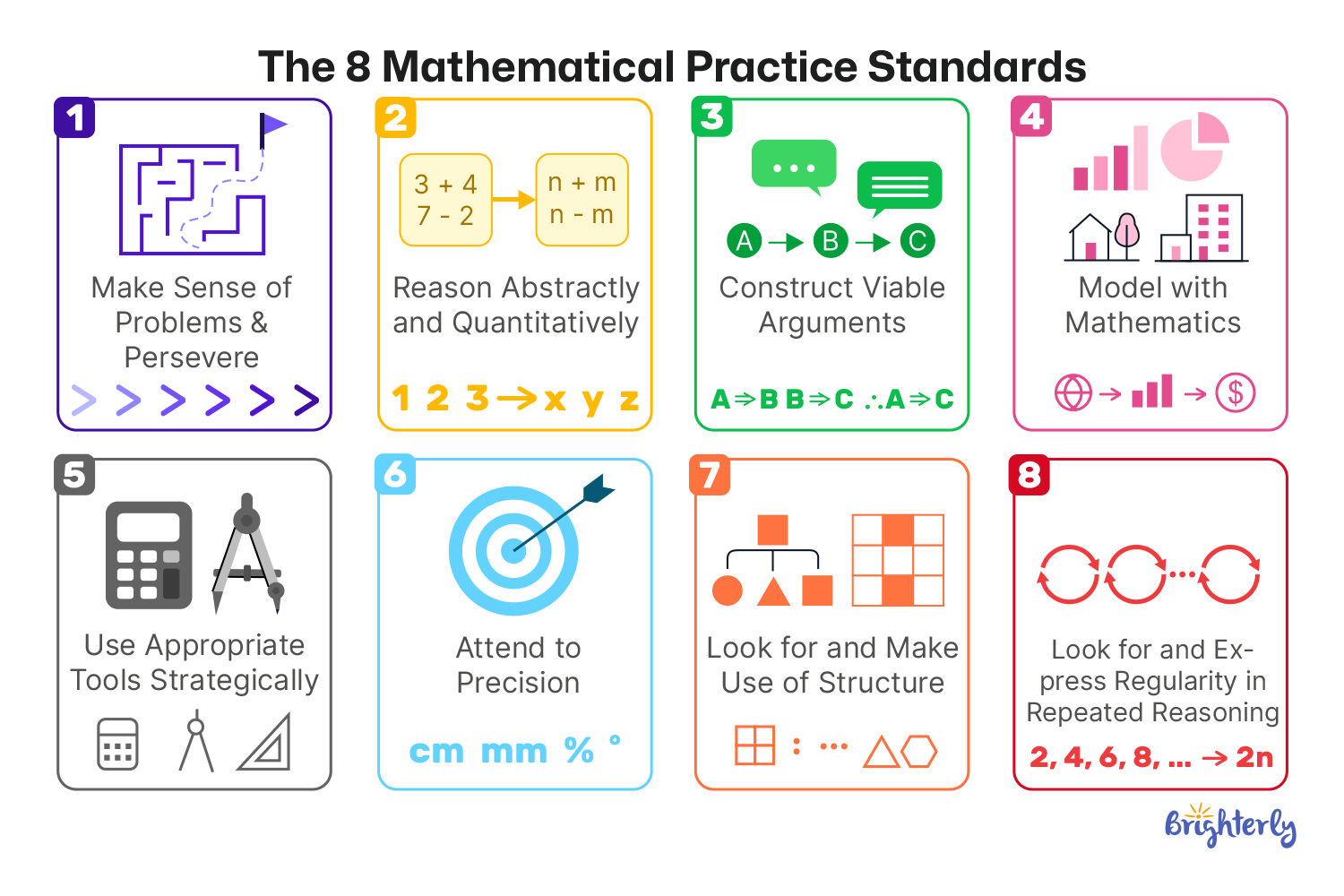
1. Make Sense of Problems and Persevere in Solving Them
The first standard asks students to analyze the problem, plan a path, and complete it, even if it requires multiple attempts. Stamina is critical for math, so instead of giving up, children learn to try different approaches.
Example of a Common Core math problem: Anna has an L-shaped garden patch. One section measures 4 meters x 3 meters, and the attached section measures 2 meters x 2 meters. What’s the total area?
Rather than using a complex formula, break down the irregular L-shape into two manageable rectangles. Calculate the area of the first section (4 x 3 = 12), then the second (2 x 2 = 4), and add them to get the total area (12 + 4 = 16).
2. Reason Abstractly and Quantitatively
According to the second standard, students need to understand the relationship between numbers and real-world quantities. Your child needs to move between two thinking modalities: understanding numbers in context (contextualizing) and working with numbers as pure quantities (decontextualizing).
Example: A bakery sells muffins in boxes of 6. Each box costs $12.50. If Mary wants to buy 18 muffins, how much would she need to pay?
To contextualize, recognize that $12.50 is a per-box price and that 18 muffins means 3 boxes. To decontextualize, strip away the muffins and the boxes and work with the equation (3 × $12.50 = $37.50).
3. Construct Viable Arguments and Critique the Reasoning of Others
The next standard in Common Core Math is explaining mathematical thinking processes, making claims, and responding to others’ approaches to solving a problem. Children start learning to build viable arguments and critique others’ reasoning in kindergarten and then grow it into deeper mathematical logic.
Example: A student says that 3 × 4 = 4 × 3. Prove that the statement is correct.
Draw an array of 3 rows of 4, then rotate it to show 4 rows of 3, both giving 12. You can then build on, challenge, or extend the reasoning process and offer other methods of proof.
4. Model With Mathematics
The Common Core Standards emphasize that math isn’t limited to the classroom only. The fourth standard helps your child apply the math they learn at school to solving everyday problems.
Example: A family is planning a road trip and wants to figure out how many miles they can travel over a few days based on their driving speed and break schedule.
Depict this everyday situation as a mathematical model. Create a line graph that displays distance over time, or write an expression that represents the total distance as a function of the driving time and speed, as well as the stops.
5. Use Appropriate Tools Strategically
The next standard gives your child the toolkit they need to solve math problems and shows them how to use it. This toolkit varies due to the subject (algebra vs geometry) and your child’s level and can include everything from rulers and compasses to scientific calculators. The goal is to teach students to choose the most efficient tool for each situation.
Example: Your child needs to estimate the classroom’s width, and they have to decide on the most strategic option.
Use a measuring tape for precision, count floor tiles to make estimates, or use steps to measure if you only need an approximation. The point of learning this standard is not just to grab a tool and use it, but to develop judgment about when each tool makes sense.
6. Attend to Precision
This standard focuses on teaching your child to communicate mathematical thinking clearly and accurately. In math, attending to precision means using the accurate mathematical vocabulary, stating specific units of measure, and showing the meaning of symbols to formulate your answers in a manner that makes sense to others.
Example: Your child needs to calculate the area of a bedroom floor for remodeling.
Define terms explicitly before working with numbers. Instead of just writing 50, write:
- Length: 5 meters
- Width: 10 meters
- Total area = 5 x 10 = 50 square meters (sqm)
This approach teaches learners to avoid vague language and make sure mathematical arguments are easy to follow.
7. Look for and Make Use of Structure
The seventh CCSS Math standard shows that numbers have structures and hidden patterns. Students learn to step back and look at the underlying organization of an equation rather than treating every problem like a new puzzle.
Example: Your child needs to mentally calculate 7 x 12.
Look at the structure of 12 and break it down to tens and ones (10 + 2), and then use the distributive property of multiplication. Calculate:
- 7 x 10 = 70.
- 7 x 2 = 14.
- 70 + 14 = 84 (total).
Breaking numbers by place value teaches students to look for shortcuts through basic number properties.
8. Look for and Express Regularity in Repeated Reasoning
The final core principle helps students discover general shortcuts or formulas on their own. Your child learns to identify repeated patterns or consistent algorithms to solve complex problems more easily.
Example: A student needs to solve a series of multiplication problems involving algebraic expressions:
- (x – 1)(x + 1)
- (y – 1)(y + 1)
- (z – 1)(z + 1)
Solve these expressions step by step until you notice an emerging pattern in the answers:
- x x x = x^2
- x x +1 = x
- x x -1 = -x
- -1 x = -1
Uniting the equation gives us x^2 + x – x – 1 = x^2 – 1. When solving the expression in different variations, your kid will quickly notice that the middle terms cancel out, and the answer is always (x^2 – 1).
Reasoning-first online math classes for K-12!
Our professional teachers customize learning to your child’s need for strong fundamentals.
Common Core Math Examples by Grade: What Your Child Learns Each Year
While the 8 Common Core Standards Mathematical Practice Standards remain the same from K-12, the math curriculum prescribes the specific concepts that students need to cover in each grade level. Importantly, the Common Core Math Standards are designed to logically build on previous levels through a step-by-step progression from grade to grade.
Grades K-2: Building Number Sense
Between Kindergarten and 2nd grade math, the Common Core focuses on understanding what numbers mean – or developing number sense – before having to make calculations. Typical activities include counting physical objects, decomposing numbers (understanding that 7 is the same as 5 + 2 or 4 + 3), and working through simple word problems with reasoning.
Example: Max has 7 toy cars. He wants to put some in a red box and some in a blue box. What are two different ways Max can sort his cars?
Use red and blue plastic counters or draw a simple picture to show two distinct combinations that equal 7.
- 5 cars in the red box and 2 cars in the blue box (5 + 2 = 7).
- 4 cars in the red box and 3 cars in the blue box (4 + 3 = 7).
Note: You can assess your child’s current knowledge with our free grade 1 math test or let them practice with grade 2 math worksheets.
Grades 3-5: Operations and Fractions
As your child enters upper elementary school, the CCSS Math Standards move on to more advanced number operations. Let’s look at some examples of 3rd, 4th, and 5th grade math.
Example: Calculate 35 x 14 using a visual area model.
Expand 35 into 30 + 5 and 14 into 10 + 4. Then:
- Multiply the tens: 30 x 10 = 300.
- Multiply the top corner: 5 x 10 = 50.
- Multiply the bottom corner: 30 x 4 = 120.
- Multiply the ones: 5 x 4 = 20.
- Add the products: 300 + 50 + 120 + 20 = 490.
This multiplication method not only helps get the right answer, but also sets the foundation for multiplying algebraic expressions like (x + 5)(x + 4) by teaching them to organize numbers.
Note: With Brighterly free learning resources, your child can take a 3rd grade math test or solve printable 5th grade math worksheets.
Grades 6-8: Ratios, Algebra, and Functions
The Common Core Standards Math curriculum incorporates more critical thinking math elements and abstract reasoning as your kid progresses to middle school math classes. In 6-8 grade, your child uses algebraic properties and equations to evaluate changing quantities.
Example: An ice cream shop charges a fee of $3 for a souvenir bowl plus $2 per scoop of ice cream. If Sarah’s total bill comes out to $11, write an equation to find out how many scoops (S) she ordered, and solve it step-by-step.
Translate real-world math problems into formal algebraic expressions:
- Equation: 2S + 3 (bowl) = 11
- Step 1: Subtract 3 from both sides to undo the flat fee and isolate the variable term.
- 2S = 8
- Step 2: Divide both sides by 2.
- 2S = 8
- S = 8/2 = 4 (one scoop)
Note: To support your little one’s foundational math skills, print out a grade 7 math worksheet or have them work through a grade 8 math test for free.
Grades 9-12: Number & Quantity, Algebra, Functions, Geometry, Statistics & Probability
In high school math, your child will develop understanding across five main areas: numbers and quantities, algebra, geometry, statistics, and probability if they follow the Math Common Core Standards. High school students work with more complex equations and functions, analyze mathematical relationships, apply geometric reasoning, and use data and probability to solve problems use math in the real world.
Example: A school sells tickets to a play for $8 each and needs to earn at least $1,200. If it has already received a $240 donation, how many tickets must it sell?
Your child can represent the situation with an inequality and solve it step-by-step:
- Write the inequality: 8x + 240 ≥ 1,200.
- Subtract 240 from both sides: 8x ≥ 960.
- Divide both sides by 8: x ≥ 120.
- So, the school must sell at least 120 tickets.
Note: You can evaluate your child’s skills with a 10th grade math test and have them solve 12th grade math worksheets to make sure they stay at grade level throughout high school.
The table below summarizes what is Common Core Math curriculum for each grade level:
Grade Level
Main Common Core Math Focus
Kindergarten
Counting & cardinality; comparing numbers; basic addition & subtraction; measurement; shapes
Grade 1
Addition & subtraction within 20; place value; measurement; simple data; shapes & their attributes
Grade 2
Addition & subtraction within 100; place value to 1,000; length measurement; time & money; data collection & display; partitioning shapes
Grade 3
Multiplication & division within 100; four-operation problem solving; area & parameter; shape properties & classification
Grade 4
Multi-digit multiplication & division; fractions & decimals; measurement & angles; data representation; classifying shapes
Grade 5
Fraction & decimal multiplication & division; long division; unit conversions; volume; coordinate graphing
Grade 6
Ratios & proportions; rational numbers; one-variable equations & inequalities; geometry; introductory statistics
Grade 7
Linear equations & inequalities; proportional relationships; rational number arithmetics; probability introduction
Grade 8
Linear algebra & functions; systems of linear equations; positive & negative rational numbers; similarity & Pythagorean theorem; irrational numbers & real numbers
Grade 9
Real numbers; algebraic expressions & equations; linear & quadratic functions; coordinate geometry; statistics
Grade 10
Quadratic & polynomial functions; geometric reasoning; similarity & trigonometry; equations & modeling
Grade 11
Advanced functions; exponential & logarithmic models; trigonometry; statistics & probability; mathematic modeling
Grade 12
College- and career-ready applications; advanced algebra & functions; trigonometry; statistics; quantitative reasoning
How Many States Use Common Core Math?
According to World Population Review, as of September 2026, 30 US states plus the District of Columbia have adopted the Common Core Math Standards. Meanwhile, 15 states have adopted the standards with changes, and one state (Minnesota) has only partially adopted them. Four states – Alaska, Nebraska, Texas, and Virginia – have never used the Common Core.
Adopted
Adopted With Changes
Never Adopted
Partially Adopted
California, Colorado, Connecticut, Delaware, District of Columbia, Hawaii, Idaho, Illinois, Iowa, Kansas, Maine, Maryland, Michigan, Mississippi, Montana, Nevada, New Hampshire, New Jersey, New Mexico, North Carolina, Ohio, Oregon, Pennsylvania, Rhode Island, South Dakota, Tennessee, Utah, Vermont, Washington, Wisconsin, Wyoming
Alabama, Arizona, Arkansas, Florida, Georgia, Indiana, Kentucky, Louisiana, Massachusetts, Missouri, New York, North Dakota, Oklahoma, South Carolina, West Virginia
Alaska, Nebraska, Texas, Virginia
Minnesota
Source: World Population Review, September 2026
Common Core Math vs Traditional Math: Key Differences
The main difference between the Common Core State Standards for Math and traditional math is that Common Core emphasizes the concepts and reasons behind operations, while the traditional curriculum highlights the memorization of formulas and procedures without understanding the logic. The Common Core takes an integrated approach to math to develop skills like critical thinking of vital importance for different subjects.
Common Core Math
Traditional Math
Approach
Stresses reasoning & conceptual understanding
Focuses on memorization, procedural steps & correct answers
Problem-Solving Skills
Promotes multiple problem-solving methods
Provides one standard method or algorithm to solve a problem
Focus
Covers fewer topics but in detail for deeper fluency
Covers a wider range of topics but in less depth
Critical Thinking Capabilities
Emphasizes critical thinking, reasoning & explanation
Highlights getting the right answer rather than explaining the solution
Real-World Application
Incorporates math into real-world scenarios for practical problem-solving
Puts more focus on abstract math problems
Use of Visuals and Models
Implements visual aids & decomposition for deeper understanding
Focuses more on memorization of formulas & algorithms rather than visualization
Communication
Encourages discussion & explanation
Doesn’t focus on the discussion, pays more attention to correct answers & calculations
Assessment
Assesses deeper understanding, application & reasoning skills
Evaluates the ability to recall the right formulas & accurately integrate required methods
Tips for Helping Your Child With Common Core Math
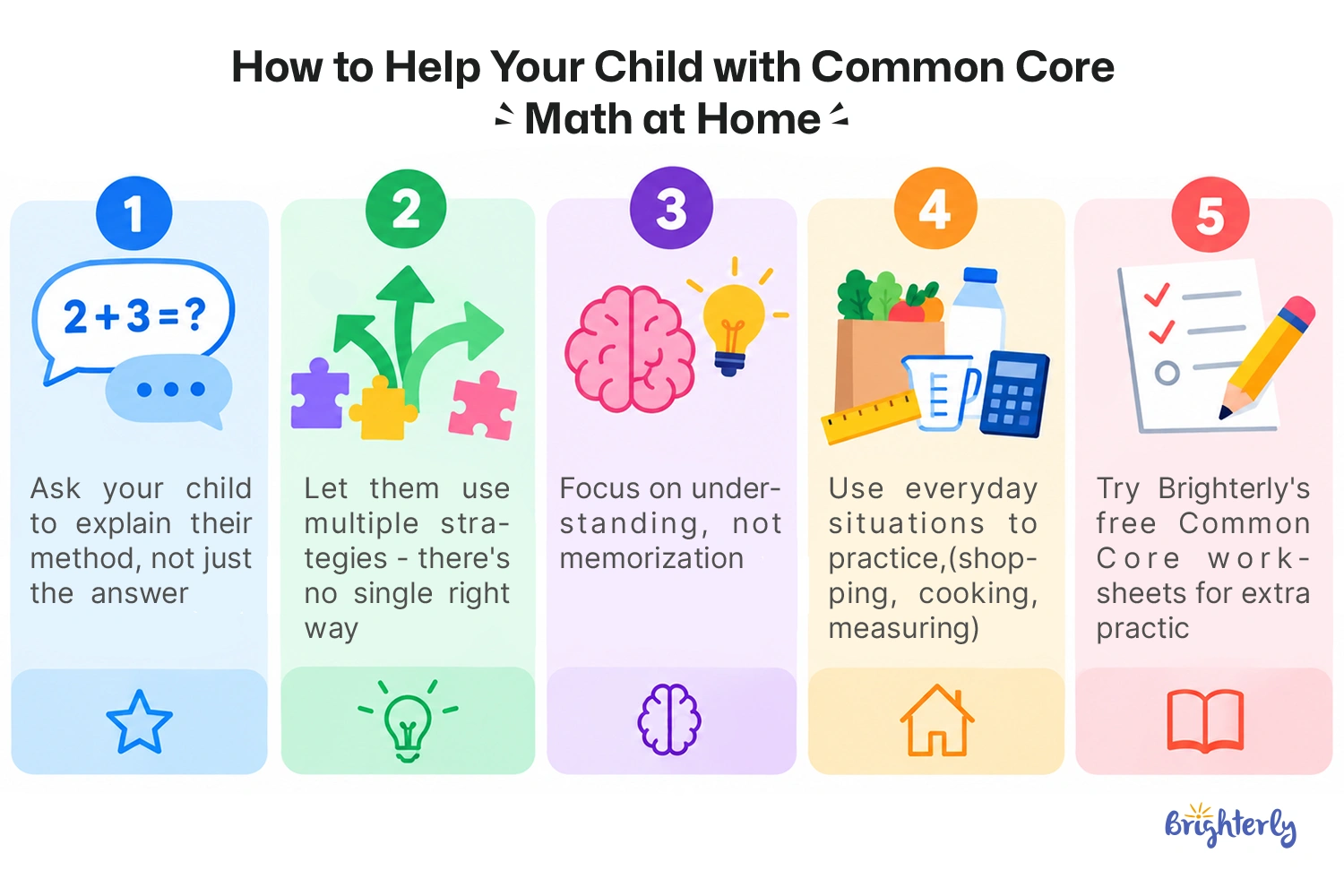
To help your child with the Common Core Math, focus on comprehension rather than memorization. Encourage your little one to explain their reasoning when solving problems, try different approaches, and connect math to real-world scenarios. Using visual models, hands-on practice, and targeted learning resources can also make unfamiliar concepts easier to understand and apply.
- Ask your child to explain their method, not just give you the answer: If your kid gets stuck, ask, “Can you show me how you would draw this?” or “Walk me through the first step your teacher showed you.” Having your little one explain their logic aloud helps them spot their mistakes.
- Suggest your child use multiple strategies: Under the Common Core, there’s no single right way to solve a problem. If your kid wants to use an open number line instead of stacking numbers, or an area model instead of long multiplication, encourage them to do so.
- Focus on understanding, not speed: Give your child enough time and space to understand the structure of the problem in order to build long-term procedural fluency.
- Use everyday situations for practice: Turn daily routines into real-world math problems. Have your child calculate total spending when shopping, scale down ingredients when baking, or measure spaces around the house using real-life tools.
- Benefit from free learning resources: Don’t navigate math standards unarmed. High-quality free online learning resources can help. If your child needs targeted practice, we have free math worksheets designed by our certified tutors to follow the US state standards, organized by grade level and topic.
And finally, you’re not on your own if your child brings back homework that looks like nothing you’ve learned at school. Our tutors, who are familiar with the Common Core-style methods, will recognize the strategy your kid is using, explain how it works in a language that makes sense to your little one, and guide them through it step by step. To give it a try, you can book a free lesson with an algebra tutor for extra support.
Conclusion
Common Core Math can look unfamiliar at first, but the goal is to help students become more flexible and confident problem-solvers. Once you recognize the reasoning behind the methods, it becomes easier to support your child without needing to relearn math from scratch.
And if you need some help, you can book a free math lesson to check out our tutors’ style.
Frequently Asked Questions
Is Common Core Math Harder Than Traditional Math?
Common Core Math is not necessarily harder than traditional math; it’s just different. Common Core asks students to explain reasoning and understand concepts deeply, rather than follow memorized procedures. Your child might feel overwhelmed at first, but they’ll build stronger foundations for advanced math.
What Grade Does Common Core Math Start?
Learning the Common Core Math Standards begins in Kindergarten. The standards build progressively from Kindergarten through grade 12, and each concept rests on the previous one. First, the focus is on counting, basic operations, and number sense. Later, the curriculum introduces algebra, functions, geometry, and statistics.
What’s the Difference Between Common Core Content Standards and Practice Standards?
The Common Core Content Standards define the exact topics and concepts students need to learn in math at each grade level. Meanwhile, the Common Core Practice Standards set up the critical thinking habits and operational skills that learners need to develop and apply to engage with the new knowledge each year.
Why Do Parents Find Common Core Math Confusing?
The main reason why some families find Common Core Math difficult is that school taught them to memorize algorithms and follow procedures without understanding how they work. So, Common Core methods, like breaking numbers apart visually or using number bonds, sound unfamiliar.
Is Common Core Math Used in All 50 States?
As of September 2026, not all US states use the Common Core. A total of 30 states and the District of Columbia follow the exact Common Core Standards, while 15 states use them with adaptations to their own regulations. Minnesota adopted the Common Core only partially – for ELA, and the remaining four states never adopted the standards.
How Can I Help My Child With Common Core Math at Home?
To help your child with Common Core Standards, ask them to explain their thinking rather than just checking whether the answer is correct. Work through real-world problems together. If your child uses a method that looks unfamiliar, ask them to show you how it works. For targeted practice, you can use free math worksheets.



Toddlers are at the perfect age to start learning through play. Math games with counting toys or playing constructors are some of the best ways to introduce math concepts. Of course, learning numbers and new theories may not be fun but it’s possible to find creative math activities for toddlers to enjoy. In this article, […]
Mar 23, 2022

As we age, we see time as an inherent and integral component of our everyday existence. However, kids often find this idea complex. Generally, it takes children a few years to master essential time-telling skills, let alone make precise forecasts and projections. In this article, you will learn all about teaching kids how to read […]
Apr 05, 2022
Math & reading from 1st to 12th grade
Looking for homework support for your child?

Choose kid's grade

Math & Reading for Grades 1–12
Build real confidence for your child with a Brighterly math or reading tutor.