Homeschooling Statistics 2026
reviewed by Jo-ann Caballes
Updated on May 20, 2026
Key numbers
Over 3.4 million children in the United States were homeschooled as of 2025–2026, representing ~6% of school-age students (NHERI, 2025), and these numbers will keep growing in 2026. This homeschooling statistics guide covers growth trends, state-by-state data, academic outcomes, and reasons parents choose homeschooling.
Note. Before making the switch to full-time homeschooling, it is important to know your state’s legal requirements. Some states have minimal or zero requirements, while others may ask for standardized testing or a portfolio review. Whatever the case, understanding the legal position will make your transition to a new educational system easier.
How Many Students Are Homeschooled in the US in 2025-2026?
As of April 2026, NHERI reports 3.4 million homeschool students in the 2025-2026 school year, either fully or partially.
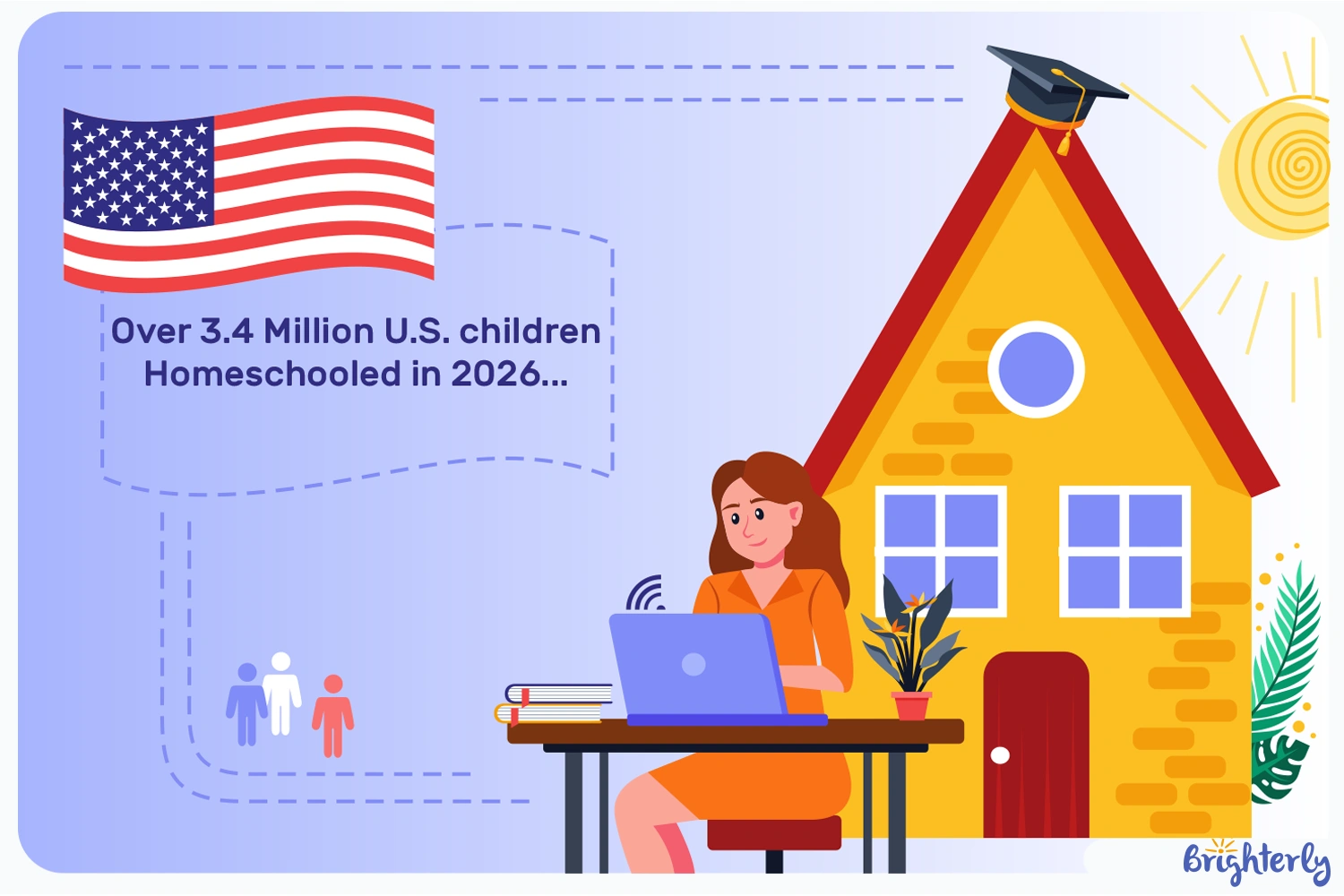
The exact number of how many people homeschool in the US may be even more, as the supporting sources to official NHERI stats mention the number between 3 and up to 4 million homeschooled in 2025. The gap between estimates depends on whether virtual or hybrid learners are counted.
Explore Brighterly Learning Experience
Learn exactly how Brighterly helps students thrive through expert sessions, online tools, and proven feedback from thousands of satisfied parents
How Has Homeschooling Grown Over the Years? (2012–2026)
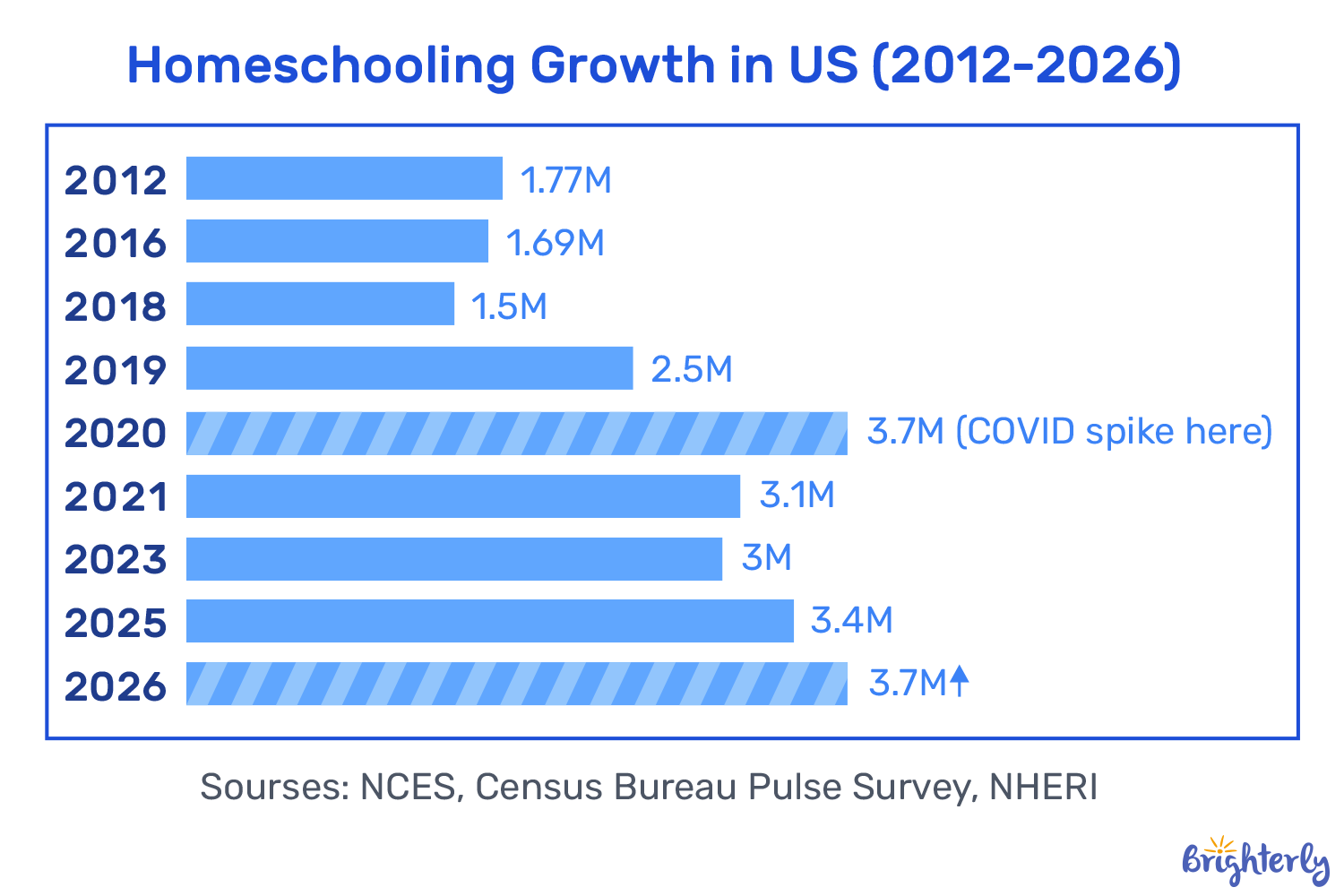
Based on homeschooling growth statistics in the US from NCES, Census Bureau Pulse Survey, and NHERI, the number of homeschooled children increased from around 1.77 million (3.4% of school-age population) in 2012 to around 3.0-3.7 million (average 3.4 million) by 2026 (6.3% of school-age population).
Why Do US Parents Choose Homeschooling?
According to Pew Research Center (PRC) information in 2025, approximately 72% of the US homeschooling parents express dissatisfaction with the academic quality of traditional schools, driving the number of homeschooled students in US.
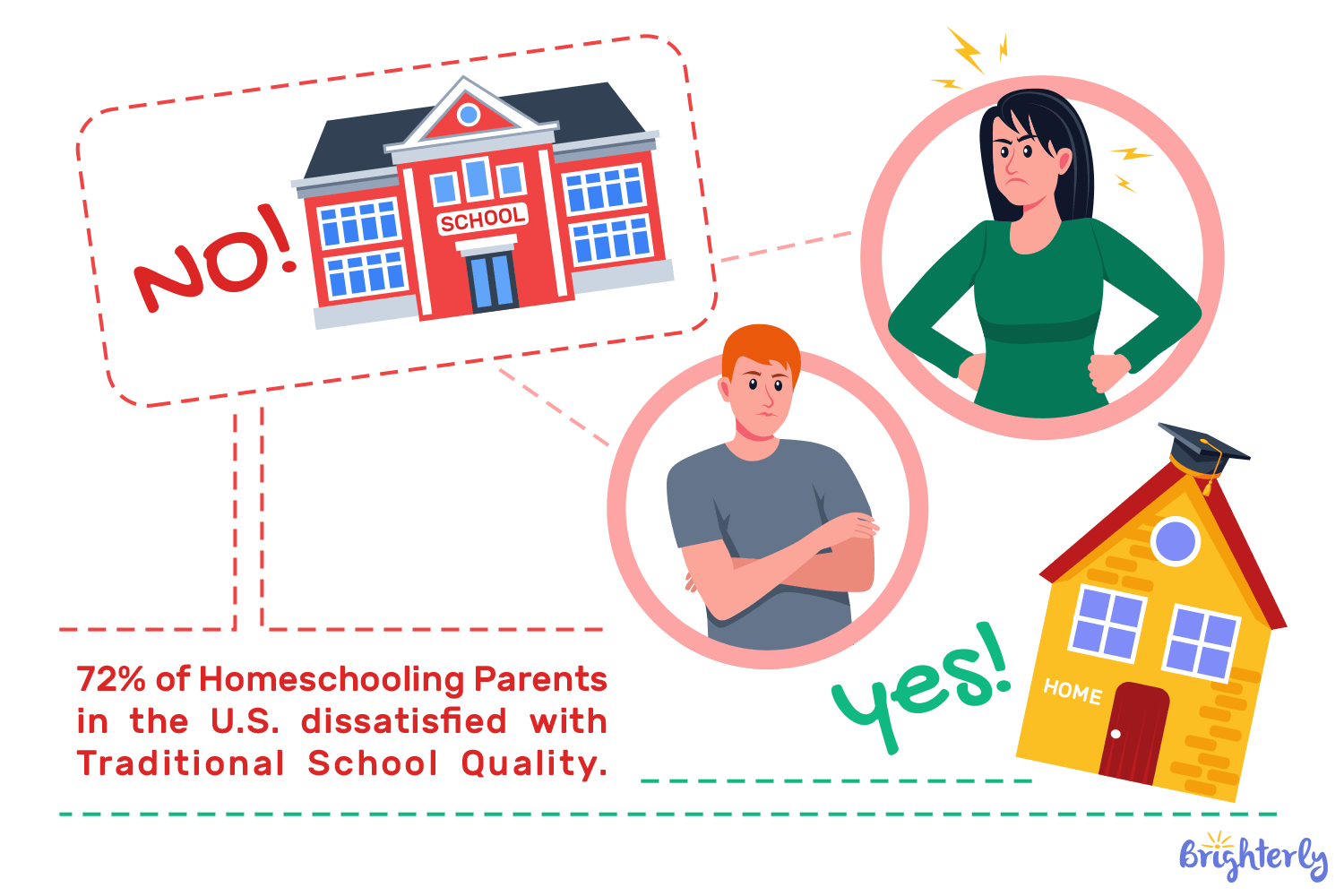
The common reasons to choose alternative models include safety concerns, desire to improve teaching standards, and searching for a more personalized approach to education.
If you can relate to these concerns about traditional school education, tutors from our 1:1 homeschool math program and homeschool reading program adapt lessons to your child’s exact level and learning pace. A Brighterly teacher will work with students individually, understanding how to make a homeschool schedule that addresses their needs and parents’ concerns.
Personalized high-quality education for kids & teens
Join the Brighterly homeschool or after-school reading and math program now. 
Challenges and Limitations: What Negative Statistics Show
Based on PRC research (2025), the major reasons for choosing homeschool programs in the US are:
- Concern about school environment (PRC states that 83% of parents are worried about safety, drugs, and negative peer pressure)
- Desire to spend more time together (72% of parents)
- Desire to have more control over moral guidance on kids’ education (72% of parents)
Regarding the challenges, homeschooling can be costly and inaccessible for some families, being more common in households earning over $75,000/year (49%) (PRC, 2025). The accessibility of a parent is also key for homeschooling success, as the quality of studying depends on instruction approach, curriculum choice, and available resources (NHERI, 2024). Socialization is also a homeschooling challenge, as a 2024 BCES Conference paper found that homeschooled students without structured extracurricular activities show lower peer-interaction development scores.
Homeschooling Statistics vs Public Schooling Statistics in the United States
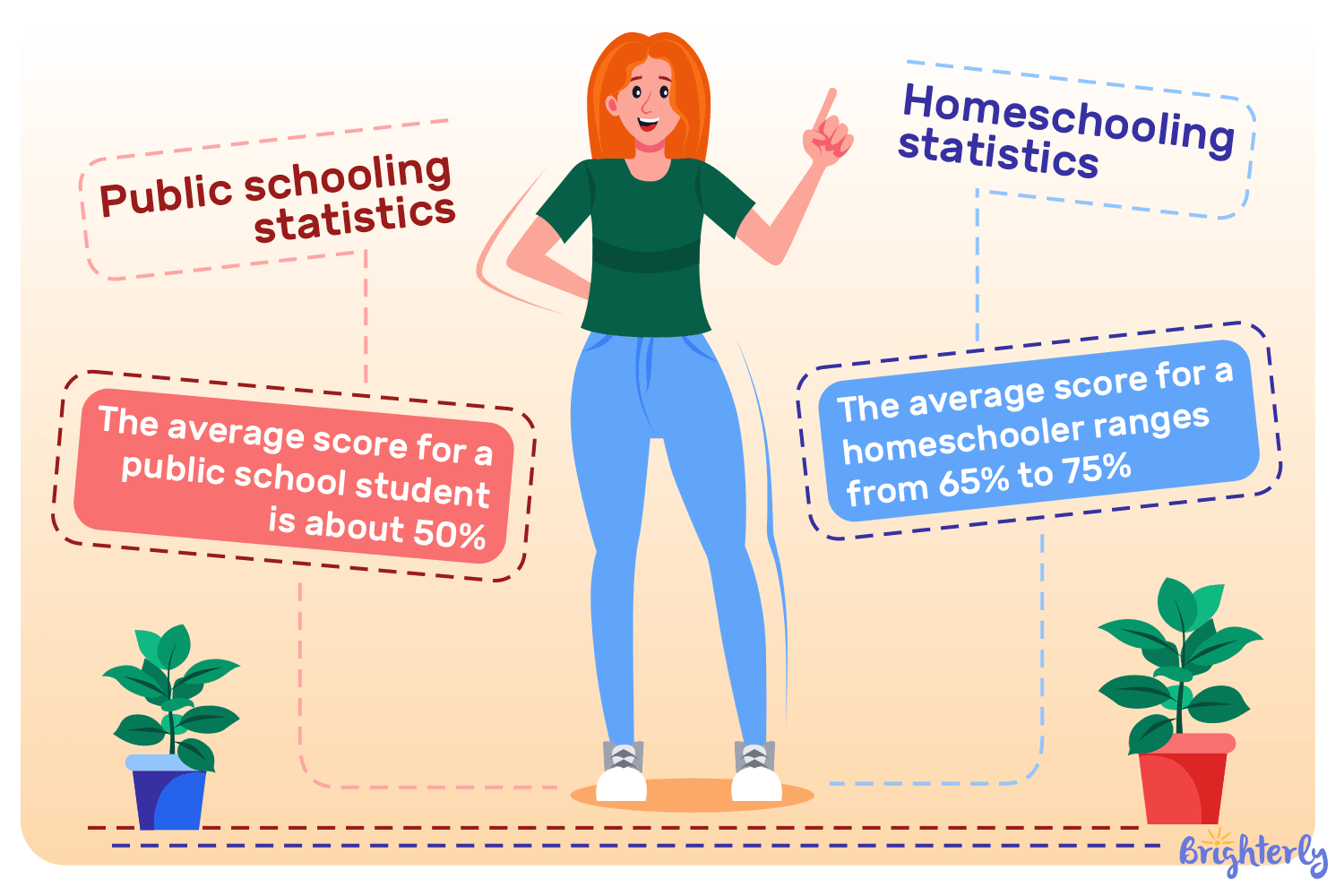
In 2026, NHERI mentions that homeschooled kids typically perform at the 15-25th percentile above public school students in standardized testing statistics. In the table below, you’ll find out more about what drives homeschooling trends 2026, what benefits parents see in homeschooling, and why they refuse public schooling.
|
Homeschooling vs public schooling statistics |
|
| Positive homeschooling statistics | Traditional public schooling statistics |
| Higher college acceptance and academic performance. The average score for a homeschooler ranges from 65th and 75th percentile (NHERI). | Lower college acceptance and academic scores. The average score for a public school student is about 50% (scores range from 1 to 99). |
| Adaptive learning that motivates children. According to the NHERI (National Home Education Research Institute) homeschool statistics, a clear advantage of homeschooling is the ability to adapt learning to each child. | Risk of an unhealthy environment. Based on National Center on Safe Supportive Learning Environments, 1 out of 5 students between the ages of 12 and 18 is bullied every year. |
|
Personalized approach. According to the Pew Research Center, 21% of US parents prefer homeschooling because their kids have some special needs that the academic instruction in the regular education system doesn’t address. At home, you can control and adjust the curriculum, choose your tutors, teach, and do everything to ensure the academic achievement of your child. |
One-size-fits-all approach. Based on NCES homeschooling facts, 20.5% of students reported disabilities in 2025, yet only 15% were reported as covered by the Individuals with Disabilities Education Act (IDEA) that mandates special attention to such students. Also, IDEA doesn’t cover temporary disabilities. |
| More control of the child’s environment. According to data from Pew Research, more than 53% of parents choose homeschooling because they want religious or moral education. | Lack of control of the child’s environment. Based on the Institute of Education Sciences information, 45% of public school leaders reported confiscating some type of weapon and 57% of them reported having confiscated some type of substance during the 2023-2024 school year. |
General Homeschooling Statistics Around the World
Based on the homeschooling statistics up to 2026, the United States remains the country with the greatest number of homeschoolers in the world. Still, the number of homeschooled kids is increasing all over the world, based on these facts:
- UK: Based on the UK Education Statistics, the percentage of kids homeschooled in 2024 increased from 92,000 to 111,700 children in one year.
- Australia: In 2025, 45,000 young people out of 4.1 million schoolers in Australia are homeschooled.
- Canada: After the pandemic spike with 83,988 homeschooled students, the current homeschooling rate is 63,150 students.
- New Zealand: By the end of 2024, 75% of homeschooled families reported homeschooling their kids for up to 5 years.
- The US: 98% of homeschooled students participate in an average of 5 extracurriculars per week. Studies have shown that homeschooled students are more likely to participate in extracurricular activities than their peers in traditional schools.
How Many Homeschoolers Are in the USA?
The NCES reports that 5.2% of children in the US received homeschool instruction in 2024, and Johns Hopkins Homeschool Research Lab states the increase in this trend to 5.4% in the 2024-2025 school year. The 5.4% rate for USA homeschooling statistics 2025 marks a dramatic increase from 2.8% pre-pandemic (NCES, 2019).
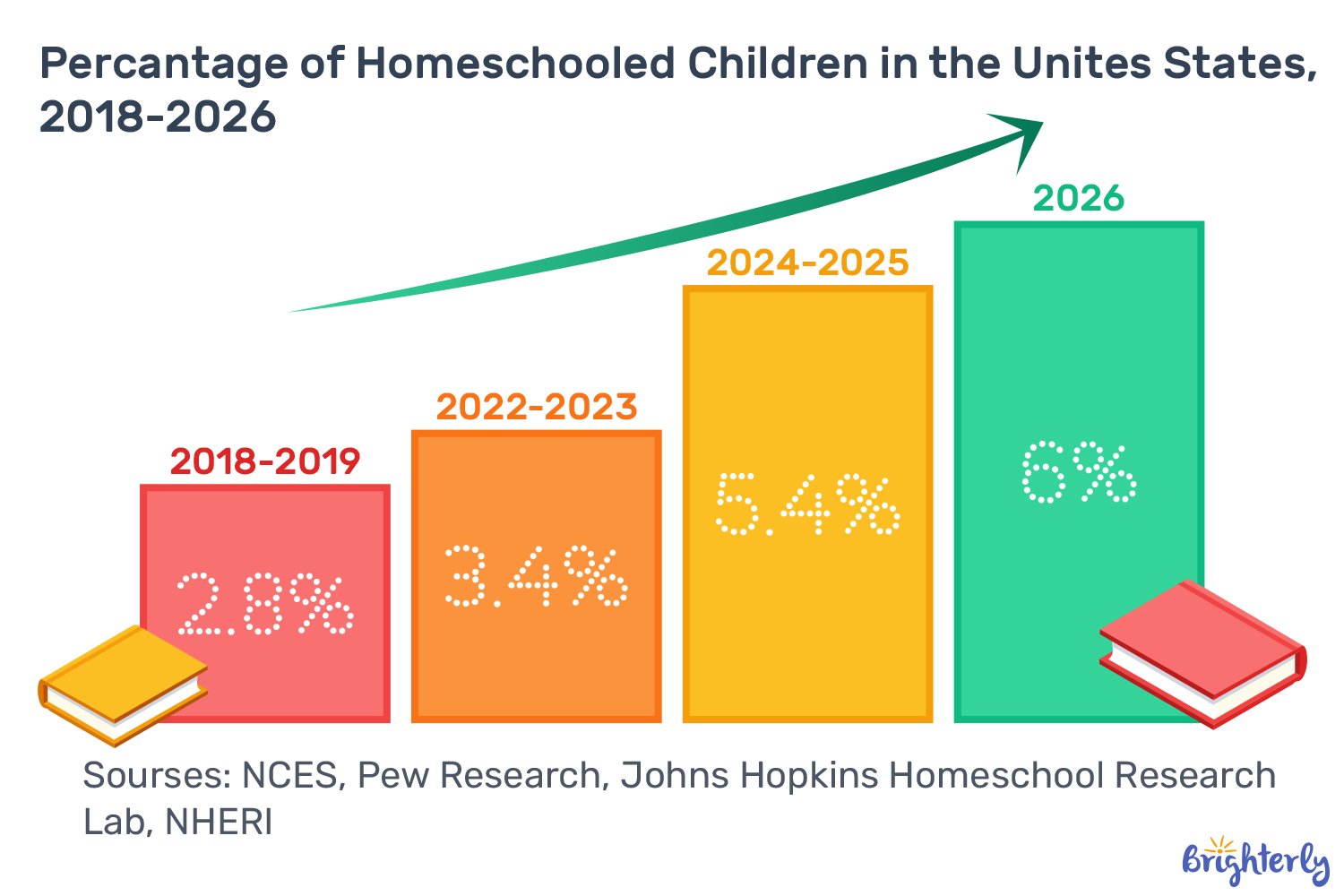
As of 2026, NHERI provides information that 3.4 million, or ~6%, can be considered as homeschooled school-age students in the US for the 2025-2026 academic year.
How Many Kids Are Homeschooled in the US?
Based on NHERI information in 2026 and supporting sources, the number of homeschooled kids in the US can be estimated between 3 and 4 million by 2026, with a dramatic spike during COVID times and increased popularity of homeschooling in recent years.
Homeschooling Statistics Pre-COVID [2018-2021]
|
Homeschooling statistics 2021 |
Homeschoolers in 2020 |
US homeschooling statistics 2019 |
Homeschoolers in 2018 |
| 3.1 million | 3.7 million | 2.5 million | 1.5 million |
According to NCES, growth of homeschooling in the United States from 2018 to 2021 was from 1.5 million to 3.7 million, with a huge spike during the COVID-19 lockdown validated by the Census Household Pulse survey for the 2020-2021 academic year.
![How many kids are homeschooled in the US? [2018 – 2021]](https://brighterly-stage.xyz/wp-content/uploads/2023/01/5-2.png)
Homeschool Rates by Year in the US: 2022 – 2025
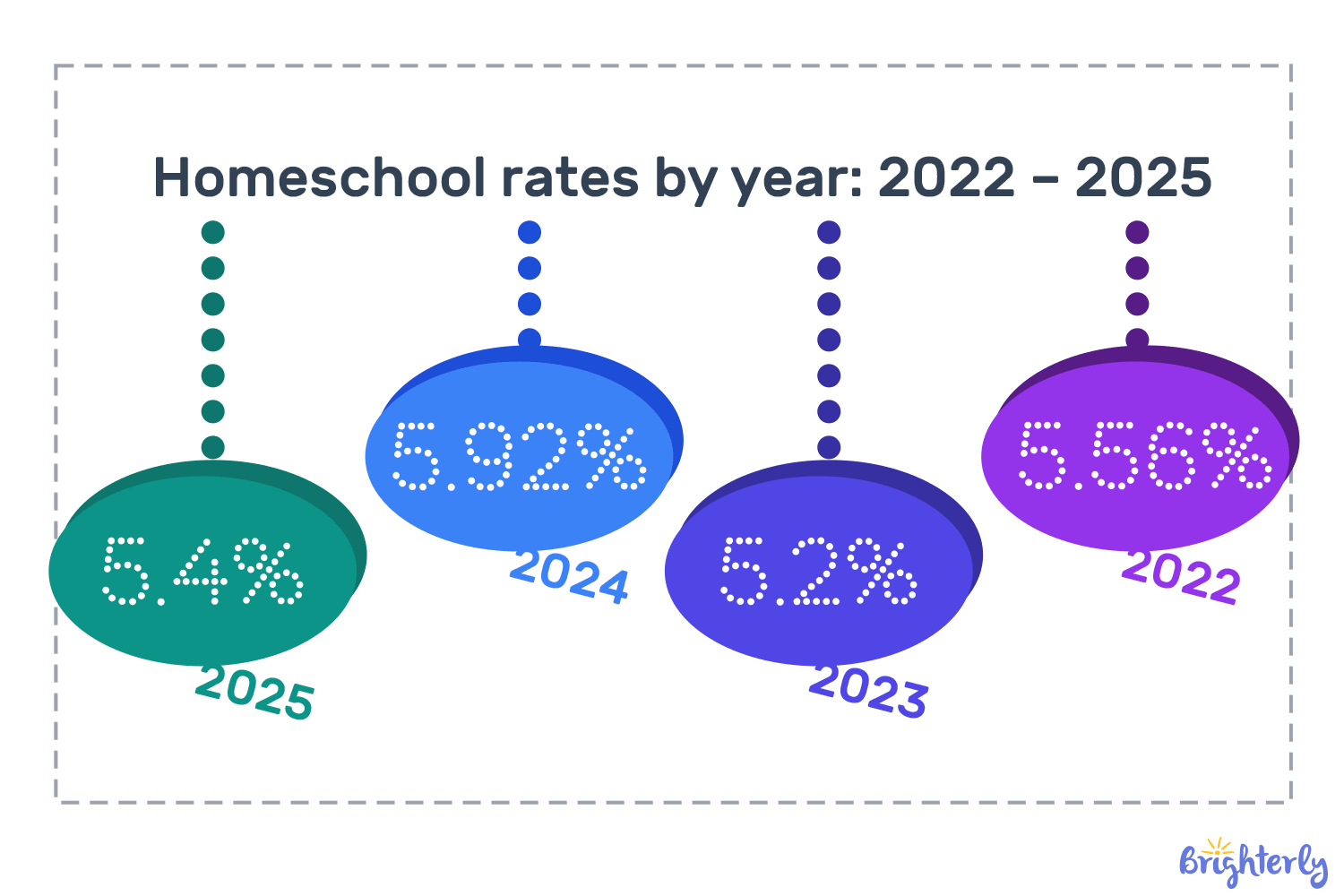
The percent of homeschooling in America from 2022 to 2025 remained between 5% and 6% of all K-12 students, according to NCES, Johns Hopkins Homeschool Research Lab, NHERI, and other sources.
|
Homeschooling statistics 2025 |
Homeschool statistics 2024 |
Homeschooling statistics 2023 |
Homeschooling statistics 2022 |
| 5.4% | 5.92% | 5.2% | 5.56% |
In 2022, after the heat of the pandemic had died down, the number of homeschooling children declined. The figures for 2023 show the same thing. But in 2024-2025, the number of homeschooled children has risen again to the level of 2021, and the popularity of this model continues to grow.
As the US Census Bureau estimates 54.1 million K-12 students in the school year 2025-2026, we can expect up to 7% of homeschooled children in the coming years.
States With the Most Homeschoolers in 2025-2026
The top 10 states with most homeschoolers are Alaska (10.4% homeschooled), North Carolina (9%), South Dakota (6.5%), Missouri (6.4%), Idaho (5.9%), Nevada (5.8%), Maine (5.7%), Alabama (5.5%), Kentucky (5.4%), and Indiana (5.1%) (EdСhoice, 2025)
Regarding the growth trend of how many people are homeschooled per US state, the statistics below show the increase in dynamics by the US state based on the information available from the Johns Hopkins Homeschool Research Lab for the 2024-2025 academic year.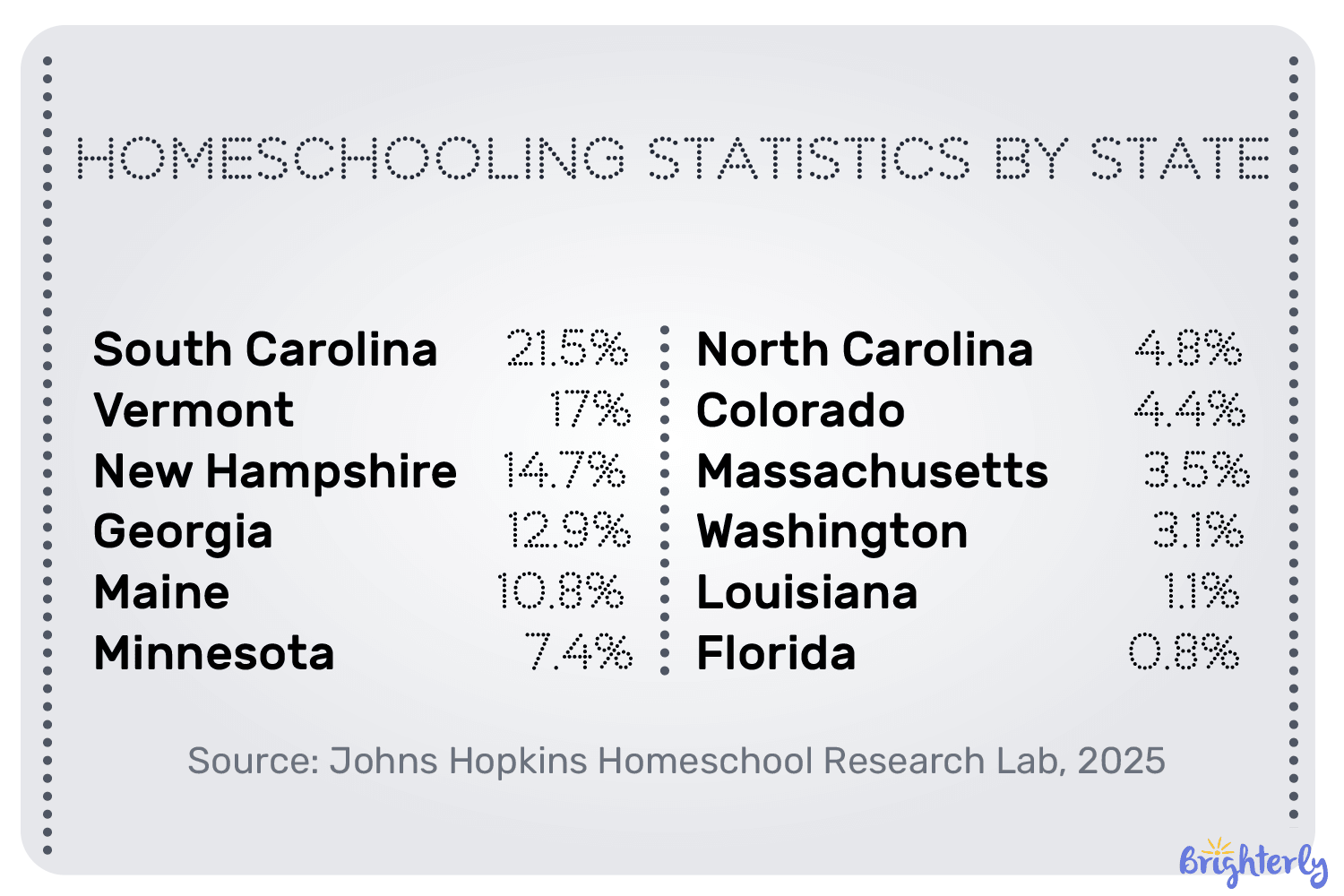
Detailed Homeschooling Statistics 2025 by State
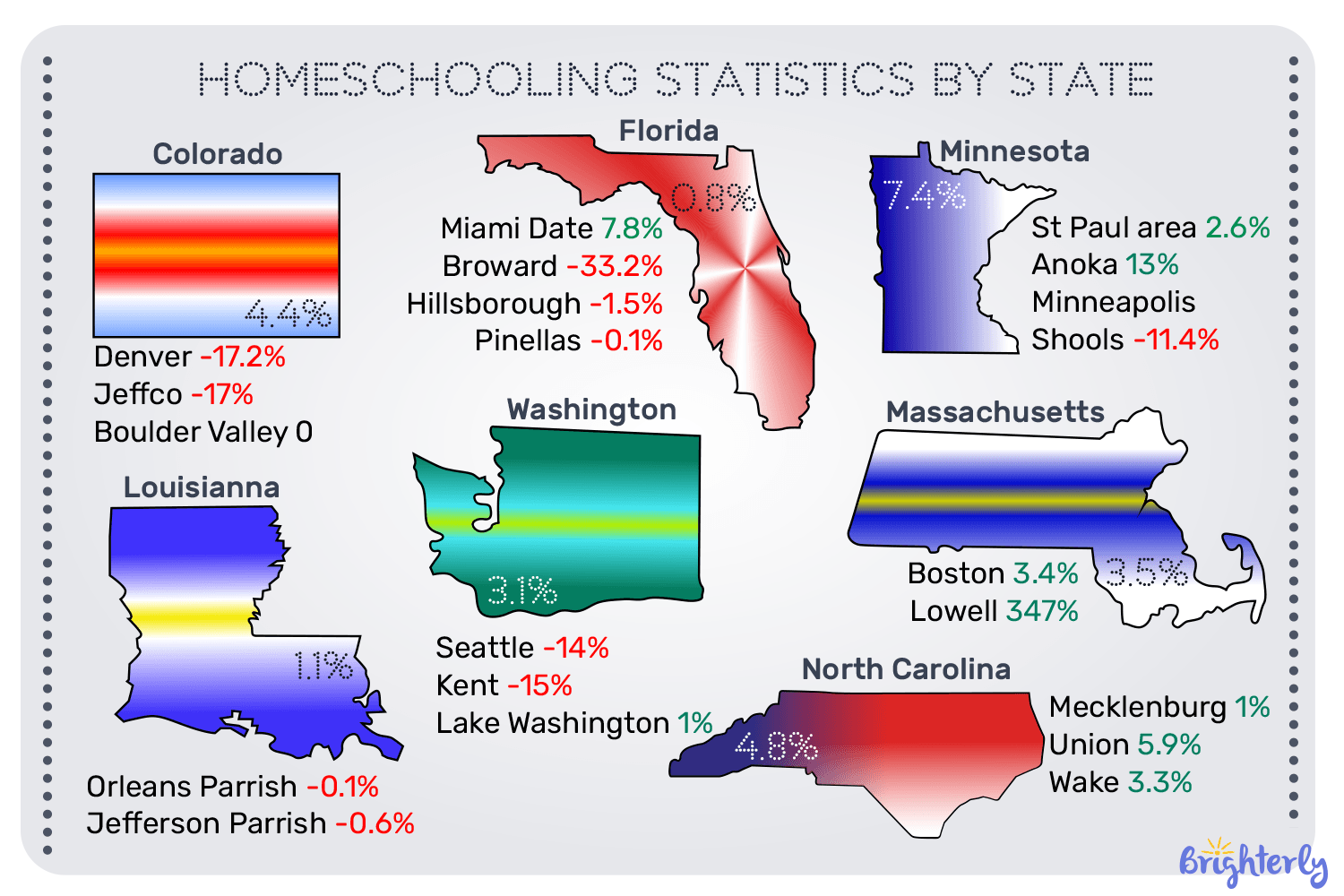
Based on the latest available data through 2025-2026, each US state demonstrates different homeschooling dynamics due to varied legal regulations, finding program capabilities, and social and cultural peculiarities between cities and districts. Some of the ratio findings available for the 2024-2025 academic year in this regard are available in the table below.
Which State Has the Most Homeschoolers?
As of the recent statistical update by April 2026, Alaska is a leader in homeschooling among all the US states (EdChoice, 2025-2026). The top 3 states with the highest number of homeschoolers in US are Alaska (10.4%), North Carolina (9%), and South Dakota (6.5%).
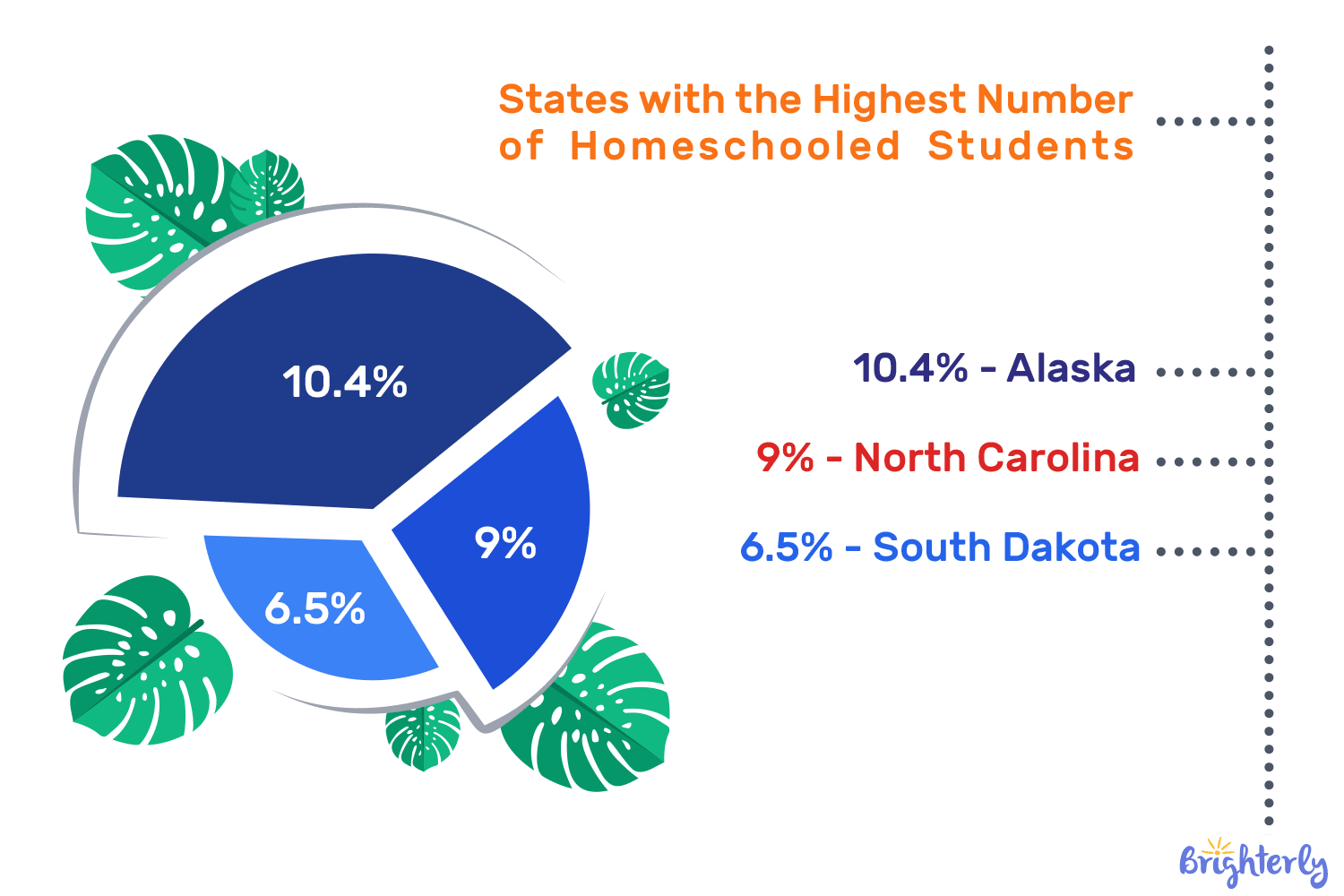
Based on EdChoice information, the strongest growth in the 2024-2025 academic year is shown in South Carolina (21.5%), Vermont (17%), New Hampshire (14%), and Georgia (12.9%).
Percentage of Homeschoolers vs Traditional Public School by State
Based on EdChoice 2025-2026 analysis, 74.6% of all K-12 students report being involved in traditional public school education, compared to 4.7% homeschooled ones. Thus, even though the homeschooling rates keep constantly increasing, the traditional public school model is still prevailing. Some details on this number per state are presented in the table below.
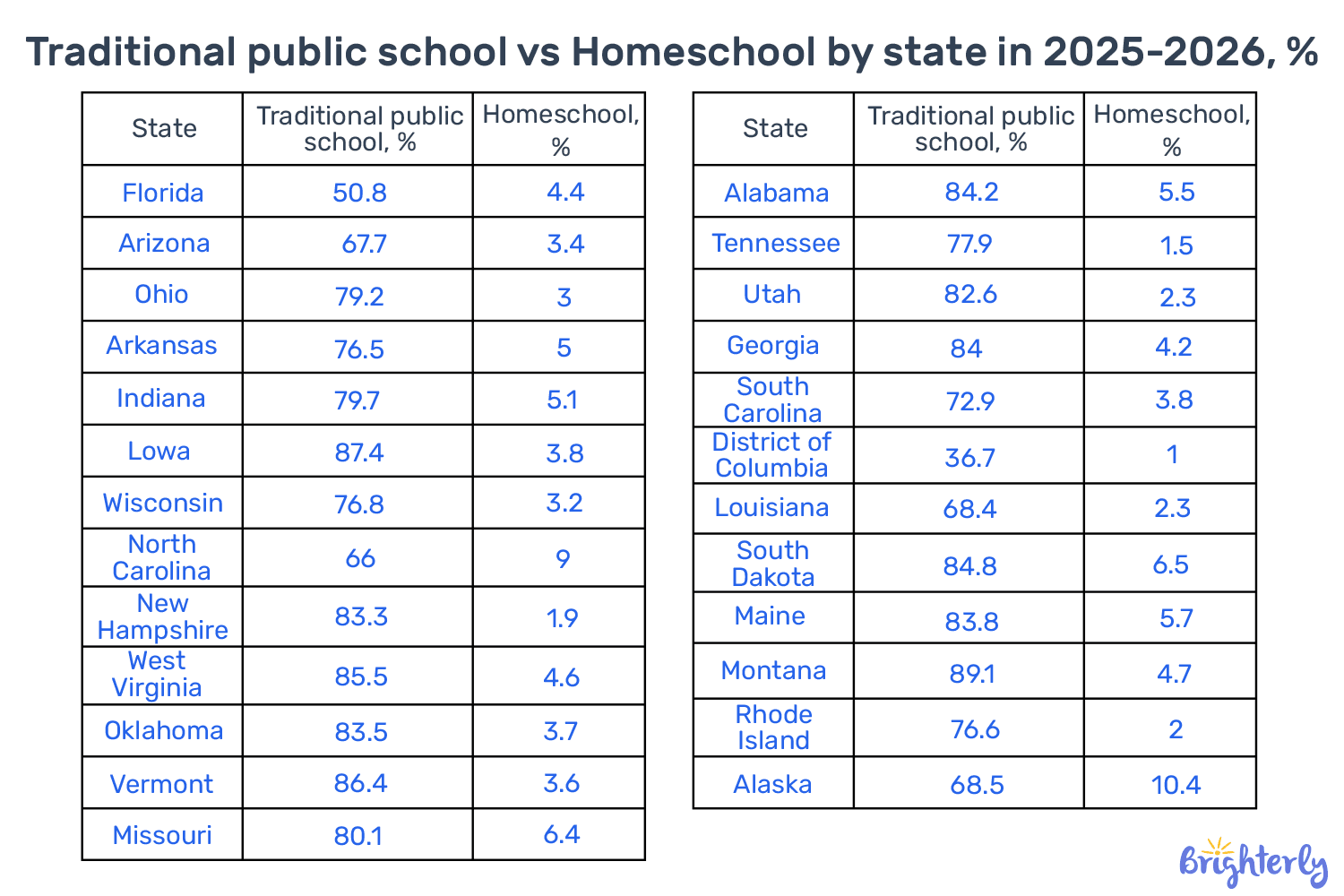
Source: EdСhoice, 2026
Homeschool vs Public School Statistics: Details
Strict rules may affect homeschooling statistics: in Washington, the rate of homeschooled students is only 2.6%, but it’s 10.4% in Alaska, as parents are not required to notify the state or provide any details on qualifications, number of hours of instruction, or curriculum. Also, in some states (like Arizona, Florida, and Ohio) parents prefer to send kids to private schools instead of homeschooling them.
In 2025-2026, the number of homeschooled students in Alaska is several times higher than in most of the US states (including New Hampshire, Kansas, and Rhode Island). Compared to Michigan, this number is 104 times higher (0.1% compared to 10.4%).
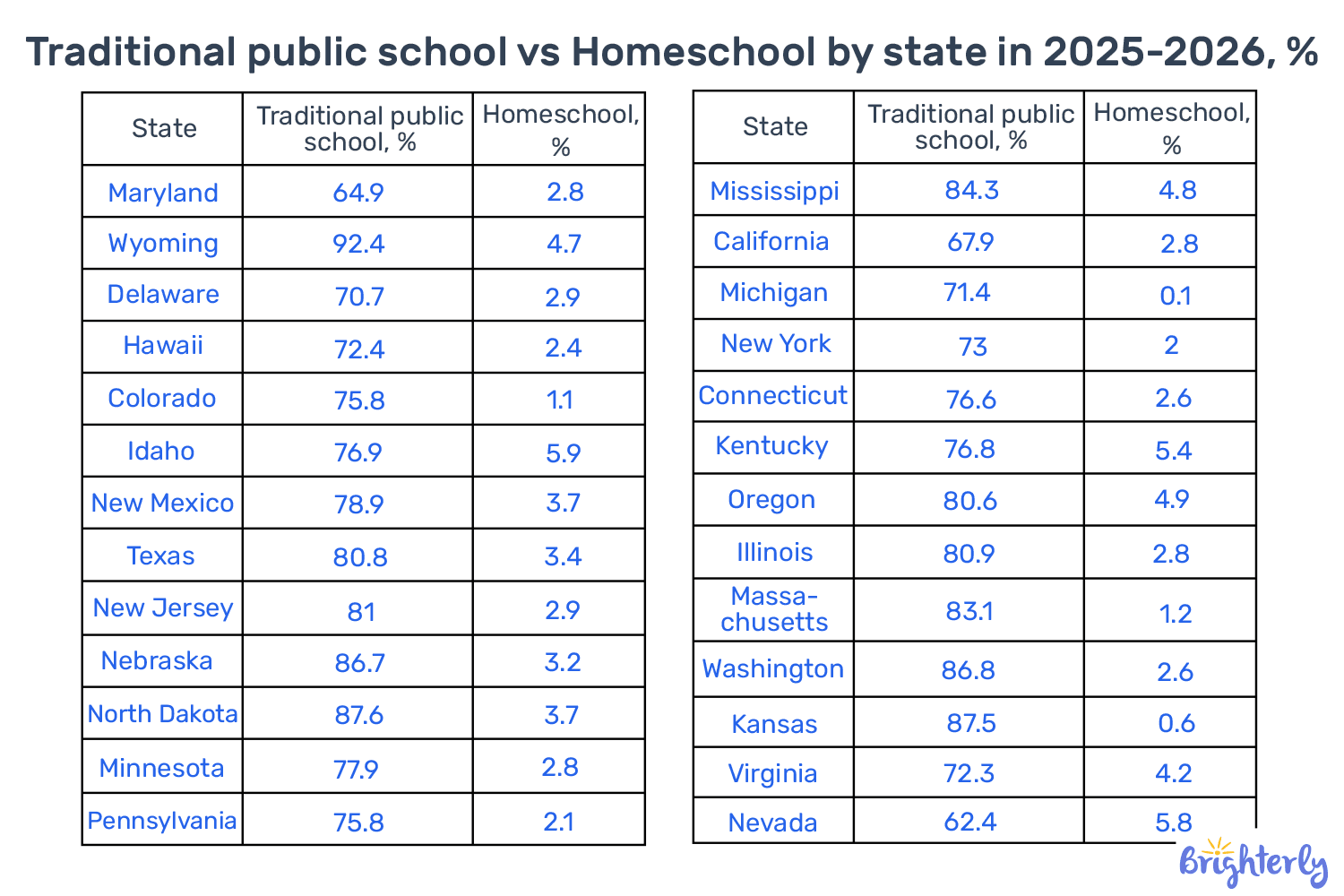
The lowest number of homeschooled children, based on these homeschooling percentage by state stats, is in:
- Massachusetts (1.2% homeschooled)
- Colorado (1.1% homeschooled)
- District of Columbia (1% homeschooled)
- Kansas (0.6% homeschooled)
- Michigan (0.1% homeschooled)
Reasons for the High Success Rate of Homeschooling in 2025-2026
- Safe environment
- Homeschool success rates for academic results
- Religious education
- Personalized education program
- Flexibility in the schedule
![Statistics for homeschooling: Reasons for choosing [Infographic]](https://brighterly-stage.xyz/wp-content/webp-express/webp-images/doc-root/wp-content/uploads/2023/01/12-2.png.webp)
Note: Here are major reasons for switching to partial or full homeschooling according to homeschooling stats from the National Center for Education Statistics (NCES) and our experts from 2022 to 2026. Read more about each reason below.
Homeschooling Success Statistics
With around 6% of school-age children reported as homeschooled in 2026 (NHERI), parents opt for the homeschooling model as a decent choice to cover for ineffective traditional education and create a more controllable environment for their kids. Given the growing pandemic learning loss concerns, the ability to choose the learning tools and the structure of the curriculum helps kids succeed academically.
In a reviewed study of success in adulthood and college in the publication “A Systematic Review of the Empirical Research on Selected Aspects of Homeschooling as a School Choice,” one block can be highlighted:
| What are the statistics on homeschooling success? Eleven of the 16 (69%; studies on success into adulthood and college) showed positive outcomes for the homeschooled compared to those in conventional schools. One study found positive outcomes for conventional school students compared to homeschooled students. Finally, four of the studies found no significant difference between those from homeschool backgrounds and the others from institutional school backgrounds. |
Homeschool success statistics for individual academic subjects
![Statistics for homeschooling: Reasons for choosing [Infographic]](https://brighterly-stage.xyz/wp-content/webp-express/webp-images/doc-root/wp-content/uploads/2023/01/13-2.png.webp)
How Safety Impacts the Homeschool Percentage by State
According to 2024-2025 estimates, NCES homeschooling statistics show that 83% of parents choose homeschooling because of their concern about a safe environment.
Safety is a great concern for parents these days, with the growing number of bullying, cyberbullying, and disturbing behaviors at public schools. On the latter, the IEC reports that for most of the educators, the lack of focus or inattention (26%), academic unpreparedness (21%), and disruptive behaviors (19%) are the most important negative factors on learning.
The safety concern explains why many parents choose to take matters into their own hands, and the homeschooling percentage rises. Still, the PubMed 2025 research highlighted the possible problems related to social isolation related to homeschooling, which suggests that this switch may become a full-time job for a parent.
How the Quality of Learning Drives the Homeschooling Percentage by State
Based on NCES homeschool success rates by April 2026, about 72% of parents mentioned the poor academic quality and teachers’ approaches in public schools as the primary reasons for homeschooling.
“Many parents are concerned about the quality of education in traditional schools.”


Still, Based on the latest available data through 2025-2026, there is no study that shows a direct correlation between homeschooling and academic success, suggesting that there might be other factors influencing the school and career outcomes for homeschooled children.
Impact of Religious Education on Homeschooling Stats
According to the NCES homeschooling statistics by April 2026, 53% of the answers of parents were in favor of homeschooling religious education.
Providing an integrated religious instruction in the child’s curriculum is also a reason for homeschooling. The inability to pray at school and commuting challenges can be the reasons for this. At the same time, insisting on a certain model of education can limit the transparency of homeschooled education and increase the risk of child maltreatment, according to PubMed 2025 research.
How the Need for Personalization Drives the Percentage of Homeschoolers in US
As of April 2026, 21% said in the NCES study that the reason for homeschooling was the child’s special needs, and 15% mentioned a physical or mental problem causing dissatisfaction with the traditional system. 36% of parents feel like this model can provide a more customized learning approach to their kids.
Public school classrooms average 25+ students per teacher (NCES, 2024), which results in their limited ability to address psychological health and emotional states of each child. Yet, as the academic success rate of around 50% in public schools (NHERI) suggests, there are kids who can benefit from the educational system as it is.
Help your child reach their full potential!
Answer a few quick questions about your child’s learning, and we’ll recommend next steps.
Remember, traditional schooling may work for most parents, but it certainly has a few drawbacks. For instance, teachers in charge of large classes rarely pay special attention to each child’s specific learning needs. This causes many kids to lag in class, while their needs go unaddressed.
Homeschooling lets parents choose the curriculum, pace, and teaching method that fits how their child actually learns. For the public school vs. homeschool statistics, you can tailor lessons to meet their needs and fill any learning gaps.
“One of the most significant factors behind parents choosing to homeschool by 2025 is their desire for a more customized education for their children based on their needs and learning styles.”
For example, here is a personal case: I am personally close friends with a woman whose son had severe dyslexia and could not learn in a traditional classroom environment. When they decided to homeschool him, the curriculum, pace, and methods used could be truly customized to his special needs, and they produced astounding results. His grades got so much better that his confidence had never been higher.

Flexibility in the Schedule and Homeschooling Stats
According to the National Center for Education Statistics, 34% of parents cited other reasons to homeschool their kids, including flexibility in the schedule.
Unlike traditional schooling, where you have to follow rigid rules set by the school, homeschooling is very flexible. As a homeschooling parent, you can make your own choices. You’ll be able to create your own curriculum and schedule. The best part? With homeschooling, learning isn’t limited to school hours, and can be assisted by an online math tutor.
When your child joins the percentage of homeschoolers, there’s less commuting time and more time spent at home. Generally, homeschoolers complete all their work earlier in the day, too.
“Homeschooling education gives more time for family interaction and bonding.”

However, supporting more personalized teaching for kids may be limited to some families due to income requirements. In this regard, read about the pros and even cons of homeschooling.
Homeschool College Acceptance Rates and Career Outcomes
As cited by NHERI in 2026, the 2010 study by Cogan (there is no up-to-date evidence) suggests that the homeschooling model increases the college acceptance rates (66.7% compared to roughly 54% national average) and career outcomes.
The most recent analysis regarding academic performance of homeschooled students vs engaged in traditional schooling formats combines the findings of Ray (2010, 2015, 2017) and Ray & Hoelzle (2024). Based on these studies, it’s possible to suggest that greater standardized testing results are connected with greater academic performance, but not necessarily college acceptance or career outcomes.
How Homeschool Socialization Statistics Change the Success Rates?
Based on NHERI findings, 64% of studies in the field concluded that homeschooled kids perform statistically better than those involved in traditional classrooms. Also, it helps to perform better on standardized tests.
Notwithstanding the common negative homeschooling statistics regarding a low social engagement of kids who study at home, homeschool socialization findings actually recommend opting for homeschooling. In particular, they reveal that kids engaged in homeschooling programs demonstrate good social and emotional development skills, which is also good for homeschooling numbers.
In this regard, interactive learning statistics show that homeschooling programs, especially those based on small-group studying and 1:1 tutoring sessions, provide a highly safe and comfortable environment for kids to learn fast from their peers and learning partners.
Which Grade Has the Most Homeschoolers?
Based on the recent NCES data, the highest number of homeschoolers by state is among students in grades 6 to 8 (3.4% vs. 2.3% of high schoolers). In 2012, the dominant homeschooling grades were 9-12. However, this trend has shifted in recent years.
How Many Kids Are Homeschooled by Grade?
The 2012-2019 NCES data shows the range of 8-31% from total schoolers as the number of homeschooled kids in the US. Here’s a more detailed breakdown of this range, based on the overall age distribution:
|
Grade |
Percentage of homeschoolers 2012 |
Percentage of homeschoolers 2016 |
Percentage of homeschoolers 2019 |
| Kindergarten | 12% | 11% | 8% |
| Grades 1 to 3 | 20% | 18% | 22% |
| Grades 4 to 5 | 15% | 17% | 18% |
| Grades 6 to 8 | 24% | 24% | 29% |
| Grades 9 to 12 | 29% | 31% | 22% |
In general, the grade distribution seems to be roughly even across all grade levels from kindergarten to graduation.
Homeschooling Statistics 2025-2026: Trends by Family Size
Based on the NCES US homeschooling statistics as of 2026, up to 48% of homeschooling households have 3 or more children. About 33% of homeschooling households have 2 children, while only 19% have 1 child.
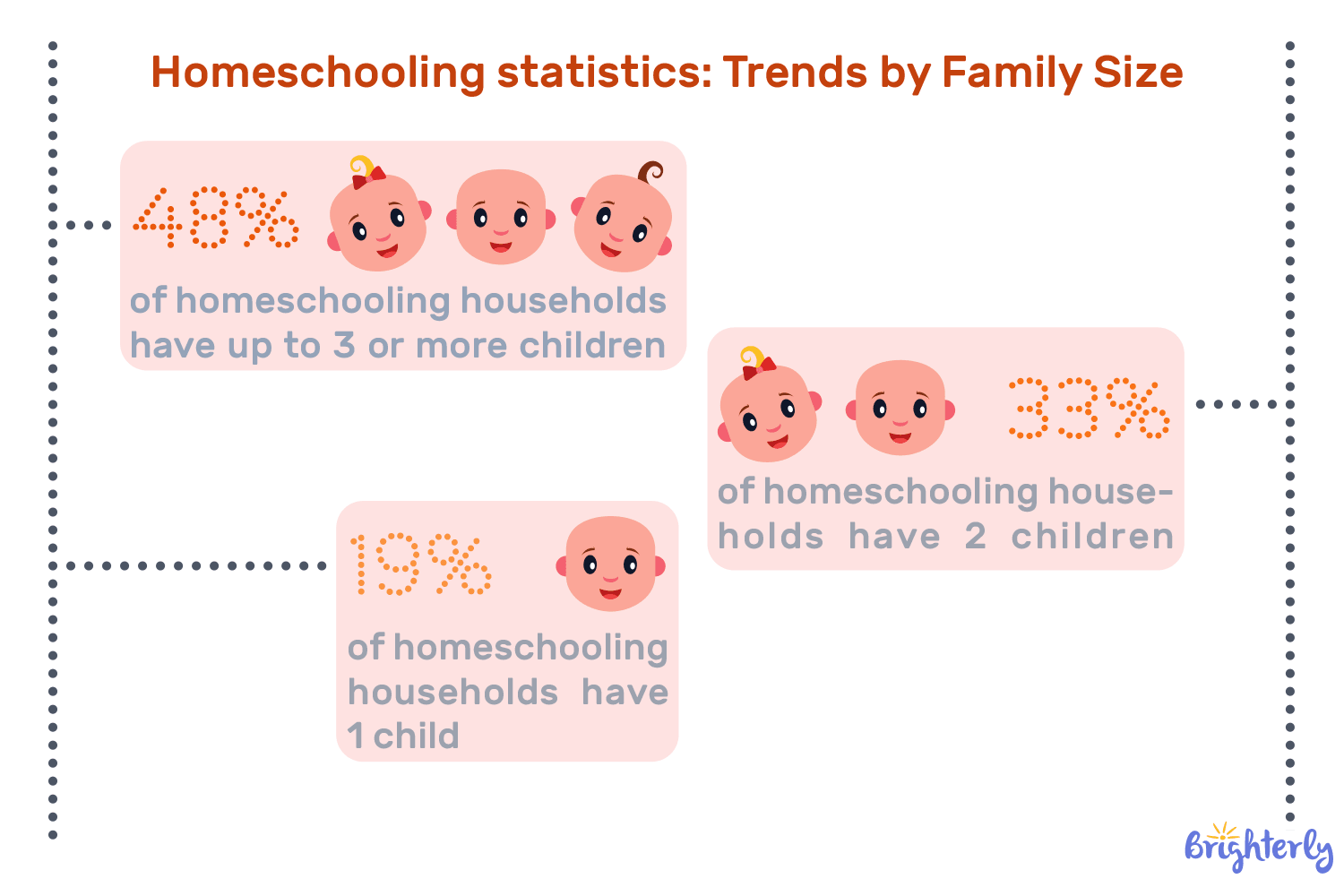
It puts an interesting perspective on the homeschooling concept. One may say that it’s easier to homeschool in a household with more than two kids since there’s already a higher focus on kids. Thus, the more kids you have, the more likely you are to go down the homeschooling path.
| 3+ Children | 2 Children | 1 Child |
| 48% of households | 33% of households | 19% of households |
Similarly, NCES’ statistics for homeschooling data also show that 83% of homeschooled students live in two-parent households.
Private vs Homeschooling vs Public School Statistics and Average Cost
Based on the price lists of the most popular platforms, the average cost of homeschooling is between $500 and $2,500 per child every year. As the private schools usually cost between $32,351 and $71,715, public schools will require around $1,000-1,500 per year on commuting, learning materials, and extracurricular activities. Homeschooling is usually less expensive than private school education, though costs may vary compared to public school-related expenses.
![Average income of homeschooling families [Infographic]](https://brighterly-stage.xyz/wp-content/uploads/2023/01/17.png)
Homeschool Statistics: Income of Homeschooling Families
According to NHERI’s most recent 2024-2026 studies and statistics on homeschooling:
- 34% of homeschooling households have a combined annual income of over $100,000
- 15% of homeschooling households have an annual income of $75,001 to $100,000
- 21% of these households make between $50,001 to $75,000 each year
“Homeschool funds are a treasure. ”
College resume building. My eldest niece has a 4.87 GPA because she takes dual-enrollment courses at the local community college. She can take classes any time of day because of her flexible schedule
Average income of homeschooling families 2025-2026 [Infographic]
Conclusion
Homeschooling can be either full or partial. For the first option, parents need to familiarize themselves with the rules of switching to this education type in their state. Each state has its own requirements.
Homeschooling has been on the rise in recent years and from all indications, this trend will continue in 2026. More than 3 million is the answer to how many homeschoolers in US are now.
Why do so many parents choose this education for their children?
- They want personalized learning,
- The child doesn’t waste time learning information they don’t need,
- The learning program is focused on what the child is good at,
- And they have more control over their safety.
If you’re interested in full-time homeschooling or part-time, book free lesson from Brighterly to try our full homeschool program or supplemental online after-school classes.
Frequently Asked Questions
Is Homeschooling Legal in All 50 States?
Yes, homeschooling is legal in all US states, but its regulation differs. Based on the percentage of homeschoolers by state information from EdСhoice (2025-2026), the most accessible homeschooling is in Alaska, Texas and Idaho, while in New York, Pennsylvania, and Massachusetts, homeschooling is highly regulated.
How Has Homeschooling Changed Since the Pandemic?
The pandemic significantly affected how many children are homeschooled in the US, as the highest spike in homeschooling statistics happened during the pandemic year (around 3.7 million homeschooled), with the US Census Bureau’s Household Pulse Survey reporting 11.1% homeschooled by autumn 2020.
Since then, the popularity of homeschooling has decreased but remained higher than in pre-pandemic times. By the end of 2026, the number of homeschooled kids may increase to around 4 million, or up to 7%.
Are Homeschooled Students More Successful Than Public School Students?
As of 2024, 66.7% homeschoolers were accepted to 4-year colleges, compared to the 54% national average (NHERI). NHERI information relies on the studies by Ray (2010, 2015, 2017) and Ray & Hoelzle (2024), homeschooled kids typically perform at 15-25 percentiles above public school students on the national average. Additionally, based on secondary courses, homeschooled students tend to pass standardized testing better, but their performance and possible 87% college acceptance (vs 68% of public schoolers) depends on several metrics of home education quality and cannot be verified.
Do Homeschooled Students Struggle Socially?
As of NHERI findings by 2026, the major part of studies (around 64% in the scope) suggest that homeschooling can support social interaction and communication skills in students. Yet, the quality of homeschooling education is mostly missing from the stats in 2026. For example, 2024 BCES Conference paper highlights the positive effect of extracurricular activities to homeschool curriculum as a determining factor in forming socialization-related skills.



US teachers say that 40% of students perform below their grade level. “How can I be better at math?” is a common question asked by kids and parents. It’s clear that many kids need to increase their math skills, and there are a lot of ways they can do that. In this article, we cover […]

Jan 04, 2023
Mathematical proficiency is a vital asset since it is necessary not only for academic success but also for daily tasks like shopping, meal prepping, etc. However, it is still common for school students to struggle with some math concepts. Math diagnostic assessments can pinpoint improvement areas. Read this article to get multiple free online math […]
Jan 10, 2023
Math & reading from 1st to 12th grade
Looking for homework support for your child?
Choose kid's grade

Math & Reading for Grades 1–12
Build real confidence for your child with a Brighterly math or reading tutor.